
“Bring Your Own Shovel” Party at Marina Harbor Entrance
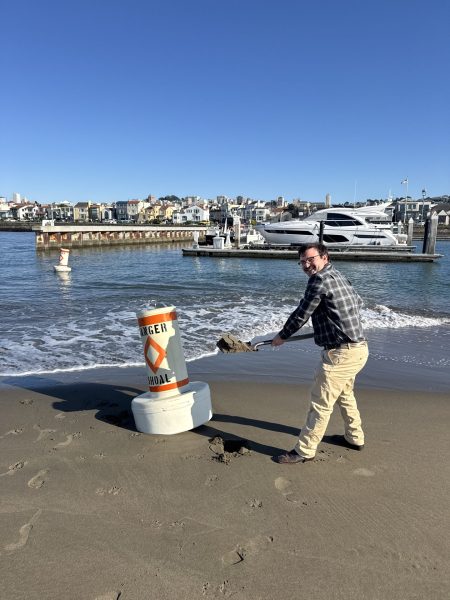
Sometimes you have to make fun of a bad situation. That’s what a group of Bay Area sailors decided to do after work on Monday, May 18, with a “Bring Your Own Shovel” party at the entrance to the San Francisco Marina West Harbor.
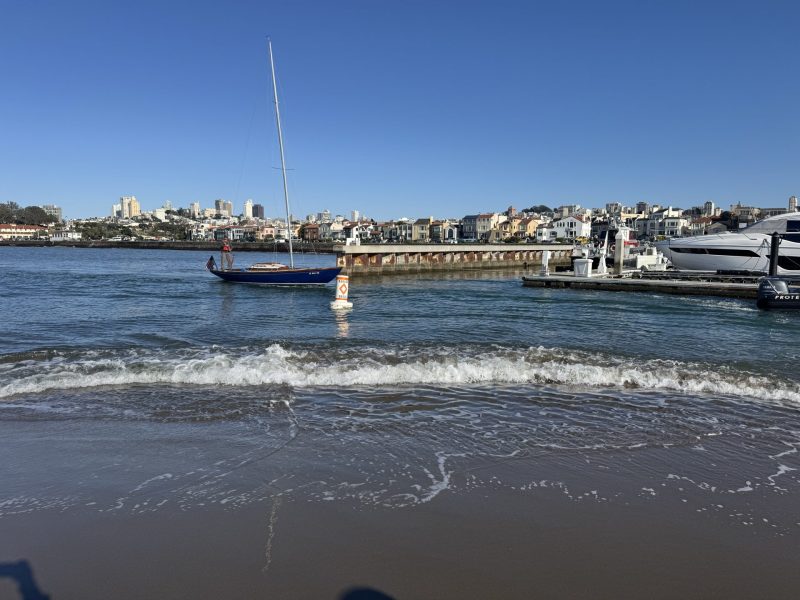
The sand buildup and blockage of the Marina West Harbor has been a source of frustration for sailors and cruisers alike over the past months. While dredging has been going on for about two weeks now, and the entrance is generally passable at high tide, the sand still extends out significantly.
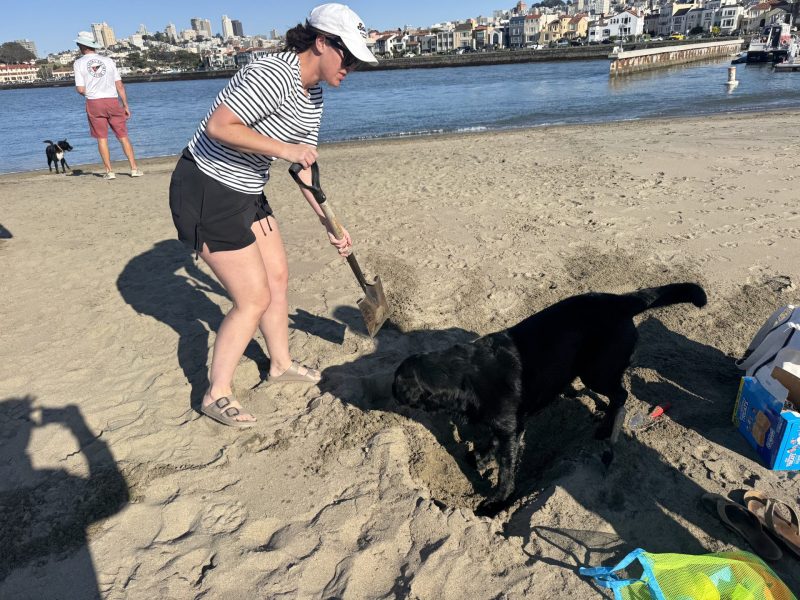
While the shovelfuls of sand were only half serious, every little bit counts, right? Especially since the dredgers were not on site Monday. Several sailors’ dogs even decided to chip in and try to help move some of the sand, though not always in the right direction.
During the party, several boats made their way into and out of the harbor. Mike Peterson towed a Knarr back into the harbor, and several powerboats came in and out. Several J/22s that were practicing 2v2 team racing sailed successfully back into the harbor with the help of good boat handling and a fairly southerly breeze.
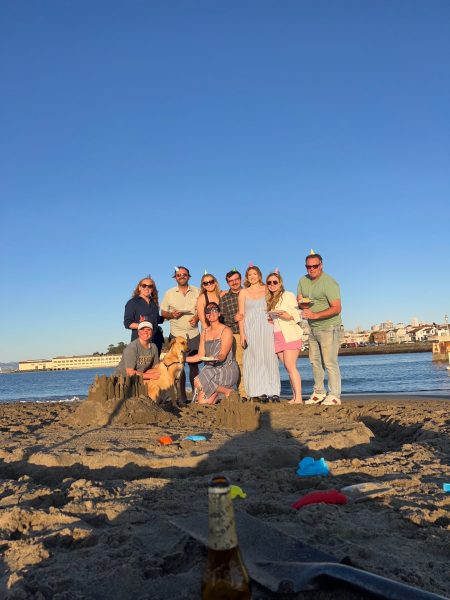
The shoveling party culminated with an impromptu surprise birthday party for its primary organizer, Maddy Kuhn. As frustrating as the sand buildup and the ineffective action at the harbor entrance have been, it’s important to have fun and find ways to laugh at the situation.
Good Jibes #244: Karin Heck on Preparing for the High Latitude Challenge, With Host Moe Roddy Wieneke
In this episode of Good Jibes we chat with Karin Heck about her lifetime of sailing, teaching sailing, and now preparing for Jimmy Cornell’s High Latitude Challenge. Karin grew up sailing with her dad in Sweden, has done deliveries around the world, and is an instructor at Spinnaker Sailing.
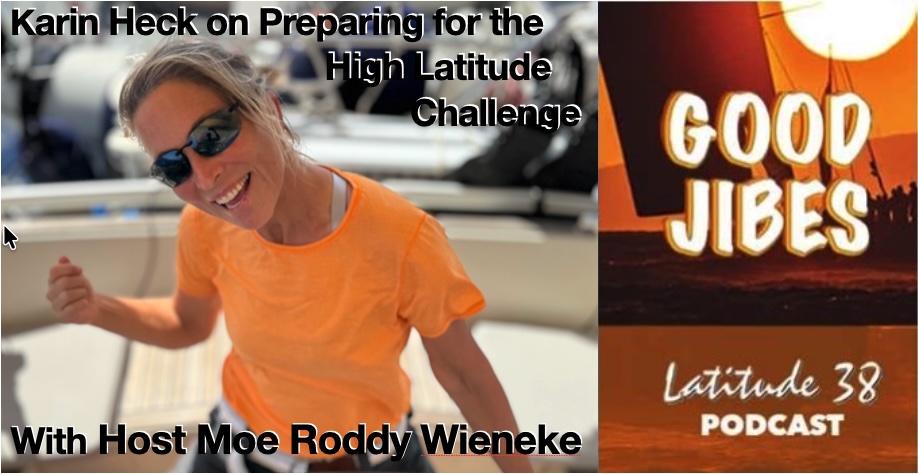
Tune in to hear Karin share her favorite memories from the Baltic Sea, the most gorgeous sunrise she’s ever seen, her best advice for women sailors, how she’s preparing for a unique and rigorous circumnavigation, and her favorite point of sail, with this week’s host Moe Roddy Wieneke.
Here’s a small sample of what you will hear in this episode:
- The confidence gap, communication styles on the boat, and why Karin stopped trying to “sound like a man”
- The most underrated sailing skill according to Karin
- The women’s sailing seminar Karin developed at Spinnaker Sailing in Redwood City
- Sailing through the night solo while two crew were sick below, and watching the sunrise to a U2 song
- Karin’s boat for the expedition the High Latitude Challenge
Listen to the episode on Apple Podcasts, Spotify, and your other favorite podcast spots — follow and leave a 5-star review if you’re feeling the Good Jibes!
Learn more at KarinIngeborg.com, SpinnakerSailing.com, and CornellSailing.com
Check out the episode and show notes for much more detail.
Life Is Better With a Boat — Find Yours Today With Cruising Yachts
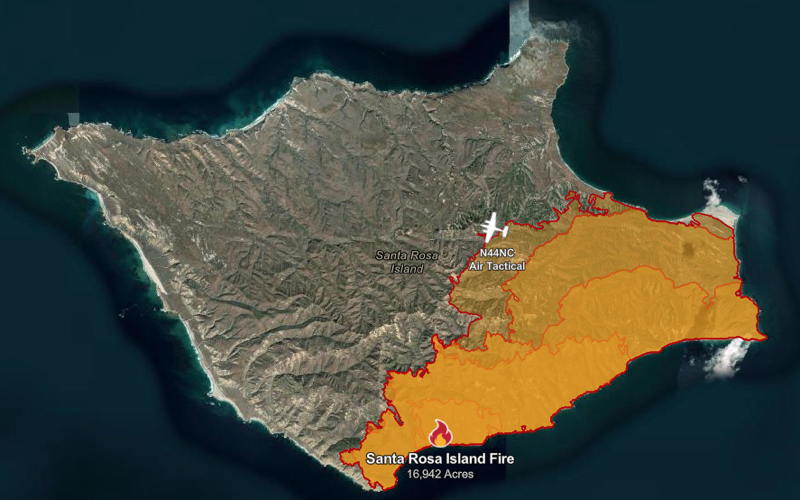
Santa Rosa Island Fire Continues To Burn
The bad news continues from Santa Rosa Island. The fire has now burned almost 17,000 acres on the 50,000-acre island and is only 26% contained. News reports now have more detail on the boat, which was on fire as it lay on its side, wrecked on the beach. It’s reported to be a 54-ft sailboat named Wet Vette that sails out of Long Beach.
The owner recorded a video of the boat on fire, saying in the video, “Wow, that is a hot fire, I hope it doesn’t start this island on fire; that wouldn’t be good.” As reported on Monday, the sailor, who unsurprisingly wishes to remain anonymous, inexplicably felt compelled to fire off flares to alert local fishermen about his need for rescue. A tragic mistake.
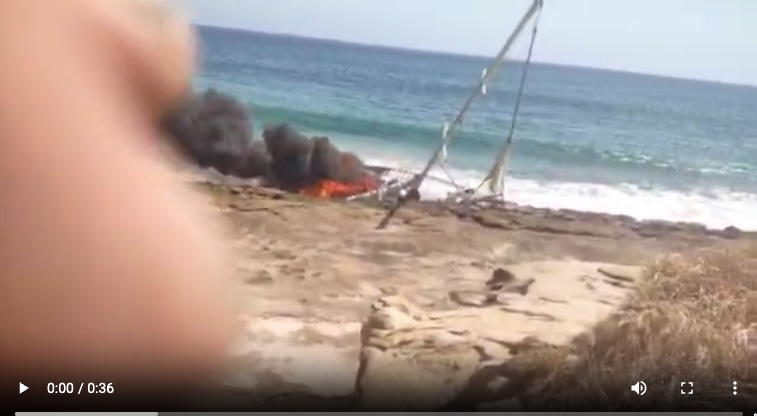
As many commenters pointed out in the comments on Monday, there are many potentially better ways to signal distress besides firing off flares near dry grassland. Locals report there is no cell service there so a cell phone wouldn’t work unless you have a model with the ability to send SOS signals. A working handheld VHF would likely be best since it would reach any nearby boat monitoring Channel 16 (which we should all be doing while boating). An EPIRB would also summon help, and non-pyrotechnic flares like Sirius Signal could also work.
Regardless of the rescue options, Santa Rosa is an inhabited island with roads, paths and people nearby. The sailor was reported to be uninjured, so we continue to be mystified regarding what the urgency was for rescue, unless it was perhaps a misplaced hope that the boat could be saved.
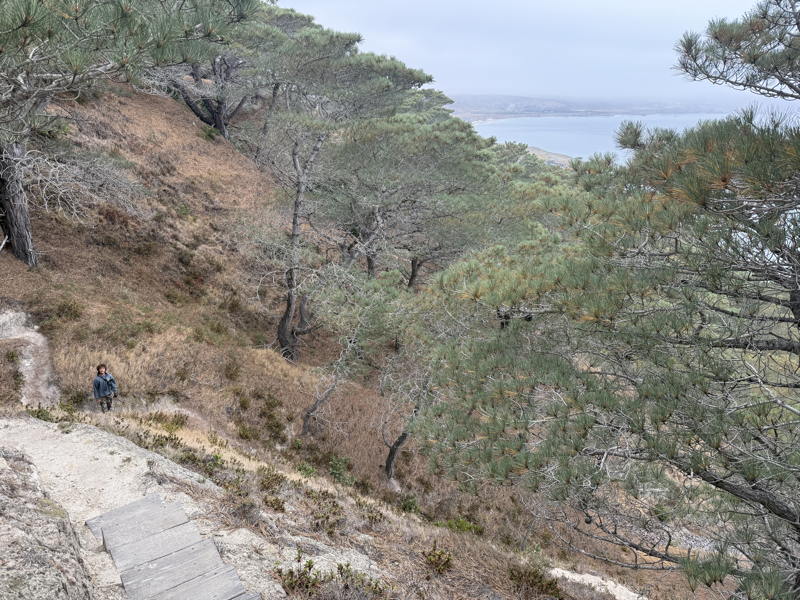
Don Litton, whose Columbia 29 Pythagoras appeared on our March cover and who has regularly cruised these islands with his family, wrote in our Monday comments of the incredible sadness he’s feeling for the islands and the endangered Torrey pines, which grow only on Santa Rosa Island and in the San Diego area.
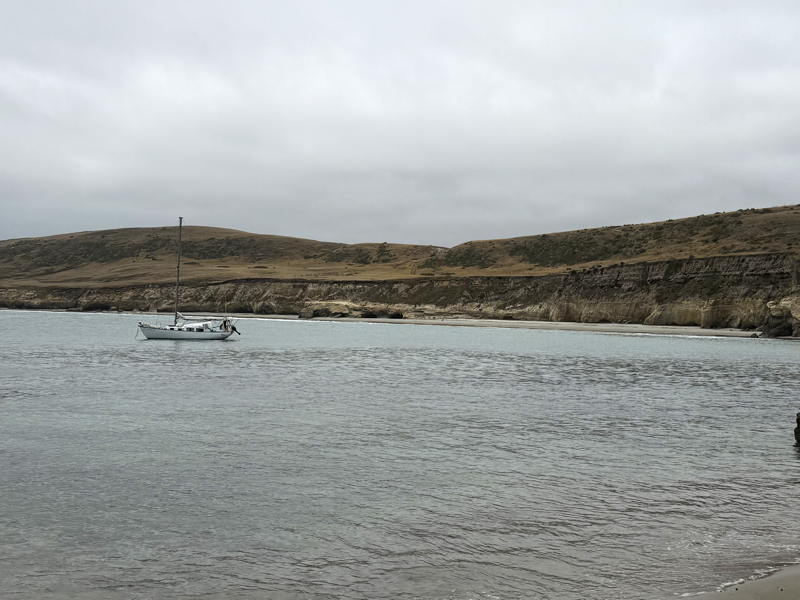
Don describes the area behind the photo: “The coast beyond the boat in the anchorage has burned, according to the CAL FIRE map. The area has a great deal of Chumash artifacts. It appears to have been a feasting and gathering spot.”
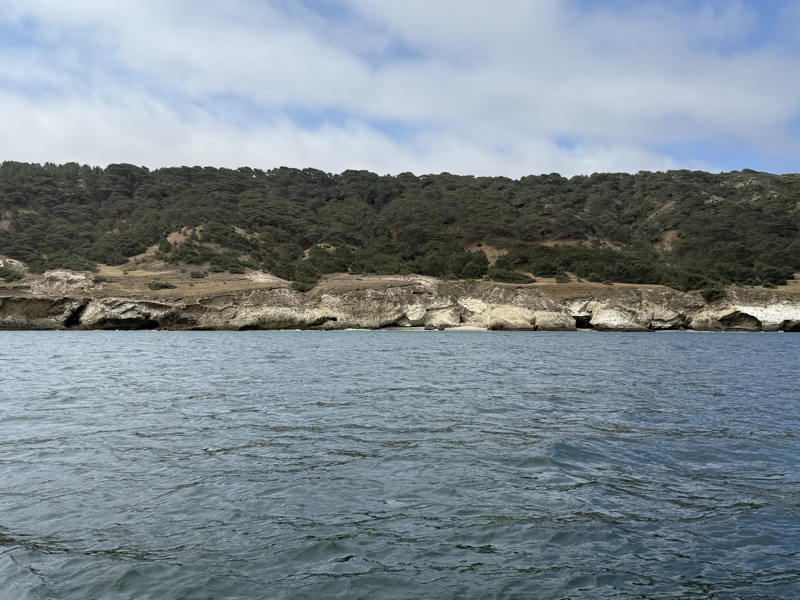
Don describes Becher’s Bay as the main anchorage there, with the best area up at the pier in the northwest corner of the bay. “I took the shots as I was sailing northwest toward the pier, if that makes sense. It’s not an anchorage there though one could; it’s all sandy bottom there and sheltered from the prevailing NW swell. In the afternoon that wouldn’t be comfortable as it gets really windy and choppy there.”
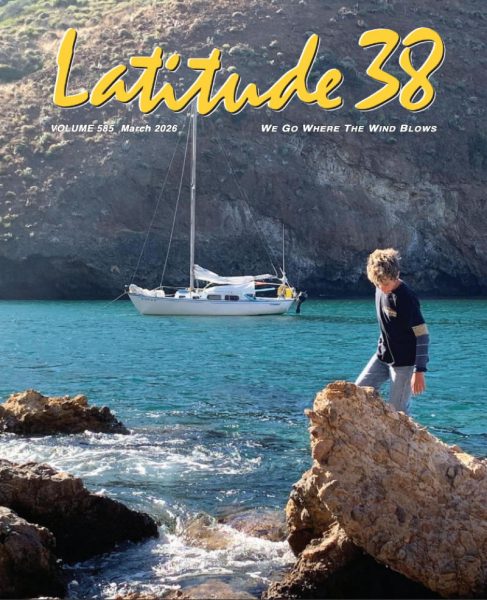
The Channel Islands are one of California’s great treasures, and we were happy to learn more when Don Litton wrote about his family cruising on Pythagoras. Though most photos we see of cruising these remote islands show empty anchorages, we know it’s a cherished destination for many Southern California sailors or those who cruise south from Alaska on down.
The video taken by the Wet Vette sailor can be seen in this television news report. We hope to learn more over time and hope the fire can be brought under control quickly. It’s a popular destination for Memorial Day Weekend.
Dinghies Descend Upon St. Francis Yacht Club for Elvstrom-Zellerbach
On May 16 and 17, over 60 dinghies made their way to the St. Francis Yacht Club (StFYC) for the annual Elvstrom-Zellerbach regatta, one of Northern California’s premier dinghy events. While normally a given on the annual calendar, whether the regatta would take place was up in the air until almost the last minute, due to the much-needed dredging at the Marina West Harbor entrance.
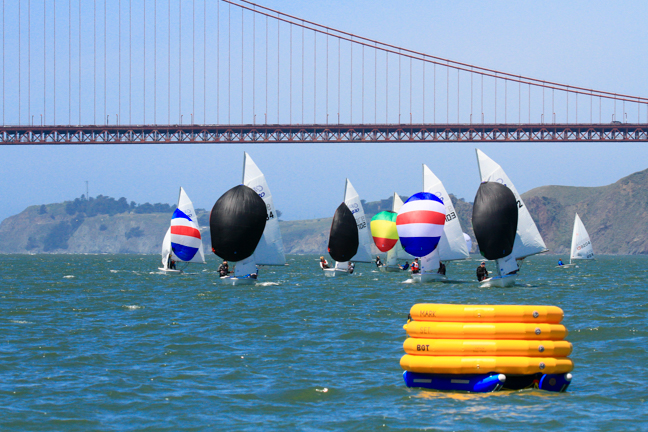
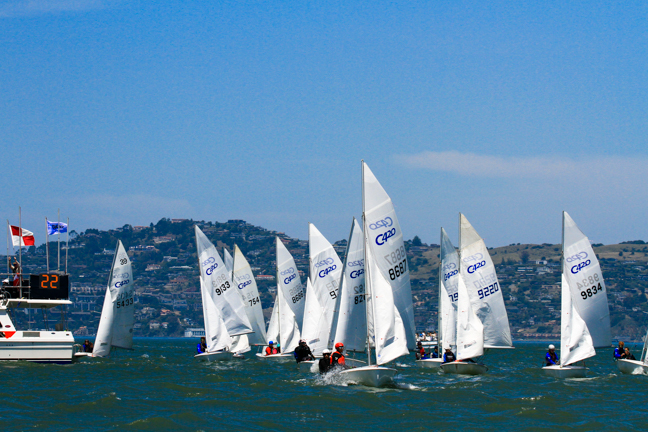
Seven different divisions raced, with three doublehanded classes and four singlehanded. Conditions were sunny, with relatively moderate breeze for San Francisco Bay in May. By far the largest division was the 20-boat C420 class, made up entirely of junior sailors. Six races were sailed, with San Francisco Yacht Club’s (SFYC) Beckett Kern and Elsie Schroeder coming out victorious. The winning duo won races one and two, and finished second in races three, four and six for a net total of eight points (they were OCS in race five, their drop). The StFYC/SFYC combination of Mark Xu and Oscar Melet finished second with a net total of 11 points, winning races three and four.
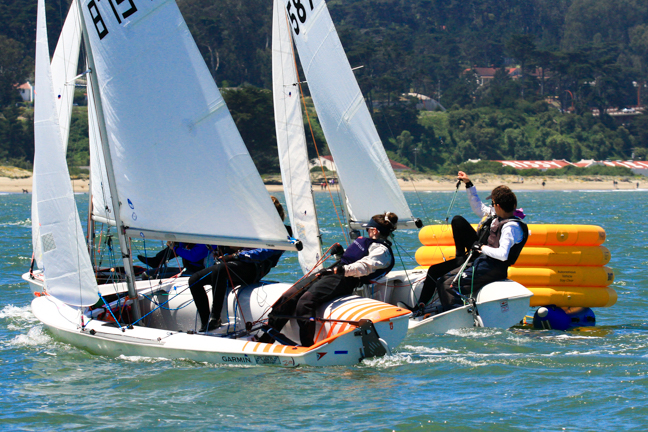
Another type of 420, the I420 (International 420) had six boats participating and saw a sibling duo victorious. The Peninsula Youth Sailing Foundation’s (PYSF) Francisco and Sofia Dias tallied a net of six points from six races, winning four and finishing second in two, one of which was their drop. The adult doublehanded class, 5O5s, saw the winners — StFYC’s Eric Anderson and Nic Baird — record a nearly identical scoreline to that of the Dias siblings: four bullets and two second-place finishes.
In the realm of singlehanded racing, only eight ILCAs competed. Josh Gutow, representing Alameda Community Sailing Center (ACSC), won the four-boat ILCA 7 fleet with a net of seven points, and won the final three races of the event. Ian Adamson (StFYC) won the ILCA 6 series with eight points, just one ahead of ACSC’s Alan Sun. Adamson won three races, while Sun won one.
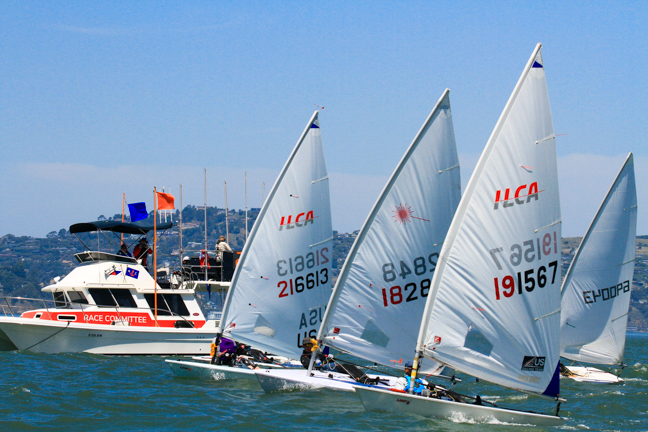
Two different Tera fleets saw the youngest competitors go head to head. Twelve boats competed in the RS Tera Pro fleet, with Richmond Yacht Club’s Skylar Dubuc earning a net total of 14 points from eight races, with three bullets and finishing outside of the top three only once (his drop, a fourth in race six).
Eight boats competed in the RS Tera Sport class, with StFYC’s Trey Roost putting on a dominant showing: a net total of eight points from seven races. Roost won four of the first five races, and finished outside of the top two only once.
You can find the full scores for the 2026 Elvstrom-Zellerbach regatta here.
A Historical 2026 Round the Rocks Race Report
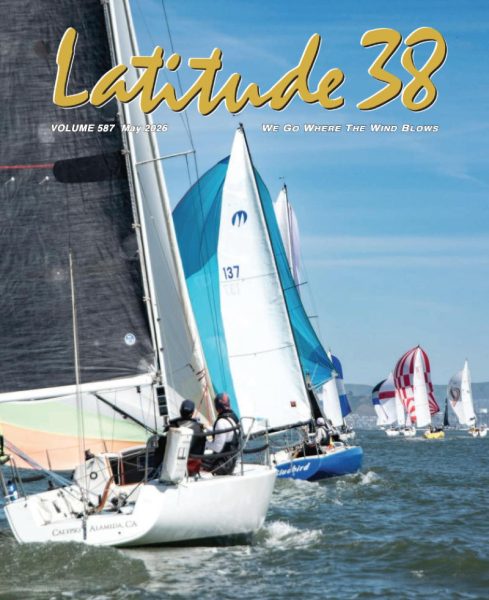
Greg Nelsen, winner of the Singlehanded Division of the Round the Rocks Race on his Azzura 31 Outsider, wrote us asking why we didn’t give coverage of the 132-boat fleet that raced way back on March 28. Good question! We thought we had because Andy Schwenk of Sir Edmund had sent us a great report. It turns out it was buried under lots of bits and bytes in the metaverse. Almost two months can feel like ancient history in 24-hour CNN news cycle created by recently passed sailor Ted Turner, though it’s still fun to read the story of a great day of racing. (Erik Simonson’s photo from the event did make our May cover — there’s just nothing on the race on the inside!) Take it away, Andy:
Any time you don’t think you have enough crew to participate in sailboat racing on San Francisco Bay, surf on over to the Singlehanded Sailing Society website and think again. Either step aboard and let ’er rip by your lonesome, or find one measly person that can put up with you for a four- or five-hour jaunt around these tactical juggernauts.
March 28 featured the SSS [Singlehanded Sailing Society] first race of the season, Round the Rocks. With a name like that, you would assume it’s brought to you by a local boatyard.
I can guarantee that when the race committee calls you with less than 48 hours to the start to confirm exactly how much depth you need to accommodate the draft of your vessel to compete in a regatta with the word “Rocks” in the title, this could be a memorable event, but for entirely different reasons than would require a boatyard’s intervention.
We started in the vicinity of Southampton Shoal and set sail for Blossom Rock. The first lesson we relearned was to be aware of the geographical location of that destination and the amount of current ebbing out of the South Bay. A straight line is always the shortest course, rather than overstanding and practically needing a spinnaker to get down to the rhumb line.
Vessels rounded to starboard and set sail for Little Harding. Second lesson, relearned again. Those vessels that turned at the mark and headed to Little Harding riding the outgoing current did much better than those that sailed to the Cityfront and then ended up overstood and practically had to set spinnakers to get down to the rhumb line.
East Brother was the next rock to round, and spinnakers blossomed down Raccoon Strait. The current was strongest in the middle, so vessels chose a side and none played the foul current better than Raven, skippered by John Kernot, as he pulled a classic “horizon job” on the fleet. After exiting Raccoon Strait, he slipped up the beach along the way to East Brother and did a masterful series of jibes to further capitalize on an astounding lead. A short beat with a profound amount of positive current brought the fleet to Richmond YC for a warm welcome, including the fancy kind of wieners.
The mighty Sun Dragon was only 35 minutes behind on corrected time. Kangaroo Jockey slipped in for third overall, ably assisted by former legendary Bay sailor Mark Howe aboard. If the podium had a fourth space, it would be occupied by two masts as the schooner Sir Edmund held on for fourth.
Of course, what regatta would be complete on San Francisco Bay without a Cal 40 in the top five? Congrats to the Bay Shaman, Bart Hackworth, falling out of a Moore 24 and into his new ocean whip. Then a venerable Wyliecat 39 with Paulling and Roche at the control line, yes, singular. For all those who question whether PHRF can work, check out that lineup. The outlier is a C&C 115 (37 feet) with electric winches leading the way, a modern 35 rocket ship in second, a 27-ft sportboat holding onto third, a schooner … a what? Who are those guys in fourth? Fifth, a crab-crushing Cal 40, and then a wing-sailed, locally produced 39-ft catboat.
If you have a yacht and you like having fun, come sailing ‘round the Devil’s Teeth, the race that launched the organization: Singlehanded Farallones, May 23.
If you’re looking for some more recent racing news shorts:
- Paul Cayard continued his magical winning ways in 2026 by winning the just-completed Etchells Worlds in San Diego with James Mayo and Ben Lamb aboard Magpie against a 76-boat fleet. This is John Mayo’s third Etchells World Championship win in a row. Complete results here.
- Less current is the month-old news that Cayard was honored as the winner of the 2026 Magnus Olsson Prize at the end of April.
- SailGP just announced it is returning to San Francisco Bay on April 3–4 for the 2027 season, after the 13-event tour starts in Victoria Harbour, Hong Kong, on January 23–24, 2027.
Cayard continues to be on a roll that began when he started sailing!
- Environmental News
- Safety
- Hurricanes
- General Sailing
- West Coast Sailing
- Racing
- Commentary
- Cruising
- Events
- Sponsored Post
- Maritime History
- Heading South
- Community Sailing
Like What You Read in Latitude? Help Us Share More!