

Episode #244: Karin Heck on Preparing for the High Latitude Challenge, With Host Moe Roddy Wieneke
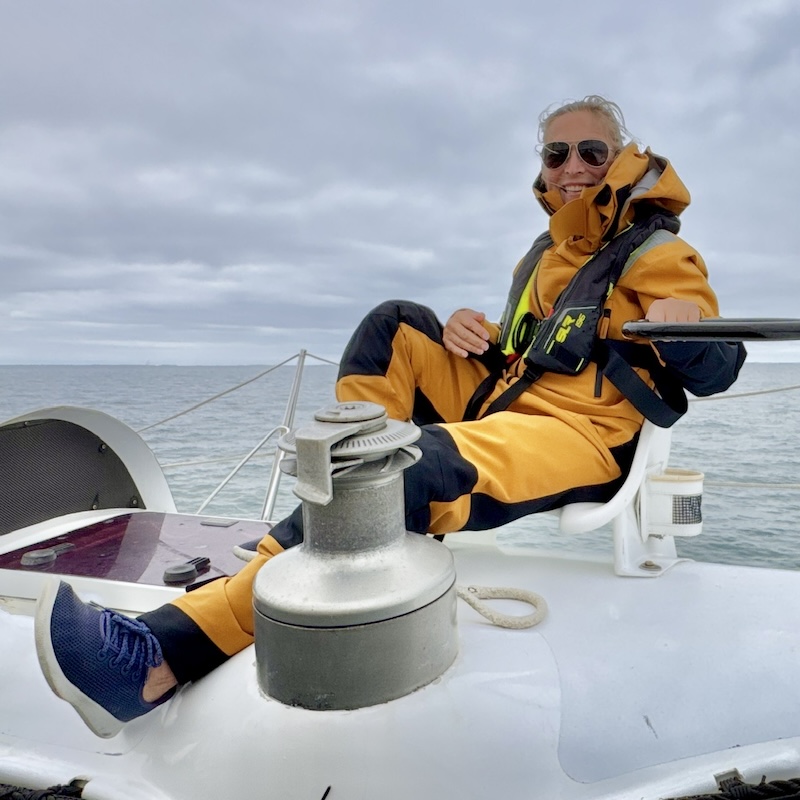
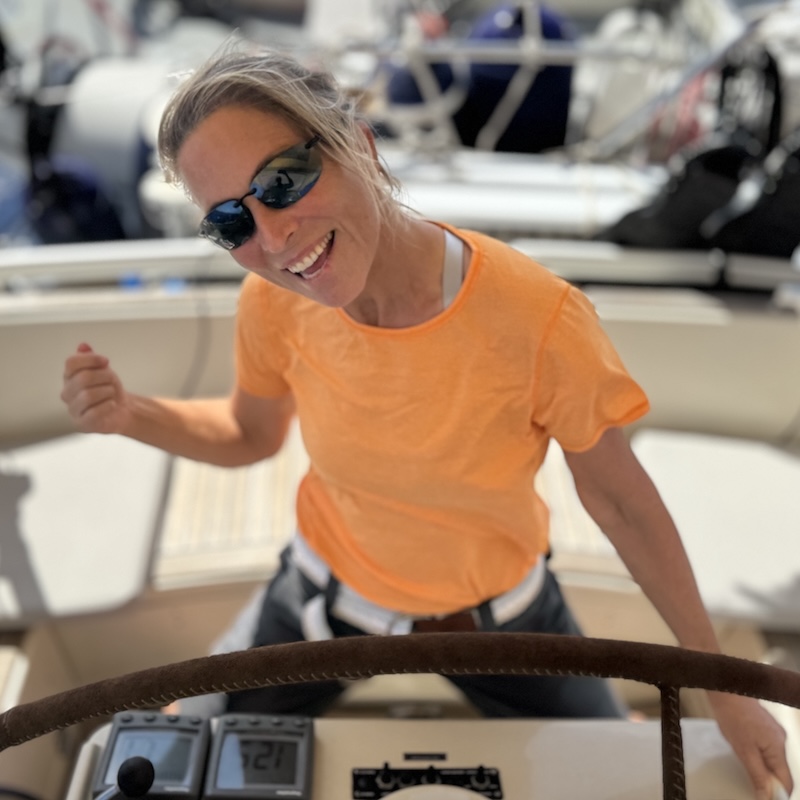
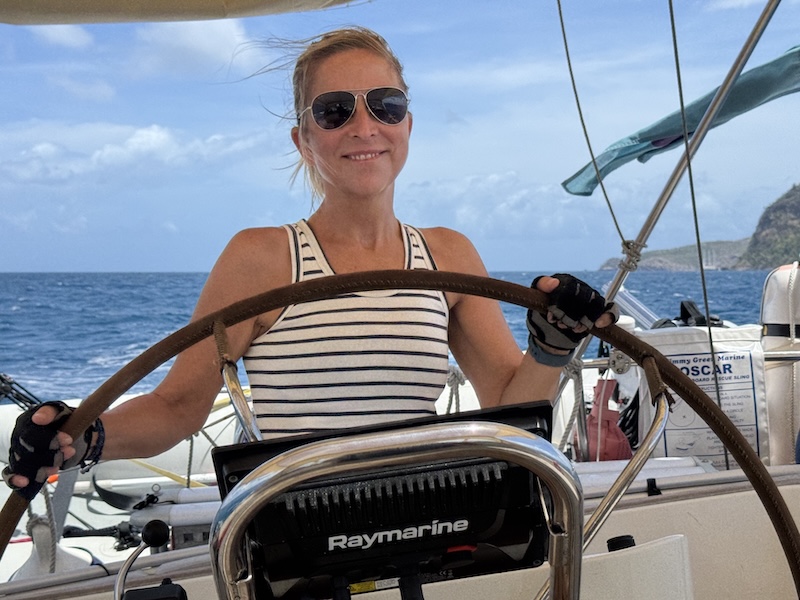
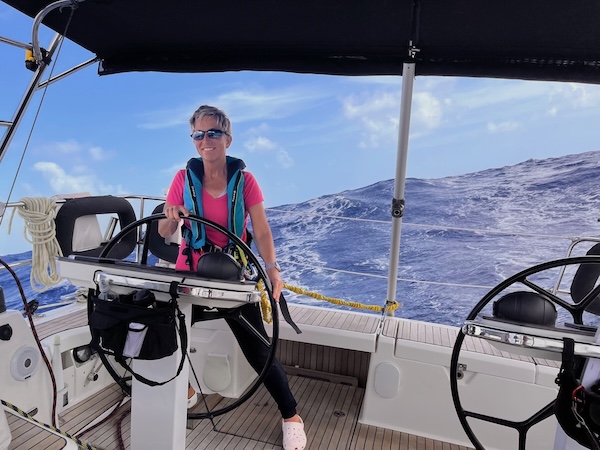
In this episode of Good Jibes we chat with Karin Heck about her lifetime of sailing, teaching sailing, and now preparing for Jimmy Cornell’s High Latitude Challenge. Karin grew up sailing with her dad in Sweden, has done deliveries around the world, and is an Instructor at Spinnaker Sailing.
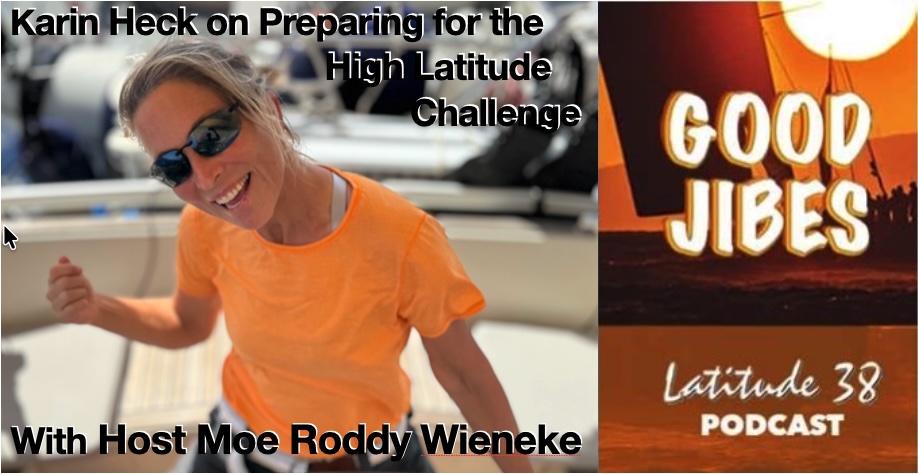
Tune in to hear Karin share her favorite memories from the Baltic Sea, the most gorgeous sunrise she’s ever seen, her best advice for women sailors, how she’s preparing for a unique and rigorous circumnavigation and her favorite point of sail, with this week’s host Moe Roddy Wieneke.
Here’s a small sample of what you will hear in this episode:
- The confidence gap, communication styles on the boat, and why Karin stopped trying to “sound like a man”
- The most underrated sailing skill according to Karin
- The women’s sailing seminar Karin developed at Spinnaker Sailing in Redwood City
- Sailing through the night solo while two crew were sick below and watching the sunrise to a U2 song
- Karin’s boat for the expedition The High Latitude Challenge
Listen to the episode on Apple Podcasts, Spotify, and your other favorite podcast spots — follow and leave a 5-star review if you’re feeling the Good Jibes!
Learn more at KarinIngeborg.com, SpinnakerSailing.com, and CornellSailing.com
Check out the episode and show notes below for much more detail.
Show Notes:
- Karin Heck on Preparing for the High Latitude Challenge, with Host Moe Roddy Wieneke
- [0:14] Welcome to Good Jibes with Latitude 38
- [0:50] Welcome aboard, Karin Heck
- [3:42] Growing up sailing in Sweden and Karin’s first memory is sitting in a flooded cockpit at age three
- [7:04] A “horror night” sheltering from a storm in Finland, and what shaped her love of the ocean
- [11:35] How the two Atlantic crossings started with a delivery from Greece to the Caribbean on a Bavaria Vision 46
- [15:22] Sailing through the night solo while two crew were sick below, watching the sunrise to a U2 song
- [19:37] Check out our Classy Classifieds at Latitude38.com
- Teaching Sailing
- [20:36] The women’s sailing seminar Karin developed at Spinnaker Sailing in Redwood City
- [25:53] The confidence gap, communication styles on the boat, and why Karin stopped trying to “sound like a man”
- [30:21] How most women come to sailing as an add-on to their partner’s dream and why that’s a hard setup for building real confidence
- [34:11] Join our Crew List at Latitude38.com
- High Latitude Challenge
- [34:40] The High Latitude Challenge: Jimmy Cornell’s expedition circumnavigation: France, Buenos Aires, Ushuaia, Antarctica, Easter Island, Hawaii, Alaska, Northwest Passage, Newfoundland, and back
- [38:57] Karin’s boat for the expedition is a Garcia 52 aluminum centerboarder built in Cherbourg
- Short Tacks
- [43:43]What’s the most underrated skill in sailing?
- [44:11] What’s the most important piece of gear Karin brings with her?
- [45:50] The Mysterious Case of Rudolf Diesel by Douglas Brunt as her favorite sailing book
- [48:41] Best advice: “Slow is pro” and how treating the High Latitude Challenge as a project plan brought her teenage circumnavigation dream back to life
- Connect with Karin at KarinIngeborg.com
- Check out the May 2026 issue of Latitude 38 Sailing Magazine
- Make sure to follow Good Jibes with Latitude 38 on your favorite podcast spot and leave us a 5-star review on Apple Podcasts
- Theme Song: Pineapple Dream by SOLXIS
Transcript:
Please note: this transcript is not 100% accurate.
00:03
I have wanted to do circumnavigation since I was a teenager. It was my dream.
00:14
Welcome everyone to the Good Jibes podcast brought to you by Latitude 38, the sailing magazine for West Coast sailors since 1977. I’m your host today, Moe Roddy, and I’m so glad you’re here. Each week, we bring you the stories and the adventures and voices of the people who make sailing on the West Coast so special, whether it be about racing or cruising or exploring and everything in between. So settle in.
00:43
drop your anchor and join me for another great conversation.
00:50
Welcome back to Good Jives. I’m Moe Roddy Wieneke and today we’re talking with Karin Heck. From growing up sailing in the Baltic to Atlantic crossings, Bay racing, and now high latitude sailing ahead, Karin brings both depth of experience and a real focus on helping others step into sailing with confidence. Karin, so great to have you here. Welcome to the Good Jibes podcast. Thank you so much. I’m so happy to be here.
01:16
Nice. So I always start at the beginning because it’s where we all started. Where did you grow up? In Stockholm, Sweden, which is in northern Europe, as far north as you can get basically in Europe. Oh, nice. I saw that you had done some early sailing in the Baltic. I wasn’t really sure where you were from. And how long did you live there? Until I was 25 and then moved to the US. And what brought you here?
01:46
uh Grad school, basically. I went to Columbia in New York. Very nice. That’s a nice school. What did you major in? Actually, I was 28. It was my second graduate degree, so I got an MA in Arts Management. Okay. Have you been able to oh translate that into anything with sailing? Yes. I am looking forward to talking about that. Okay, good. And so you grew up in Sweden and were your parents sailors?
02:17
uh Kind of. My dad bought a boat when I was three and knew nothing about sailing and didn’t even know that he needed to know about sailing before he started. my first sailing memories is I think I was three or four sitting on the cockpit sole with water up to my neck and wondering what was going to happen next. The boat filled up with water?
02:45
we were overpowered and water was just flooding over the comb. So, I mean, that’s just my first memory. There were so many things like that. Wow. What kind of boat was it? you know? Yes, it was. had a series, my dad had a series of boats. That one was just a 25 footer with an outboard, kind of similar to what I’m sailing now at work, a Mary 25, but not as good.
03:13
No, are these like a day sailor with an open cockpit and a small little cabin? They were for, they had a cabin exactly. were out. Oh, nice. Is it water really cold there? Isn’t it? The season is short. You can only sail from May to October and be covered by insurance. The water, I mean, the water is really cold here. So I wouldn’t say that it’s much colder in the, in the Baltic. It’s just that the air is.
03:42
colder and more miserable. Here or there? There. Okay. Cause I’m from the East coast. think it’s pretty miserable here. Especially they don’t like to, they don’t like to reef here. You know, I’m from Newport, Rhode Island. It’s 15 knots. It’s like, put a reef in. Out here it’s 39 knots. it’s like, just another day. So did you go through a, a program growing up, a junior sailing program? No, just my dad’s program.
04:12
Okay. Did your mom sail? No, she tried in the beginning, but with the kind of school of hard knocks that my dad put us through, she was out. So it was me and my dad sailing. Okay. Did you have siblings? No. Just you and your dad. But I loved it. I mean, it sounds, I mean, there were a lot of things happening, but there was also a lot of
04:39
Good memories, quality time, know, it’s just us on the boat, no distractions. And the water’s always been my happy place. There are photos of me when I’m really little at the helm, looking so excited and a lot of responsibility. Obviously he needed me. is the, we didn’t have autopilots or anything like that. it’s just, yeah, really good place. Yeah. Sweet. Did you go on any overnight trips and like cruises? the time. That’s what we did. Yeah. How nice.
05:09
The way people, everyone is Sweden sails almost and you go out for, if you’re working, you would go out on the weekend, but people have six weeks of vacation in the summer and then you go out sailing. So we would sail across to Finland and sail there because there weren’t as many boats there. And then what was his next boat? Then um it was 28 foot. We didn’t have it very long because
05:37
very rocky in Sweden and we ran aground a lot and it sprang leak every time so was a very stressful couple of years. And then he bought the boat that he had for the rest of his life which is kind of funny because his boat was one of the first ones. It’s uh called the Linhette 30. Really, really small boatyard. But now in the last couple of years I’ve been reading in yachting monthly and yachting world that this uh shipyard is small.
06:06
to me is a small shipyard run by three brothers. They’re producing the winning boats, cruising boats. So I don’t know how they’re handling all this global demand that they must be getting. But so- racer cruiser. What’s the name? Is it still Linh Nhat? Yeah, Linh Nhat. They’re making bigger boats now, but I think 38 is the one that has been winning all these uh awards. And so this boat was the boat that really shaped you, do you think? Yeah. Yeah.
06:36
Nice. And then how old were you when you started skippering the boat? I’m not sure. think maybe 15, 16. So nice. And you start getting annoyed with your father’s way of doing things. And then what stands out? Do you have like a moment or a memory when you were a child that you were on the boat that you really it was a profound moment for you?
07:04
In addition to the having water up to my neck. Yeah, that was I guess that stands out. No, I have memories. We were once in Finland and there was a storm that came in and everyone that was seeking shelter were really nervous and we were all standing on the dock wondering what was going to happen to our boats. we still talk about my dad and I would refer to it as the horror night that Yorumoto place we were at. oh
07:33
I was clutching my dog wondering if the boat was gonna be there the next morning. But at least you were able to get off the boat. Yeah, yeah. Yeah, we were all off our boats. Yeah, scary to stay on the boat. Is there a time in that period of your life that you think shaped you for who you are today? Were you gonna end up? I mean, it’s hard to know what’s cause and effect, but I…
08:00
I’m sure I’ll talk more about I just love oceans and open water and being on the water. So if it was doing that that Created that or if it’s the other way around that I always Had that and that’s why I was so happy to go with my dad. I don’t know I know my mom quoted this study Well that she’d read that people have different genetic predispositions
08:24
for either open water or being in a forest or being in a cave or up on a mountain top and that that is for the survival of the species so that the tribe would spread out. So if there was a fire somewhere and an animal somewhere, the tribe would survive. So sometimes I think it’s just genetic for me, like my happy place is on the ocean. It feels like it’s genetic, it’s so profound. Yeah, that’s pretty interesting. um
08:52
I love the rain and I always blame that on my, I’m Irish and I blame it on my genetic memory in nursing care. And I guess being offshore is like that too. I come from a line of grandfathers who went offshore. Yeah. So, all right. So you grew up in Sweden. You are sailing your father’s boat. You’re learning a tremendous amount, getting a lot of experience. And you go off to college.
09:21
And when you first went to college, just out of curiosity for me, what did you major in? Business. Yeah. In Sweden, you don’t have the undergraduate thing. You go straight to grad school. So I got an MBA. OK. And then worked for a while. And then I went back to grad school again. And then was the grad school at Columbia that brought you to the United States that brought you over here? My second grad school, yeah. OK. Going to Columbia. All right. So when you’re in Columbia now, you’re in New York City. Did you sail there?
09:49
I did actually a little bit. did some racing in Long Island Sound. I had done some racing with my dad. We obviously knew each other well. And then I did some racing with a terrible skipper. And so I got that experience that kind of traumatized me for quite a while. But it was fun to experience.
10:15
We sailed out of Derry and it was all very posh. In Sweden, everyone sails. It’s more like the people’s sport. It was kind of fun to see the other side of racing. Yeah, exactly. Especially as a poor student. And then, so when was the first time you went offshore?
10:37
Well, it depends on how you define offshore. Do you call the Baltic offshore? Then I was probably eight or something like that. I mean, to us, felt offshore because this is before GPS. So you plotted your course and you sailed eight hours or 12, depending on the wind, without knowing exactly where you were. And when you saw that first lighthouse, hopefully you were so excited that you actually ended up where you thought.
11:05
Were there like overnight trips then though that you sailed overnight in the Baltic through the night? No, we wouldn’t. It would be day cruises and you would leave early in the morning and you would only do a sail like that, hoping that you would get in before dark. I think once the wind didn’t come in the way we thought and we made landfall after dark. But you know, in the summer in Sweden, it’s only dark for like in Stockholm, which is quite far south. It’s only dark for an hour or two in the middle of the summer. So it’s not it.
11:35
huge problem. Okay, so but you ended up doing two Atlantic crossings. So how did you happen to do the first one? I well it started here in the bay. I just had this pool I wanted to get out into the Pacific. I was sailing down in the bay. So I signed up for just a three day thing from Redwood Shores where which is where where I sail a lot of those vinegar sailing.
12:04
to go to uh Half Moon Bay and um it was a great trip and it just reinforced that I love the ocean. So I decided I need to do more of this. So first I started looking at crewing on a pack-up boat, but all the positions for women were galley work and that was not what I wanted to do. I could not find a single normal crew position for women.
12:28
And so then I started asking around and then I heard of someone who needed a delivery done from Greece to the Caribbean. And then I got to be get on that delivery. Oh, nice. That’s not bad for your first offshore delivery. No. So you went so you literally sailed through the Mediterranean out Gibraltar and headed down. Yeah.
12:56
And then we did it in two times seven weeks. So the first stretch was to Las Palmas, the Canaries. And then the second stretch was from the Canaries to the Caribbean. How many of you were there? So was just the two of us for the first stretch until Gibraltar. And then Gibraltar down, we were three. And then across, were four. OK. And what kind of boat was it? It was a Bavaria Vision 46. OK.
13:25
Another boat. So you did it in two seven-week stretches? Mm-hmm. Okay. How many miles total was it? I actually don’t know. You better learn that. I know, I know. I’m seeing now more and more people are quoting how many nautical miles they’ve sailed. I have no idea. I mean, I know it’s more than 4,000 because I’ve crossed the Atlantic twice, but how much more I don’t know. All right. So then you did it again. Now how did this time come about?
13:53
Um, so I was doing delivery work for another owner in the med and I helped him sail the boat down to Las Palmas and then was that double handed? It was double handed down to Las Palmas. And then I sailed also from Cape Verde across the Atlantic. So I flew into Cape Verde. So they were three. Um, he got two crew members from Las Palmas down to Cape Verde. And then I came into Cape Verde and sailed across.
14:23
And what kind of boat was that? Regina 43, which is a Swedish blue water cruiser. They’re kind of like halberd rassi, but better, I would say. Nice. I love being offshore, too. It’s one of my favorite places. There’s nothing like looking up at the sky at night and seeing something from a place on the planet that very few people have been to and can look up and say they’ve seen like the Southern Cross or, you know, things like that. It was pretty amazing.
14:53
Yeah, I also have, I’m going to ask you this too, but I have a very fond memory of being in heavy, heavy weather. And then the weather breaking and looking at the clouds that with the sun was setting, this looks like after four days of, you know, 50 knots, hit 62 at one point, knots of wind and just like this feeling of this beautiful clouds and I put them
15:22
this memory in my brain. And I figured someday I’m going to be an old lady and I’m going to be in a wheelchair and I’m going to be sitting in the window and I’m going to bring back this vision of what I experienced that afternoon. Do you have anything like that? Does something jump out at you that you really thought was profound? Yeah, I hadn’t thought of it actually. So thank you for making me recall that on my first crossing, we were down to two of us sailing.
15:52
two were out of commission. were they seasick? One was seasick the entire time and below deck and the other person was dehydrated and below deck, actually quite sick. So we were two, which meant, so I took a double shift so that the other person would get to sleep a little bit more than three hours.
16:17
And so I did the whole night basically, and I tend to listen to music. I just have one air pot in so I can hear what’s happening. But and I was listening to you two and then the sun rose above the horizon and it was the most gorgeous sunrise. And it was something about, you know, having sailed the whole night and then listening to this amazing song. actually don’t remember which one it was. And then seeing this
16:46
glorious sunrise was just perfect somehow. And you’ll have that forever now, Karin. You know, it’s uh now when you’re that when you’re that little old lady, you know, can’t, you know, who’s in a wheelchair, you’ll able to think back to that as well. I know I had another experience with em I was in the Atlantic Ocean on my way to Bermuda and I was by myself and I had um it was just a quiet, quiet night. And I had this
17:16
like I want to call it an auditory hallucination. My mother had been dead for, I don’t know, 15 years, 20 years at that point. And I remembered the sound of her voice. And I think there’s something profound, you know, when you turn off all of our devices and the world around us goes away and our world just becomes whatever we can see from our boat, from where we’re sitting, it’s very profound and it leads to a lot of
17:46
Self-discovery, I think. um Exactly. It’s interesting when I came ashore, I was full of all this positive experiences and then I started talking to other cruisers and quite a few had bought a boat and sailed across and were now going to sell it because they hated it. It’s not for everyone, but for the ones it’s for, it’s just so amazing.
18:12
And now so both of these, where did you ended up in the Caribbean from both of these deliveries and where did you end up? Grenada. Grenada both times. And did you stay long or did you hop on a plane and get back? I hopped on a plane. I stayed for the parties. And then I flew home. Okay. Was this part of the arc? Arc plus. Okay. All right. You are listening to Loudie238.
18:41
Good Jibes podcast. We will be right back. Hey Good Jibes listeners and Latitude 38 readers. Have you looked in our classy classifieds lately? It would be impossible for us to know how many boats have sold to new owners over the last 45 plus years of publishing Latitude 38. But we’re sure they have helped countless people realize their sailing dreams. Every month there are new boats listed that will fill someone’s sailing adventures.
19:08
If you have a boat you want to sell or are looking for that next boat in your life, the pages of Latitude 38 will surely have something to suit your fancy. Pick up a magazine at a local marine business or visit our classy classified pages at latitude38.com to find boats, gear, job opportunities, and more. Then tell us your next sailing story. Welcome back to Latitude 38’s Good Jobs podcast. I’m Mo Roddy-Winnke and I’m your host today.
19:37
Our guest is Karin Heck. Let’s get right back. What do you think about yourself now? Are you a racer, cruiser, offshore sailor, something else? I mean, this very moment, I see myself as an instructor. m And then I am preparing to become an expedition sailor. Nice. You have to meet Ashley Parent. Do you know who she is? No. Oh, I’ll make an introduction. She’s amazing. She’s an ice pilot and an expedition sailor. Yeah. Yeah.
20:07
She’s wonderful. um So you’re teaching, so basics, what are you teaching and where are you teaching? I’m teaching at Spinnaker Sailing and yeah, I’m teaching the intro classes and I do afternoon sales and now I’m teaching this women’s seminar that I’ve just launched and then I’m gearing up preparing to teach the more advanced classes. Well tell us about the women’s seminar, what’s that? Yeah, it’s teaching women who already know how to sail.
20:36
how to make it easier for themselves, how to make the boats feel smaller and more manageable and less intimidating. So it’s both physical ergonomics and mentally what’s helpful. And what are some of the things you see that are different for women? What are you doing that’s specific for them? So if we start with the physical, I mean, all the teaching that I have seen and experienced myself is geared
21:05
towards 25 year old professional athletes, basically. I see some men struggling too with, I mean, it’s very physically taxing a lot of the stuff we do on the boat, especially if you don’t do it right. So it’s looking at techniques for how to make it easier. It’s looking at gear for you or for the boat to make things easier, but it’s also,
21:34
encouraging them and pointing out that a lot of things could be much easier. For example, winching in a sail is much easier if you do power the sail. So unless you’re racing, ask the helmsman to go up into the wind. You don’t need to exhaust yourself and things like that. And then it’s geared both to women who are crew and want to stay crew and women who are skipper want to become skipper. So we’re taught
22:02
And I think everyone should be prepared to do both. Because even if you want to be a crew, your skipper might be incapacitated and you will have to become a skipper. talked to someone this morning who was just crew and then her husband had a heart attack and she had to figure out everything as she was on her way in to die. She didn’t know how to dock the boat and she was calling, you know, airlift of him. And yeah, you don’t want to be that person who’s learning while…
22:31
while you’re in an emergency. But also people who are skippers need to understand what it’s like. You can’t be a good skipper unless you know what it’s like to be a crew, because you need empathy for what they’re going through. So I work on all that. And then mentally, think, well, I’ve seen that women learn differently. I mean, I’m overgeneralizing here now, but men often might…
23:00
male students, they have more confidence than ability and women have less confidence than ability and ah Neither is good. But if you have less confidence than ability your learning curve might be slower than it should be so working with them on how to Why do you think that is? I Think that’s how we’re raised. Mm-hmm. Yeah men are pushed sometimes probably against their will to to do more than they
23:29
then they can and women are told not to. That’s my guess. I think it’s interesting you hit on something about the skipper. always say that the skipper is the weakest link on the boat in terms of if something happens to that person and nobody else on the boat can do those functions, then now they become the problem instead of the solution. So I think it’s always important for skippers to…
23:57
Keep that in mind when you go offshore that somebody can step in and take your place if they need to. Otherwise, it’s a problem. Yes. And ergonomically, I think boats are built for men. They’re not built for us. When you look at the reach to a wheel or a tiller where the seating is and the size of the winches, I had the luxury of putting my own winches on my boat. So they were oversized. They were like 47.
24:27
millimeters instead of like 43 and the guys would laugh at it, but you know, I could get my sales in really quick. Yeah. Good for you. And I also try to get them in before I had any load on them and then I could ease them. you know, once there’s a load, gets a little more difficult. And also winching techniques where, you know, if you read the books, you’re like, oh, you should position your shoulders over the winch and use your whole arm. But
24:56
For example, me, was a downhill ski racer growing up. So my strength is in my legs. So I encourage the students to figure out where is your strength and use that in your movements. So when I winch a lot, like on Sunday, I was winching all day, I started, I used my legs to winch. And so that’s something I work with the students to actually understand where they are the strongest. And some people are the strongest in the arms, but it could be their core, et cetera.
25:26
What technique do you then deploy to do whatever it is you need doing, winching or racing a sail, et cetera, using your strong muscles? Do you have any advice for women who want to learn how to sail? Do it. I think that’s the most important thing. A lot of women hesitate. I would say just do it and do it now and then call me and I’ll talk you through. mean, everyone’s journey is.
25:53
I that goes for both male and female students. Everyone has their own journey. So find someone who can help you find your journey. Mm-hmm. And what about, have you noticed anything different about the way women communicate on a boat? Yes. And that applies to me too. Could be cultural too. The Swedish culture is a little different than American. But women tends to ask nicer, which is seen as a problem.
26:22
And I was told when I was starting to instruct, I was told that I needed to start sounding like a man. And I tried for a while. And then I decided that it was too much work for me to try to change myself. And also, I’m not sure that, I mean, what they meant was I should start screaming more. And I don’t, I’m not sure that any student really likes being screamed at. So.
26:47
I’ve had to figure out other ways to assert my authority that are a little calmer. Obviously, if you’re in an emergency, you’re very clear and direct and authoritative, but otherwise, I think women can work around it and find their communication style. Yeah, it’s an absolute challenge and it goes hand in hand also with the confidence. So if you’re less confident, you might…
27:14
women often position things as a question and then no one listens to them even though they were right and the problem would be solved immediately if anyone listened to them. So yeah, I don’t have any answers. I just have observations so far. I should point out you did not go to school for this. Well, have you noticed that women problem solve differently on a boat than men?
27:43
Not really. I mean, I’ve heard women talk about it. I have not seen it. I think it comes back to communication that women just communicate their problem solving differently so that they might not be listened to the same way um as a man is. But I haven’t seen this style. know you. But also, I’ve heard a lot of women talk about that women have more collaborative problem solving style.
28:12
But I haven’t sailed with a lot of women. no, haven’t seen I mean, I’m thinking about it. No, I haven’t seen that I think.
28:25
Collaborative problem solving is the way to go in a crisis. So to me, it’s not gender. It’s just, is this person a good skipper or a bad skipper or a good problem solver or not? I like the term collaborative because it’s, you know, when you think back to, this is going to be really out there, but you know, when we were cavemen and women, were hunter gatherers and women, know, obviously if you’re nine months pregnant, you can’t run away from a saber tooth tiger. So we were relegated to gathering.
28:56
And together we had that opportunity to chat and talk and problem solve. And you can’t do that when you’re trying to kill a saber-toothed tiger like the guys are doing. So I think they’re probably a little different the way they communicate just from, I know this is out there, sorry everybody. No, no, no, I love it. I hadn’t thought of that. That’s true. It’s just how I always think of women and why we are so.
29:24
why we collaborate so much with each other, because we’ve done it for time forever. Yeah. When it comes to strength and the ergonomics and efficiency, do you think women are adapting to systems that weren’t designed for them? Oh, I mean, they have to. I mean, and that is what I’m trying to break with my class to tell them no one is telling them that they can and no one told me that I could in the beginning. And then I was lucky enough to have a, he’s my sailing mentor.
29:53
find someone who actually started telling me, oh, you should sit down and use your legs here. You should do this and that. And so, but in general, no, it’s uh women don’t even know it’s possible. Yeah. Yeah. What do you think it’s in the way of us taking commanding a boat? It could be how they, how women come to sailing. A lot of women come because their husbands or partners want to sail.
30:21
and have sailed. So they’re coming into it as a crew and an add-on and just being ordered around. I’ve only had one man. I’ve had many, many women who come into sailing that way. I’ve only had one man who came in because his wife wanted to sail. So I think that’s important. And the man wants to command the boat. That’s his dream. So his wife is just an enabler. So that’s not a good setup for it.
30:51
Yeah, and then it could be, I mean, I’m just thinking about when I started restarted sailing, I was in situations where I was more experienced than a lot of people. But I mean, just the mere fact that I was this I was a woman and I was an unknown entity to them made made it harder for me to come in and assert myself. I know I always found, you know, if I was sitting on a boat,
31:21
I’d be relegated below with all the wives and stuff. Well, the guys were top up top talking about technology and stuff. And I wanted to be talking about that. Yes. I don’t want to talk about recipes. Exactly. Exactly. Yeah, that was always my problem. So you write a lot as well. I have a blog that actually I started writing it for my dad because
31:49
He was not on social media and he was anxious. then I got, I actually have quite a few followers and then I’ve written a couple of articles. Yeah. One that’s published. For in a magazine and in a magazine. Yeah, exactly. Yachting magazine. Yeah. Yeah. Yachting monthly. That’s a nice magazine. Yes. Before we, before I switch gears here, is there anything you want to let women know? mean, tell us again.
32:18
where you’re teaching at. Yeah. And do have a website for all that? Yes. So I teach a spinnaker sailing. Where is that? It’s down in Redwood City. Okay. Which is the perfect, I would say the perfect place to start sailing or to hone your skills because it’s much calmer. The waters are calmer down there and um
32:43
Yeah, just the weather is the winds are predictable, et cetera. So it’s a really good place to learn and hone your skills. we have, so we have this women’s seminar that I developed and that’s evolving. So um I’m open to hear about everyone’s experiences and um teaching women who already know how to sail, how to make the boats feel smaller and more manageable. But I’m also, I’ve had
33:13
a lot of interest also doing a women’s seminar teaching women how to sail, which I know exist in other clubs around the Bay as well. I think both are important. Yeah. You know, I have found that sometimes you get on a boat and the skipper and the first mate, I like to call the first mate, this lesser experienced one doesn’t even know how to turn the radio on much less.
33:41
know what channel to put it on or whatever thing is. There’s a lot to process and learn that you just take for granted that you don’t realize and people don’t know this stuff. You are listening to Loudie238’s Good Jibes podcast. We will be right back. Hey Good Jibes listeners, are you looking to sail more? It’s the biggest mismatch on the California coast. There are thousands of boats not sailing because they need crew and thousands more sailors or soon to be sailors who want to sail.
34:11
but can’t find a boat. For over 45 years, Latitude 38 has been connecting boat owners with sailors to sail, or race the bay, or travel far over the horizon. Some connections have turned into thousands of blue water cruising miles, or race winning cruise, or long term relationships, or just happy days of sailing. If you have a boat or want a crew, add your name to the Latitude 38 crew list at latitude38.com. You don’t know where such a simple act will take you.
34:40
Tell me about this high latitude challenge. What is that? It’s Jimmy Cornell. the books? Yes, exactly. And he started the ARC and the World ARC, et cetera. It’s his latest thing. It’s uh actually an expedition. It’s not a rally. You had to apply to be allowed to apply. It’s just a little intimidating. And it’s starting in France. And it’s sailing from these are the stops.
35:08
uh Cherbourg, Las Palmas, Buenos Aires, Ushuaia, Antarctica, Easter Island, Hawaii, Harbor, Alaska, Northwest Passage, Newfoundland, and back to France. So it’s basically circumventing but the other way. Yeah. North to South. Okay. And when does it happen? So they’re doing it for the first time in 2026, I’m admitted and I’m already on the
35:37
I’ve been on all the webinars. I’m so jealous. I can’t go until later because I have to wait for my daughter to go to college. would they do this every two years? So they’re going to do the first one starting in this September and then they plan to do it every year. And I’m going in 29. And do you have to have your own boat? Yes. Okay. And I would assume aluminum or…
36:03
Yes, so I put a deposit on a boat, Garcia 52. I did all this research, first paper research, and then I actually went to different shipyards, etc. And that’s what I picked. is just so, I wanted to make sure that I would stay as safe as possible on a journey like that. And I mean, you need to not just have a spare propeller, but you need to have a spare propeller shaft. You need to have
36:32
I just read a book of someone sailing the Northwest Passage who was running short on impellers and he had eight on board because the water is cold. There’s just so much complexity and you need to have one year’s worth of extra of food in case you get frozen in on either end, cetera, cetera. And how many boats are in the expedition? So this year there going to be six. Six boats.
37:00
Would they be collecting data as well? Scientific data along the so they were, the last two webinars they were talking about scientific partnerships and people are free to have their own partnerships as well, but they also had some that had approached them. And how many people, how many crew members can you have? They haven’t specified that. You’re not allowed to go if you are solo. That’s the only. Okay, so no single-handing. Three pages of rules.
37:30
That’s the only one regarding crew. And I’m just wondering, it highlatitudechallenge.com? Would that be a website? I’m making that up. I actually don’t know. Just Google high latitude challenge. it’s the first one. I think it’s on Jimmy Cornell’s website, if I remember correctly. And what’s pulling you in that direction? I have wanted to do a circumnavigation since I was a teenager. It was my dream when I was a teenager. And I would have gone and then not read about piracy.
38:00
And then I chickened out. But so that is one. And then I did some uh exploration to really remote parts of the world when I was in my 20s. And I loved that. So this checks that box. I’m hoping that especially in the Northwest Passage, uh I can actually stop and meet some people and experience remoteness and then the chance to learn from Jimmy Cornell. You know, he’s
38:29
on these webinars. He helped me when I was unsure about my boat purchase. We had calls on that. I mean, that just the, he’s amazing, obviously, and the chance to get to know him is. Now, is the boat being built for you or is it a, uh it is? And where is it being built? Sherbrooke. It’s is built in Sherbrooke, which is basically Northwest corner of France. Okay. And what’s, what’s unique about it other than the fact that it’s going to be aluminum?
38:57
And it has, I mean, I had this spreadsheet with 250 rows of criteria that I wanted that I interviewed all the yards on, but the top ones, aluminum felt important. It has a liftable centerboard, which I have never sailed with, but you need that in, for example, Antarctica, or you want that in Antarctica when icebergs come in so that you can go where it’s so shallow that the icebergs can’t get in.
39:25
And also supposedly it’s much safer when you’re sailing down big waves, down the risk of a broach and a roll or pitch is much lower if you have this liftable centerboard. I mean, it’s built for expedition. It has crumpled zones in the bow and in the stern on the rudders and watertight compartments everywhere and lots of storage and…
39:53
all the stats in terms of how long, if it gets flipped, how long it stays upside down and all these things. It’s a safe boat. And a lot of redundancy. What kind of rig? It’s a regular full-size rig, a slab reef. Again, you want that for… Yep, but a sloop, not a catcher. And a water safe or dry pilot house.
40:20
It has two, you can sit inside. It’s built kind of like a pilot boat so you can sit entirely inside in the cabin when the weather is really bad and just close up and do everything from inside. And then it has a kind of hard dodger thingy that you can sit under outside as well. And you can enclose that. and then obviously you can be in the weather too.
40:50
Are there rules for this expedition in how big your boat should be? mean, so that everybody can keep up with each other or is it just? So you don’t sail together that way. So no, I know he’s mentioned that he’s turned a lot of boats away because he decided they weren’t safe. And he also turned away both that were commercial boats like paid crew positions.
41:19
I’m sure he has more criteria, but safety is, I know, his biggest. He wants, and that’s why he had this, I you basically, I felt like the most important job interview I’ve ever done. Because you want to make sure, obviously, that it goes well for everyone. I think it’s exciting. I’ve wanted to go to Antarctica forever. Yeah, me too. Me too. And I’m even more now, I’m even more excited about the Northwest Passage. I know there’ll be less sailing and
41:48
I love sailing, but lots of other exciting things. Yeah. One more reason you need to meet Ashley. I think she’s been through the Northwest Passage. I don’t know. Five, six, seven, eight times maybe. Yeah. Yes, I want to talk to Yeah. Yeah. And of course, being a nice pilot, she’s been down to Antarctica a lot. goes every year. Let’s switch gears again. And these are what we call short tacks. So they’re just quick little questions that uh it helps people get to know you better.
42:18
em And so my first question is what’s your favorite point of sail? I know all sailors will hate me but close reach Okay, and why close versus a like a broad reach and I might change my mind when I sail more in bad weather But to me, it’s just you’re fighting the element. You’re pushing it. You have the wind in your hair It’s it’s really it feels like sailing really sailing m
42:46
What’s your favorite place that you’ve ever sailed? Middle of the Atlantic. Sweet. Good answer. And well, I think you’ve kind of answered this. What’s your dream destination? Well, I mean, yes, I talk about those two, but I have so many I can’t pick. have so many. think that’s the beauty of sailing. can have your it’s like a snail. You have your home on your back and you go wherever you want to. So that’s my answer.
43:15
I like that one too. Yeah. I love any anywhere I go and I can drop the anchor after I’ve been offshore. It’s like so exciting. That’s my new favorite place. What’s your what do you consider the most underrated scale on a boat? Risk management. And you were asking about things I learned from my previous life. So a lot of the jobs I had is about risk management, you know, when you’re launching big projects or running companies, etc.
43:43
when I’ve sailed, especially if you look at crew dynamic and how things work out. mean, it’s a safety aspect if you sail with a skipper that doesn’t handle risk well, that’s obviously an issue. even if, I mean, having sailed with people who are more risk-averse than I am, I mean, then it becomes really boring if you listen to that person or meet halfway. So finding someone who assesses risk the same way,
44:11
and has the same attitude to preparation, I think is important. I think that is the one thing. People don’t talk about it, but I think that’s where, experienced or experienced crew and skipper, that’s where the robber tends to hit the road most when you’re underway. And what do you consider the must-have gear on a boat? What’s the most important piece of gear you can bring with you? Gloves.
44:38
good sailing gloves. That’s what I tell my students that are starting. Buy gloves. You can buy them at Home Depot if you’re not sure you want to keep on sailing, buy good gloves. And I tell the women that I sail with, buy better gloves because you have gloves with um really good grip. You don’t have to hold the rope so hard. And based on my learning from the last time I sailed, my last crossing,
45:04
Also have a pair of long finger gloves with you and use them when you’re sailing with your spinnaker because even if it is warm because I got a terrible rope burn on my fingertips because I had regular gloves. So the right gloves for the moment. So now I won’t get on a boat without a knife. Oh, I mean, I have a long list of things. I have a very long list of things.
45:29
I actually on my website I added because there so many people asking me I have a resource list of things. It includes know thermos and yeah the right uh right foul weather gear so that you can go to the bathroom in the middle of the night and you know whatever all these things. yep very nice. What’s your favorite book about sailing? The mysterious case of Rudolf Diesel.
45:57
which is not exactly about sailing, but I got it recommended when I took this great marine diesel class. so first of all, it’s a great historical biography, also it reads like a mystery novel. But it is about Rudolf Diesel who invented the diesel engine. And before I read it, I saw the whole learning about diesels as, I need to outsmart my enemy.
46:26
And after I read the book, I just fell in love with diesel engines. And now they’re my friend and I think they’re amazing. So it’s just, yeah. And everyone I’ve recommended the book to love it. So read it if you haven’t. I will. That sounds awesome. And what’s your favorite food to eat when you’re offshore? I mean, my go-to food is hummus. think hummus is great. can just…
46:52
If you’re a seasick and you don’t want to cook, you slap it onto something or you can do it more, make it more advanced. So that’s my short answer. But again, on my website, I have a long list of recipes. I like to cook on board. see it as a challenge and bake and all those things. Well, when you do a nice long passage, you have the time. It’s fun. Yeah, do that. Yeah. Yeah. I usually stuff my my pockets full of Starbucks coffee, frappuccinos and stuff in a jar.
47:21
in a glass bottle because I’ll get a migraine headache if I don’t get my caffeine. on my foul weather gear when I take it off, when I’m coming in for my watch, I go immediately and put new bottles of um cappuccinos in so that I have that. ah I got from a friend, got, I like salt licorice, sweet sweet salt licorice.
47:45
And a friend of mine bought me a salt licorice advent calendar. And that was when I did a long passage. That was so great. Every day you open, and then you, you could celebrate. Yes, I made it another day. You open number one, you open number two, et cetera. So. Wow. You mentioned your daughter, cause my daughter was growing up when I was doing a lot of offshore sailing. What was it like for her to see you go off and do these things? Was she scared?
48:13
Yeah, she doesn’t like it. She still doesn’t. And she’s not a big fan of the high latitude challenge either. Yeah. That’s hard to balance. Yeah. I’ve tried to talk her into coming with me. It’s not going so well so far, but I have another two and a half years. They worked on her. When you get on a boat, what’s the first thing you check? Well, I sail a lot of boats with outward motors and they are still my
48:41
enemy that I need to outsmart. So that’s the first thing I check is like, is this thing going to start and it’s going to run. And what’s the best advice do you think you’ve ever gotten about boating? Slow is pro. Oh, very nice. Mine was don’t be afraid to stay on the dock if the weather’s bad. Oh, that’s a good one. Yeah. And if you could choose one word to describe sailing, what would you say?
49:10
Expansive. It may be expensive. What’s the one question I didn’t ask you that you wish I had? And how would you answer it? No, I mean, I have one more thing. I’m just thinking about kind of profound, pivotal moments. So I had this amazing, my first boss out of my business school, I was this amazing, he was such a great manager and people manager and just so perfect all around. And
49:40
Years later, I wanted to find him and thank him because he’s had such a profound impact on me. And it turned out that he’s done a TED talk on sailing around the world. Go on. So I watched it. And at that point in time, you know, I started remembering my teenage dream about sailing around the world. And he talked about basically setting it up as a project plan, which he had taught me back when he was my manager.
50:08
and treating it as such. So that’s what I did with getting back into sailing and that I’m doing right now with highlighted challenge. You just say, I’m here. I need to go leave and do X by that time. And what are all the things that need to happen to make sure that I am ready by then? And then you just map it out and then you just get going and don’t sit around and wonder if it’s the right thing to do or just do it.
50:37
and it’ll get easier along the way. And I thought that was such good advice. And now when I teach students, I always start by asking them, what is your sailing goal? And I prompt them to start building their project plan in their head. Yeah, that’s excellent advice. That’s good. I’m just curious, as going into the high latitudes, what are you looking for? What do you hope to get out of this next big adventure you’re planning for?
51:07
Oh, I’m an adrenaline junkie. So adrenaline, excitement, hopefully surviving them. But also, I love animals and nature, know, seeing penguins up close, seeing polar bears not up close, and oh meeting people along the way. And then these moments, just like I
51:34
have in the middle of the Atlantic where you’re just one with nature. And then coming back to you were talking about your experience that you’ll go back to an old age. Once when you’ve been through something really traumatic and then you accomplish it, you manage it, there’s a special sense afterwards of calm and satisfaction of, yeah, I made it through this thing that is just.
52:03
Yeah, I had a little bit of joy onto that. Yes, exactly. Exactly. We survived. Oh, I just want to give you one more opportunity before we wrap this up to is there anything you’d like to leave our listeners with? And again, um share with us to help people can contact you. Thanks to sailing is so much fun and
52:31
If you learn the right way, it should be easy and fun. So just find your place and your learning style that’s right. Don’t think that you are wrong. If it doesn’t feel right, go somewhere else and learn from someone else or in a different way. There are so many ways to learn. Don’t give up. I love talking about sailing, as you can tell, and hearing about people’s experiences. So men and women, if anyone has any thoughts or…
53:00
advice or questions. I love sharing my love and sharing my my learnings. So contact me and I have I have my blog and there’s a way you can contact me via my blog. There’s a and what’s address for the blog? Oh, it’s it’s very Swedish. It’s my first and middle name. It’s Karin uh Ingivorg.com. So it’s K-A-R-I-N.
53:30
INGEBORG.COM All right, well, Karin, thank you. This has been, I think, a really good conversation. I’ve enjoyed it. Thank you. Me too. Thank you. And I just want to let a few listeners, don’t ever want to miss the Good Jibes podcast. Be sure to visit our website at Latitude38.com and subscribe to not just the podcast, but to the electronic version of Latitude 38. You won’t be sorry.
53:59
Again, my name is Moe Wieneke now. I got married and I’ve been your host today. And to all our listeners, thank you for being here. We’ll see you next time on Good Jibes. And in the meantime, take the word impossible out of your vocabulary and dream big. Cheers!