
Sailor Seeking Rescue Starts Grassfire on Santa Rosa Island
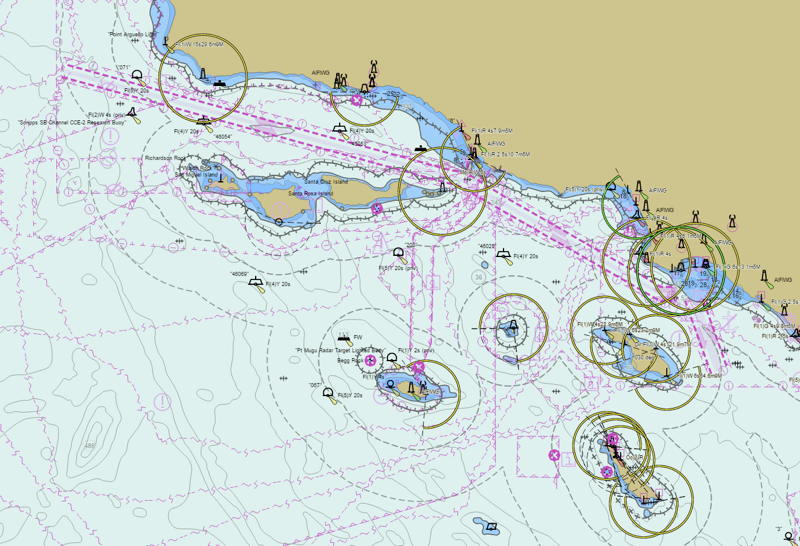
Tragedy first struck a sailor in Southern California when he lost his boat on the shores of Santa Rosa Island, and then again when his rescue flare set the island on fire. SFGate reported that when the sailboat hit the shoreline on Santa Rosa Island on Friday the captain set off a flare, which lit an unintended grassfire that has now spread to over 10,000 acres of the 50,000-acre island.
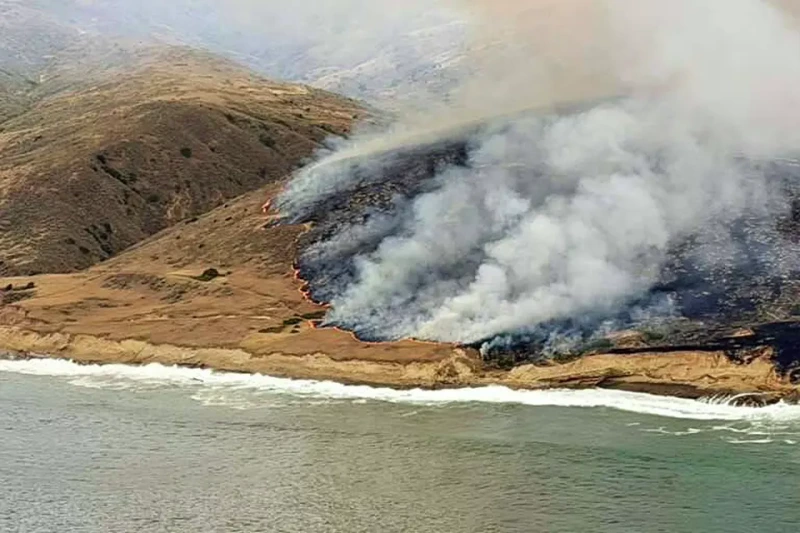
From what we’ve learned online, the 67-year-old sailor may have first had a fire on their 54-ft sailboat, which then went aground and sank along the shore. After seeing the smoke from the fire, the captain of a charter fishing boat saw the stranded sailor and called the Coast Guard, who sent a helicopter to pick up the sailor and take them to safety.
The boat went aground Thursday night, the fire was seen early Friday morning, and the sailor was rescued by about 10:30 in the morning.
There have been strong winds fanning the flames all weekend, so the 10,000-acre fire continues to expand with zero containment so far. The island is a national park that is popular with Southern California cruisers. (Mike Pyzel wrote a story in our August 2020 issue about the pleasures — and challenges — of cruising these islands.) The fire has already destroyed two historic sites, including Johnson’s Lee Equipment Shed on the western edge, and the Wreck Line Camp Cabin on the eastern edge.
It’s a tragedy for the sailor, the national park and CAL FIRE, which is struggling to bring the fire under control.
According to Fox News, 11 National Park Service employees were evacuated from the island. Around 70 firefighters have been working across the weekend to contain the fire, with more expected to arrive today, KTLA News reported.
The island is home to six native plant species found only on Santa Rosa and nowhere else in the world.
There’s more to be learned in the days ahead. Meanwhile we all hope the fire can be contained as soon as possible.
Sausalito City Council Blocks Sale of Pelican Harbor Marina
The Sausalito City Council has denied a request by Bridgeway Marina owner Cameron Razavi to lease tidelands* beneath the neighboring marina at Pelican Harbor. The council’s 4-0 vote, taken at a special council meeting last Thursday, May 14, means Razavi’s proposed $13.4 million purchase cannot go ahead.
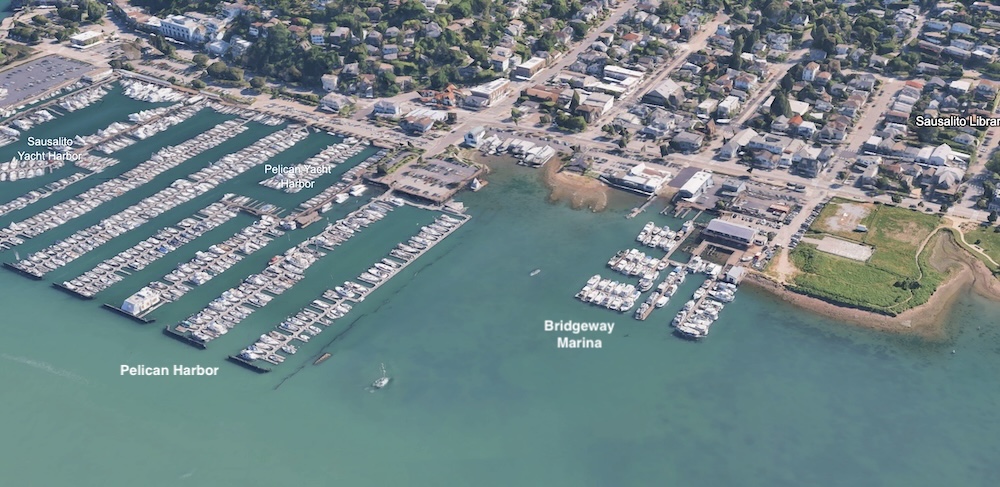
According to the Marin Independent Journal, when word got out that Pelican Harbor’s current owners had asked the city to transfer the tidelands lease to a new limited liability corporation owned by Razavi’s wife, Christina Suh, a number of Pelican’s residents approached the council to step in “until another buyer was found,” citing Razavi’s record as the proprietor of Bridgeway Marina as reason for disqualification.
Sausalito Assistant City Manager Brandon Phipps, City Attorney Sergio Rudin and city building inspectors released a report on Wednesday that included Razavi’s “qualifications and suitability.” The report contained a long list of documented “code enforcement issues” such as illegal construction, illegal floating docks, inadequate wastewater discharge procedures and several other items.
Ahead of Thursday’s meeting, the council had received 15 letters from people opposing the lease transfer; many people attended the meeting and spoke out in person against the proposal.
Sausalito sailor and friend of Latitude John “Woody” Skoriak says he spoke with Mayor Steven Woodside prior to the meeting and shared with him some of the harbor’s history. “I told him about all the famous (and ‘infamous’) boats that sailed through Pelican, like Lord Jim, Spike Africa and Lizard King, as well as all the beautiful wooden power and sail boats that were there year-round,” Woody tells us. “And some years later, Sterling Hayden’s son Dana lived there.” Woody also shared a little about who, how and when the marina was built and its philosophy of “wooden boats only.” (Here’s a little background on Pelican Harbor). “Hard to push something through Sausalito when the only one for the project is the petitioner and everyone else, and I mean everyone else, is against it,” he added.
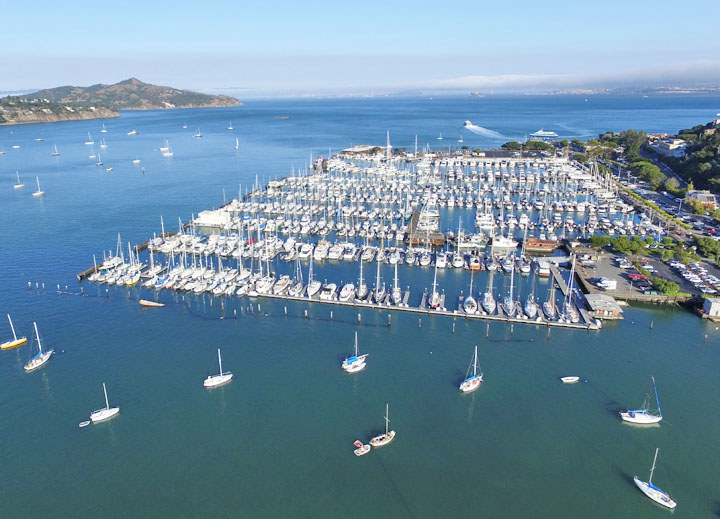
*Note: As we understand it, the marina or harbor operator must control the land-side portion of the property — the parking lot, shore access, utilities and related infrastructure. In Sausalito this is generally referred to as the “Tidelands Lease.”
Premier Vessel Care at Safe Harbor
ILCA Fleet Sails Richmond Yacht Club’s ‘Big Dinghy’ Regatta
April 25 and 26 brought out Richmond Yacht Club’s (RYC) Big Dinghy Regatta. No, it’s not a regatta for big dinghies. The name derives from RYC’s Bob Klein, beloved commodore and mentor to many junior and adult sailors. He was known as Big Daddy, and in the early spring the Big Daddy regatta is run in his name. Then, a couple of weeks later, RYC’s race committee volunteers do it all again for the non-ballasted (and minimally ballasted Wabbit and U20) crowds. We could call it the Little Daddy, but that name went to a high school regatta.
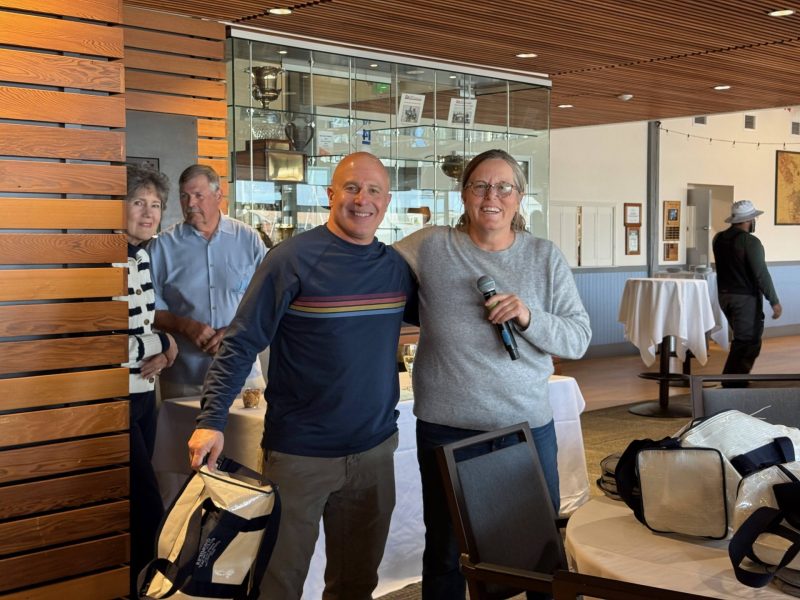
The ILCA 6 fleet on day one had some competitors missing. On Saturday we had four boats on the line, sailed by Chris Boome, Jon Andron, Ernie Galvan and Riley Shear. PRO Robin Van Vliet (herself a big deal in J/24s and very generous with her time running races for dinghy sailors) set us up between Brooks Island and Southampton Shoal. Saturday was overcast. Breeze was moderate and shifty. Chris and Jon made short work of the shifts, trading first and second place (except for race two, when gear failure sent Jon back to the cheap seats). We got our full four races on Saturday. Thank you, Robin.
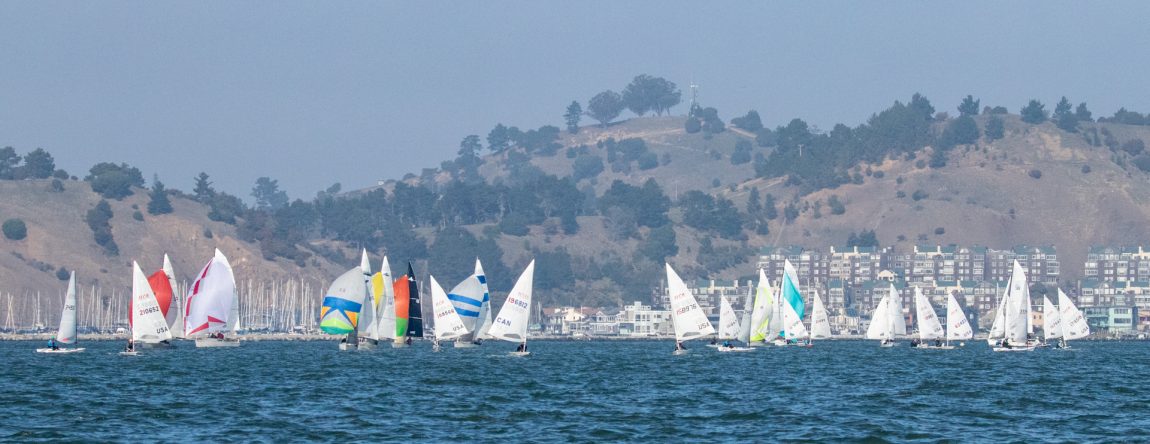
Day two, Sunday, was greeted by the warmth of partially sunny conditions, and the return of the prodigal David LaPier and Toshi Takayanagi. Now we were up to six boats for three races. Jon, David and Toshi came hot into Sunday’s race one, and their OCS scores allowed a one, two, three by Riley, Ernie and Chris. By Sunday’s race two, David and Toshi had dialed in their starts, and got the first and second positions, followed by Jon and Chris. By the last race, the wind was up quite a bit, and the two Laser sages retired for the day, leaving David, Riley, Toshi, and Ernie to finish out the regatta in that order.
Chris Boome and Jon Andron took home the ILCA 6 first- and second-place trophies, and then the fleet crashed the RYC new-members’ buffet.
Summer Cruising in the Med
We recently heard from Allison Stark Edwards, whom we first met while she and husband Nick were starting their cruising life aboard their Beneteau 393, Salt, berthed in Sausalito. Nick had already sailed to Cabo a couple of times with his father, Lee, a longtime cruising vet who’s been in Latitude several times over the decades. Nick and Allison started out on the 2017 Baja Ha-Ha with Nick’s father aboard as crew. Now, almost 10 years later, it was great to get a note catching us up on their cruising plans in the Med this summer.
Allison wrote, “I hope you are well, it’s been too long! Nick and I just bought a Hanse 548 in Turkey and are beginning our next cruising chapter in the Med with our 4.5- and 6.5-year-olds. Salt, our Beneteau 393, is still happily berthed in Sausalito where we will continue sail her whenever we visit the Bay Area. Our current plan is to skirt the coast of Turkey [near] Didim and head east toward Goçek. We’ll head to Greece in July.”
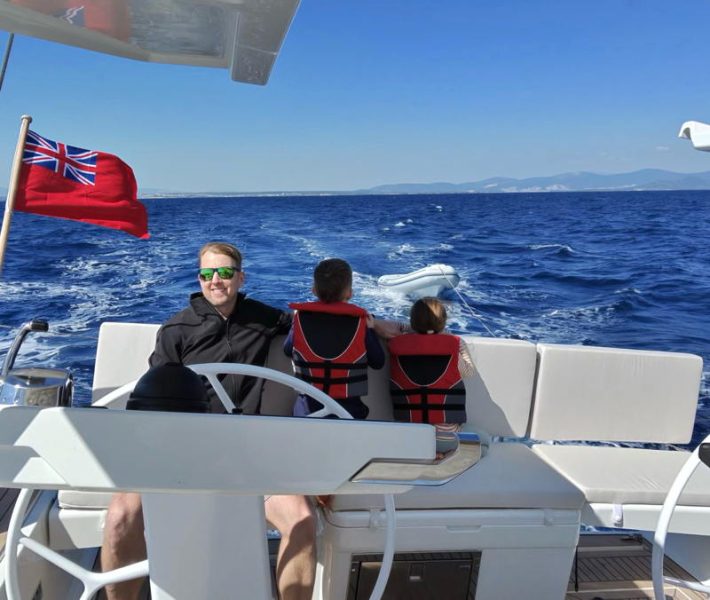
Allison was reconnecting to give us an update, offering to share more of their cruising life in Changes in Latitudes. She added, “My grandparents, Marvin and Ruth Stark, have been longtime contributors of Latitude 38 and are joining us in June. This is particularly special because Mara and Colin (the kids) are the fourth generation of cruisers in our family. Nick’s father, Lee, is currently sailing with us, which is great. He’s made a few cameos in Latitude 38 over the years, with one of his funnest appearances being a pic of him digging out Bernard Moitessier’s boat off the Cabo beach in the early ’80s.” (You can read about the surprise Cabo storm that put 22 sailboats, including Bernard Moitissier’s Joshua, and six powerboats on the beach on December 9,1982, here.)
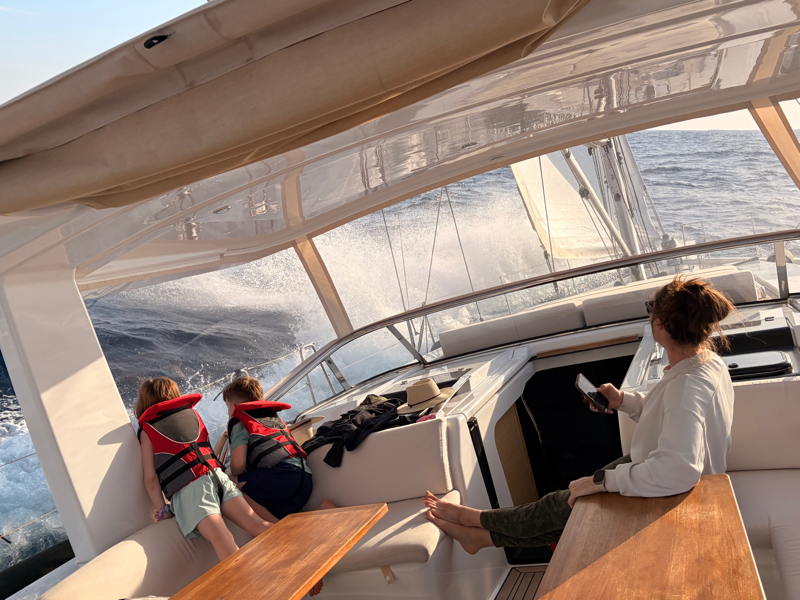
One other note on the cruising life: “Side note, by some random stroke of fate the first cruising couple we met were from Terra Linda and are members of SFYC. Such a small world! Anyway, meet Ethos!”
We attempt the impossible task of keeping up with “the world of sailing through the eyes of the West Coast sailor,” but given the incredible range of adventures, we only partially succeed with the help of great contributors like Allison and family.
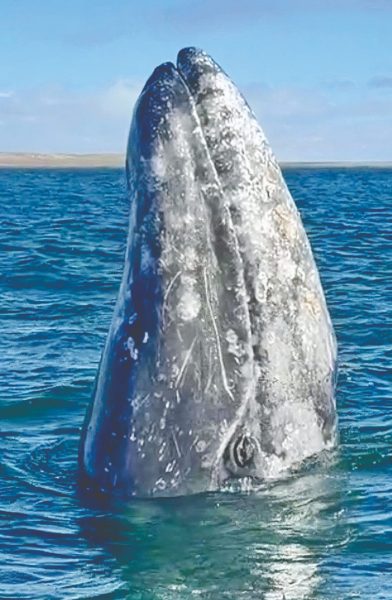
You’ll find many more of these adventures in this month’s Changes in Latitudes here. If you’d like to help West Coast sailors catch up with your sailing adventures, send photos and stories to [email protected].
Reeves and Shragge Closing the Around the Americas Loop
Two of the West Coast’s most seasoned passagemakers are nearing the completion of a hemispheric loop. After setting out on their multi-leg Around the Americas voyage nearly three years ago, the doublehanded duo of Randall Reeves and Harmon Shragge are back in the Pacific. The end of a 40,000-ish-mile lap is within sight. As of this writing, the tracker shows the venerable 45-ft aluminum sloop Moli docked in Puerto Montt, Chile — latitude 41 south — which lies at the foot of the Andes and the northern end of the Patagonian fjords.
Unlike Randall Reeves’ “Figure 8 Voyage 2.0,” a singlehanded endurance exhibition in 2018-19 that took him from the Bay, around the Southern Ocean, through the Northwest Passage and back, the Around the Americas has involved far more exploration of far-flung locales. With Moli’s crew increasing by 100%, two distinct characters have been documenting their travels.
Randall and Harmon departed San Francisco in August 2023, bound for Homer, Alaska. Moli wintered there before her crew rejoined and set out for an eastbound transit of the Northwest Passage in summer 2024. Latitude last spoke with the duo in October that year, after they had reached Halifax, put Moli on the hard, and returned to the Bay Area. Last year, Randall and Harmon headed across the Atlantic to the Azores and then Madeira, followed by the Cape Verde islands off West Africa. Though Harmon has sailed in legs of the Clipper Race and through the Arctic, he’d never crossed the equator, and went through the customary ritual, paying homage to King Neptune.
Randall Reeves, who has circumnavigated the globe twice since Latitude first met him in 2017, mused on the basic geometry of sailing in a July 2025 blog while in transit near the equator. “Sailing is a game of surfaces. Surface winds upon ocean surfaces and the resulting seas and currents at surface; surface winds powering sail surfaces; surface currents and seas dragging on hull surfaces. Always the boat moves between these surfaces, never at what anyone would call speed, but fast enough to give its hangers-on a sense of constant motion, of rising and falling even when way is minimal, of ghosting along, of slipping over a greasy sea, of surging forward, of charging onward with a bone in her teeth. And all this motion locked into a horizontal plane of surfaces slipping by surfaces.”
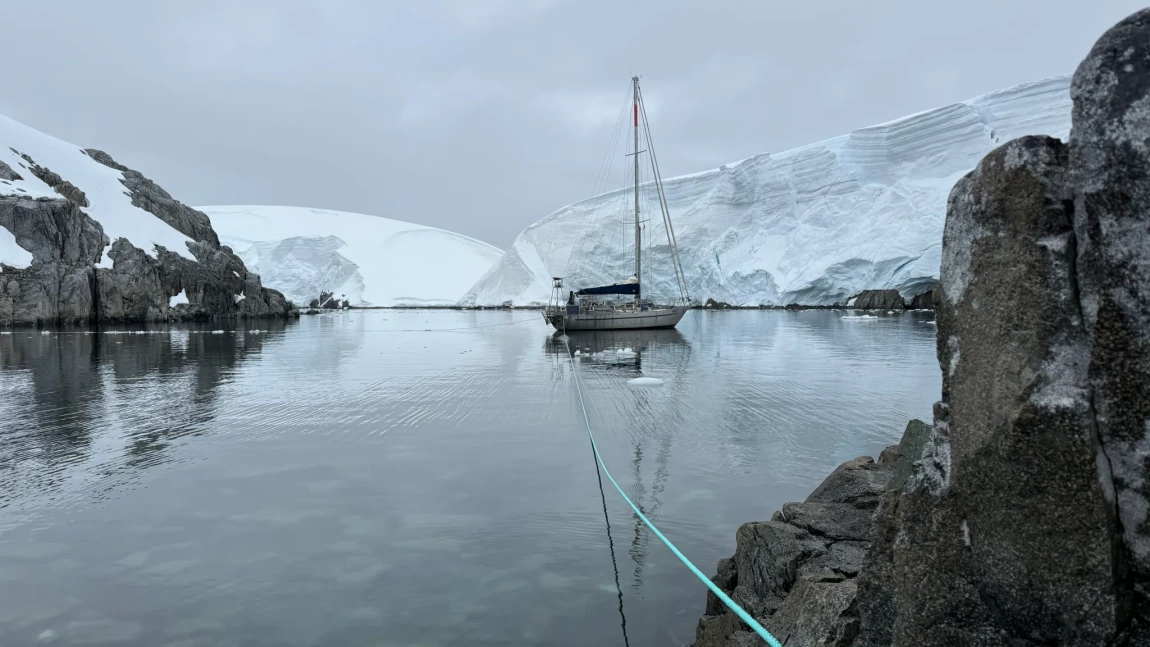
A particularly brutal trip through the doldrums caused Moli to divert to Fernando de Noronha, a volcanic archipelago off the northwest coast of Brazil. Moli sailed on to Rio de Janeiro and arrived in Piriápolis, Uruguay, in late November 2025. The duo quickly set out for the Falkland Islands and the high latitudes, then made their way past Cape Horn — it was Randall’s third time and Harmon’s first — across Drake Passage around New Year’s and into the Melchior Islands off the northwest coast of the Antarctic Peninsula. When we spoke with Harmon in 2024, he was ecstatic about what he’d seen in the Northwest Passage, which he described as “four trips:” the sailing aspect, the geographic, the cultural and the zoological. In a January blog post, Harmon wrote about Antarctica: “After anchoring, we ran shorelines, often one to four, to rocks to hold the boat against sudden 60-mph wind shifts. Randall fed out 100-meter lines while I took the dinghy ashore, fighting cold, wind and current to land, secure the line, and climb onto the rocks. In freezing water, falling in wasn’t an option.” Harmon added that keeping hands warm was necessary for line handling.
- Events
- Sponsored Post
- Maritime History
- Heading South
- Community Sailing
- Environmental News
- Safety
- Hurricanes
- General Sailing
- West Coast Sailing
- Racing
- Commentary
- Cruising
Like What You Read in Latitude? Help Us Share More!