

Reeves and Shragge Closing the Around the Americas Loop
Two of the West Coast’s most seasoned passagemakers are nearing the completion of a hemispheric loop. After setting out on their multi-leg Around the Americas voyage nearly three years ago, the doublehanded duo of Randall Reeves and Harmon Shragge are back in the Pacific. The end of a 40,000-ish-mile lap is within sight. As of this writing, the tracker shows the venerable 45-ft aluminum sloop Moli docked in Puerto Montt, Chile — latitude 41 south — which lies at the foot of the Andes and the northern end of the Patagonian fjords.
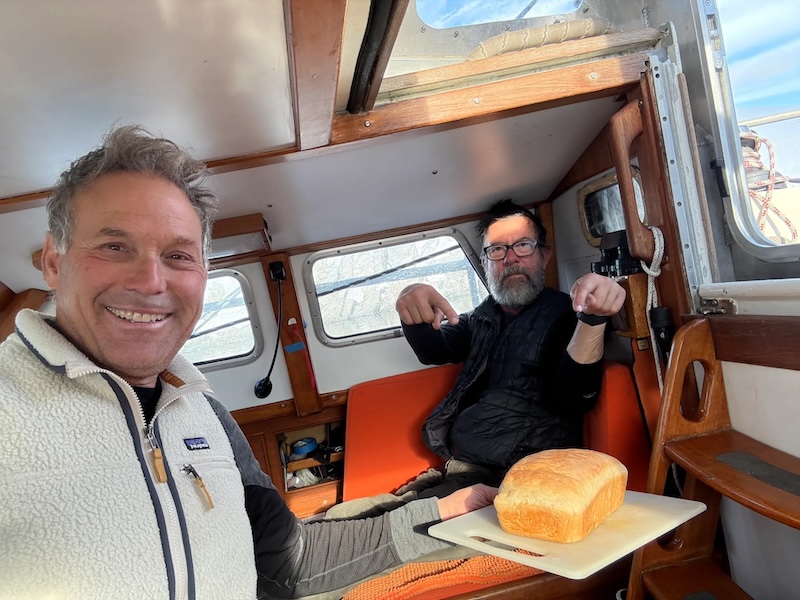
Unlike Randall Reeves’ “Figure 8 Voyage 2.0,” a singlehanded endurance exhibition in 2018-19 that took him from the Bay, around the Southern Ocean, through the Northwest Passage and back, the Around the Americas has involved far more exploration of far-flung locales. With Moli’s crew increasing by 100%, two distinct characters have been documenting their travels.
Randall and Harmon departed San Francisco in August 2023, bound for Homer, Alaska. Moli wintered there before her crew rejoined and set out for an eastbound transit of the Northwest Passage in summer 2024. Latitude last spoke with the duo in October that year, after they had reached Halifax, put Moli on the hard, and returned to the Bay Area. Last year, Randall and Harmon headed across the Atlantic to the Azores and then Madeira, followed by the Cape Verde islands off West Africa. Though Harmon has sailed in legs of the Clipper Race and through the Arctic, he’d never crossed the equator, and went through the customary ritual, paying homage to King Neptune.
Randall Reeves, who has circumnavigated the globe twice since Latitude first met him in 2017, mused on the basic geometry of sailing in a July 2025 blog while in transit near the equator. “Sailing is a game of surfaces. Surface winds upon ocean surfaces and the resulting seas and currents at surface; surface winds powering sail surfaces; surface currents and seas dragging on hull surfaces. Always the boat moves between these surfaces, never at what anyone would call speed, but fast enough to give its hangers-on a sense of constant motion, of rising and falling even when way is minimal, of ghosting along, of slipping over a greasy sea, of surging forward, of charging onward with a bone in her teeth. And all this motion locked into a horizontal plane of surfaces slipping by surfaces.”
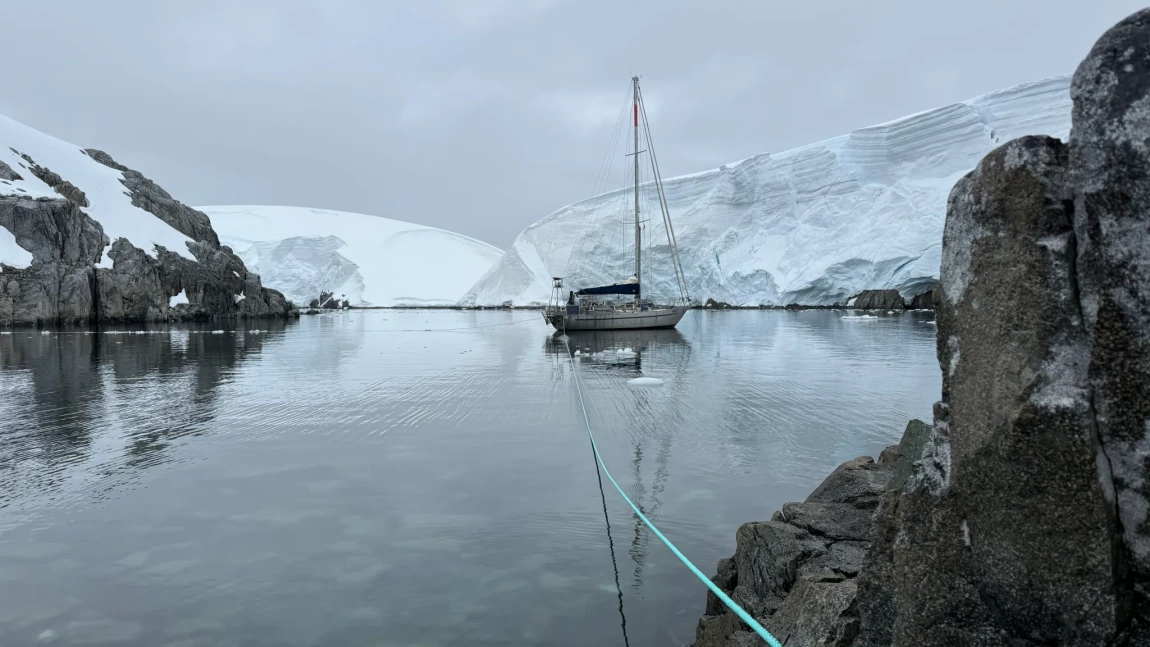
A particularly brutal trip through the doldrums caused Moli to divert to Fernando de Noronha, a volcanic archipelago off the northwest coast of Brazil. Moli sailed on to Rio de Janeiro and arrived in Piriápolis, Uruguay, in late November 2025. The duo quickly set out for the Falkland Islands and the high latitudes, then made their way past Cape Horn — it was Randall’s third time and Harmon’s first — across Drake Passage around New Year’s and into the Melchior Islands off the northwest coast of the Antarctic Peninsula. When we spoke with Harmon in 2024, he was ecstatic about what he’d seen in the Northwest Passage, which he described as “four trips:” the sailing aspect, the geographic, the cultural and the zoological. In a January blog post, Harmon wrote about Antarctica: “After anchoring, we ran shorelines, often one to four, to rocks to hold the boat against sudden 60-mph wind shifts. Randall fed out 100-meter lines while I took the dinghy ashore, fighting cold, wind and current to land, secure the line, and climb onto the rocks. In freezing water, falling in wasn’t an option.” Harmon added that keeping hands warm was necessary for line handling.
The posts by Harmon and Randall have been an armchair delight. In nearly all cases, I wished that I was there. Then reality set in, including age, physical condition, and the costs to participate. Then, I settled into my armchair again and had a delightful time following their adventures. Cheers to their sailing exploits. Bigger cheers for their reporting.