

The Weekend That Ate Spinnakers in Tahoe
The last weekend of June showcased two exciting sides of South Lake Tahoe racing. Around the Pins on Saturday, June 27, dished out three buoy races in heavy-air conditions that left a trail of broken gear and shredded spinnakers. By Sunday, June 28, the breeze had eased just enough for the Commodore’s Cup to become a tactical mid-distance chess match instead of a survival contest.
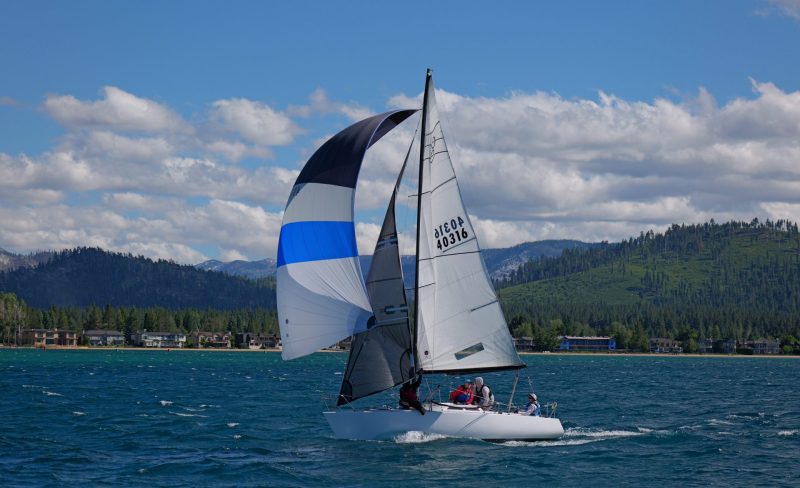
With winds building into the high teens and gusting well over 25 knots, several boats made the prudent decision to stay ashore. The day ultimately became an all-Express 27 affair, with five boats lining up for three windward-leeward races in spicy conditions.
The carnage began before the starting gun.
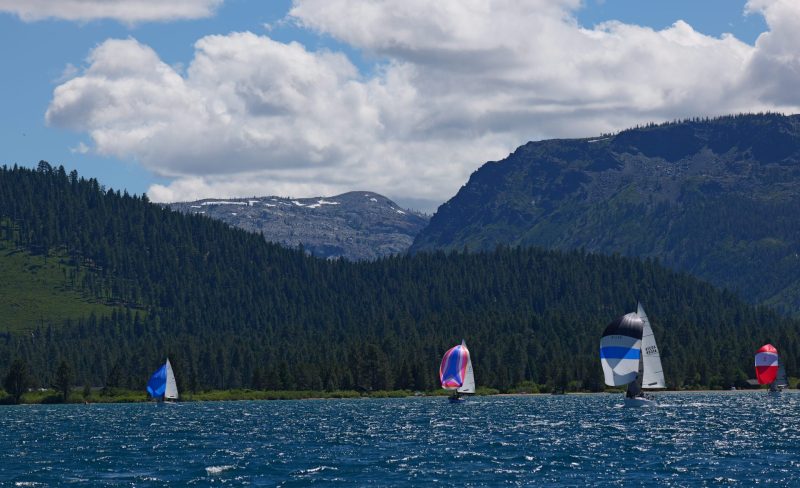
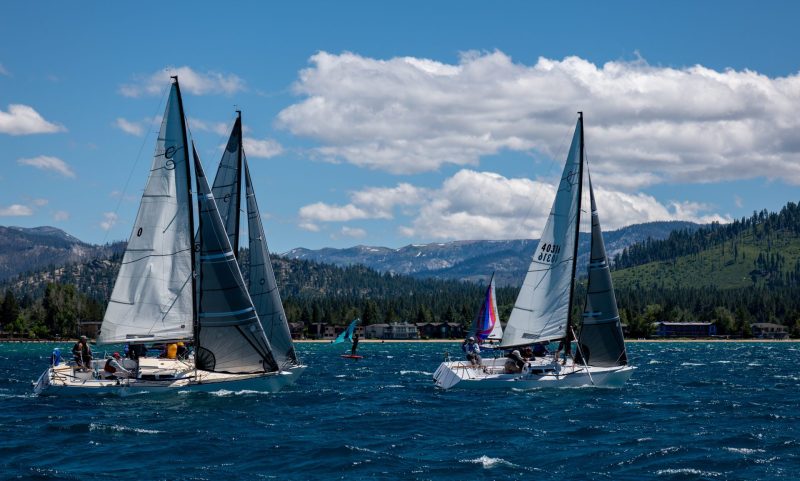
Wild Thing shredded its only spinnaker during a practice hoist, leaving four boats with kites for the opening race. Race two claimed another victim when New Wave rounded down in a shifty gust and snapped her spinnaker pole. Shortly after the second race, Dianne’s chute got to meet the rudder. By the final race, only Under the Radar and Expressway were still flying spinnakers; the rest of the fleet resorted to wing-on-wing tactics for the screaming downwind legs.
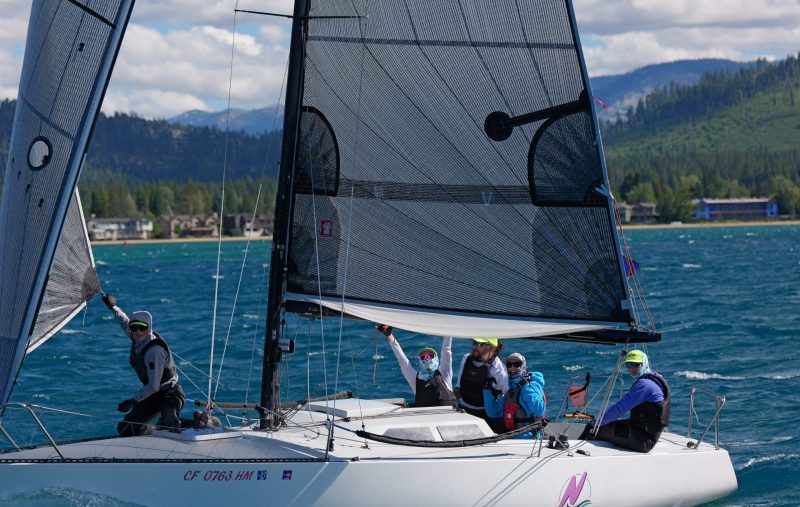
Despite the growing pile of broken gear, racing remained remarkably close. The final race came down to a tight finish, proving that even without spinnakers, the South Lake Tahoe fleet knows how to put on a show.
Greg Felton’s Under the Radar emerged victorious, posting three straight bullets with a crew sailing together for the first time.
“We had never before sailed together,” Felton said. “But I had faith in all the individuals and in the crew to meld.”
Rather than trying to match the fleet’s aggressive downwind tactics, Under the Radar adopted a strategy born from caution and observation. After discovering during a practice jibe that maneuvering in 25-plus knots with a new crew was asking for trouble, they developed a different plan. Instead of setting immediately after each weather mark, they jibed onto port first, giving themselves time to organize the foredeck before setting the spinnaker. They waited until they could comfortably lay the leeward mark on starboard without another jibe.
“More than anything else, this differentiated our approach from the fleet,” Felton explained.
The conservative tactic paid dividends. While other boats fought deep angles, broaches and gear failures, Under the Radar sailed stable broad reaches, executed clean leeward douses, and steadily climbed through the fleet. By the final race, their strategy looked even smarter, as only one other boat remained capable of flying a spinnaker.
Sunday’s Commodore’s Cup was a welcome change of pace. With a friendlier breeze and a larger PHRF fleet, competitors set off on a 10-mile course that proved to be more of a tactical puzzle than a test of survival.
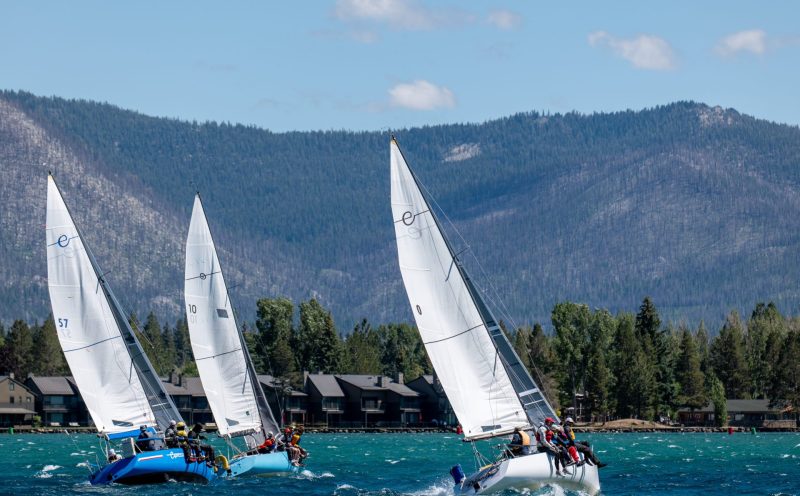
The forecast called for a light northwesterly that would gradually clock west throughout the afternoon, making it a classic “head out of the boat” day. The race committee’s course selection couldn’t have been better. On the opening beat, the fleet split between the east shoreline and the middle of the lake, each side offering its own advantages. Boats sailing left found steadier pressure but sailed extra distance, while those hugging the east shore enjoyed better VMG in shiftier air. The convergence of boats at the windward mark off Zephyr Cove made for a busy and exciting rounding.
“Our start wasn’t great, so we rolled the dice and went inshore,” said Ashley Farr on New Wave. “It was nerve-racking, but when we looked around, we were in good company with Ross Groelz’s Eagle and Steve Katzman’s Dianne.”
Spencer Griscom’s Melges 24 BOB won the race to the weather mark, set its asymmetrical spinnaker, and quickly stretched its lead downwind. New Wave rounded next, leading the inshore group.
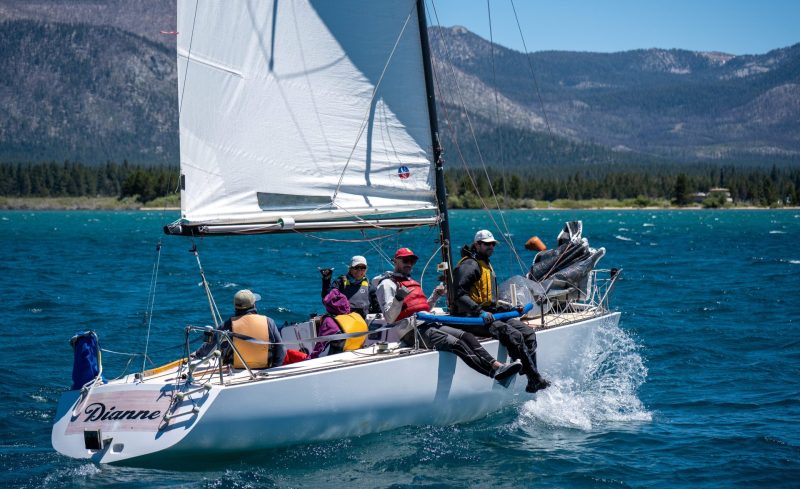
Midway through the downwind, the breeze started to shift again and the most westerly boats were picking up speed. “It looked like it was going to be a parade to the finish until we noticed that Under the Radar settled unexpectedly into a much higher lane than us,” Farr said. “Don’t sleep on the Tahoe westerly.”
In the end, BOB claimed line honors as the expected westerly eventually filled across the course, but the northwesterly held on long enough for New Wave to take the corrected-time victory.
Special thanks to our incredible PRO, Steve Sheldon, and our race committee volunteers, Breanna Di Pinto, Craig Forsberg and Leslie De Tarr. From managing challenging conditions during Around the Pins to setting an outstanding tactical course for the Commodore’s Cup, their efforts ensured two days of exceptional racing!
Good Jibes #253: Phil Mills on Restoring Old Boats, With Host John Arndt
In this week’s Good Jibes we chat with Phil Mills about the beauty of restoring old boats. Phil is a West Coast sailor who loves restoring classic wooden boats and is heavily involved in the Master Mariners.
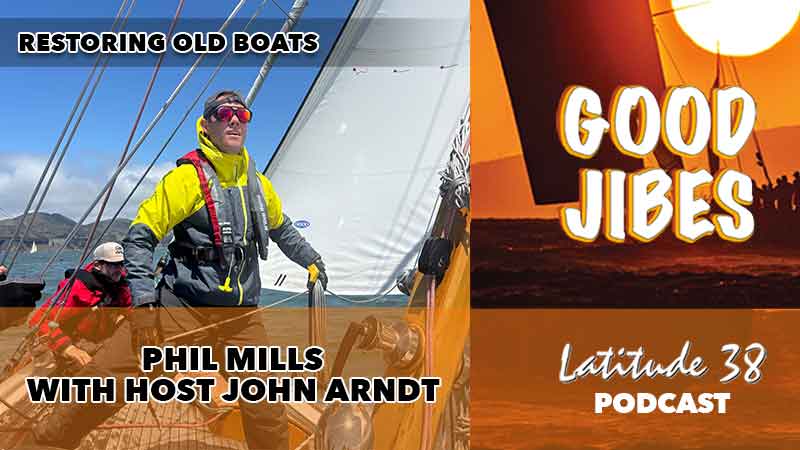
Hear why you should consider buying a cheap old boat, how working on boats brings people together, how to restore boats without spending a ton, how to get your kids to love sailing, and the value of the Crew List parties.
Here’s a small sample of what you will hear in this episode:
- How you can learn to sail without spending anything
- Why little boats make kids feel in charge and as if they’re at play
- How to actually restore a classic plastic boat with zero prior experience
- Why more people should sail the Bay (and how to get the most access)
- What a year-and-a-half of piecemeal cabin reconstruction actually looks like
Listen to the episode on Apple Podcasts, Spotify, and your other favorite podcast spots — follow and leave a 5-star review if you’re feeling the Good Jibes!
Learn more about Phil in ‘Lectronic Latitude — Phil Mills Sails His Arch Davis-Designed Dinghy Home, and Against the Grain: The Master Mariners Wooden Boat Show.
Check out the episode and show notes for much more detail.
Steering the Dream With Hydrovane
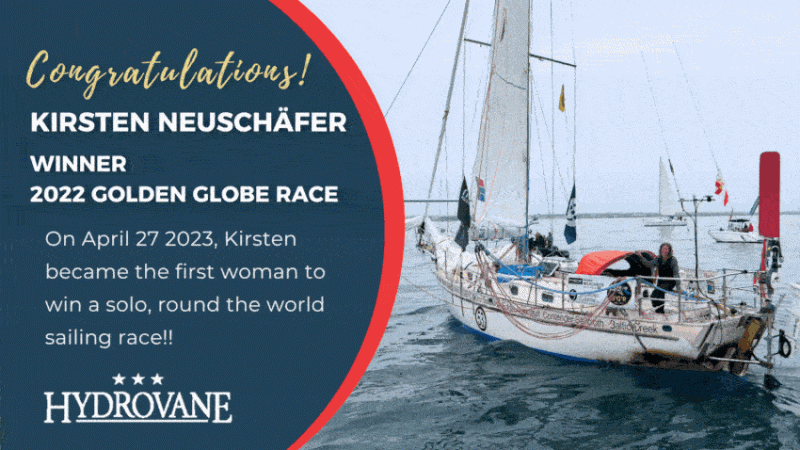
Hydrovane is your best crew member: an independent self-steering windvane and emergency rudder/steering system … ready to go!
Finally, Progress on Cleaning Up the Oakland Estuary
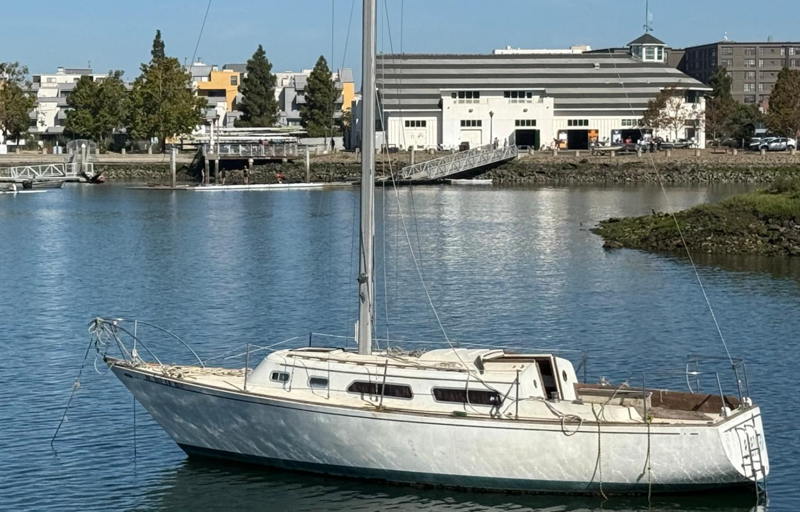
Last week we received news from Brock de Lappe that some of the long-awaited progress on cleaning up the Oakland Estuary had begun. In fact Brock said, “Offshore of the Jack London Aquatic Center is the cleanest this has been in years!” He went on to report that tagged vessels had moved out and some of the abandoned boats had been dragged up the ramp and destroyed.
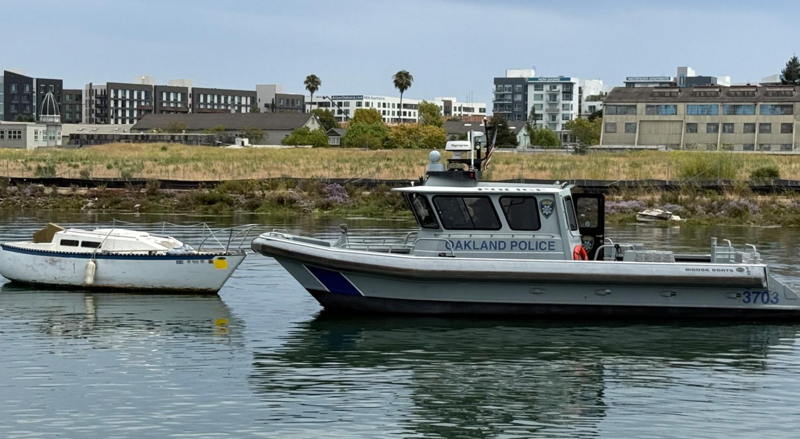
Brock reported that over a couple of days last week there had been significant developments on removing abandoned and derelict vessels (ADVs) from the Oakland Estuary. This resulted in there being only one illegal anchor-out offshore of the Jack London Aquatic Center, though 15 sunken and beached vessels still remained in that one cove.
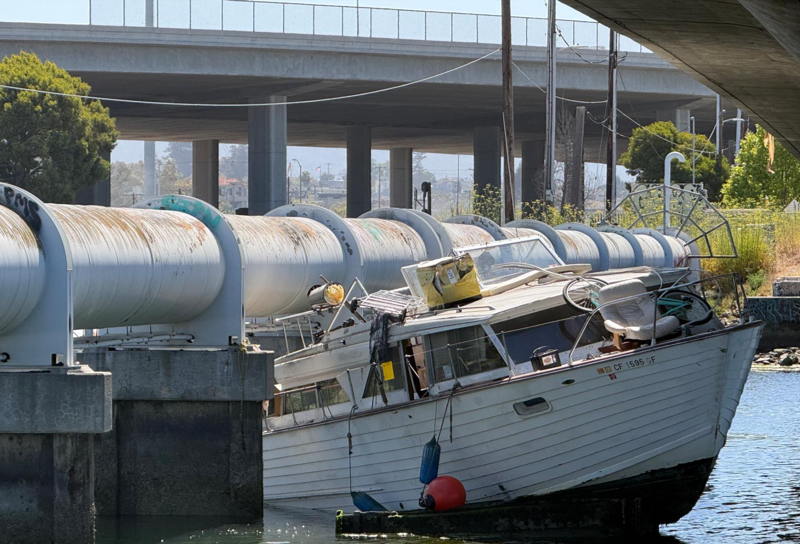
Brock stated, “EBMUD [East Bay Municipal Utility District] paid for the removal of two boats from under the Embarcadero Bridge over the channel to Lake Merritt. One of these was wedged under a pipeline that carries jet fuel to the Oakland Airport. One can only imagine the potential consequences if this damaged the pipeline when pressed up during a high tide.”
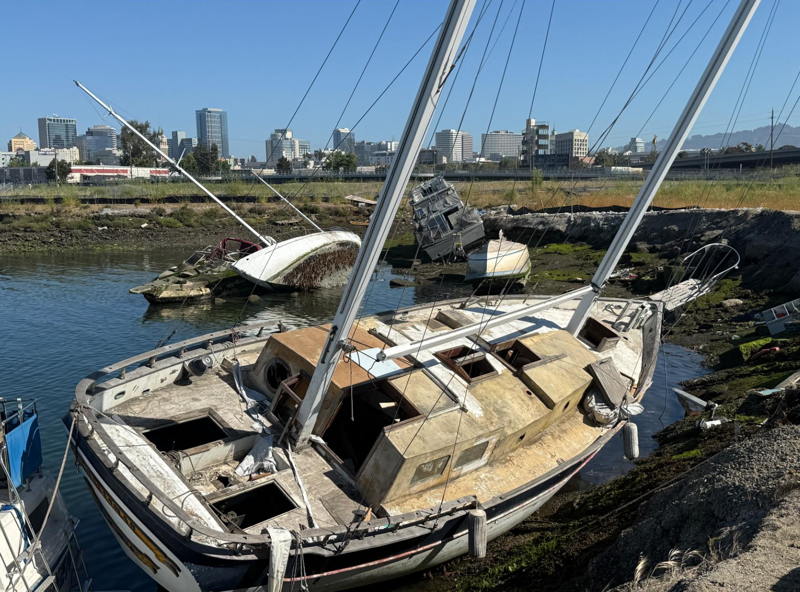
The City of Oakland has contracted Lind Marine to remove 16 sunken vessels later this month, the maximum allowed by permit from the State Water Resources Control Board. This will be a dent in the more than 40 sunken wrecks along the Oakland shoreline.
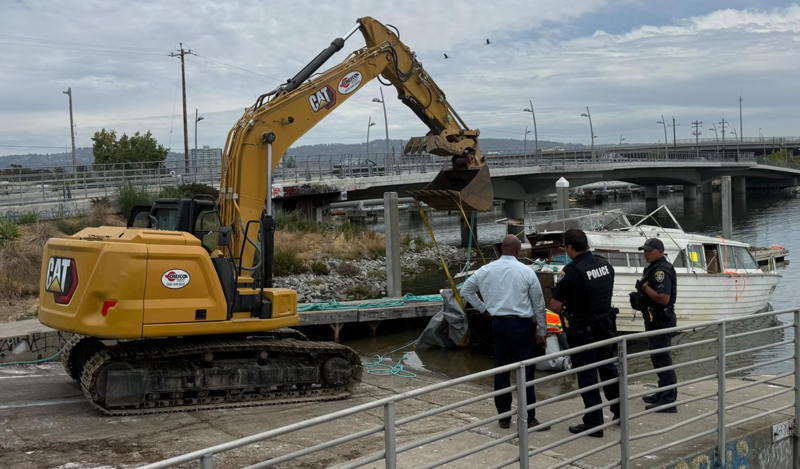
While the progress is welcomed, Brock continued with a report on the bureaucratic malaise that results in the ongoing failure to get the problem under control. He highlighted that it is now the State Water Resources Control Board that is handicapping the Estuary cleanup. In late 2023 the proposal was submitted to NOAA for funding to remove sunken boats from the Oakland Estuary. In October 2024 the City of Oakland and the nonprofit I Heart Oakland Alameda Estuary were among 13 locations in the United States sharing a grant of $3.16 million. Despite the grant, progress has been agonizingly slow.
Brock writes, “The removal of sunken vessels required the City of Oakland to obtain permits from the US Army Corps of Engineers, the Bay Conservation and Development Commission (BCDC) and the California State Water Board. Unbelievably, the State Water Board would only permit the removal of 16 sunken vessels even though there are currently more than 40 along the Oakland shoreline. The number of 16 was in the original 2023 proposal, though the number of abandoned boats has increased dramatically over time.
“Andrew Mason, the NOAA project manager for this grant, has stated that the number of 16 was a minimum floor for boats to be removed, not a cap as being treated by the Water Board. What are the consequences of using data three years old at this time? The City of Oakland has contracted with Lind Marine to bring their barge and crane to the Oakland Estuary to remove sunken boats. Simply deploying this equipment is a significant expense. It makes no sense to limit their ability to remove vessels while this equipment is on site. This is an example of irrational bureaucracy.”
The progress is a positive development for all who use the Estuary to row, sail, paddle or otherwise recreate on the waterway. The East Bay Rowing Club can now get kids on the water with reduced threats to health and safety. We hope to see the progress continue, though we would also love to see old boats saved by getting into the right hands, and to see stable housing found for those who need it. It’s taking far too long with far too many negative consequences, but we’ll applaud any progress toward a clean, enjoyable Oakland Estuary.
Brock also called to remind us that this enormously expensive, multi-year clean-up project could likely be entirely avoided if Oakland would simply fund their estuary police patrol unit to prevent this infestation from happening in the first place. As they say, ‘an ounce of prevention is better than a pound of cure.” In this case, it would save millions and millions of dollars, especially if you count the seemingly infinite staff hours of ineffective agencies, that are trying to solve a problem that would be moot with an effective marine patrol unit.
While Oakland remains a poster child for mismanagement of public waterways and shorelines, the issue of abandoned and derelict vessels is a national problem. For those who can help, the BoatUS Foundation maintains a national database to track abandoned vessels across US coastal waters and territories and the Great Lakes. As part of the program, BoatUS Foundation will also host the Turning the Tide Summit on December 6–9 in New Orleans, bringing together industry leaders, environmental stakeholders and waste-management experts to advance removal, recycling and prevention solutions.
To report an abandoned or derelict vessel in your area, submit a report here.
Andy Newell Recaps the 2026 YRA Westpoint Race
The Westpoint Marina, the first new marina in the Bay for quite some time, opened in 2008. In 2009 Sequoia Yacht Club (SeqYC) and Westpoint Marina started the Westpoint Regatta. At some point one of my regulars got a ride on another boat for the race. The next time we saw each other he told me how much fun the race was and that he thought it would be a good fit as part of the YRA “Party Circuit.”
I can’t take credit for pulling it all together, but I mentioned this to the folks at YRA, and in 2014 the Westpoint Regatta was added to the YRA party circuit, now known as the YRA Destination Regattas.
The first several years the race was run by Sequoia Yacht Club in Redwood City and Treasure Island Yacht Club, with the post-race festivities taking place at Sequoia YC. Now the race is a joint effort of Sequoia YC, the Club at Westpoint, the Treasure Island YC and the YRA.
In 2023 the party was moved to Westpoint Harbor, with the party taking place at the harbormaster’s office as the clubhouse was still under construction. In 2024, with the Club at Westpoint complete, the post-race party moved there.
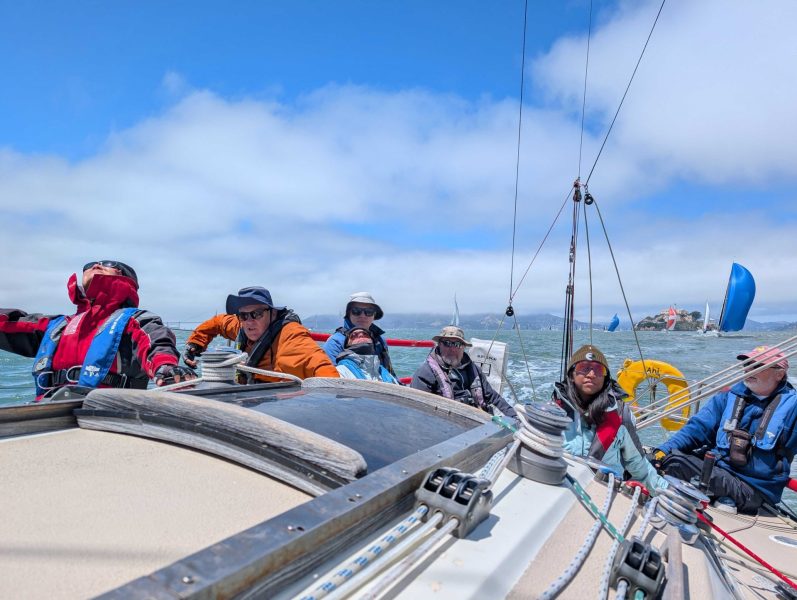
This year 29 boats made the trip from the start near Treasure Island, around Harding Rock and down to Westpoint. We had good wind north of the Bay Bridge, and the early flood was not too much of an issue. Once we were south of the bridge the current was adding a couple of knots to our progress. We were making a quick trip of it until there was a bit of a restart when the wind died near the airport. After a brief intermission the wind returned and the boats able to get to it first were rewarded. From there it was a very pleasant sail to the finish with winds in the mid-teens. The first boats finished just a bit before 1500 and the last were in a little after 1600.
Racers were greeted on the dock by Westpoint members making sure we all had a parking spot, and a bar and the party were down on the dock. By about 1730 the party moved to the clubhouse, where a band was playing and the libations were flowing. For those of us who stayed the night, coffee and bagels were available early in the morning so we could take advantage of the ebb for the ride home.
You can find the full scores here.
‘Light’n Up’s Epic Shakedown to Hawaii, Part 2
In the June issue of Latitude 38 we shared part one of Jonathan “Bird” Livingston and Gary Clifford’s shakedown of the newly built Express 27 Light’n Up in the 1984 Pacific Cup Race. We thought the tale couldn’t get any better, but it did. This month we share part two in the July issue.
After the call to Carl Schumacher in part one of this story, which ran in last month’s Latitude, things got even more insane. (Stuff that Chuck would not publish.) Here is a sample of the stupid shit we survived, and why I could not send it to Chuck: We were, by any reasonable land-based definition, completely out of our minds!
A thousand miles from land and any other meaningful obstacle, Gary Clifford and I were racing an invisible opponent called “the Squall Lord,” who, as far as I could tell, had both a cruel sense of humor and an advanced degree in personal humiliation. The scoreboard — yes, we had a scoreboard — was scrawled in grease pencil on the cockpit bulkhead. On one side: the Squall Lord. On the other hand: our noble, questionably managed vessel, Light’n Up. At that moment, we were ahead, which felt less like victory and more like a clerical error.
The wind had been building from 30+ to 40 in the squalls, the kind that starts as a suggestion and escalates into a ball-busting threat. Then the squalls began marching toward us — tall, bruised-looking things, like bad ideas you should have declined earlier in life. We named them as they approached, because nothing says “good decision-making” like anthropomorphizing weather systems in the middle of the Pacific.
We’d just finished tangling with one we’d christened “Double-Dicked Debbie,” named for reasons that made perfect sense at the time and none whatsoever in retrospect. Debbie had taken her swings; we’d come out ahead. Scoreboard didn’t lie. Then we saw the next one.
“Oh, shit, Cliff. Look at what is coming!” I said, as if I were seeing 1000 Trojan soldiers running at us. We cued up the war music on the cassette deck — the Ghostbusters theme, naturally — because if you’re going to be assaulted by weather, you might as well do it with a soundtrack. There’s something deeply reassuring about hearing “Who you gonna call?” while staring down a wall of black cloud that looks as if it eats smaller clouds for breakfast.
We named the badass squall “Panty Raider” and it did not disappoint. The Squall Lord sent its Jedi master to kick our arrogant asses and teach us who da Big Kahuna was. It hit harder than Debbie, as if she’d gone home, lifted weights, and come back with friends. The boat went over, laid flat, as in, “We appear to be sailing sideways now.” Is that normal? The kite was still up, flapping like a bedsheet in a hurricane, everything snapping and cracking in a way that suggested the boat had strong opinions about our leadership.
Then I noticed something subtle, but concerning: We were sliding sideways and the sea was close to the hatch opening. Gulp! This, it turns out, is what happens when your keel — the part of the boat specifically designed to prevent this exact situation — is no longer in the water doing its job. Instead, it was somewhere above us, minding its own business, while we performed what I can only describe as a nautical impression of a tipped-over shopping cart — and Cliff and I were in the parking lot upside down.
Hand-Crafted Custom Captain’s Hat!