

Baja Ha-Ha XXXII Sets Sail in Three Weeks!
Eighty boats have signed up for the 2026 Baja Ha-Ha, the 32nd fleet in a long line of successful annual cruisers’ rallies. The honor of being number 80, and the last boat to squeak in before the registration deadline, is Bar Hopper, a Nautitech 44 Open sailed by Mark Mocco and Heidi Olson, who list their homeport as Florida. Mark and Heidi join an illustrious fleet of Ha-Ha veterans and first-timers who will be heading south on November 2.
In the lead-up to this year’s Ha-Ha, assistant Poobah Patsy Verhoeven has sent out an update that includes some rather important information. So if you’re one of those people who tend to skim over emails, don’t get caught with your … sails down. Check out the following details and “TIPS.” (By the way, it’s not just Ha-Ha crews that can benefit from this information; some of it is useful to anyone sailing to Mexico.)
——————————–
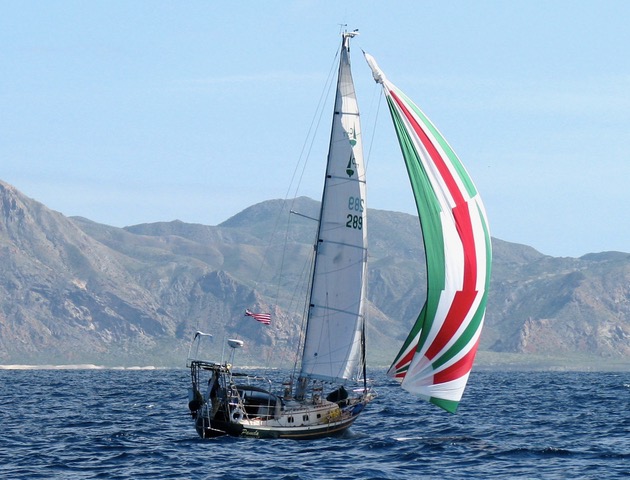
BAJA HA-HA DIVISIONS: The Poobah has created provisional divisions for Ha-Ha XXXII. Please check the attached PDF to see if you think you are in the right division. For example, did you sign up as a non-spinnaker boat and have since acquired a spinnaker, and therefore no longer belong in one of the “white sails” divisions? If so, we need to know about it. The same if your boat seems to be radically different from the other boats in your division. Not everybody will be thrilled with the division they are in, but we are doing the best we can with a very diverse fleet.
THE SPECIAL HA-HA ANCHORAGE AT GLORIETTA BAY OPENS IN ONE WEEK: This is a cool little place, more or less under the Coronado Bridge. For the exact location, go to the Ha-Ha website and click on the blue San Diego Slips and Anchorages bar. There is no need to sign up with the port to use this anchorage, but you must fly your burgee. There is a nearby short-term dinghy dock and a park for kids and dogs.
WAIVERS: Currently, 300 people are expected to participate. Alas, only 150 of you and your crew have signed waivers. Do this ASAP, please. It’s simple. Go to www.baja-haha.com. Then go to the blue box on the left that says Owner/Skipper Waiver or Crew Waiver. One week before the start, Patsy will email you with a list of waivers on file for your boat. That gives you time to track down any stragglers. This is ultra-important. If you show up at the Skipper’s Check-In and Meeting on the morning of November 1 and you or any of your crew haven’t signed waivers, you will not be an official entry — until you do. That means no swag bag full of goodies or free lunches for you. So please, it’s so easy to do.
DROPOUTS: The Rally Committee has heard from a few boats that will not be able to make this year’s start. If you will not be starting with the fleet on November 2, please email [email protected] as soon as possible, as it affects our preparations for this event. If you can’t make the start, you can pick up your swag bag and tickets at the Costume Kick-Off Party on November 1, and enjoy a Last Cheeseburger while meeting this year’s group.
STARLINK OCEAN MODE DATA: PredictWind came up with a switch for its DataHub that blocks selected apps, streaming, backups and updates from using Starlink data while keeping forecasts and critical apps online. One switch covers all devices on the boat. Pretty important with the new $6-per-gig Ocean Mode pricing! https://www.predictwind.com/datahub/family
SLIPS IN SAN DIEGO: Or how about a mooring? The San Diego Mooring Company has a few of their coveted inexpensive moorings available. Contact them at (619) 291-0916 or [email protected]. We have also heard there are a few slips available at the Kona Kai Marina, (619) 224-7547 or [email protected]. The transient rate for boats under 45-ft is $200/day. The rate for boats over 45-ft is $5/foot per day.
SIGN UP FOR PREDICTWIND FLEET TRACKING: If you go to the Ha-Ha website and click on the PredictWind Fleet Tracking Map, you can see the current location of 14 of this year’s entries. It’s free, so email [email protected] to get set up. No doubt there will be more each day.
BASEBALL: Here’s an idea: Stop by a resale sporting goods store and buy a mitt. Play in the famous Turtle Bay Kids & Cruisers Bazeball Game, then toss the mitt into the pile of donated gear when you’re done. The kids love everything from socks and helmets to mitts, catcher’s gear, bats and balls. This year, we’re adding soccer gear, too, to go with their new soccer field!
GET YOUR TEMPORARY IMPORT PERMIT (TIP): Everyone seems to be having problems with the new TIP system — including some pretty high-tech software-developer types! It appears the system was rolled out before all the bugs were worked out. If you simply cannot get the TIP website to work, you have four options:
1) Get your TIP at a Mexican consulate. Quite a few people have successfully gotten their TIP in person at a Banjercito located inside a Mexican consulate, often without making an appointment. You just pay the regular TIP fee — there’s no additional charge — and it reportedly takes only a few minutes. However, not every consulate has a Banjercito. The consulates offering this service are in Los Angeles, San Bernardino, Sacramento, Phoenix, Albuquerque, Dallas, Houston, Austin, Denver and Chicago.
2) Get a TIP across the border in San Diego. When you get to San Diego, you can go to Otay Mesa — just outside San Diego, not Tijuana — and get your TIP at the Banjercito just across the border there.
3) Hire someone to do it for you. This is, unfortunately, ridiculously expensive. There are several agents offering the service, including two bilingual agents who can issue TIPs remotely: Michelle Aguilar, BC Connection: +1 (619) 305-9385 and Yolanda Espinoza, Eco Naviera: +52 (612) 348-8787.
4) Start the Ha-Ha from Ensenada. Get a slip in Ensenada and the Marina will help you check into the country and help you get your TIP for free.
Hopefully the website will be sorted out soon, but it is unlikely to be in time for the Ha-Ha fleet. And don’t think you can sail into Mexico without a TIP. These aren’t the old days.
CHECKING INTO MEXICO: If you have decided to check into Mexico at Bahia Santa Maria it’s important that you connect with Mag Bay Outfitters as soon as possible so they can open a file for your boat. In addition, send them as many of the required documents as you can, as soon as you can, to avoid a last-minute paperwork logjam.
Don’t wait — there’s a $50 penalty if at least some forms and payment aren’t in by October 17.
Please be courteous, as the Mag Bay folks are sport fishermen and not paperwork people. And if it weren’t for them, there would be no Ha-Ha.
And please remember to support our sponsors!
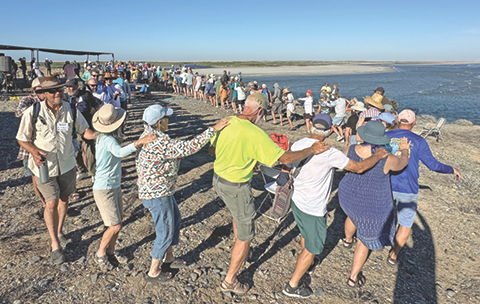
California Flare Disposal Event on October 24 and 25
Do you like having the option to drop off your expired marine flares for someone else to deal with? We do. That’s why we encourage you to support the upcoming Flare Collection event with locations around the Bay. As the California State Parks and California Coastal Commission say, “Boaters’ participation is essential to the success of these important and unique expired marine flare collection events.”

Below is the official notice from California State Parks and the California Coastal Commission, with a list of dates and locations where mariners can drop their flares this month:
Alameda County, West Contra Costa County, Marin County, San Mateo County, Santa Cruz County, the Port of San Diego [San Diego County], Orange County and Ventura County have partnered with CalRecycle, the California Product Stewardship Council, California State Parks and Coastal Commission’s California Boating Clean and Green Program to collect expired marine flares and educate residents about marine flare management safety, including the advantages of reusable distress signals, to protect California communities and the local environment.
Residents and boaters berthing their boats in these counties can take their expired marine flares to their county’s designated marine flare collection events. Only expired marine flares from residents and boaters berthing their boats in the covered areas will be accepted. No marine flares from commercial craft or an organization nor other forms of household hazardous waste (HHW) will be accepted during the special events. Proof of residence or eligibility is required (i.e., license, registration or slip fee).
Please check additional detailed information and requirements for each event below:
Northern California:
Alameda County
Sunday, October 25, 2026 9 a.m. to 1 p.m.
By appointment ONLY. Sign-up for an appointment: www.stopwaste.org/marineflares
Marin County
Sunday, October 25, 2026, from 8 a.m. to 12 p.m.
Clipper Yacht Harbor, 310 Harbor Dr., Sausalito, CA 94965
San Mateo County
Sunday, October 25, 2026, from 10 a.m. to 2 p.m.
Pillar Point Harbor, 1 Johnson Pier, Half Moon Bay, CA
By appointment ONLY: Call (650) 372-6200 (M–F); or visit smchealth.org/hhw
This event is open ONLY to San Mateo County residents, boaters who berth in the County, and County commercial boaters who generate less than 100 kg of hazardous waste/month. To participate, you must provide proof of residency, boat berth or business address in San Mateo County.
Santa Cruz County
Sunday, October 25, 2026, from 11 a.m. to 3 p.m.
Santa Cruz Harbor Maintenance Yard, 425 Brommer St,. Santa Cruz, CA
West Contra Costa County
Oct 14–Oct. 24, 2026, Wed–Sat 9 a.m. to 4 p.m.
101 Pittsburg Avenue, Richmond, CA 94801.
This event is only for West Contra Costa residents or boaters in the following cities: El Cerrito, Hercules, Pinole, Richmond and San Pablo, and unincorporated Contra Costa County (i.e., El Sobrante, North Richmond, Tara Hills, Rollingwood, East Richmond Heights, Bayview, Montalvin Manor). Must prove WCC residency to participate.
Southern California:
Orange County
Saturday, October 24, 2026, from 7 a.m. to 1 p.m.
Sunset Aquatic Marina, 2901 Edinger Ave., Huntington Beach, CA 92649
Port of San Diego
Saturday, October 24, 2026, from 8 a.m. to 12 p.m.
Shelter Island Boat Ramp, 2210 Shelter Island Dr., San Diego, CA 92106
Ventura County
Saturday, October 24, 2026, from 11 a.m. to 3 p.m.
Channel Islands Harbor Marina, 3850 Harbor Blvd., Oxnard, CA 93035
The United States Coast Guard (USCG) requires boaters to carry several unexpired visual distress signals on board, day and night. Pyrotechnic marine flares are a common type of distress signal, but they are explosive and contain toxic chemicals and must be managed as hazardous waste when expired or no longer needed. To assure safety and protect the environment, it is essential to manage single-use pyrotechnic marine flares carefully. Boaters should never throw expired or unneeded flares overboard or in the trash.
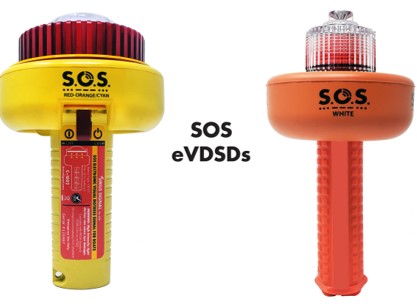
Single-use pyrotechnic marine flares expire and must be replaced every 36 to 42 months after their manufacture date, and recreational vessels generate about 174,000 pyrotechnic expired marine flares every year, according to the California Expired Marine Flare Working Group estimate in 2011. However, California boaters do not currently have access to an ongoing statewide disposal program for expired marine flares. To avoid the difficulties of safe disposal for pyrotechnic marine flares, the partners encourage boaters to consider an electronic visual distress signal device (eVDSD) as a reusable, safe and cost-effective alternative to buying the single-use pyrotechnic marine flares.
For more information about expired marine flares visit, dbw.parks.ca.gov/marineflares and to learn more check our podcast about this topic.
Hear from Marie Rogers, California Recreational Boater Certified Sailing Instructor, competitor in major regattas like the Transpac about these collection events
Quality Yachts With Premium Service From Swiftsure Yachts

Swiftsure Yachts offers exceptional service, quality brokerage boats and new yachts for world cruising. Visit our website swiftsureyachts.com.
Trudy Follows Simon and Rachel — A West Coast Hurricanes Update
While Hurricane Simon has unloaded a drenching upon Mexico’s west coast, another system has now strengthened and is making its way toward shore. Hurricane Trudy is the latest in a run of late-in-the-season hurricanes giving our southern neighbors a rough few weeks.
To date, Hurricane Simon, which did not actually make landfall, is said to have weakened to a remnant low, but not before causing Mexico boaters some degree of distress earlier this week. John Schulthess of Wind Toys sent us an update from his location on Barra Navidad.
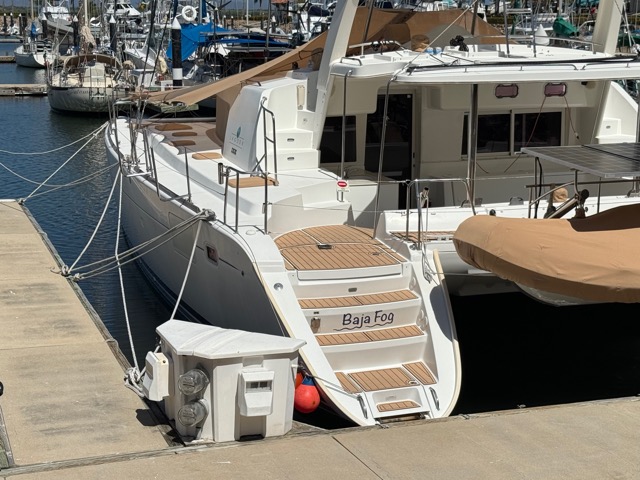
“All reports from our marina and town are all good. Baja Fog had 24 kts in her slip, no surge or waves; the swells from the entrance channel go right by the marina entrance and head to the massive lagoon, where nobody was anchored as far as I know. Anyone out there would come into the hurricane-hole marina. Now let’s talk high water!
“Most restaurants on the lagoon and the back side of town that backs to the lagoon had a foot of water on their decks; just flooding again, no waves washing stuff away, I figure 4–5 feet of tide. The nearby towns can’t handle the 6+ inches of rain coming down from the hills. We see the rivers washing down their streets every rainy season, but we always wondered why the sidewalks were two feet higher than the streets — standard summer mode?
“We had about 4 feet of piling left before we got docks floating away. Monique and I worked pretty hard last season rebedding deck hardware, and it paid off! Our local and favorite boat-maintenance guy Pancho reports totally dry bilges. All canvas and hatch covers are still in place.”
“Our friend Fito Espinoza, dock master at Marina Coral, Ensenda, reports that the boats all came through unscathed after enduring the wrath of Tropical Storm Rachel added to Simon’s force.
“Fortunately we don’t have any damage in our marina. The winds were tolerable so our dock and boats handled [them] well.
“In the city we did see extensive flooding in the streets, and unfortunately, loss of life and people missing that were swept into the arroyo south of Ensenada.”
According to recent news reports, six people have died as a result of the storms that caused major flooding and landslides along Mexico’s Pacific coast.
But it’s not over yet. Another storm system, this one, named Hurricane Trudy, is making its way toward the Mexico coastline.
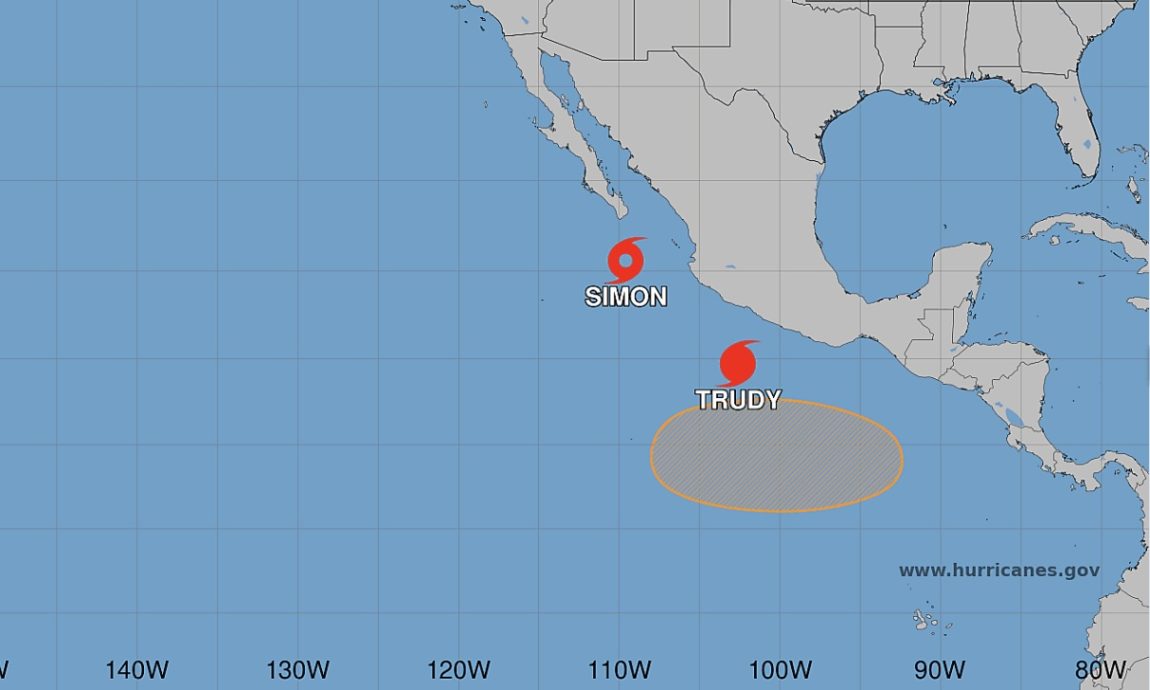
As of this morning, NOAA reported that satellite wind data shows Trudy is weaker than previously indicated, with a hurricane-hunter crew launching to investigate. Whatever the outcome, it appears Mexico is in for another very wet weekend at the least.
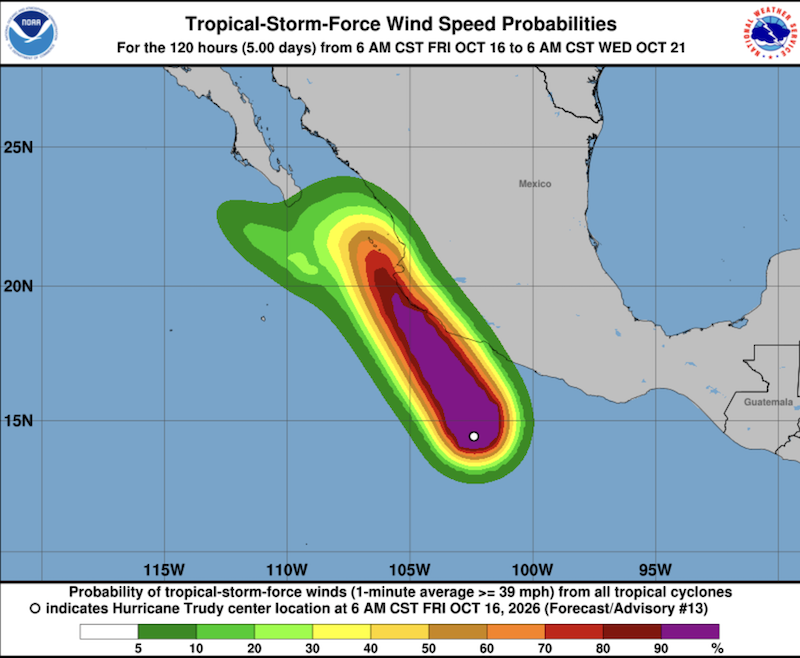
NOAA has issued warnings for the following regions:
A Hurricane Warning for the coast of Mexico from Manzanillo northward to Playa Perula; the coast of Mexico north of Playa Perula to Cabo Corrientes, and the coast of Mexico from Manzanillo southward to Punta San Telmo.
A Tropical Storm Warning is in effect for the coast of Mexico from Manzanillo southward to Zihuatanejo, and the coast of Mexico north of Cabo Corrientes to San Blas.
Stay safe out there!
The Disconnection of Connected Cruisers
For some time now, cell coverage has kept coastal navigators connected with phone and internet, right up until the signal runs out a few miles offshore. But until relatively recently, offshore sailing remained a disconnected affair. That came with real risks, gladly accepted by those who sailed far not only for adventure, but for refuge in that sanctuary where crew and boat worked with skill and presence toward new and distant shores. In our third year of cruising the Pacific, we’ve come to wonder what satellite internet is doing to that sanctuary — to the cruising community, and to the people we visit in some of the most isolated corners of our world.
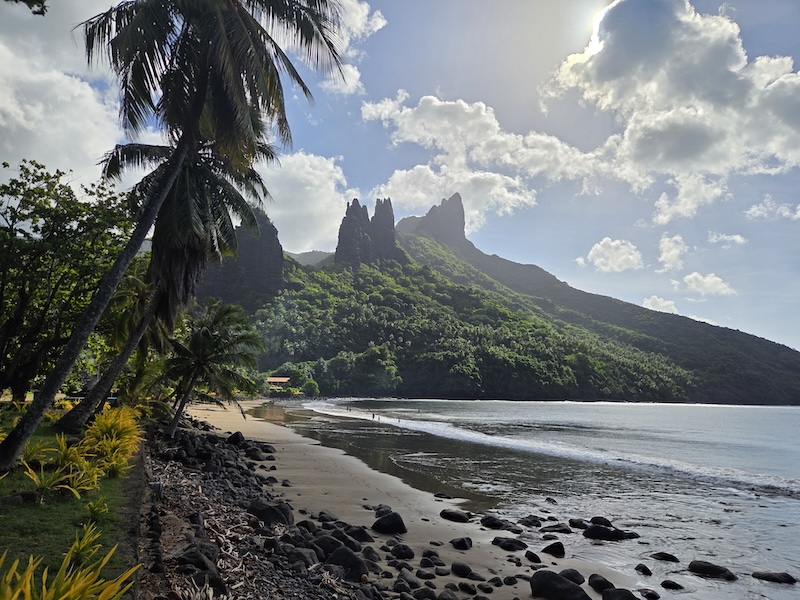
The idea that new technology comes with unpredictable side effects is nothing new. Our boat used to be a floating island, a place to step away from it all and reconnect with our own values: the farther from shore, the better. In recent years, satellite internet, with Starlink as the sole provider in this arena, has built a bridge for the noise of everyday life to reach us wherever we go. It’s also given many people the confidence to turn cruising dreams into reality: Couples mid-career are heading out with kids and pets in tow, and young couples with little sailing experience, filled with curiosity and hope, are spending their savings and youthful energy fixing up old boats and pointing them at the horizon.
Some of that confidence comes from how much easier the mechanics of sailing have become. GPS solved the 500-year-old question of “Where exactly am I?” No more solving the riddles of celestial navigation, a fine and worthwhile art in its own right, but one with a steep learning curve. SSB, SailMail, satellite phones and EPIRBs used to be the price of entry for offshore weather and communication, and their foreign-sounding names kept plenty of would-be sailors at arm’s length. Dedication to the skill of sailing offshore, and a robust inner call to adventure, were must-haves.
Internet on board was really the last piece of technology in this incremental process, the final hurdle holding many people back from taking the leap.
Find Relief With Division of Boating and Waterway’s Pumpout Nav App

You know what really floats our boat? Clean California waterways. Next time your vessel’s septic tank is running on full, find your nearest pumpout station with the Pumpout Nav app. Download it for free today. http://www.boatcalifornia.com/