

Big Sail 2025: Bands, Mascots, Alumni, and Team Racing
On Wednesday, Nov. 19, generations of sailors and fans descended on St. Francis Yacht Club (StFYC) for the 21st edition of the Big Sail between Cal and Stanford. With the infamous “Big Game” between the two set for Saturday, the rivalry between the two institutions is in the air of the Bay Area this week, and that made its way to the water on Wednesday.
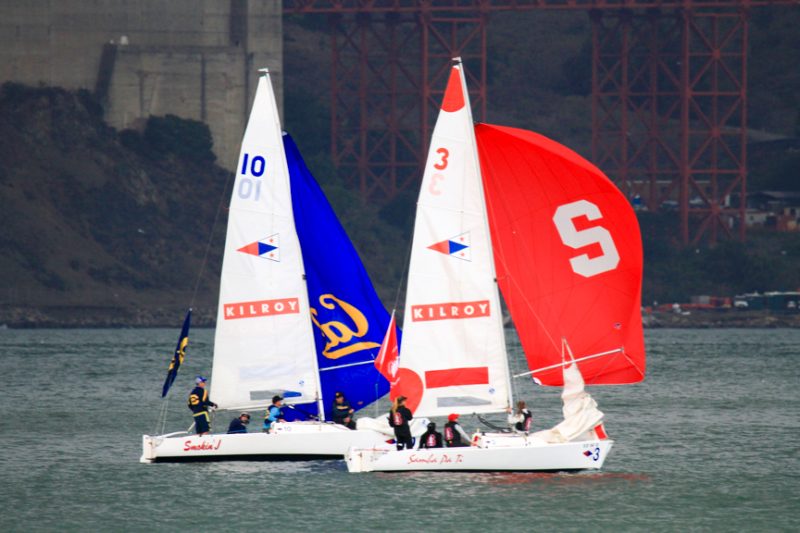
The spectacle of Big Sail is unlike any other college regatta. It’s not an official ICSA regatta, but bragging rights are on the line. StFYC was adorned with both the blue and gold of Cal and the white and red of Stanford. Alumni and students alike crowded the clubhouse to see the racing, and the bands and mascots from both schools made appearances, performing in the clubhouse and on the racing deck in a musical face-off.
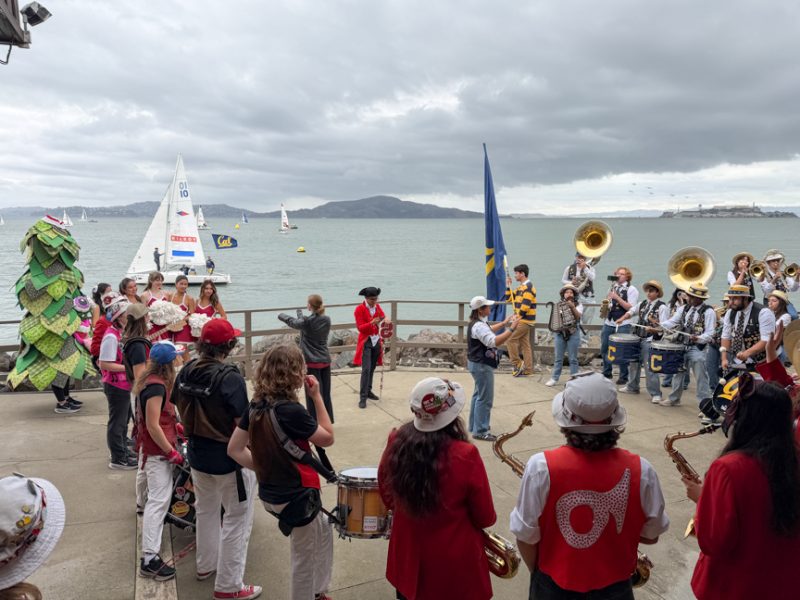
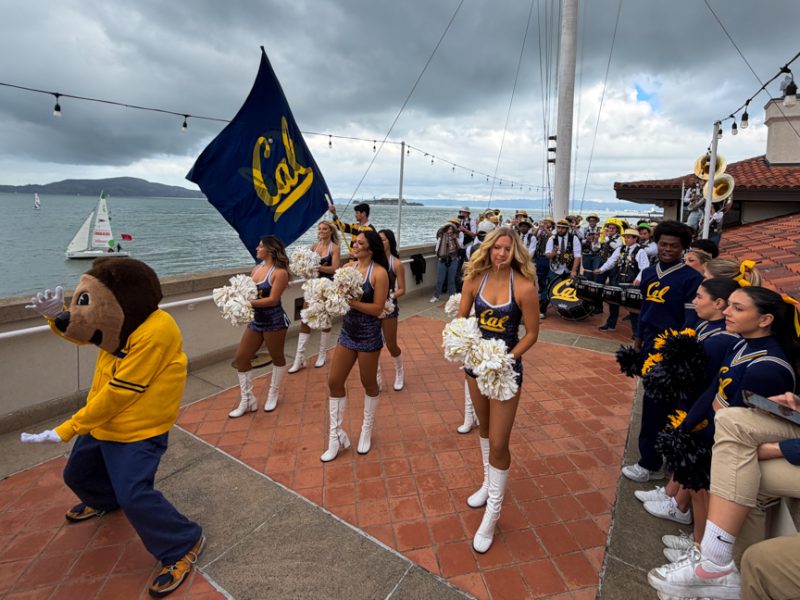
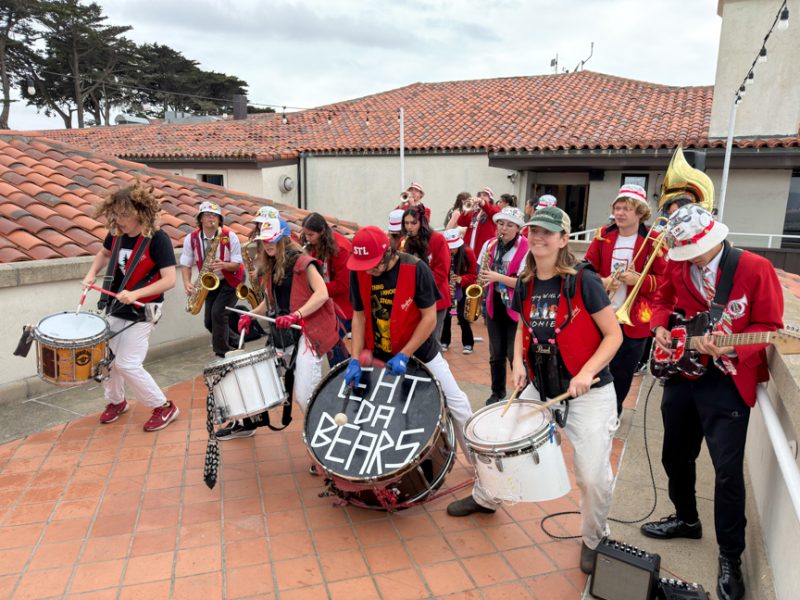
The regatta isn’t only between the two schools’ current varsity teams. Each school fields five boats: a varsity boat, a women’s boat (which can include both women from the current team and alumni), a young-alumni boat, a master’s alumni boat, and a grandmaster’s alumni boat.
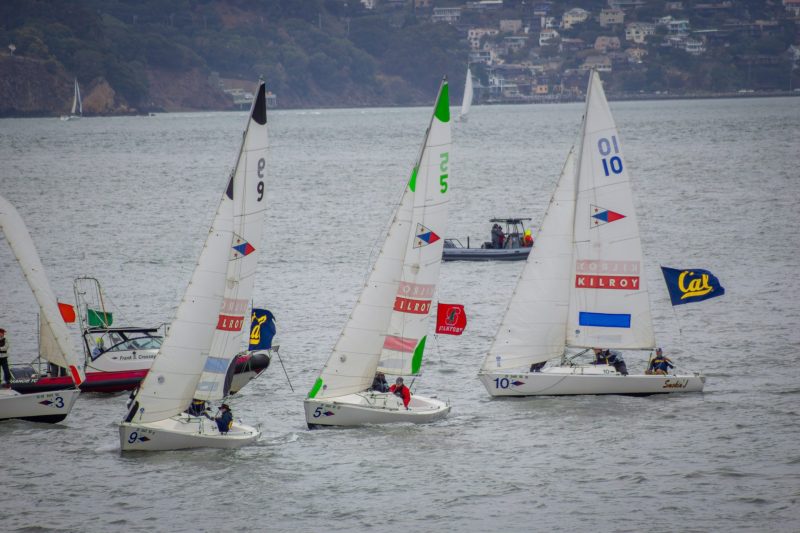
In the past, the regatta had been a match-racing event, but this year the format shifted to two-on-two team racing (a format in which the last boat to finish loses) on a box course. Another unique twist to the format was that in each race a different pairing of boats made up the two competitors. For example, the first race of the event featured the young alumni and varsity boats from each school racing against each other. The pairings changed with each successive race.
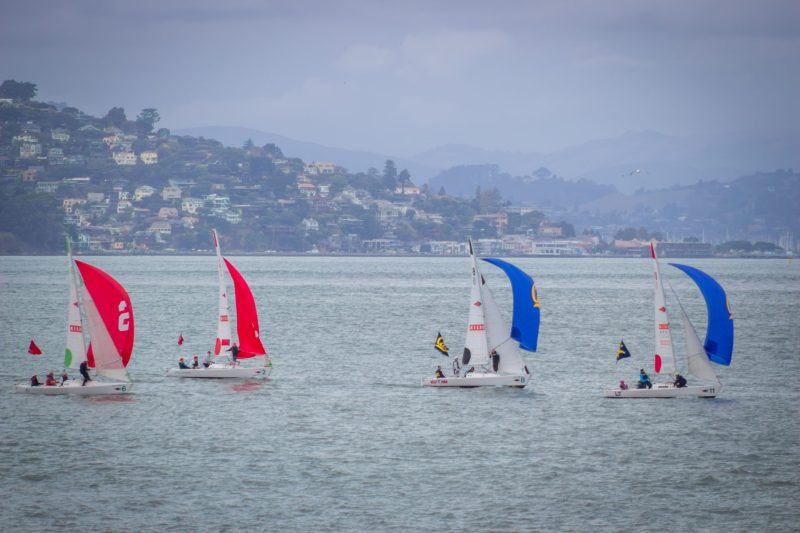
Conditions were light and shifty, with the wind dying multiple times. The plan was for 10-minute races, but given the light winds and a cross current caused by a southerly wind direction early in the day (not to mention the nature of two-on-two team racing), most of the early races took far longer. It became clear early on that the original plan to crown a winner, once one school got to 11 wins, wasn’t going to be feasible. In the end, 12 races were finished, with Stanford taking the win 8-4.
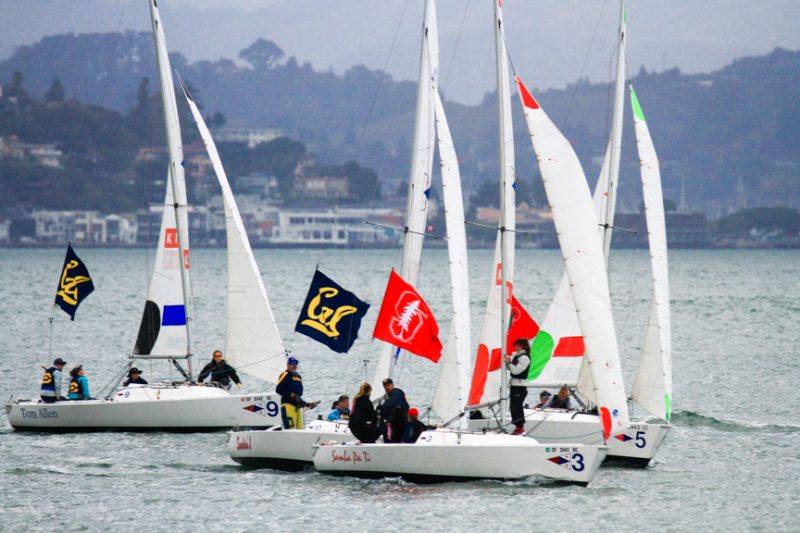
“For me, Big Sail is one of the highlights of the racing calendar,” Al Sargent, a Stanford sailing alum, bowman for the Cardinal master’s boat, and Big Sail Stanford team captain tells Latitude. “It’s a great opportunity to reconnect with old college sailing friends, and make new friendships with younger college sailors. It’s also a great opportunity to team race with some of the best college sailors in the country, since Stanford has recently podiumed multiple times in team race nationals. Big Sail is a great way to introduce our sport to new audiences, since it’s run right off the race deck of the St. Francis, and a great way to show college sailors the opportunities for post-college team racing that is emerging at StFYC, SFYC, and other clubs. I’d like to give credit to the Cal team. In the last three years, they’ve gone from losing 0-10 in 2023, to 2-8 in 2024, to 4-8 this year. At the current pace, we could have our hands full next year!”
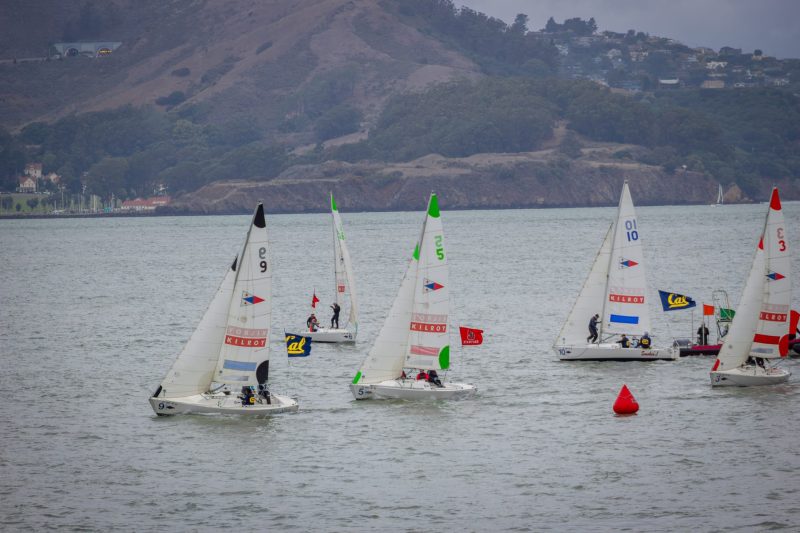
“The Big Sail had existed back in the late ’80s [and] early ’90s — originally won by StFYC’s own Seadon Wijsen,” Cal alum and Big Sail team captain Brian Mullen tells Latitude. “My dad, Jim Mullen, and Jaren Leet were both J/105 owners and racing campaigns on the Bay at that time. Their thinking: It’s Big Game week. We have the Big Game, the Big Meet, the Big Splash … why isn’t there the Big Sail? And Jim (and Jaren) agreed it should be a spectacle!
“Beyond sailing, it’s about relationships and connection,” Mullen continues. “These sailing teams from each school span generations, and there is a common thread through each sailor, from each era, across multiple generations. Once a year, the Big Sail brings everyone together by pulling that common thread. The oldest generation reminisces, telling old stories from back in their day. The young alumni embrace their newfound status as college sailor ’emeritus,’ just a couple years out from graduation. And the varsity sailors themselves see what lies ahead: a camaraderie that will last for decades. It’s pretty astounding how one activity, and one annual event, holds together a unique community of sailors and supporters.”
‘DragonSlayer’ Sails Baja Alongside Racing Dolphins
Cliff Newell and Katy Jacobs, aboard the 2017 Beneteau Oceanis 45 DragonSlayer, were among the 105 boats that cast off from San Diego on November 3 in the 31st Baja Ha-Ha. Along the way they experienced the wonder of sailing with a very large pod of dolphins.
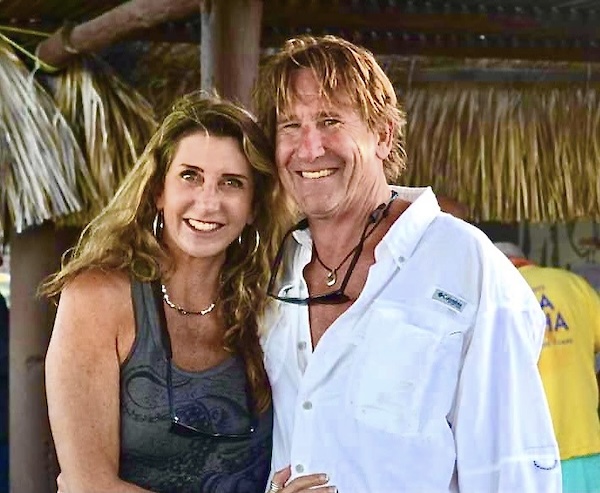
Cliff, 68, is a retired district attorney, while Katy is a DA prosecutor. Joining them onboard were John DuPerry, 50, a captain and camel trainer. (Yes! A camel trainer.) And a second crew member whose name we didn’t catch.
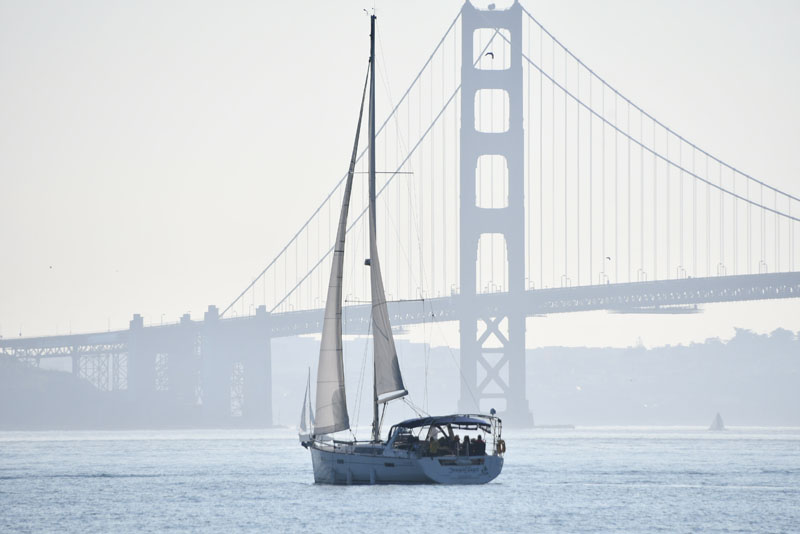
Cliff and Katy’s plan, post-Ha-Ha, was to moor their boat at their home on the East Cape of Baja. Though after watching the video they sent us last week, we’re wondering if they might just keep sailing to capture more of nature’s astounding beauty. We’re referring to a large pod of dolphins that was racing across the ocean, after the couple departed Bahía Tortuga.
“They converged on DragonSlayer at sunset,” Cliff wrote, “surrounding us, then just slingshotted away.”
Play the video with your sound on. Cliff says they sounded like a herd of mustangs racing across the prairie.
Given that one of Cliff’s favorite quotes is “To dream the impossible dream, that is my quest,*” we feel this dolphin encounter may have represented one of those impossible dreams, though not impossible for ocean sailors.
*According to Google, this quote is often attributed to Miguel de Cervantes Saavedra, author of the 1965 musical Man of La Mancha, but is actually ‘a song lyric written by Joe Darion for the musical based on Cervantes’ novel Don Quixote.’”
“The Man of La Mancha was a real dragon slayer,” Cliff adds.
Who else has had a similar experience while sailing offshore? (This writer has! It is truly extraordinary.)
The Moorings 5200
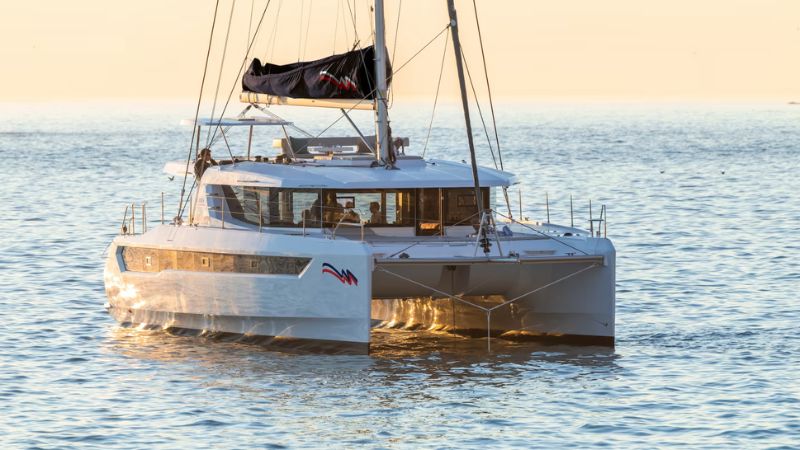
Meet the latest fleet addition. Designed for comfort and ease and ready to redefine charter sailing in the BVI, Belize, St. Martin and beyond.
Stanford Wins Fall PCCs in the Santa Barbara Rain
College Sailing’s Pacific Coast Collegiate Sailing Conference (PCCSC) hosted its fall Pacific Coast Championship on Nov. 14 and 15 in Santa Barbara, with the sailing team at UC Santa Barbara and Santa Barbara Yacht Club (SBYC) named as the official hosts. Stanford, the powerhouse of the West Coast and defending Leonard M. Fowle Trophy winners, dominated the regatta, which featured 20 teams from up and down the West Coast, as far out into the Pacific Ocean as the University of Hawaii, and as far inland as Arizona State University.
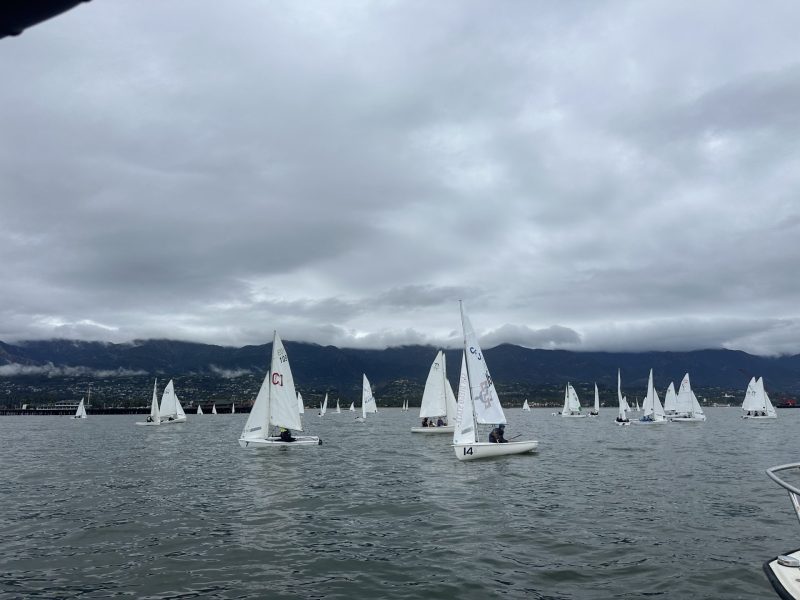
Racers and race committee alike battled light winds and heavy rain throughout the weekend. The regatta featured three divisions, but only four races were sailed in each division due to the conditions.
“The skipper’s briefing took place in a downpour of rain and no wind — a potential precursor to what was to become of the weekend,” the official regatta report on Techscore tells us. “A short postponement on shore occurred before enough breeze warranted getting out of cars and going sailing. Fortunately, the rain lightened enough and the wind increased enough (four knots minimum to about 12 knots at the absolute peak puff) to get three A races, two B races, and two C races before race 4A had to be abandoned when the wind fell below the limit early in the race. The sailors waited around on the water from 1:30 to 2:30 p.m. when a front came with plenty more rain yielding a lot of wet sailors and one more A race. Race 3B was started and abandoned when the wind died again. Frustrated, the RC called the day at roughly 3:30 p.m., recognizing a large dump of water was coming along shortly and sunset was before 5:00 p.m. As the sailors hit the docks, the dumping began, and so did the 8-10-knot southerly. Truly a brutal day to try to run races. During the races that did occur, the wind shifted steadily right the entire time, starting from the east and switching all the way to the northwest.”
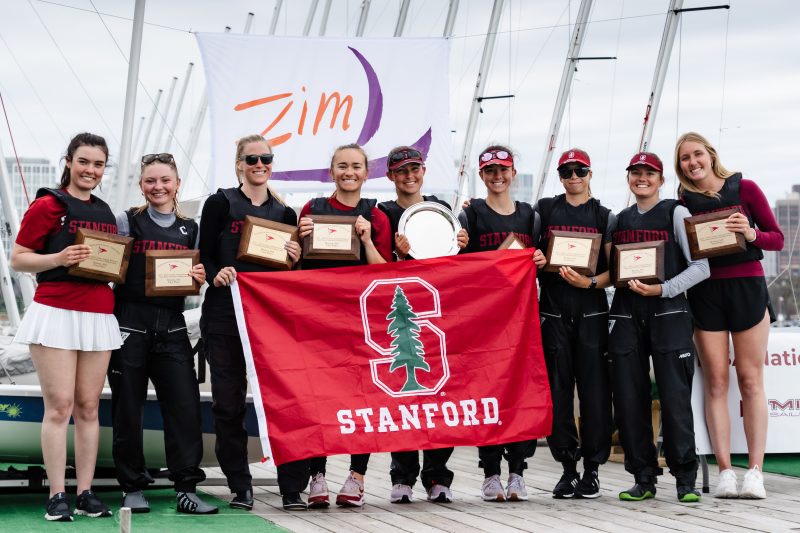
“The rain forecast looked less ominous Sunday morning,” the regatta report continued. “The wind forecast was not great, but also not to be trusted. The first warning was moved up to 10:00 a.m. in hopes of completing the regatta. But at 10:00, the wind died. Fortunately, some mercy occurred with an easterly breeze that kicked on at a whopping four to five knots at 10:20 a.m. Two more races were completed in every division, getting A division through race 6A when the wind zeroed out and race 5b was abandoned. And that was it.… On a very positive note, the conference was in great spirits the whole weekend and seemed to agree they were building character — several teams camped all weekend!”
Stanford was dominant throughout the regatta, finishing outside the top two in only two of the 12 races that were sailed (fourth- and sixth-place finishes in races 2A and 3A, respectively). The Cardinal freshman duo of Samara Walshe and Kate Myles won all four races in C division, while freshman skipper Freddie Parkin and sophomore crew Piper Blackband recorded three bullets and a second in B division. Junior skipper Reade Decker and sophomore crew Abby Baird recorded two bullets in A division to go with the fourth and sixth. Stanford’s final tally was 22 points for the weekend.
Host UC Santa Barbara was second behind the Cardinal with 49 points. The Gauchos recorded bullets in races 3A and 3B. In third with 69 points were the Cal Poly Maritime Keelhaulers, who, despite never recording a top-two finish, finished outside the top six only twice. Also of note, San Diego State’s A Division boat, skippered by freshman Ian Nyenhuis and crewed by sophomore Sadie Marinerstein, was the only non-Stanford boat to win a division, finishing with 11 points. The Aztecs finished fourth overall with 72 points.
You can find the full scores from the PCCSC Fall PCCs here.
‘Yankee’ Needs a New Home
There comes a time in every wooden boat’s life when a new steward is needed. Two old sailors want to pass on a Bay Area classic that’s been sitting dormant and is ready for new people to breathe new life into an old boat.
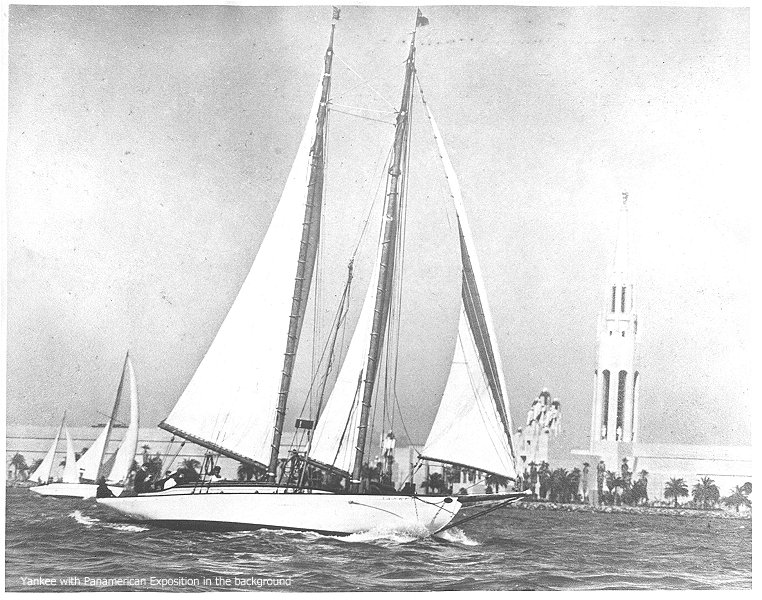
Some 120 years ago, Frank Stone and his son Lester were building the 65-ft gaff sloop Yankee — which has since been re-rigged as a schooner — at his boatyard on the San Francisco waterfront near the Presidio. The story goes that she was launched before the April 1906 earthquake. Surviving the disaster, Yankee has been racing and cruising the Bay ever since.
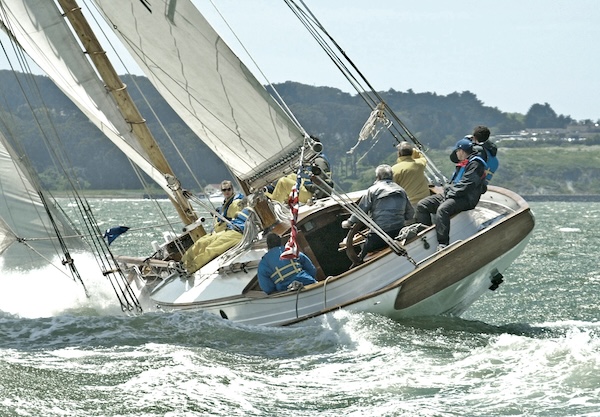
She started her life racing under the Corinthian Yacht Club burgee before changing hands and eventually becoming the flagship of the St. Francis Yacht Club after she was purchased and maintained by descendants of the local Ford family since 1925. After appearing in countless Master Mariners regattas and other classic-boat events on the Bay, she’s been absent since the pandemic.
Latitude reached out to her current caretaker, St. Francis staff commodore John McNeill, to ask what’s up with the legendary schooner.
John told us that Yankee has been lying in her berth at Loch Lomond Marina in San Rafael suffering from COVID-induced mothballing, with spars, rigging, caprails and sheer planking in storage. This is not an unusual lull in Yankee’s long life. The boat was in storage in San Rafael Slough in 1925 when a young Robert Ford rode past her on his bike. That’s when Sydney and Arthur Ford purchased her and had her brought back to form, preparing the boat for her next century of sailing the Bay. Since then, she’s had many adventures, including being stolen in the 1930s and recovered off Ocean Beach, then patrolling for Japanese ships during WWII. She even had a role in a Hollywood movie. Mostly, Yankee has been racing and cruising on the Bay. She was amid her regular 20-year rebuild when the pandemic struck. Partially disassembled and with parts in storage, she’s been sitting in the water since July 2020.
“Mayday, Mayday” — That Sinking Feeling on the Oakland Estuary
It’s hard to keep up with the count, but during these first few winter storms in November, it appears another four to six boats have washed up onto the shores of Oakland and Alameda. Citizens are calling out “Mayday” to the various agencies that share some responsibility for preventing the problem. So far, the calls for help have gone unanswered. It’s a reminder that when you need help, don’t call a bureaucracy.
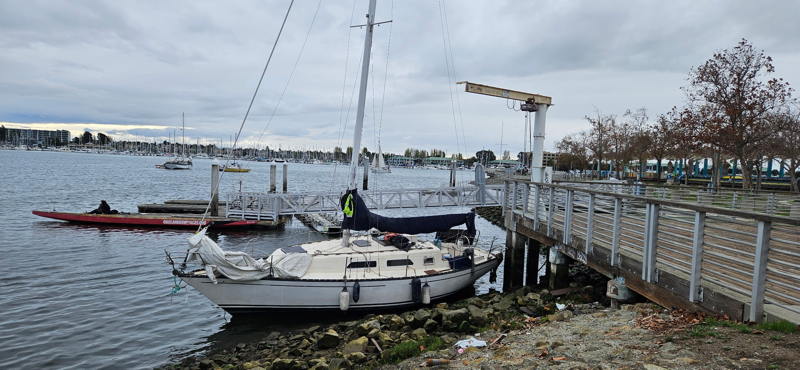
Mariners should be thankful that in an actual life-threatening emergency, the US Coast Guard has a clear responsibility to respond immediately to prevent the loss of life. They’re well trained, well equipped, and very capable. When it comes to preventing boats from sinking on the Estuary, there is no clear line of responsibility. Illegally anchored boats seem to be able to set their hook in a patch of water that falls precisely between the jurisdictions of all agencies. Once they blow ashore, the City of Oakland, Cal EPA, the Army Corps and others now spend 10 times the amount to clean up a problem that might have been much easier and cheaper if the boats had still been floating.
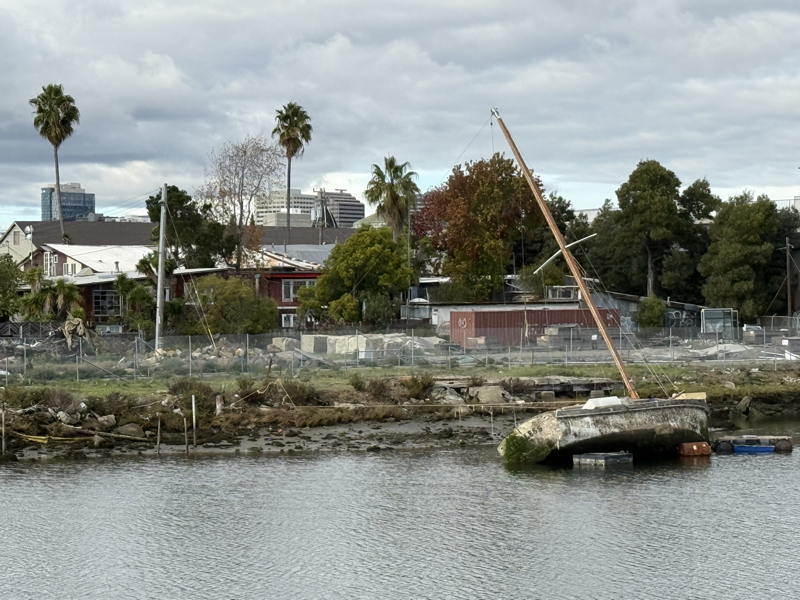
To be fair, this is not just an Estuary problem. It’s happening across the country. Like mattresses on the side of the highway, boats are being abandoned everywhere. As we reach out to various agencies to explore what is being done, we discover everyone is doing something but none appear to see this matter as urgent.
As the photos show, Mother Nature isn’t going to wait for the glacial pace of bureaucracy to solve the problem before she does. The winter storm season shouldn’t surprise anyone involved, and the predictable results are well underway. We are great believers in our country’s democracy, but when you watch government in action (or inaction), it’s easy to understand why people might like authoritarians. An apocryphal assertion is that least “Mussolini made the trains run on time.”
BoatUS has partnered with the National Oceanic and Atmospheric Administration (NOAA) Marine Debris Program to create a national database that will allow visitors to report abandoned and derelict vessels on their coastlines, to create a national view of the scale of the issue. BoatUS will also be offering grants for boat removal. In addition, the California Department of Boating and Waterways has the SAVE program, which also offers funds to support the cleanup and disposal of abandoned and derelict boats.
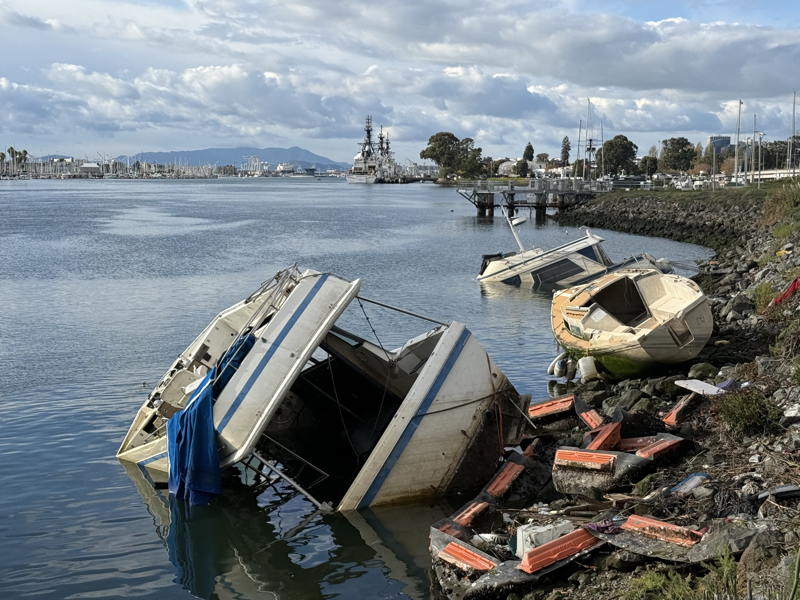
It’s frustrating, because most of the agencies involved don’t have boats and trained marine personnel to go out to manage the illegal anchor-outs. The Coast Guard has both but doesn’t have the time, or they have more important things to do than help clean up their own backyard. Once the boats are not a threat to navigation, not a threat to life, and not pollution, the Coast Guard is off the hook. Then other agencies take over.
We don’t really blame the anchor-outs. They need a home, and Oakland appears willing to tolerate their presence and willing to clean up after them. There needs to be a better alternative for those living aboard, and better ways to dispose of end-of-life boats. Additionally, the people who are “selling” these boats need alternative ways to dispose of them. We’d actually like to see capable boats and sailors be able to cruise and anchor in the Bay and have managed mooring fields like San Diego and Newport Beach. It’s not easy, but there are plenty of municipalities that know how to do it. The municipalities surrounding Richardson Bay have done an admirable job cleaning up the anchorage. It’s possible.
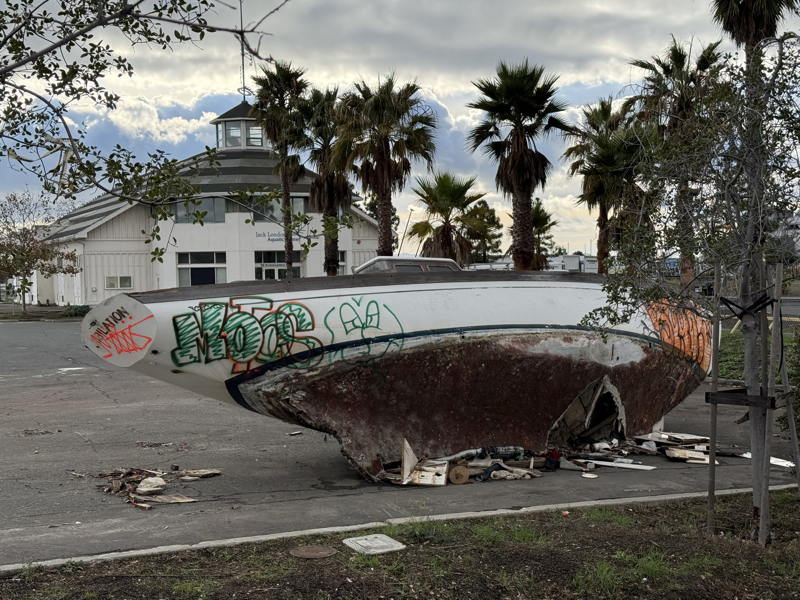
One of the great lessons of the 9/11 tragedy in New York was the communications challenge among all the first responders and other agencies. We have dedicated, capable people in all the agencies, but like New York on 9/11, they’re not practiced in working together. This suggests there is an opportunity to collaborate on a solution.
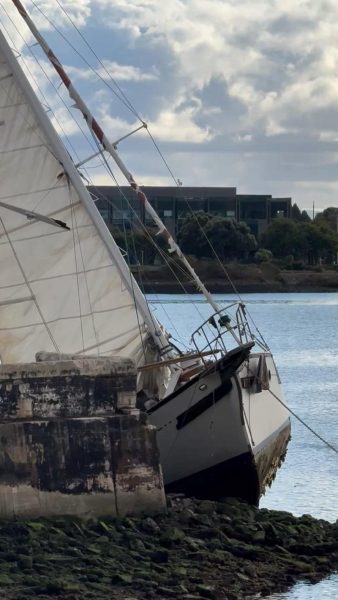
Our understanding is that the boat above was dragging around the Estuary with nobody aboard for a couple of days. It finally fetched up on the shoreline, and someone came by one night and managed to get the mainsail partly raised. So far not much damage, though Mike Gorman noted in the next tidal swing the boat could lie down in the other direction and fill with water during the next flood. If only some agency had people, budgets and boats, the possible sinking of this boat could be prevented.
While Oakland is short on the budget, boats and manpower, the USCG website for Coast Guard Island describes the assets in the Coast Guard’s control. Coast Guard Sector San Francisco includes nearly 600 active, reserve, and civilian Coast Guard men and women operating three cutters, seven small-boat stations, an Aids to Navigation team, a Vessel Traffic Service, and a Marine Safety Detachment in addition to more than 1,000 Coast Guard Auxiliarists. Its area of responsibility extends from the Oregon border to the San Luis Obispo County line and includes much of Nevada, Utah, and parts of Wyoming, as well as over 2,500 miles of shoreline within the San Francisco Bay and its tributaries.
That’s a huge area of responsibility, though the waterfront outside the front door remains a black eye amidst the many good things the service does for mariners and the country. Cleaning up the Estuary is the responsibility of Oakland, but the support and active engagement of the Coast Guard would be a critical component of managing this federal waterway.
We recently asked the current USCG base commander, Capt. Jordan M. Baldueza, to let us know what they’re doing about the problem. He responded, “The Coast Guard remains dedicated to working with our partners for a clean, safe, and thriving Oakland Estuary. In 2025, the Coast Guard has conducted 60 harbor patrols and responded to 30 reports of pollution within the Oakland Estuary, including leveraging the Oil Spill Liability Trust Fund for over $30,000 to mitigate and safely clean up the discharge of 340 gallons of oil and hazardous materials. Sixteen (16) Notice of Federal Interests and six (6) letters of warning were issued to vessels posing a pollution threat to the Oakland Estuary. The Coast Guard strongly encourages mariners who notice a discharge of oil or sheen into any navigable waterway to make a report to the National Response Center 24/7 at (800) 424-8802. To report a discharge of sewage or solid waste, please make a report to the California Environmental Protection Agency here. While there are limitations on Coast Guard authority to salvage and remove abandoned and derelict vessels from the waterway, we look forward to supporting the City of Oakland, Oakland PD, Alameda PD and other stakeholders to support potential cleanup operations leveraging the state of California’s Surrendered and Abandoned Vessel (SAVE) and the National Oceanic and Atmospheric Administration’s (NOAA) Marine Debris removal grant programs, acting within the confines of our authority and jurisdiction under federal law. For further information regarding this project, please contact the lead agency, the City of Oakland.”
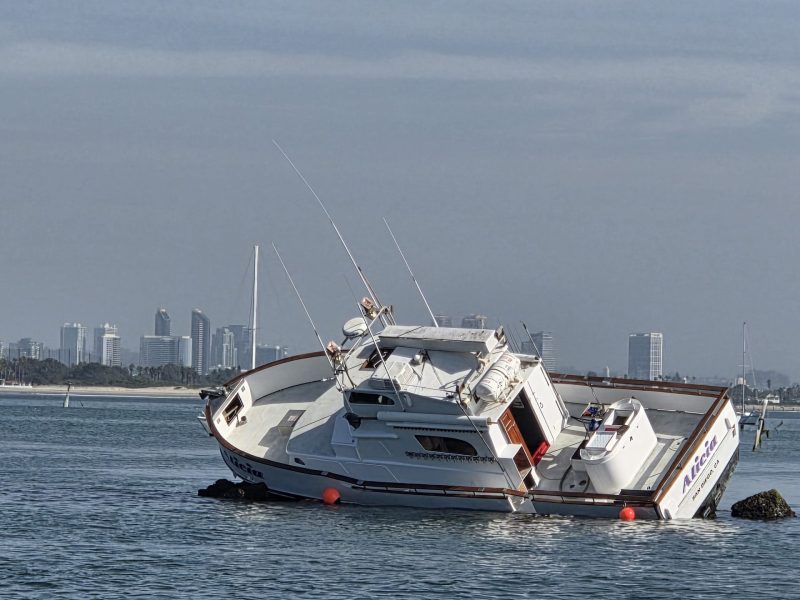
The current 10-day forecast looks good, so perhaps the sinkings will slow down. Regardless, it’s unlikely that’s enough time to prevent groundings in the next storm.
San Francisco on the Bay: “The List”

Dine, Drink, Smoke, Stay, Play and Shop. Discover San Francisco Bay and all that inspires those of us who live or visit here.