

The 2026 Baja Ha-Ha — Sunsets, Fish and Fun
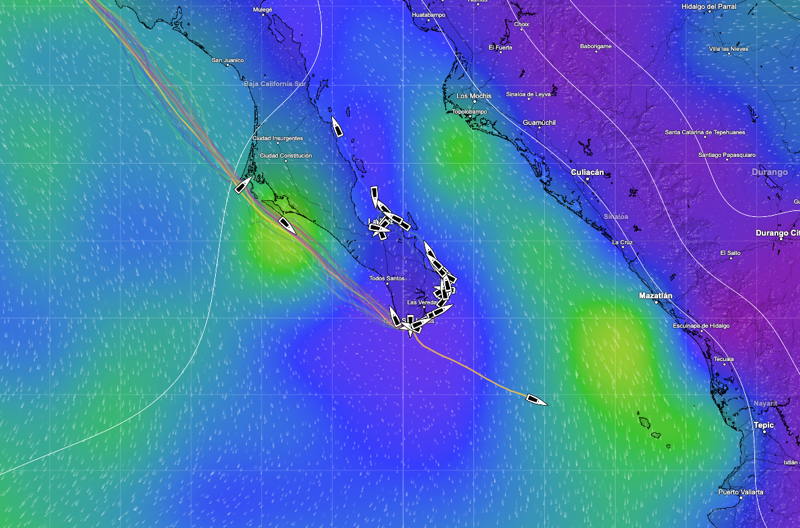
The 2026 Baja Ha-Ha wrapped up in Cabo with the traditional “Can’t Believe We Cheated Death Again” party at Squid Roe, followed by the beachside awards ceremony. The warm, balmy breezes of the southbound sail continued through the closing ceremonies, and they continue as the fleet disperses across the Mexican cruising grounds. Looking at the fleet tracker pictured below it appears most of the boats are continuing their cruise in the Sea of Cortez.
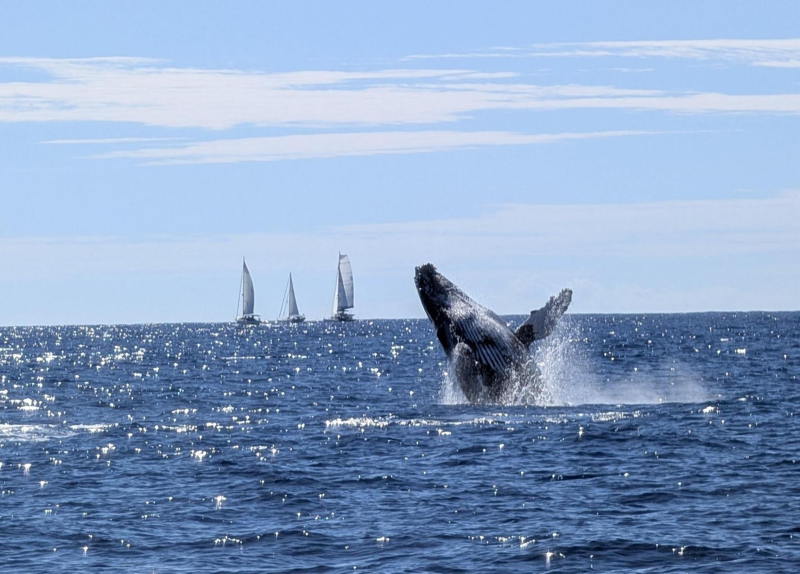
Despite a rambunctious Eastern Pacific hurricane season, the event had very pleasant sailing as the tropical storms once again faded away. This El Niño year has clearly disrupted the weather patterns, with storms causing excessive damage along the Southern California coastline while the Ha-Ha was enjoying Baja.
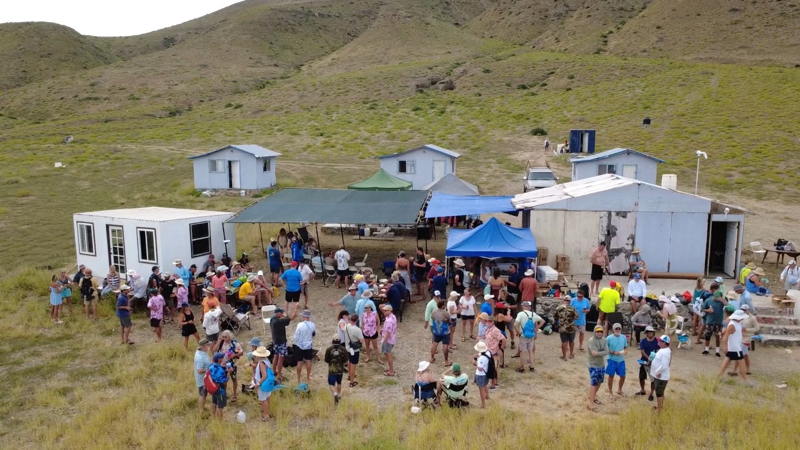
Bahia Santa Maria continued to serve as the fleet’s customs and immigration center, despite officials’ having to travel to the remote location from La Paz in order to take care of the official paperwork. In addition, the rock band showed up, the food concession was open, and the fleet was welcomed to the party with shuttle service provided by the local fishermen on their pangas. It’s amazing it happens at all and it continues to amaze all who arrive at these festivities at the end of the universe.
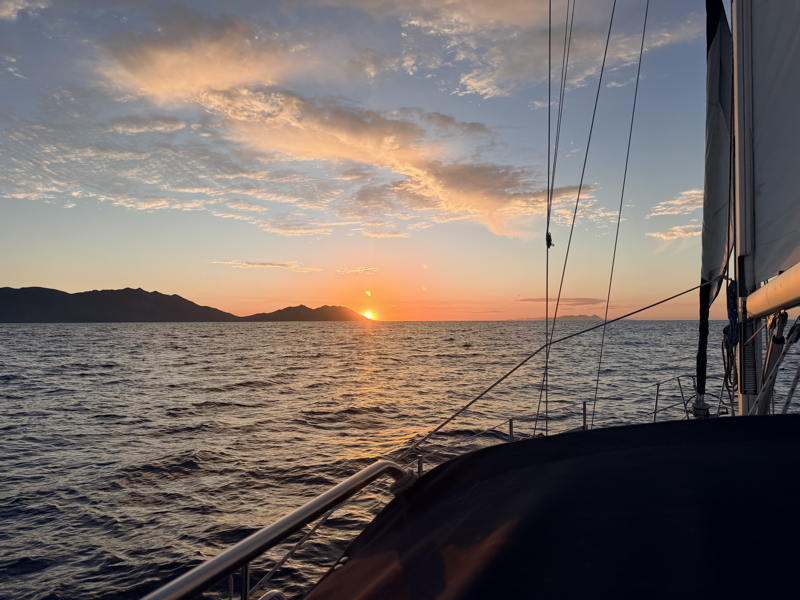
We’ll have more sunset and fish photos in the December issue wrap-up story, but we have so many shots we have to share some here. Both the fishing and the sunsets were spectacular and made for great evening meals at anchor or at sea. People caught tuna, marlin, wahoo, mahi mahi and surely some others that got thrown back. Nobody went hungry during this sail south.
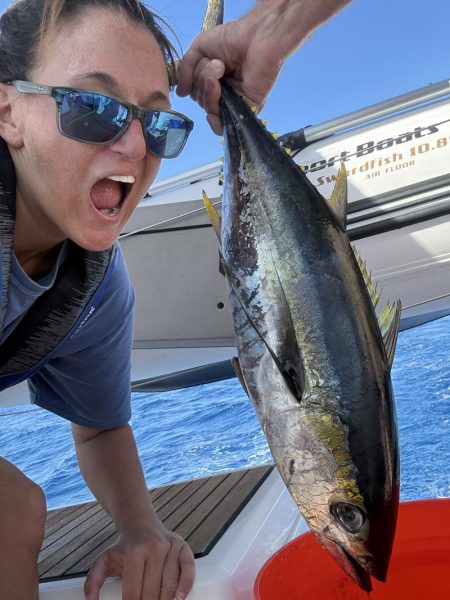
Despite Cabo’s having been overrun by fishing boats, there were plenty of fish in the sea and plenty of room for sailors to anchor offshore for the party at Squid Roe, and the awards ceremony.
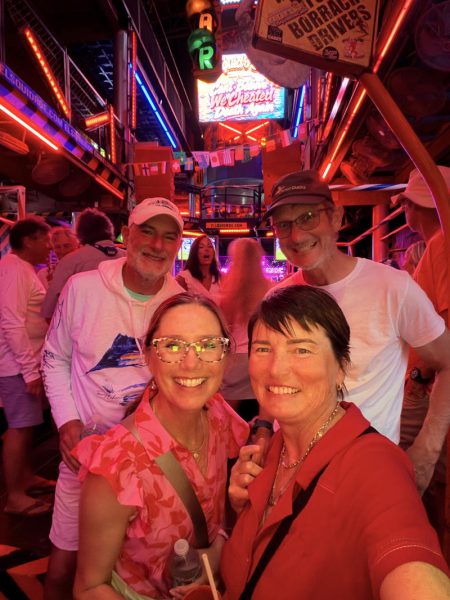
The vast majority of the almost 4,000 boats that have done the Ha-Ha have used the event to start their cruise for the season in Mexico, or to start commuter cruising or a trip around the world. A few have to turn back right away to head north for home, but most will be spending the season cruising Mexico. Some take decades to return. Those who decide to go all the way around the world often return to say the best part of a circumnavigation is the time they spent in Mexico.
We congratulate the new Grand Poobah, Chuck Skewes, and the always-reliable assistant Poobah Patsy Verhoeven, on another successful Ha-Ha after taking the helm this year. The Tanton 73 Velos, and Patsy’s Gulfstar 50 Talion, respectively, managed fleet mothership and communications duties while helping guide everyone south.
Have a great season south of the border!
Francesca Clapcich Crowned 2026 IMOCA Globe Series Champion
In our recent reports on the Route du Rhum, we mentioned USA sailor Francesca Clapcich from Salt Lake City, who was to compete aboard the IMOCA 60 11th Hour Racing. Clapcich crossed the finish line on Friday, November 13, at 0:41 a.m. Paris time. She placed eighth out of 18 boats in her division, with a time of 42 hours and 27 minutes. Clapcich’s standing in the Route du Rhum, together with her other racing achievements, has earned her the crown in the 2026 IMOCA Globe series. It is the first time a female sailor has been crowned champion.
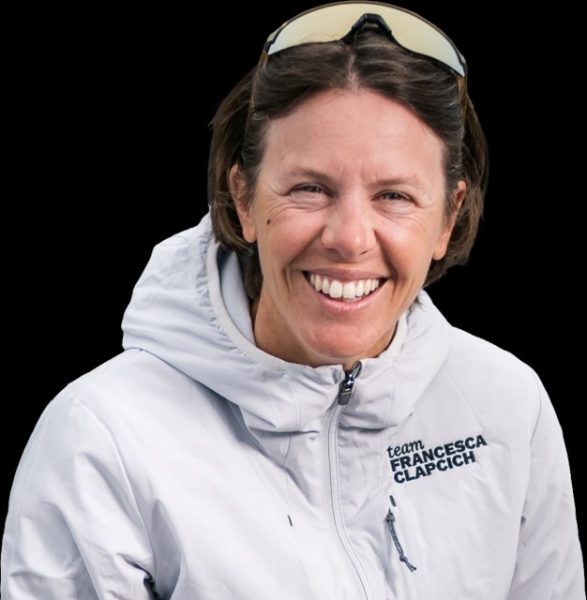
The win comes on the strength of a run of results for the Italian-born American sailor based on the season’s flagship events: the 1000 Race, the Vendée Arctique, The Ocean Race Atlantic, the Défi Azimut and the Route du Rhum — Destination Guadeloupe.
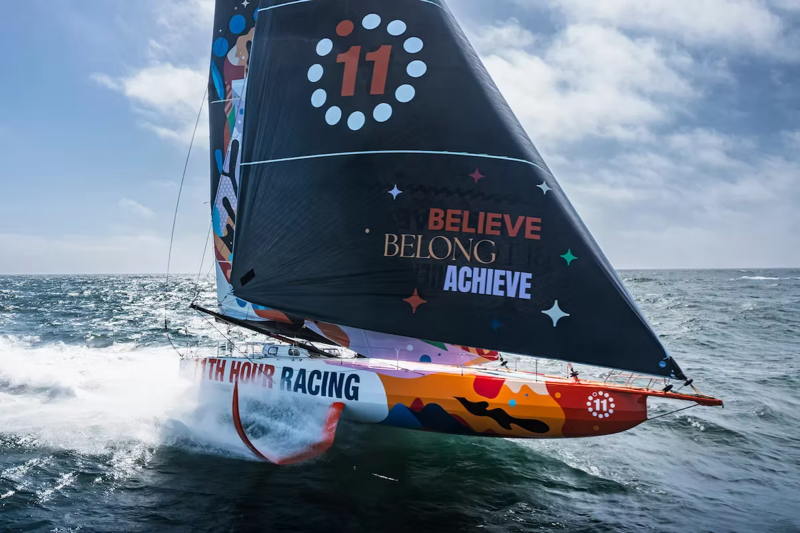
We’ve shared some of Clapcich’s stories previously in ‘Lectronic Latitude, including her involvement with the UpWind by MerConcept program, which was to recruit, train, and support a squad of six female sailors as they compete in the Ocean Fifty offshore sailing circuit, with the ambition to have a female skipper on the starting line in a multihull for the 2026 Route du Rhum.
Clapcich’s eighth-place finish in the Route du Rhum, the challenging transatlantic singlehanded sprint, clinched her the title just 36 points ahead of two-time previous winner, Sam Goodchild (GBR/FRA), with Elodie Bonafous (FRA) in third at 388 points.
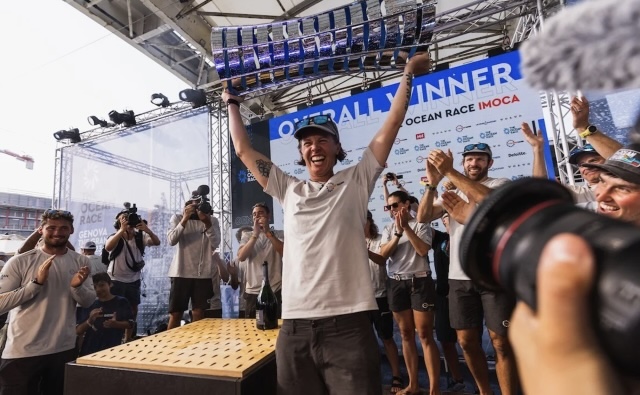
2026 was Clapcich’s first season on the IMOCA circuit, where she kicked off with a fifth place in the solo 1000 Race. This was quickly followed by another fifth in the solo Vendée Arctique. The Ocean Race Atlantic from New York, USA, to Lorient, France, was the only crewed race of the year, where Clapcich led an international 50/50 gender-balanced crew to second place.
“It’s the first time that a woman has won the IMOCA Globe Series, and I’m super-proud of that achievement, and it just showcases what women’s sport is really about these days,” Francesca said upon arriving at the pontoons in Guadeloupe. “And Elodie (Bonafous) did an incredible race in the IMOCAs and she’s on the podium for the Route du Rhum — these are all incredible achievements. It just goes to show how important women’s sport is, and that thanks to the investment there is in women’s sport from organizations like 11th Hour Racing, just what we are able to get out of it and achieve.”
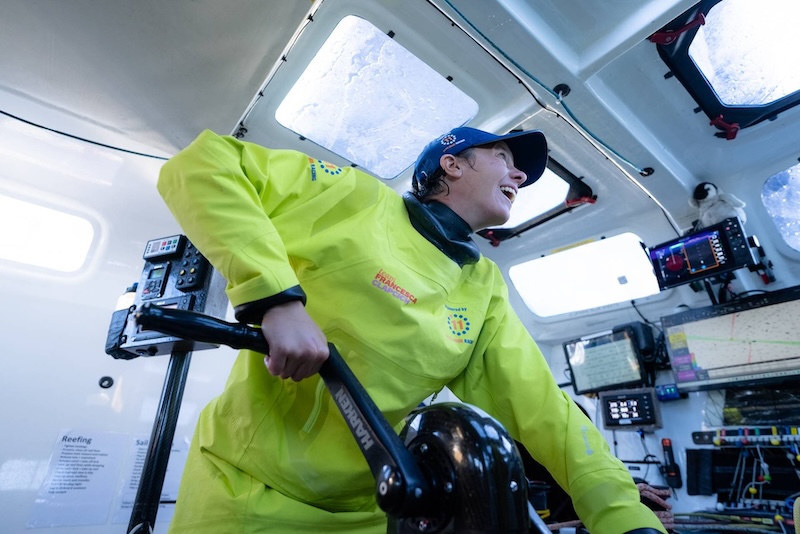
Congratulations to Francesca Clapcich and to all the Route du Rhum winners and competitors. Singlehanding across the Atlantic aboard a racing yacht is no small feat, and we applaud all who even made the attempt regardless of their result.
Fifty-seven teams remain at sea.
Visit Naos Yachts for Full Sales and Service
Santa Cruz 27 Nationals: A Great Pumpkin Battle on San Francisco Bay
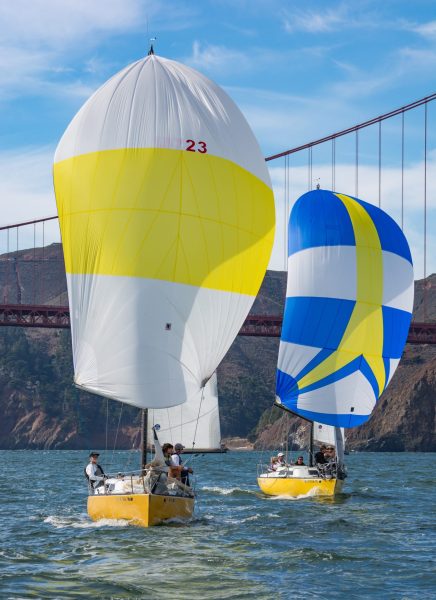
The Santa Cruz 27 National Championship returned to San Francisco Bay October 23–25, hosted by Richmond Yacht Club. In a unique twist, RYC ran the championship alongside its famed Great Pumpkin Regatta. Twelve boats made the starting line for three days of close racing, changing conditions and a distance-race finale nobody will soon forget.
Friday, Day One: Four Races, Four Winners
The first two days of buoy racing took place on the Berkeley Circle, primarily using a windward-leeward course with an offset mark and leeward gate.
Three races were scheduled for Friday, but the race committee squeezed in four to provide some insurance against lighter winds over the weekend. The westerly built from about six to 13 knots against an ebb current, producing tight racing and a few crowded windward and leeward mark roundings.
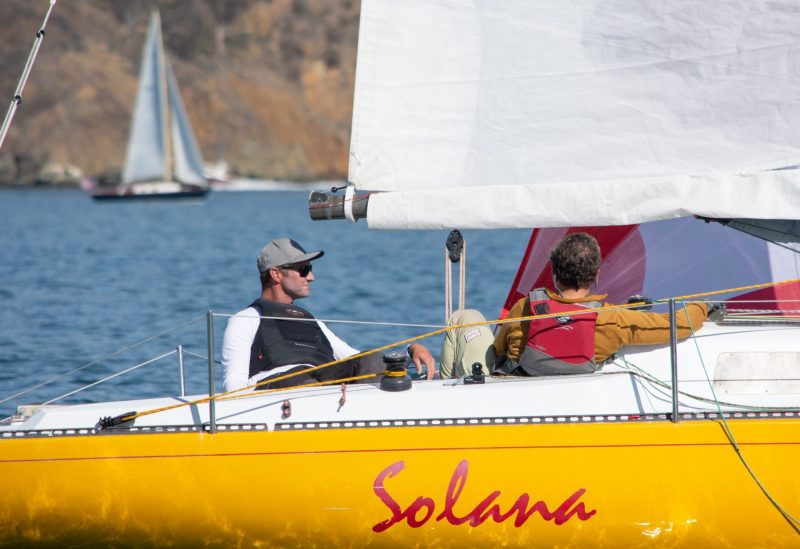
The opening race was a simple one-lap windward-leeward to get things going. It also delivered an immediate lesson: The right side paid. Boats that went left on the initially favored, headed starboard tack struggled against the ebb when they came back on port and paid dearly.
After four races and four different winners — Furthur, California Zephyr, Pacifico and Lickety Split — the championship was shaping up to be a three-day battle.
Saturday, Day Two: Patience Pays
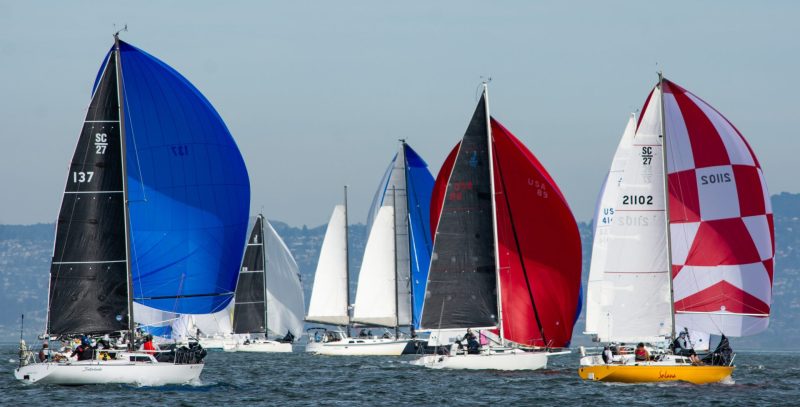
On Saturday, the SC27s shared the starting line with three other fleets. The course shifted slightly north but remained within the Berkeley Circle.
With no wind and another building ebb, patience was essential. About 90 minutes after the first scheduled start, a light westerly finally filled in, and racing got underway. Boats fought to keep the current from carrying them over the line early. One wasn’t successful.
The breeze gradually strengthened, allowing the committee to complete three races.
By the end of the day, the standings were taking shape. Furthur and California Zephyr were separated by just one point in the fight for first, while Pacifico and Lickety Split were only two points apart in the battle for third.
Sunday, Day Three: The Great Pumpkin Trick
Then came the distance race — and this is where things really got interesting.
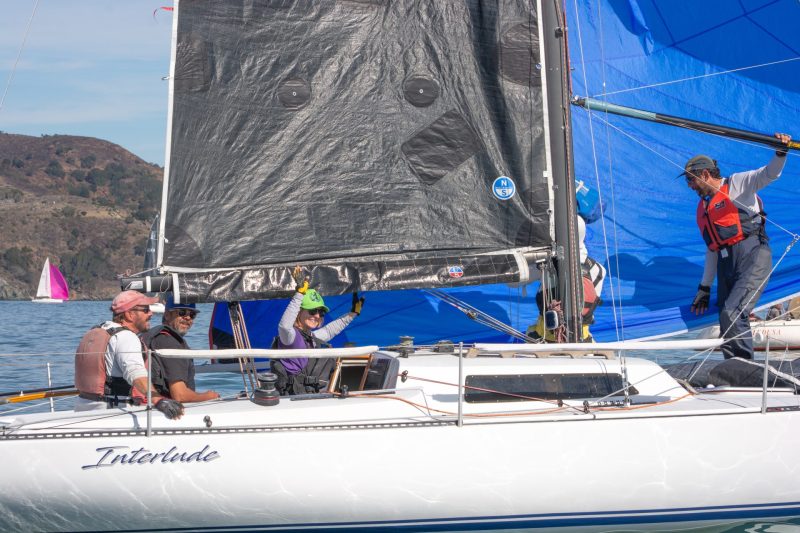
The SC27s sailed the Great Pumpkin pursuit-race course with their own fleet start ahead of the other 155 boats. The idea was to give the class enough of a head start to avoid being rolled by the larger boats.
Ha! Trick or treat?
At the annual class meeting before the race, the skippers unanimously voted to sail counterclockwise: through Raccoon Strait, around Angel Island to port, then around Alcatraz to port before finishing near Richmond Yacht Club.
The race began in a steady 5–6-knot northerly, with the last of the flood approaching slack. Pacifico, Lickety Split and Water Dragon started near the pin, while most of the fleet started closer to the committee boat.
As the boats approached Raccoon Strait, the left side looked promising, offering relief from the remaining flood and apparently more breeze along the south side of the strait. Furthur worked its way left as well, although still well behind the leading three. Those four boats built a substantial lead over the rest of the fleet.
Then they rounded Point Knox, and the wind shut off.
The leaders slid to a stop as the rest of the fleet compressed behind them. Spinnakers went down, up, and down again as crews tried anything to escape. Boats attempting to carry spinnakers on starboard poles could be seen drifting back toward Raccoon Strait.
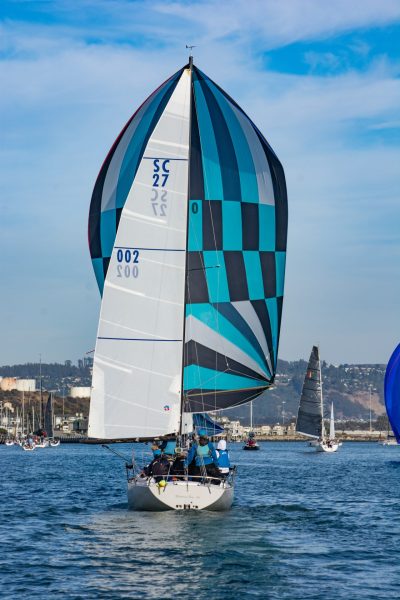
And then we looked behind us. Here came 155 boats.
Almost everyone in the pursuit race had also chosen to sail counterclockwise. The fleets converged into one enormous parking lot, filled with boats of every shape and size. The SC27s disappeared into the mayhem.
Furthur somehow managed to hold its position and emerge ahead. We later learned the crew had made the astute decision to drop anchor while others drifted backward.
The stalemate seemed endless — perhaps an hour and a half. We had arrived with open water ahead, and before long, it seemed there were no boats left behind us. The Great Pumpkin had delivered its trick.
A few boats found enough current relief close to Angel Island to make progress toward Alcatraz, but most couldn’t reach that patch of water. The fleet slowly clawed toward Angel Island while the developing ebb pushed boats west toward the Golden Gate.
Then came the treat: a fresh westerly charging through the Gate at about 15 knots. Spinnakers went up, and suddenly the entire fleet was flying — still packed tightly together.
Alcatraz and the Run Home
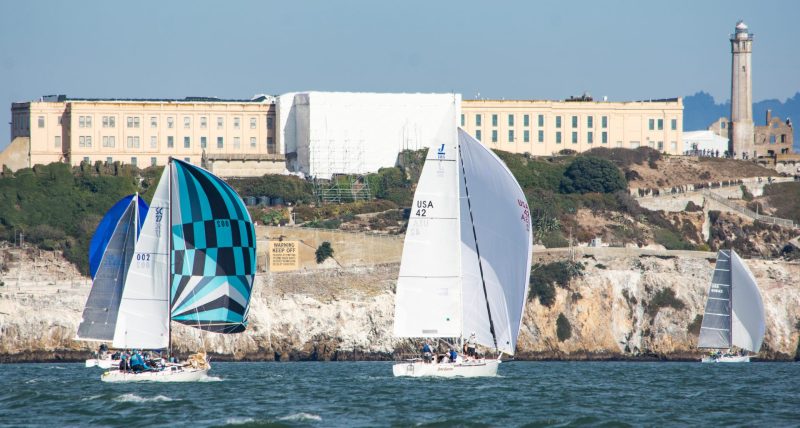
Traffic around Alcatraz was intense, with gusty conditions adding to the challenge. Jibing onto port was stressful, and some boats struggled to clear the island’s eastern, leeward side.
By the time everyone settled into the run, Furthur was nowhere to be seen. Lickety Split rounded Alcatraz with a sizable lead over California Zephyr, Pacifico and Solano. Pacifico and California Zephyr chose a lower line toward Berkeley, while Lickety Split and Solano sailed a more direct route.
The lower line paid handsomely. Pacifico and California Zephyr avoided sailing directly into the ebb and found cleaner air. Meanwhile, Lickety Split and Solano fought to keep moving as larger boats rolled past with towering spinnakers.
The distance-race top-five finishing order was Furthur, Pacifico, California Zephyr, Lickety Split and Solano.
It was an all-out brawl from start to finish, with hardly a moment to catch your breath.
Final Top-Five Overall Results
- Further — James Clappier (RYC), 2026 National Champion
- California Zephyr — Rob Boehm (SBYC)
- Pacifico — Ron Tostenson (RYC)
- Lickety Split — Rick Raduziner (TYC/RYC)
- Interlude — Todd Austin (SCYC)
Dave Diola Distance Race Trophy: Furthur.
Rob Schuyler Sportsmanship Award: Ryan Schuler (son).
The Santa Cruz 27 fleet extends a heartfelt thank-you to Richmond Yacht Club and its entire “rock-star” race management team. Their volunteers’ enthusiasm, flexibility and support made this a truly unique and memorable championship.
The Resourceful Sailor Mends a Shroud — Was This a Simpler Option?
If my sailboat’s rigging used swage terminals, was I locked into using a professional rigger with specialized equipment for a repair? What if I planned to rerig the boat soon, but wasn’t yet ready for that full commitment? What if a swage terminal was on one end of a wire and a mechanical terminal on the other end? I will tell you of a 2017 rigging repair aboard my Pacific Seacraft Flicka 20 Sampaguita, in which these questions arose. But first, I’ll tell the story of how I got there.
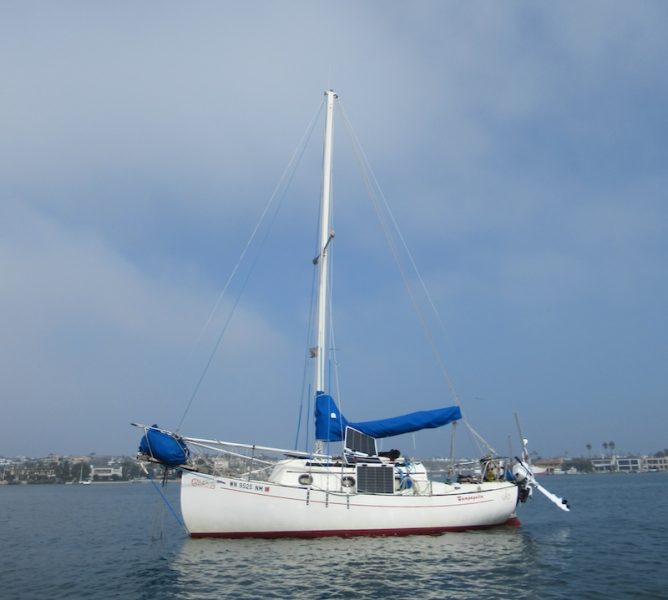
One sunny June day, Sampaguita and I had sailed from the False Creek anchorage in the city of Vancouver, British Columbia. My original plan and destination was to anchor deep in Centre Bay at Gambier Island, to the north in Howe Sound. I beat out of English Bay into the developing wave trains descending from the northwest and the Strait of Georgia. I sailed around the east side of Bowen Island, only to then face a difficult afternoon of thermal headwinds and choppy seas as they rushed up Howe Sound. I eventually arrived at the mouth of Centre Bay. I looked deep into it, over the top of the marching whitecaps at the lee shore, and thought to myself, “That looks like a bad idea.”
I retreated on a run back to Bowen Island’s Snug Cove, where I knew it was sheltered and there was a public dock to tie up to. BC Ferries’ Queen of Capilano served Bowen Island from the mainland via the small cove, and it had just recently departed as I arrived. Upon entering, it was easy to recognize the dramatically swirling current that the ferry’s powerful propellers had left behind in the cove. I circled a couple of times and abandoned my first docking attempt because Sampaguita was not going where I was steering her. Exhausted from the thermal wind beatings we had taken earlier, I circled again. Sussing that the current had settled down, I made my second attempt. I was wrong.
Warm Someone’s Winter With a Latitude 38 Gift Subscription
It’ll be here sooner than you think — there are only six weeks (plus a couple of days) until Christmas. We all have that hard to shop for friend or family member. How about gifting them a lasting ‘experience’? A 12 month gift subscription to Latitude 38 would give them joy all year as they sail through the pages of the print issue.

They get a great hold-in-your-hands magazine delivered to their mailbox every month. The colors always match, it shows great taste, and one size fits all! And, they get a reminder of you every month for 12 months in a row. Everyone wins! Order online here.