
The 32nd Annual Baja Ha-Ha Heads South!
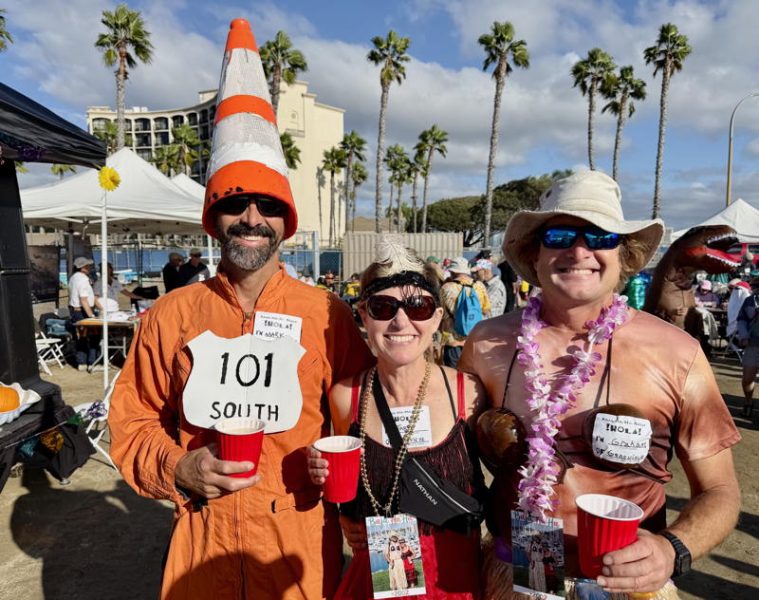
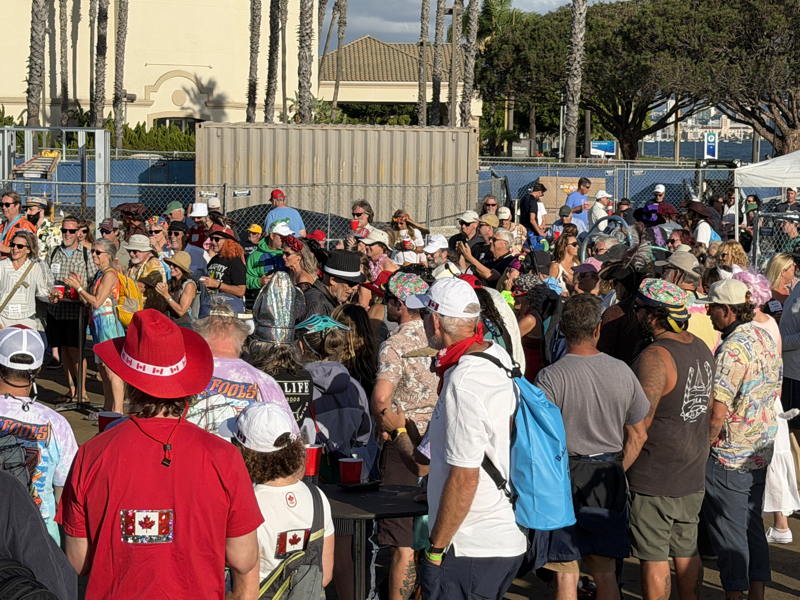
The 32nd Baja Ha-Ha took off from San Diego Bay this morning with clear skies and a warm breeze. The tumultuous El Niño-inspired weather has had us all keeping a closer eye on things, as it even threatened to rain out yesterday’s kick-off party. We flew down from sunny San Francisco to rainy San Diego on Sunday, though the rain held off for Chuck Skewes and Patsy Verhoeven to enlighten everyone during the 9:30 a.m. skippers’ meeting. It rained for an hour after the meeting, then turned to sun again as the kick-off party opened up in Harbor Island Marina’s parking lot, which, along with the marina, is undergoing a full reconstruction.
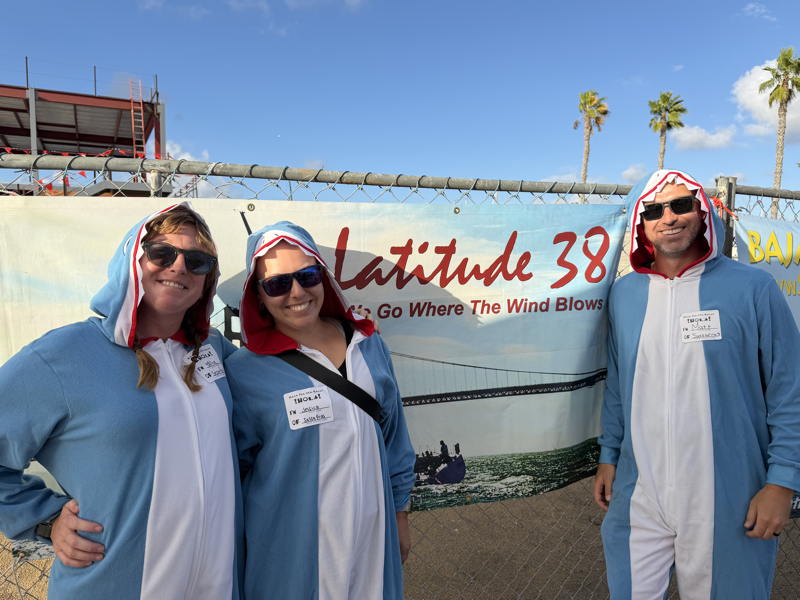
We were swimming in the shark tank when we crossed paths with the three sharks below. Despite being from the sailing capital of Annapolis, MD, Allie Eberhardt, on the left, was never a sailor until COVID came along. She jumped into it and now has been delivering sailboats all over the Atlantic. She decided she wanted to try something in the Pacific and came across Latitude 38 and our crew lists. She put her name on the Latitude 38 Crew List and found a ride with newlyweds Matt Carey and Jess England, who’ve also picked up sailing in the past few years.
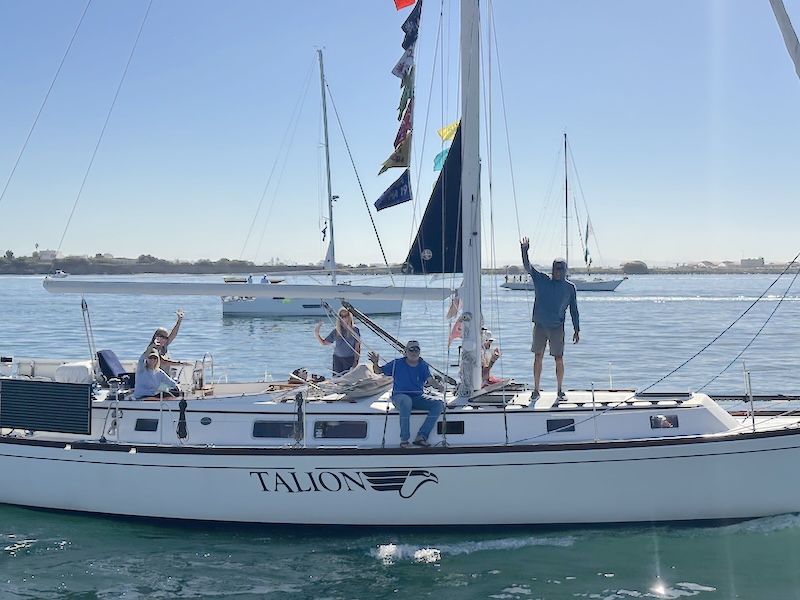
This morning’s launch of the 32nd Baja Ha-Ha was conducted under clear skies and a warm breeze. As the fleet sailed past on their way to Mexico, the envious were left behind to take photos.
Thanks again to the crew at West Coast Multihulls for hosting us on one of their San Diego charter catamarans to start the rally off Shelter Island, and also to the San Diego Harbor Police for organizing the fireboat to come out to fire off the water cannons as the fleet headed south to Mexico.
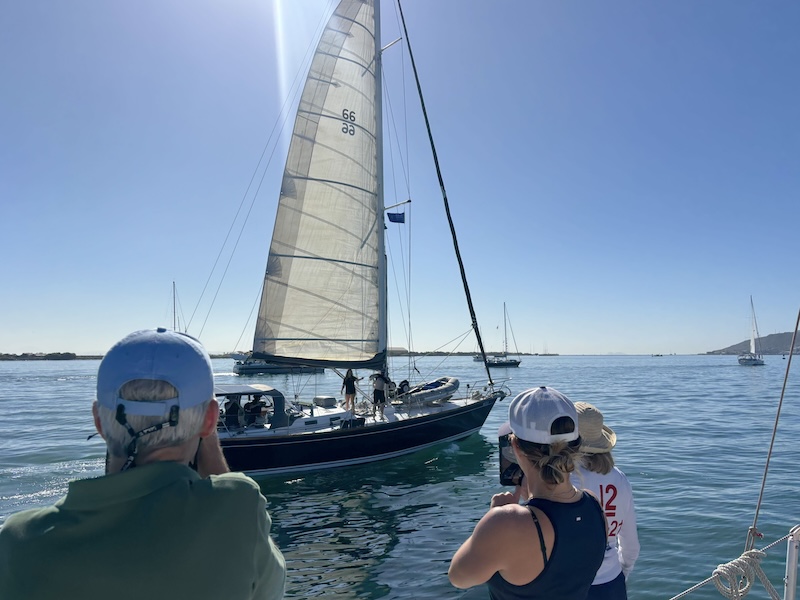
It was another magnificent start to the Baja Ha-Ha with a warm, calm morning and a building breeze for the afternoon. We’ll bring you more on the Ha-Ha as the fleet makes its way south. In the meantime, you can cruise along with them by following the tracker here.
US Coast Guard Performs Two Rescues off California Coast
An 86-year-old man and his dog were rescued on Wednesday, following a multi-day search approximately 460 miles off San Diego.
Coast Guard Pacific Area watchstanders received a report on Saturday, Oct. 24, about an overdue mariner aboard the sailing vessel Willow Wind. The vessel was en route from Astoria, Oregon, to Pago Pago, American Samoa, and had not been heard from since August 20.
A search was initiated, but with no success until Tuesday, October 27, when the Coast Guard Rescue Coordination Center in Alameda received an alert from an emergency position-indicating radio beacon registered to Willow Wind. Watchstanders launched a C-27 Spartan air crew from Sacramento and diverted an HC-130 Hercules air crew and the Coast Guard Cutter Robert Ward. They also requested assistance from nearby vessels.
The Spartan air crew located Willow Wind on Tuesday evening. The cargo ship Grand Orion responded to the USCG calls for assistance and arrived on scene at approximately 3:20 a.m. Wednesday. Due to the sea state, Grand Orion crew were unable to rescue the mariner and his dog until 5:30 p.m. Wednesday.
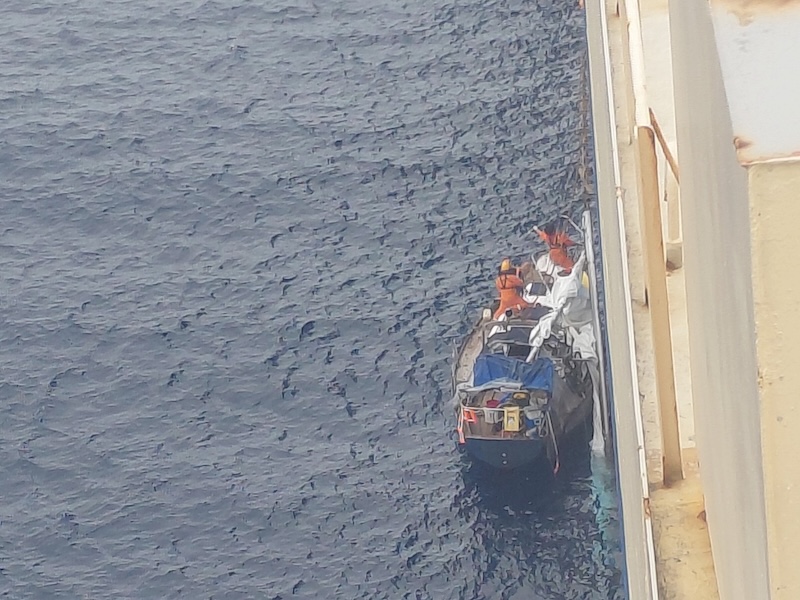
On Thursday morning, a MH-60 Jayhawk air crew from Coast Guard Air Station San Diego hoisted the mariner and his dog from the Grand Orion, now located approximately 170 miles west of Ventura, California. The man and dog were transported to Coast Guard Sector San Diego and then on to Scripps Mercy Hospital for further evaluation.
At the time of the rescue Willow Wind had damaged sails and was left adrift. At this stage it is unknown what caused the damage.
Coast Guard Cmdr. Jason Nguyen, Southwest District command center chief, stated his thanks to the merchant mariners and Coast Guard crews “whose coordinated efforts brought this search to a successful conclusion.” Cmdr. Nguyen added, “This case highlights the importance of carrying emergency communication equipment and creating a float plan so someone ashore knows your voyage plans.”
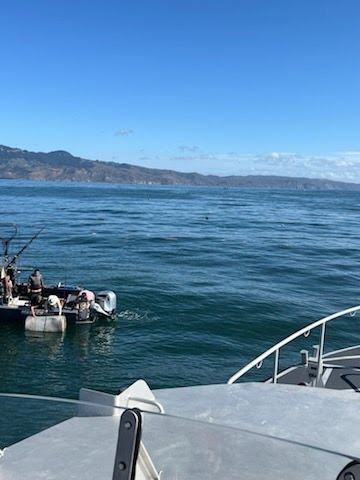
In a separate incident, the US Coast Guard and a good Samaritan vessel rescued three people from a 32-ft powerboat that was on fire and taking on water approximately five miles west of Stinson Beach last Friday, October 30. Coast Guard Sector San Francisco watchstanders received a distress call at 11:58 a.m. from a good Samaritan who reported smoke coming from the vessel and a person aboard waving their arms. Watchstanders coordinated the launches of a 47-ft motor lifeboat crew and a Dolphin helicopter air crew. The good Samaritan vessel rescued all three boaters from the burning boat before the USCG crews arrived on the scene. The powerboat subsequently sank.
The three rescued boaters were then transferred to the motor lifeboat that had arrived from Station Golden Gate. After determining none of the survivors required medical assistance, the crew transported them to Pier 45, their original point of departure.
The sunken vessel’s captain reported that the vessel began taking on water rapidly through the stern engine compartment before sinking. The cause of the incident is currently under investigation.
Steering the Dream With Hydrovane
Hydrovane is your best crew member: an independent self-steering windvane and emergency rudder/steering system … ready to go!
Running Out of Gas On the Pacific During a Return to S.F.
Nota Bene is a Beneteau 411 sailed by a crew of family and friends. They describe themselves as an attorney, IT expert, business owners, and pros, chasing miles of the Pacific with skill and reckless abandonment. This is their story of their return to San Francisco after the 2026 Pacific Cup.
Two days ago, Nota Bene ran out of propane. More concerning, the diesel supply was getting dangerously low after burning far more fuel than expected trying to get north from Hawaii and around the Pacific High.
It wasn’t for lack of planning. Erica and the shore-side team had been working throughout the ‘Pac Back,’ studying weather, plotting routes and strategizing with the crew about the best path north and eventually east toward California. But this has been an unusual Pacific. Instead of the more typical broad summer high, they encountered shifting areas of little or no wind, including long, narrow fingers stretching hundreds of miles across their path. They sailed when they could and motored when they had to. Eventually, the fuel calculations became uncomfortable.
And diesel aboard Nota Bene isn’t just about propulsion. AIS, Starlink, autopilot, refrigeration and the boat’s other electronics depend on a bank of lithium batteries. Those batteries need to be recharged, and offshore that means regularly running the engine and its heavy-duty alternator. Without diesel, eventually a lot more than the engine stops working. Add an empty propane tank for cooking, and the situation was getting serious.
So the crew reached out to the Pacific Cup organization for help. And boy, did the Pacific Cup community come through. Two boats returning home from the race offered assistance. Merlin was closer and offered 50 gallons of diesel, along with a small cook stove and two bottles of propane. Nota Bene turned south and began motoring toward a rendezvous.
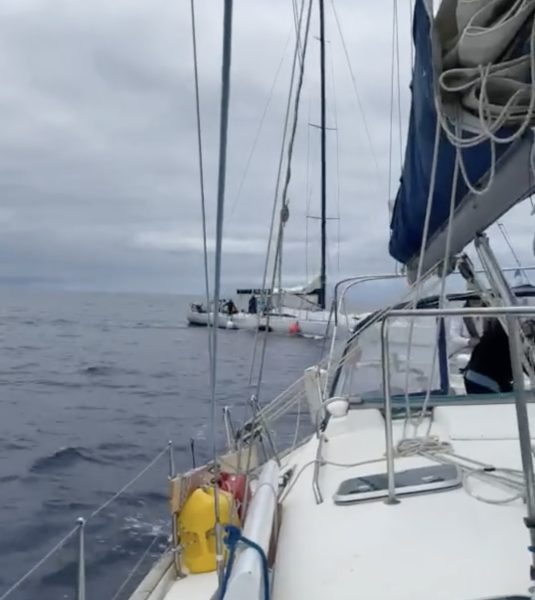
Late the next morning, Merlin first appeared on the AIS screen. Then Kimball spotted her on the horizon. The two boats converged, dropped their sails and motored slowly alongside one another through the slight wind and swell. Merlin’s crew used their main halyard to hoist a bag containing the stove and supplies, connecting it to a retrieval line Nota Bene had thrown over. Then, one by one, five 10-gallon jerry cans of diesel came across. Fifty gallons of fuel transferred between two sailboats in the middle of the Pacific, all accomplished in about 10 or 15 minutes.
“Easy-peasy,” according to Kimball, although the anxiety leading up to that moment had been anything but.
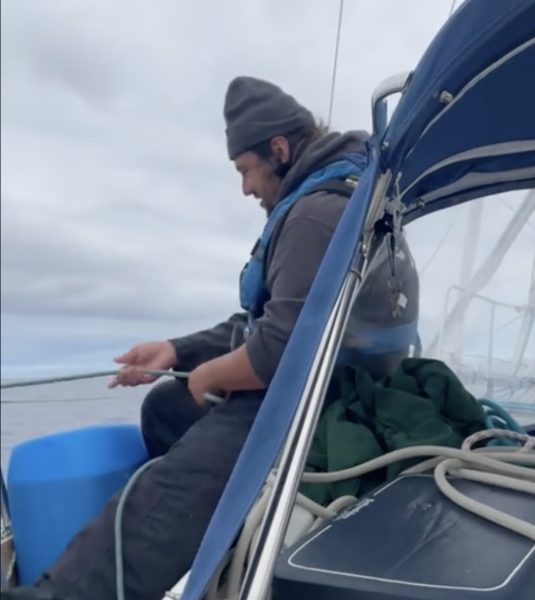
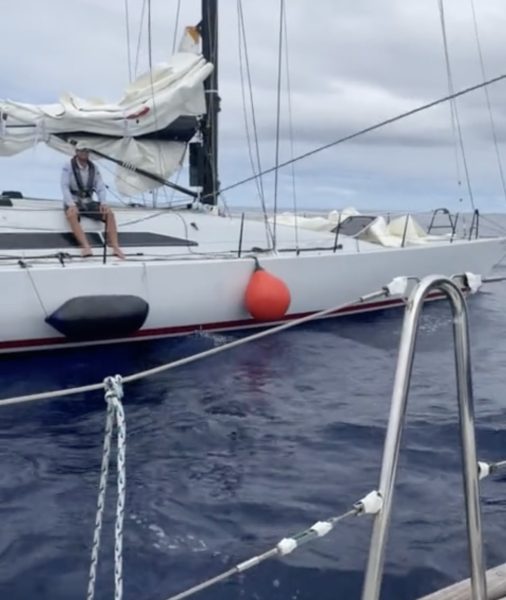
Merlin had also tucked a few surprises into the supply bag: freeze-dried food and, inexplicably and wonderfully, a box of fancy Chinese Mooncakes. The only thing they asked from Nota Bene in return was a six-pack of beer, which made its way back across the water in a small red shopping bag. We’d say Nota Bene got the better end of that deal.
Once everything was safely aboard and stowed, the three crew members each celebrated with a Mooncake. Jack drank the last remaining can of beer aboard Nota Bene, and then they pointed the bow east and, as Kimball put it, started “motoring like a banshee” toward San Francisco Bay.
The connection with Merlin didn’t end with the rendezvous. Her skipper Eugene continued checking in afterward. Earlier he’d caught a mahi mahi and sent over a picture, saying that if they’d known the two boats were going to meet, they would have saved some for Nota Bene. Later that day, Michael caught a tuna. Naturally, Eugene wanted a picture.
Apparently, once you’ve transferred 50 gallons of diesel between sailboats in the middle of the Pacific, exchanged beer and Mooncakes and helped another crew out of a potentially serious predicament, the next order of business is comparing fish.
There are a lot of things sailors prepare for before crossing an ocean. Nota Bene had experienced sailors aboard, sophisticated equipment and experienced navigation support ashore. But the Pacific has a way of reminding you that even the best planning can’t anticipate every combination of wind, weather and circumstance. Sometimes the most important backup system isn’t aboard your boat at all. It’s a race organization still looking out for its fleet and another crew willing to alter course to help. And on this particular day, it was a sailboat called Merlin appearing on the horizon with 50 gallons of diesel, propane, a cook stove, food and Mooncakes.
Thank you, Pacific Cup. And thank you, Merlin. That was one hell of a lifeline.
Kite Night — Tangling With a Spinnaker
Here we go again. This time at midnight. My spinnaker continues to play tricks on me. It has already fallen into the water twice on this passage, and both times I have had to climb the mast to rethread the halyard. Now it is tying itself into a most interesting-looking knot about the masthead and forestay. The trades are blowing 15 knots. Gusts are 20. A 6-foot swell is rolling through from the SW. About 1,300 miles from land, I have no option but to climb the mast and see if I can still save my kite.
Only 30 minutes ago I was happily working through a different problem. My friend Micky, captain of an Oyster called Mexican Wave, had just messaged me. Several other ships in her fleet had been complaining about having received foul diesel in the Galápagos. Knowing I had refueled there as well, she had been kind enough to pass along the warning. A quick glance through the glass of my engine prefilter revealed almost 3 inches of milky water had been collected. The very next time I ran my engine, the collected liquid would have overflowed and then been sucked into the fuel injectors. The incompressibility of water does not play well with the nature of pistons.
It was fortunate that I had an auxiliary fuel pump aboard. By carefully disconnecting the fuel input and return hoses from the engine, I was able to insert my aux pump inline. Keeping the existing prefilter inline as well, I had successfully created a fuel-polishing system that would allow me to filter my diesel by running the new pump for a few hours. Once finished, I would then easily change the filter, empty the collected water, reconnect the hoses, and then carry on rambling across the Pacific. Voilà! How proud I was in that moment.…
It was in the middle of the fuel-polishing process that I heard the spinnaker’s 900-square-footage luffing like someone swatting open a newspaper repeatedly. I sprang outside. Standing naked on deck with nothing but my harness and headlamp, I quickly regretted my careless decision to fly the great kite at night against the advice of other sailors. For now, my spinnaker was quickly becoming a winged pretzel.

Life Is Better With a Boat — Find Yours Today With Cruising Yachts