

Running Out of Gas On the Pacific During a Return to S.F.
Nota Bene is a Beneteau 411 sailed by a crew of family and friends. They describe themselves as an attorney, IT expert, business owners, and pros, chasing miles of the Pacific with skill and reckless abandonment. This is their story of their return to San Francisco after the 2026 Pacific Cup.
Two days ago, Nota Bene ran out of propane. More concerning, the diesel supply was getting dangerously low after burning far more fuel than expected trying to get north from Hawaii and around the Pacific High.
It wasn’t for lack of planning. Erica and the shore-side team had been working throughout the ‘Pac Back,’ studying weather, plotting routes and strategizing with the crew about the best path north and eventually east toward California. But this has been an unusual Pacific. Instead of the more typical broad summer high, they encountered shifting areas of little or no wind, including long, narrow fingers stretching hundreds of miles across their path. They sailed when they could and motored when they had to. Eventually, the fuel calculations became uncomfortable.
And diesel aboard Nota Bene isn’t just about propulsion. AIS, Starlink, autopilot, refrigeration and the boat’s other electronics depend on a bank of lithium batteries. Those batteries need to be recharged, and offshore that means regularly running the engine and its heavy-duty alternator. Without diesel, eventually a lot more than the engine stops working. Add an empty propane tank for cooking, and the situation was getting serious.
So the crew reached out to the Pacific Cup organization for help. And boy, did the Pacific Cup community come through. Two boats returning home from the race offered assistance. Merlin was closer and offered 50 gallons of diesel, along with a small cook stove and two bottles of propane. Nota Bene turned south and began motoring toward a rendezvous.
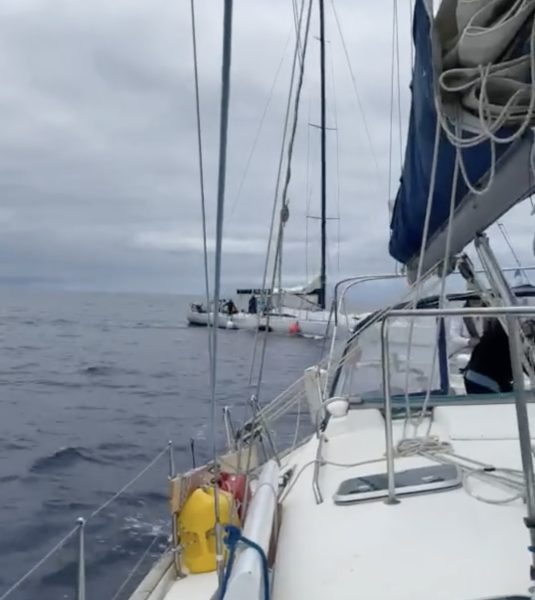
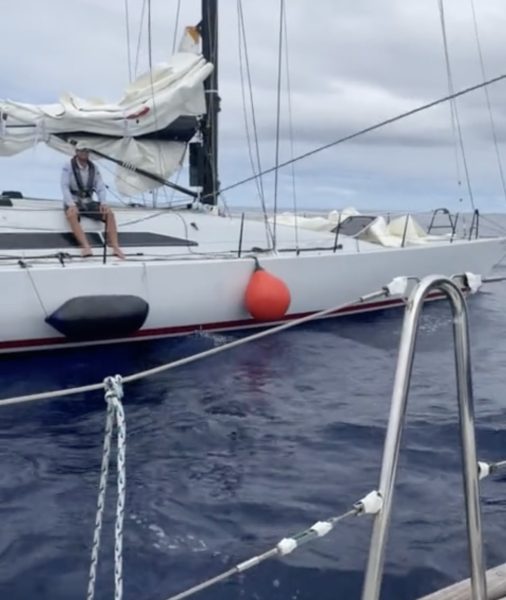
Late the next morning, Merlin first appeared on the AIS screen. Then Kimball spotted her on the horizon. The two boats converged, dropped their sails and motored slowly alongside one another through the slight wind and swell. Merlin’s crew used their main halyard to hoist a bag containing the stove and supplies, connecting it to a retrieval line Nota Bene had thrown over. Then, one by one, five 10-gallon jerry cans of diesel came across. Fifty gallons of fuel transferred between two sailboats in the middle of the Pacific, all accomplished in about 10 or 15 minutes.
“Easy-peasy,” according to Kimball, although the anxiety leading up to that moment had been anything but.
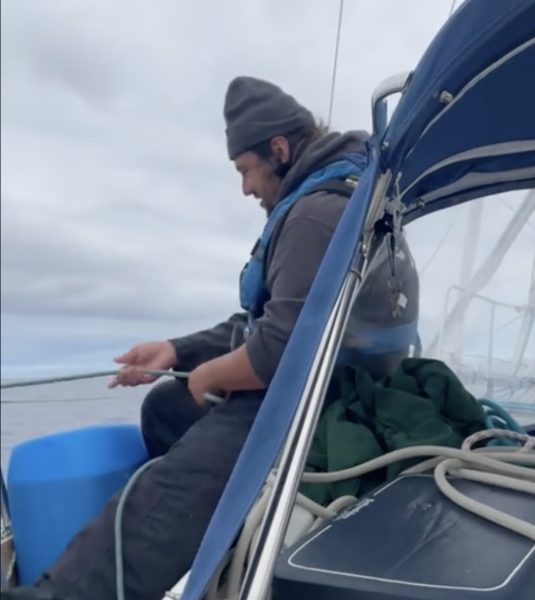
Merlin had also tucked a few surprises into the supply bag: freeze-dried food and, inexplicably and wonderfully, a box of fancy Chinese Mooncakes. The only thing they asked from Nota Bene in return was a six-pack of beer, which made its way back across the water in a small red shopping bag. We’d say Nota Bene got the better end of that deal.
Once everything was safely aboard and stowed, the three crew members each celebrated with a Mooncake. Jack drank the last remaining can of beer aboard Nota Bene, and then they pointed the bow east and, as Kimball put it, started “motoring like a banshee” toward San Francisco Bay.
The connection with Merlin didn’t end with the rendezvous. Her skipper Eugene continued checking in afterward. Earlier he’d caught a mahi mahi and sent over a picture, saying that if they’d known the two boats were going to meet, they would have saved some for Nota Bene. Later that day, Michael caught a tuna. Naturally, Eugene wanted a picture.
Apparently, once you’ve transferred 50 gallons of diesel between sailboats in the middle of the Pacific, exchanged beer and Mooncakes and helped another crew out of a potentially serious predicament, the next order of business is comparing fish.
There are a lot of things sailors prepare for before crossing an ocean. Nota Bene had experienced sailors aboard, sophisticated equipment and experienced navigation support ashore. But the Pacific has a way of reminding you that even the best planning can’t anticipate every combination of wind, weather and circumstance. Sometimes the most important backup system isn’t aboard your boat at all. It’s a race organization still looking out for its fleet and another crew willing to alter course to help. And on this particular day, it was a sailboat called Merlin appearing on the horizon with 50 gallons of diesel, propane, a cook stove, food and Mooncakes.
Thank you, Pacific Cup. And thank you, Merlin. That was one hell of a lifeline.