

Saying Yes to an Unexpected Call To Crew the Ficker Cup
I was sitting at dinner when my phone lit up.
“How much do you weigh — and are you in town this week?”
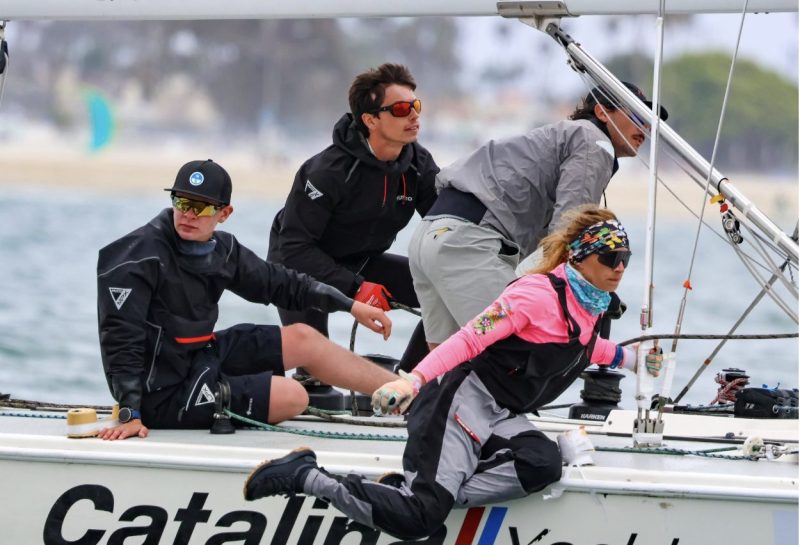
The call was from Ryan Sanders. He was talking with Tom Picot, who needed a last-minute foredeck for the Ficker Cup [April 23–24]. They were looking for 190 pounds. I’m 129. A week later, I was on the boat.
That’s the part everyone sees. What they don’t see is the five years before that.
For nearly five years, I tried to get into match racing in a real way. Rankings, events, teams — it always felt just out of reach. Not because I couldn’t sail, but because there wasn’t a clear path in. Especially in the US. Especially if you weren’t already part of a program. Especially if you weren’t willing to wait.
So I stopped waiting.
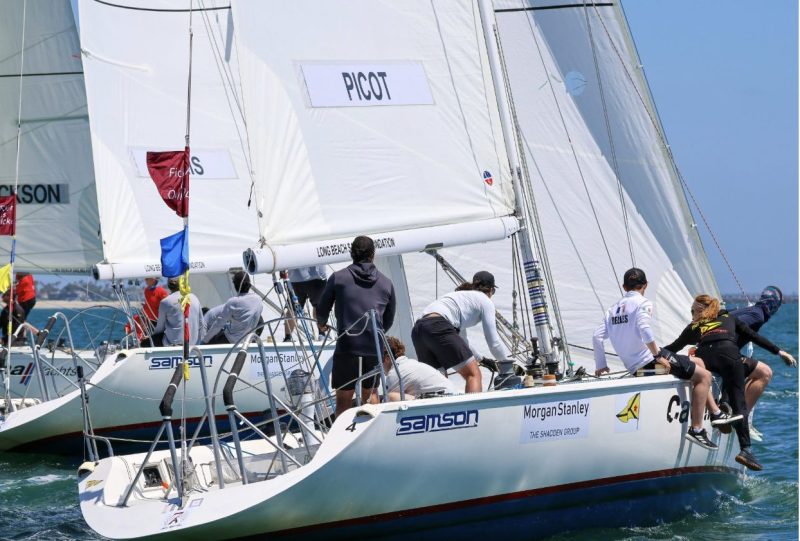
If the door wasn’t open, I’d build something next to it. That’s where the pop-ups started. Clinics. Friday match-racing days. Whatever I could piece together at Long Beach Yacht Club with the boats and people we had. It wasn’t polished. It wasn’t perfect. But it was reps. And reps are everything.
I wanted in. And I wasn’t taking no for an answer anymore. So when that text came through, there wasn’t really a decision to make.
What I thought was an Australian team turned into a French-speaking group chat within minutes. I was translating messages, figuring out who was even in the country, and realizing I’d just stepped into an international team coming from France, New Caledonia and New Zealand. I didn’t understand a word. Didn’t matter.
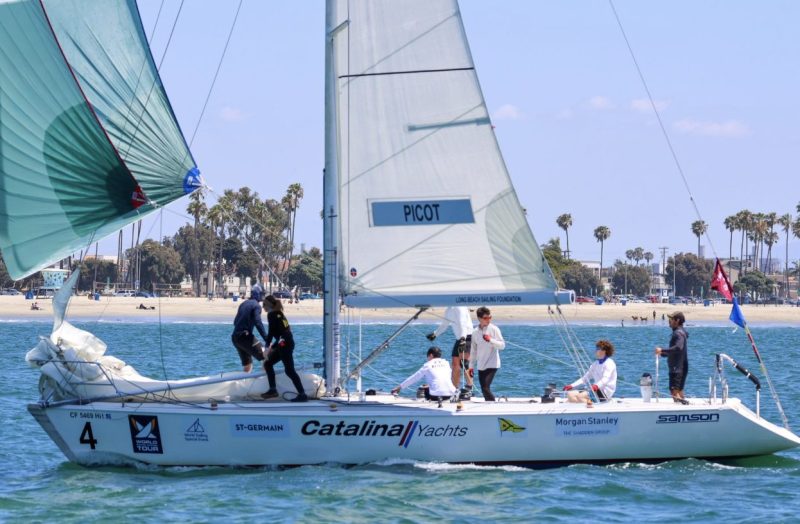
We met Thursday morning. Weighed in. Signed papers. Walked straight to the dock. And then everything flipped.
They had never sailed a Catalina 37. I had. These boats don’t exist anywhere else. If you haven’t sailed in Long Beach, you haven’t sailed them.
So there I was, the last-minute fill-in, now explaining rigging, systems, the symmetrical kite, dip pole, timing … everything that doesn’t show up on paper. This would have been Tom’s third time driving a wheel boat. And it didn’t matter.
That’s the thing about high-level sailing. You don’t wait to be comfortable. You get up to speed, fast. Practice was messy. Not bad. Just off. Timing a half step early. A half step late. Nothing major, but enough to lose races. “Tack and set.” “Port layline.” That was it.
By the end of the day, we had it — motion, timing, all of it. At some point, it stopped being about where anyone was from, or anything else for that matter. They forgot I was even a woman, until the bucket started making its way up the hatch. And even that just turned into a laugh.
Friday came fast. No sleep. Just running through systems in my head, hoping I had covered enough. First race. Port entry. Suddenly I’m hiking in a dial-up with a team I’d met 24 hours ago. No time to think. The first races weren’t clean. We hit marks. We were over early once. Simple mistakes. But at this level, that’s the race.
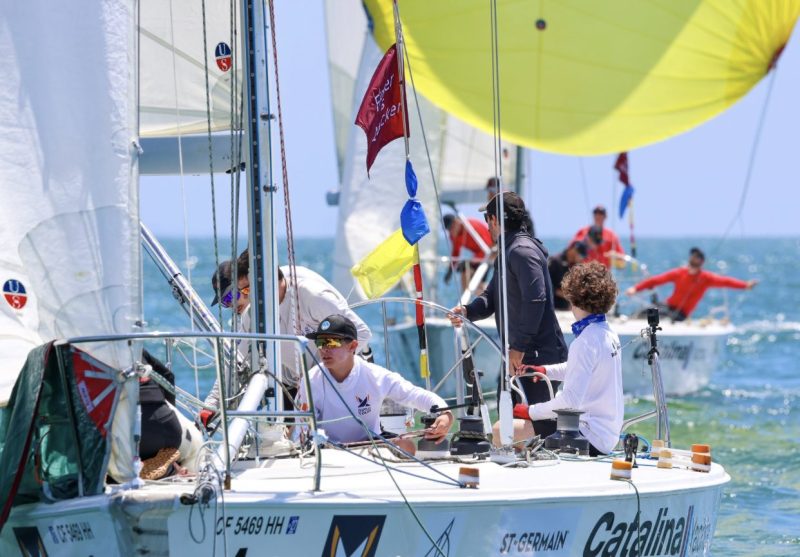
Then it clicked. We lined up against Scotty Dickson. Pre-start slowed everything down. You feel it more than you think it. Tom shut the door early, forced Scotty out, and we were gone. Clean start. Clean acceleration. Ten lengths. Then 15.
But it’s never over. They clawed back. Five lengths. Then three. Covered us all the way down the final leg. We held. Crossing that line wasn’t just a win. It was proof. We weren’t chasing the level. We were in it.
Day two showed the other side. We were ahead again in one race, managing the second leg cleanly. At the top mark, we made a move that used to be standard — engaging at the rounding. Rules changed. Inside the zone, you sail proper course now. We got penalized. Race gone.
Later that day, contact with another boat cost us -0.5 and ultimately knocked us out of the top four. No finals.
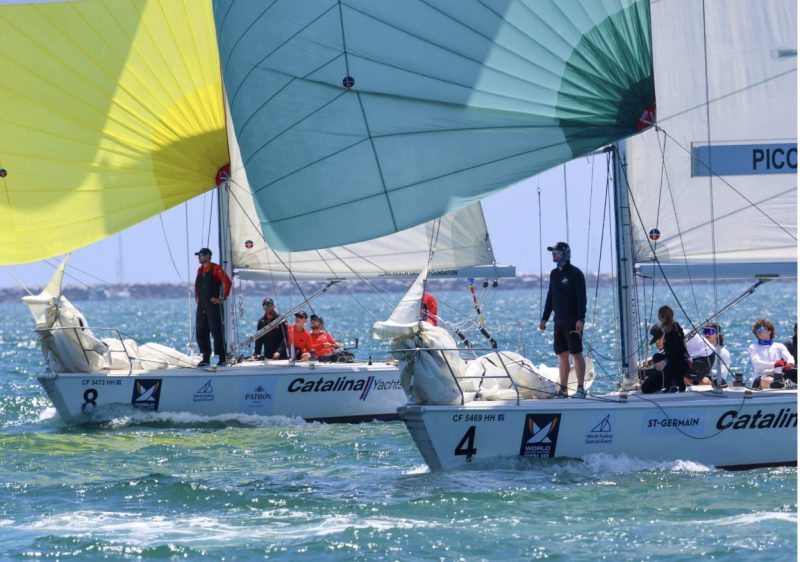
That’s match racing. Not about big mistakes. About when they happen. We had the speed. The skill. The ability. We just didn’t put it all together when it counted.
Sunday, we were off the water. Sitting at dinner with a group that had been strangers just two days before and now felt like family.
The next French team, friends of Tom and the crew, was arriving for the Congressional Cup. We wouldn’t be there to share it. That part stung.
But it also made one thing clear: We’d all be back.
I’ll sail with anyone; doesn’t matter what country they’re from. I’ll be back for the Ficker Cup. And yes, the Congressional Cup. Skipper or crew, I’ll get there. This is my path. I’ve got a long runway ahead, and I’m not slowing down.
It’s Never Too Early To Think About Rolex Big Boat Series
The Rolex Big Boat Series released the following press release on May 2, detailing information on the 2026 edition of the regatta and the early-bird discount on event registration.
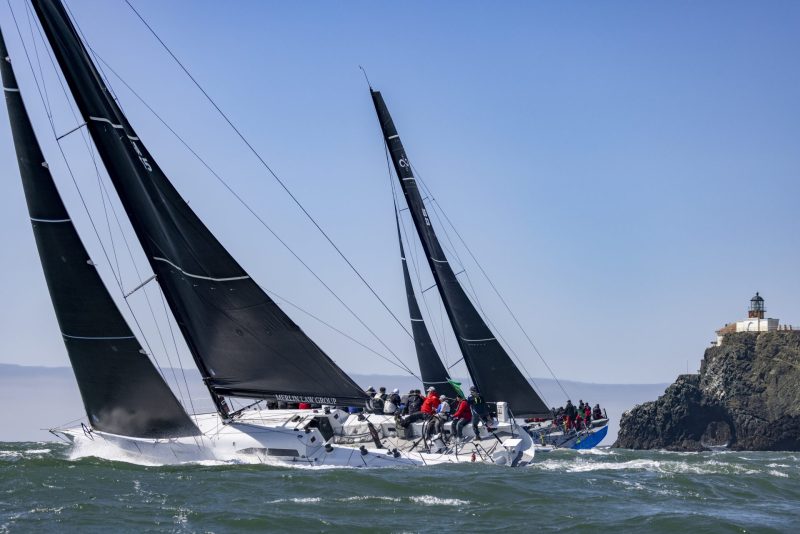
May 15 marks four months until the first starting gun of the West Coast’s most anticipated annual regatta, Rolex Big Boat Series, scheduled for September 16–20, 2026, on San Francisco Bay. May 15 is also the early-entry deadline when skippers can enjoy a great discount on registration.
Already, 30 teams are signed up to compete in this year’s Rolex Big Boat Series, which will double as the 2026 Offshore Racing Congress (ORC) North American Championship. Early entrants include Rolex Sydney Hobart division winner Bacchanal and a fully refitted Santa Cruz 52, Rosebud. We caught up with both skippers to learn more about their race preparations.
FEAR OF MISSING OUT IS OVER FOR BACCHANAL
Rolex Sydney Hobart division winner, JPK 11.80 Bacchanal, is owned and skippered by Ron Epstein, and he’s eager to see how his new boat performs in a race he knows well, having podiumed in 2023 and 2024 with his J/133 of the same name.
“I had a serious case of FOMO watching RBBS from shore in 2025, and I am so excited to be able to sail Bacchanal back in our home waters against such excellent competition,” said Epstein. “Having the ORC Championship hosted by RBBS this year is exciting and motivating, and should bring the best out of all the sailing teams,” he added, noting that his crew will be well seasoned and in tune with their boat come September, having raced over 2,000 miles together in the past year.
“I am most looking forward to getting back on the racecourse with what we learned about ourselves and our boat in Australia and [seeing] how we do!”
BACK FROM THE DEAD: ROSEBUD
The first crew to commit to the 2026 RBBS was that of the recently restored Santa Cruz 52 Rosebud. The boat won the 1999 iteration of the regatta and returns to RBBS for the first time in over two decades after a “brought back from the dead” refit by owners Blaine Pedlow, Bruce Edwards, Mike Holt and Rob Woelfel. The team was eager to sign up for this year’s race to show off the stunning refit, and also to celebrate their longtime friend Susan Ruhne, who is the 2026 commodore of St. Francis Yacht Club.
“Many of us grew up with RBBS as the pinnacle racing event on the California calendar,” said Pedlow. “We have all been lucky enough to compete against each other all over the world, so it’s pretty special for us to sail together in the amazing sailing amphitheater at St. Francis Yacht Club.”
CALLING ALL BIG BOATS
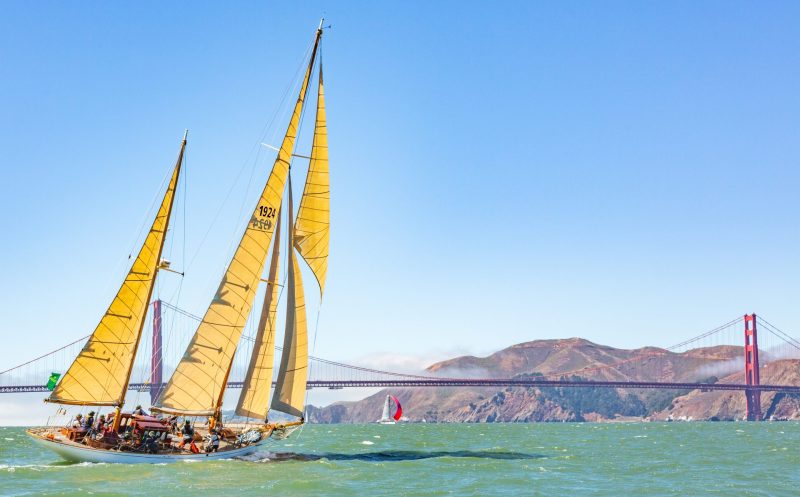
RBBS is known for its iconic setting, its challenging racecourses that send sailors to all corners of San Francisco Bay and for drawing competition that fights all the way to the finish. This year that fight will be extended beyond the Golden Gate for the ORC divisions with the addition of a longer-distance Coastal Race on nearby waters and Gulf of the Farallones, weather depending.
“We are very excited to host the second-ever ORC North American Championship, and to welcome as course race officer Eckart Reinke, an authority on ORC rules who has led numerous ORC World and European championships,” said Felix Weidling, St. Francis Yacht Club’s race director. “With our new course-setting tool introduced in 2025 and the MarkSetBots, we can select and set higher-quality courses tailored to the conditions and the fleet. Responding directly to sailor feedback, we will now schedule up to three races per day. Ten races are planned for all one-design classes, six races for all ORC divisions and four races for the Classics.”
Big boats are encouraged to take advantage of this year’s support-boat program. Race organizers will work with deeper-draft vessels to find suitable berthing, and they are encouraged to register their support boats to receive dedicated docking in the marina adjacent to St. Francis Yacht Club, allowing captains and crews to fully partake in the social scene, nightly events and clubhouse amenities. Furthermore, recent dredging of the harbor will be fully completed by race time.
“We are committed to providing an outstanding shore experience for all competitors, and part of the experience is attending morning weather briefings, having coffee and breakfast in the Regatta Plaza, and socializing with other sailors after a long day of racing at our nightly parties,” said Nadine Franczyk, regatta chair.
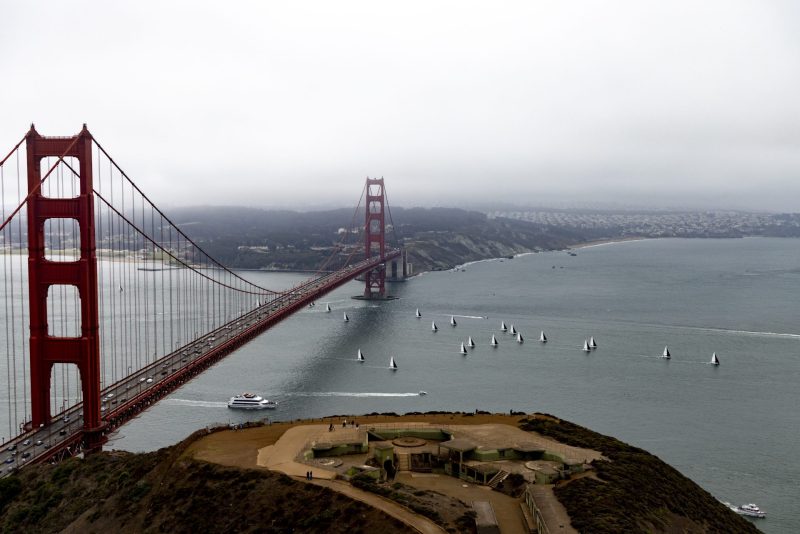
THE 2026 REGATTA IS OPEN TO:
One-design boats from the J/88, J/105, Cape 31 and Express 37 classes. Other classes with a minimum number of entries may be considered with application to the Organizing Authority.
ORC monohulls with an LOA ≥ 30 feet. ORC boats are required to have a current valid ORC International certificate issued by any national rating office. US boats can apply HERE.
Classic boats built using traditional wooden plank-on-frame construction with an LOA ≥ 40 feet and a current ORREZ rating certificate. For the avoidance of doubt, cold-molded construction boats shall not qualify.
Boats registering after May 15 will be charged the regular fees; late fees kick in after July 31 and registration closes September 1.
Visit Antioch Marina, the Gateway to the Delta

Remember the Feeling of Screen-Free Sailing?
One of the great attributes of sailing is leaving all the mayhem of digital distractions ashore. Sailors often describe being fully present and engaged in the act of sailing as a reason they find both escape and pleasure in it. This remains true in small boats and most dinghy sailing, but as technology continues to force its way into our lives, it has also taken over a significant portion of our sailing lives. Screen time is no longer something you only have ashore.
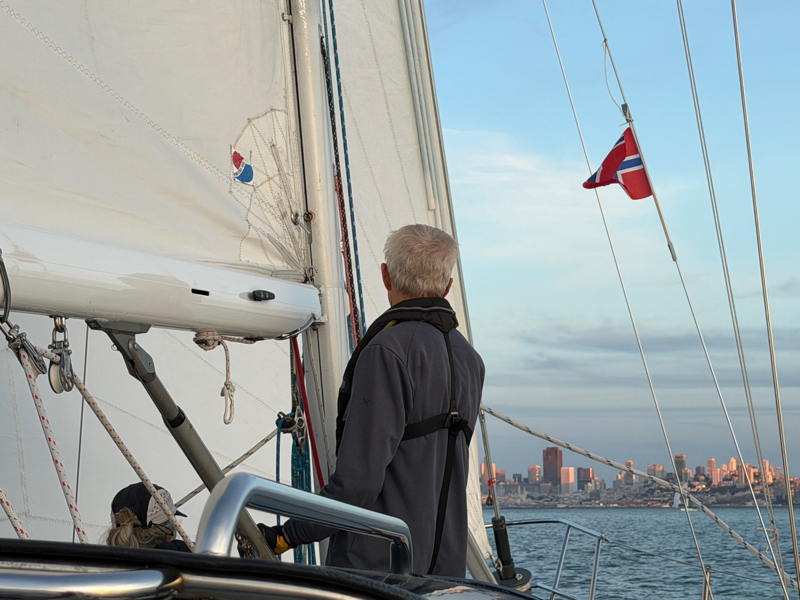
Screen time is seen as time using a phone or social media. But what about all the screens that distract us while sailing? We find them a mixed blessing. There are numerous times we appreciate our chartplotter, autopilot and wind and speed instruments, plus the various apps on our phone. But we can also get saturated with all this screen input pretty quickly. It can help keep us safe and can help us go in the right direction when racing, but it also dulls our senses as we try to “feel” the wind and current.
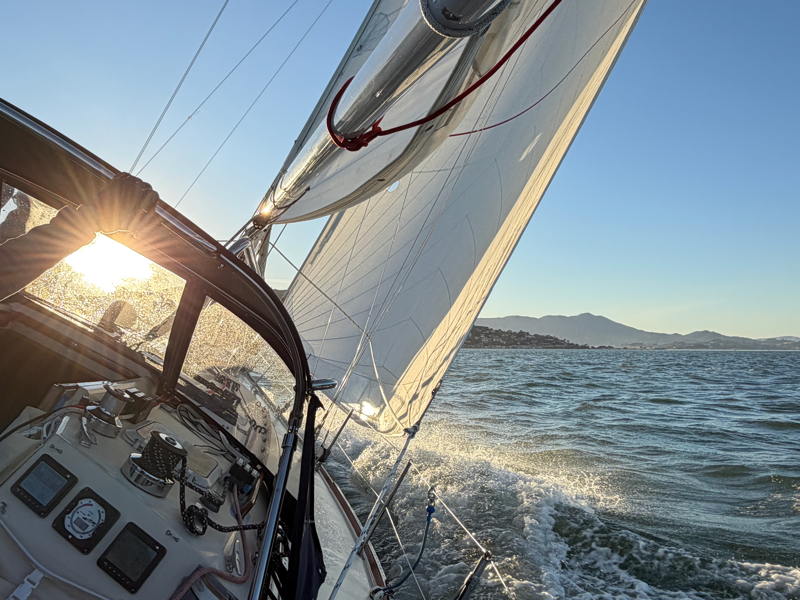
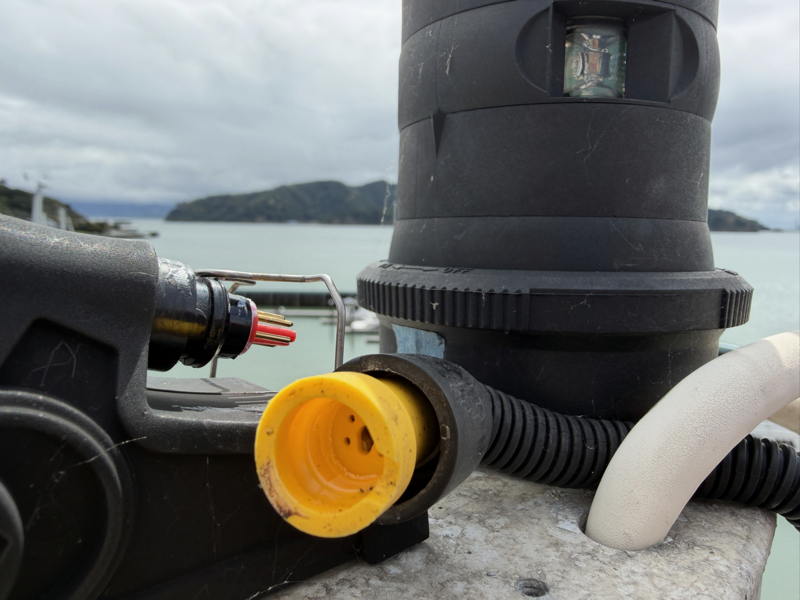
We thought about this more as we tried to fix our failing Simrad AP28 autopilot. We’ve cleaned wire leads, replaced the rudder reference unit, and reset the unit, and after a while, it feels like being at the office fussing with the computer rather than sitting on a sailboat. The same with our Simrad anemometer, which has been working fine, but for some reason, the wind-direction indicator started failing. A trip to the masthead and disassembly to clean the leads, and we successfully killed the windspeed too. The trip up the mast was made easier by a different e-tool: The electric Ewincher winch handle made it easy to get up the rig.
Our electronics failures are slowly working us backward to a simpler time when we simply looked at the yarns on the shrouds and the ripples on the water to sort out the sailing conditions. Just like when ashore, we find one of our favorite buttons on just about everything is the “off” button. Shutting the engine down, turning the phone off, or just sailing with the wind and water is a great way to enjoy the moment.
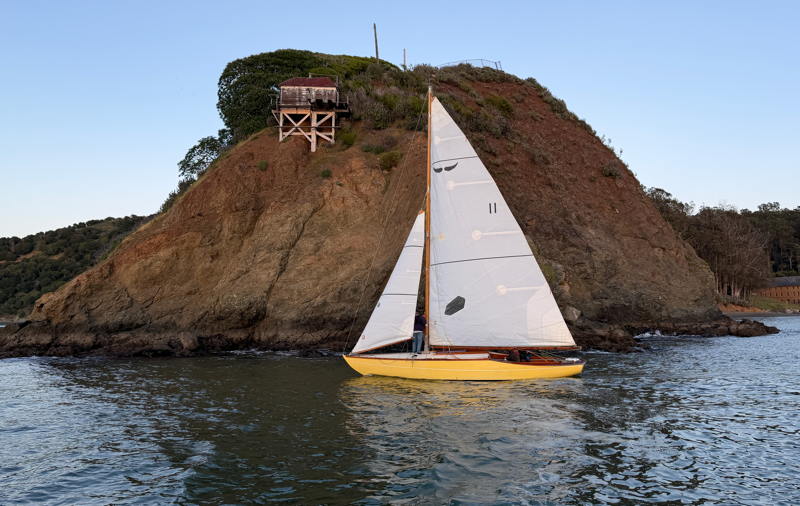
We’re told we use only about 10% of our brains, and we’re guessing we similarly use about 10% of the features offered on our digital devices. We really appreciate having them, especially when they work, but we also like the time when the screens are off and life is at its fullest. It’s also why learning to sail in smaller boats is so powerful. Engines, instruments, winches, radios and all the rest are a real distraction from understanding how to move a sailboat through the water.
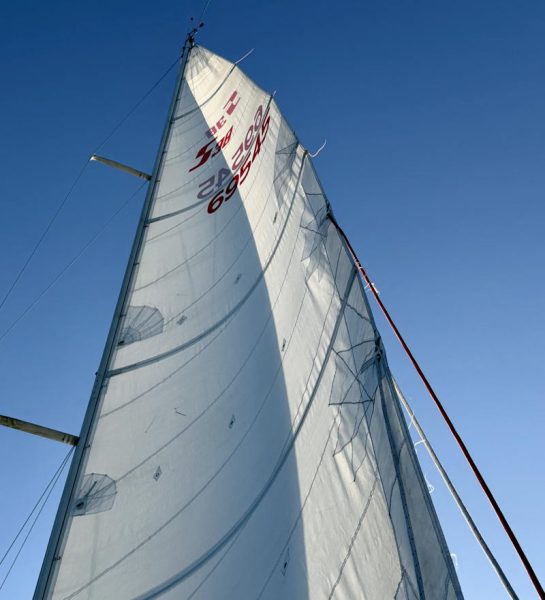
Adding electronics to your sailing later can increase safety, speed and convenience, but the real soul of sailing emerges when your mind and body are connected to the physical elements of sailing.
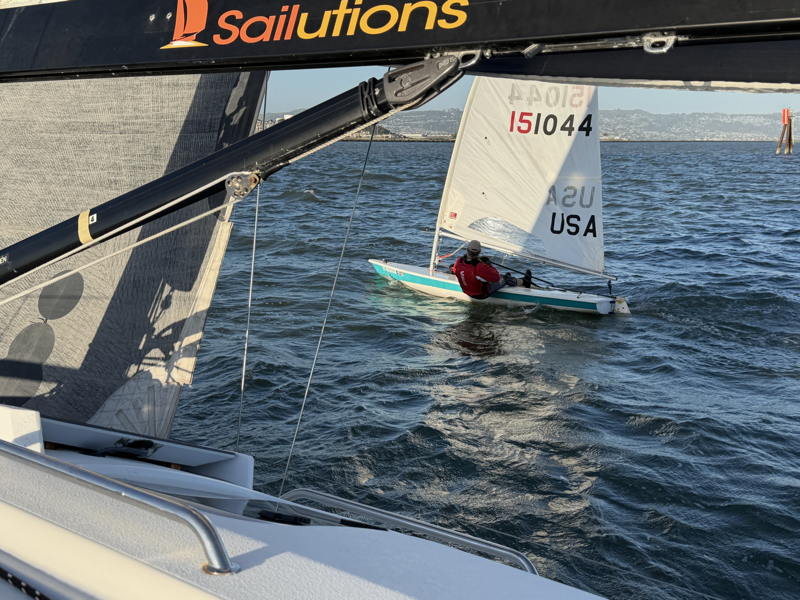
Sometimes it’s good to remember that you have to disconnect to connect.
Teak Yachts, and the Changing World of Boatbuilding
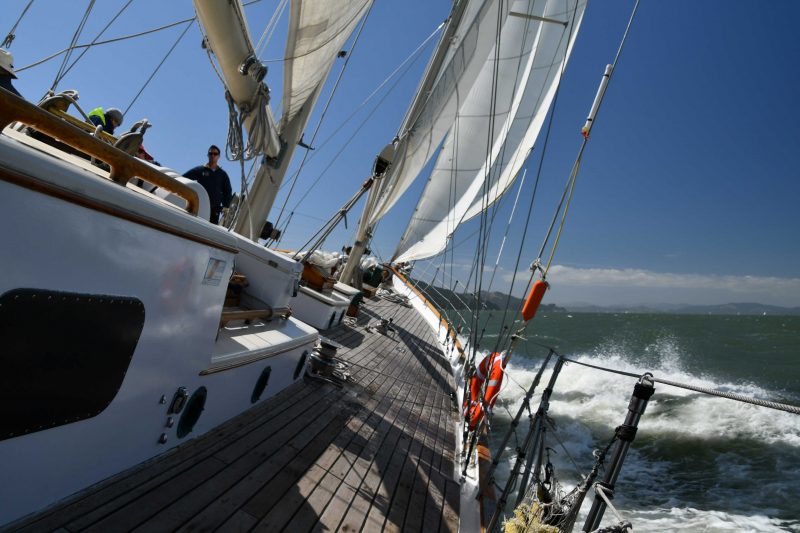
The May issue of Latitude 38 is on the docks. Unfortunately, with an error. In our page 56 feature, “Teak Yachts, and the Changing World of Boatbuilding” we captioned a photo of Call of the Sea’s schooner Seaward saying her decks were made of teak. That is incorrect. Seaward’s decks are made of fir, and the photo was in place to illustrate how timbers other than teak can be used to build a beautiful and long-wearing deck. We offer our apologies to the story’s author, John “Woody” Skoriak, and to our readers. Perhaps we can further explain the differences between teak and fir in a future story. In the meantime, if you haven’t already done so, please enjoy Woody’s story on teak yachts and the changing world of boatbuilding.
Not even billionaire Jeff Bezos could completely avoid penalties for breaking the law recently — or at least the company that built his yacht couldn’t. But the issue had nothing to do with transporting drugs or migrants, illegal fishing, or even an oil spill. The offense? Using teak. Prosecutors fined the Dutch yacht builder Oceanco $157,000 recently after it was discovered they had used teak from Myanmar for interior furnishings aboard Bezos’ 417-ft sailing yacht Koru, delivered in 2024. The fine followed a two-year investigation under the European Timber Regulation (EUTR), which prohibits the import of illegally harvested timber and requires companies to verify the legal origin of wood products before placing them on the market.
In this case, the teak had been purchased through a Turkish woodworking company, and investigators concluded that Oceanco had failed to properly verify the timber’s origin; it was therefore impossible to determine whether the wood had been legally harvested. No one is going to jail, but it does raise an eyebrow. Get fined for using teak on a yacht? The story highlights a much larger shift underway in boatbuilding — one that touches on environmental regulation, materials science, tradition and the changing economics of yachts.
Read.
Reading Latitude 38 Is Good for Your Health!