
True Test of Skills: Kasio Cup at South Beach Yacht Club
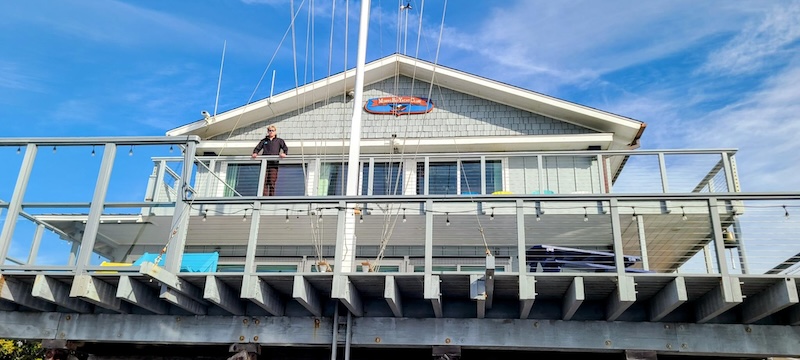
South Beach Yacht Club (SBYC) has debuted what may become the new “must-do” regatta for San Francisco Bay racers. Debuting March 14–15, the Kasio Cup PHRF-rated competition comprised four starts, with three short heats on day one and a long run on day two. Competitors faced skills challenges: Saturday dictated that all racers either stage a 720-degree turn on one race leg, or do six tacks on a leg. For Sunday’s pursuit, spinnaker-division sailors were tasked with executing a 720-degree turn (twice around) on at least one leg of their choosing. Luke O’Malley, vice commodore of SBYC, admits this event is a tongue-in-cheek response to the Rolex Big Boat Series. “We wanted to create an event that felt distinctly South Beach and competitive on the water, but a little less formal, more playful, and open to creativity.”
Late-winter conditions do not always yield rip-roaring race speeds on the Bay, so with the AP flag already flying, PRO Suni Petersen knew flexibility would be needed, courtesy of Saturday’s 0–1.4-knot breeze and 2.9 ebb forecast. Saying to herself, “This race is never going to happen,” Petersen sprang into action by kicking off with an announcement over the radio: All boats, turn your engines on and get to the windward mark. “It was really funny, they were all rushing to turn on their engines. Some radioed with, ‘What speed can we go?’ to which we answered, ‘Any speed you want.’” Once to the windward mark, racers caught the ebb and floated toward the finish between the pin and the RC boat. Not every boat crossed successfully. The Sea Scout vessel Georgie Girl drifted over sideways, as did several others. Another reached the leeward mark (located near the Bay Bridge), but with the current pushing its stern over, went stern-first around the leeward mark; conditions were even more punched-up with Sunday’s 3.1 ebb. In fact, a day’s act of heroism saw the mark-set team rescue a fatigued kayaker caught in the ebb.
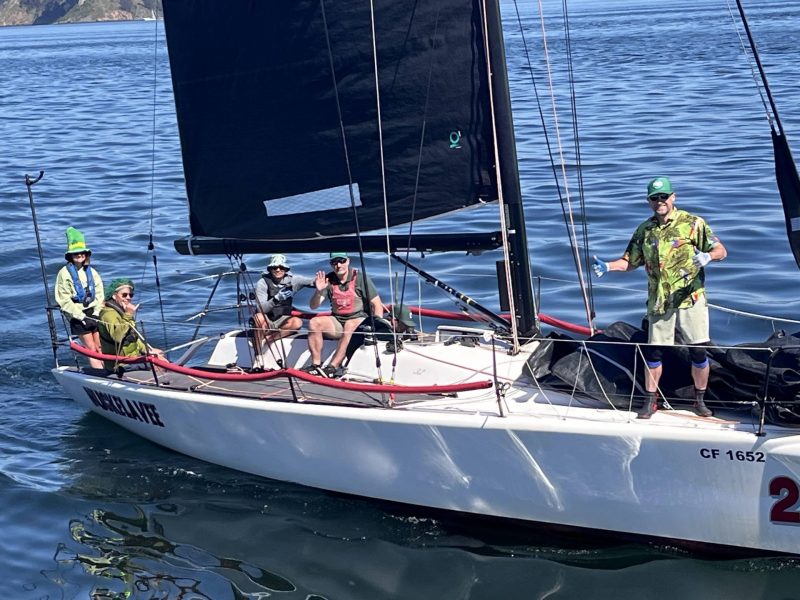
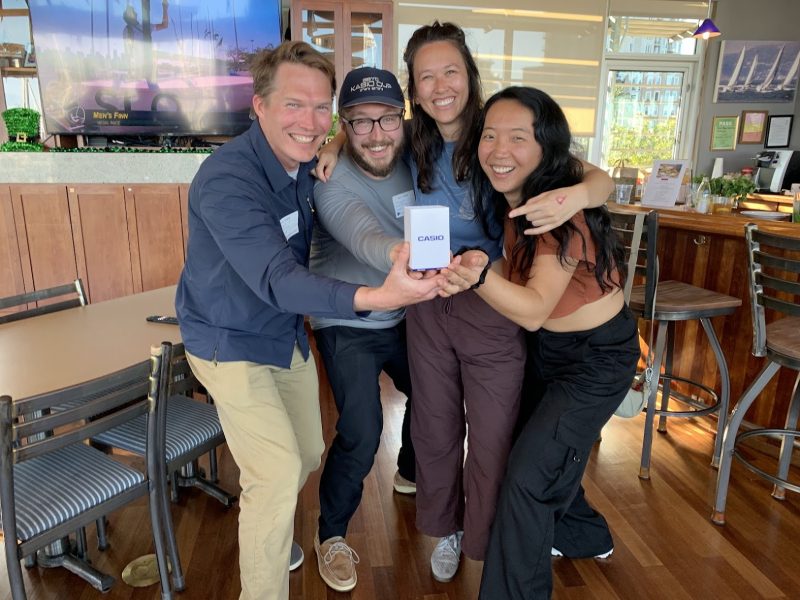
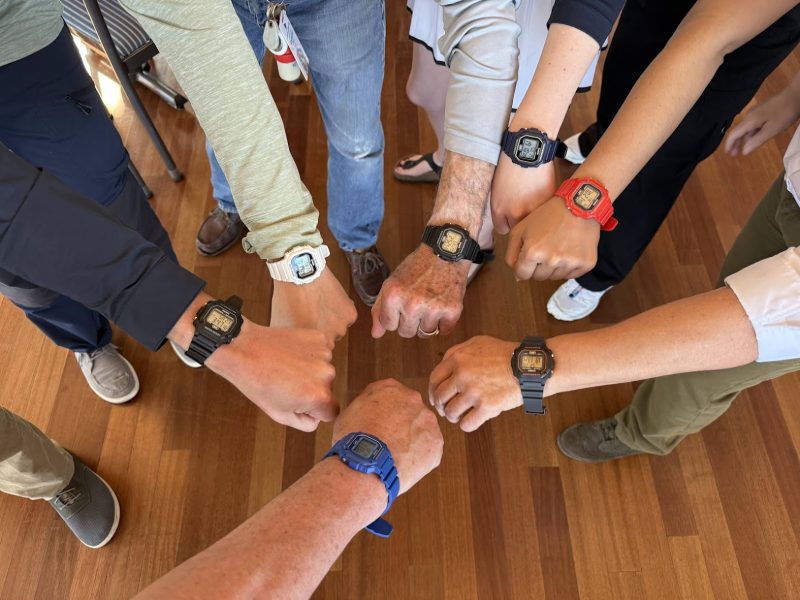
Awarded that weekend were seven Casio watches, chosen for durability and masterful performance in harsh environments, just like SBYC sailors. In Saturday’s Non-Spinnaker division, Fog Dog (Chris Nicholson, Catalina 32) took first. Second was earned by Parisian (Raymond Schulz, Ericson 35), and third went to Georgie Girl (Diana Teves, Mariner 36). The Saturday Spinnaker division saw Mermug (Zack Phillips, Beneteau First 42s7) claim first. Butcher (Dave Corbin, J/88) nabbed second, and third went to Nuckelavee (Pearl Prisco, Melges 32).
The Sunday Pursuit Race was won by Pressure Drop (Richard Bryant, Beneteau 36.7), with Fog Dog earning second and Mermug sailing to third place. O’Malley and organizers’ objectives were achieved, reporting ample fun chaos on the course, plus masterful flexibility from RC staff, who decided to mark the occasion with a special award class. “In addition to first, second and third prizes, we rewarded racers based on what actually happened out there, including ‘Most Creative Way To Round the Leeward Mark,’ given to the boat rounding stern-first, and ‘Best Use of Crew,’ handed to Butcher for rocking his vessel to the mark,” cited O’Malley.
SBYC rear commodore Corbin (also skipper of Butcher) summed up things: “The Kasio Cup is named as an antithesis of the Rolex Big Boat series and carries significant meaning. I’ve raced both, but the tactics varied significantly; for example, rocking the boat to get to the mark and developing new skills to get through extreme current and low wind. Most races would have been canceled, but we all pushed through with enthusiastic vigor and creativity.” Andi Orion, Northern Light, Santana 35, lauded organizers for turning a no-wind day into a fun race to the finish, despite being at the mercy of the current. “It was the first time seeing two boats on the same leg pointing in opposite directions. We love racing with SBYC because they think outside the box and make any day on the Bay beautiful; we had never heard of people turning on the engine at the start line.” The crew’s grinder, Duke Austin, quipped, “The age of sail taught us patience. The age of engines taught us power. Today we raced with both.”
Tom Ehman Responds: RNZYS — “Worst Trustee in the History of the Cup”
It would be an understatement to say people have opinions about the America’s Cup. One important opinion about the Cup is from San Francisco resident and St. Francis YC member Tom Ehman, who was involved in the Cup from 1980 and served as executive director of the SDYC and GGYC Cups. He has intimate knowledge of the Deed and the many legal challenges that have arisen over time. In 2013, he was spokesperson for Larry Ellison’s victorious 2013 Cup on San Francisco Bay. You may still have an America’s Cup pin from one of the many talks he did at local yacht clubs. Following John Sweeney’s filing with the New York attorney general, Ehman issued this statement this past weekend on his Sailing Illustrated Facebook page:
STATEMENT
Further to John Sweeney’s complaint filed with the Charities Bureau of the NY State Attorney General, here is the key phrase in the America’s Cup Deed of Gift:
“It is distinctly understood that the Cup is to be the property of the Club subject to the provisions of this deed, and not the property of the owner or owners of any vessel winning a match.”
In clear violation of the Deed of Gift and NY State law, the Royal New Zealand Yacht Squadron have delegated their trustee duties and responsibilities — hence “ownership” of the Cup — to their winning team, Emirates Team New Zealand. In turn, ETNZ have “sold” the Cup to a new corporation, America’s Cup Properties (ACP), which by their own admission was established for the express purpose of commercially exploiting the America’s Cup, again, clearly contravening the Deed.
As I have been saying for over a year, RNZYS is without doubt the worst trustee in the history of the Cup. The powers that be in NY State should remove RNZYS as the Trustee, and return the Cup and trusteeship to the original trustee, New York Yacht Club, so that the America’s Cup is restored in strict compliance with the Deed of Gift.
Thomas F. Ehman Jr.
San Francisco, 28 March, 2026
You may have your own opinion, but the one that really matters is that of the New York attorney general, who has assigned case number 26-020937 to Sweeney’s complaint against RNZYS. Like us, we think many sailors are feeling the loss of the Cup as a part of the sailing community. Many feel it’s been caught up in the financialization of everything, where the Cup has just become another “asset” to be monetized. Like the youth sports industry, family farms or the “wedding industrial complex,” the America’s Cup has shifted away from tradition to become another sports spectacle where success is measured in dollars rather than sailing skills.
There are arguments to be made around any of these feelings. Is the tradition of the Cup sailing or technical innovation? Does it matter if there are sailors on board powering winches or are batteries OK? Would it be OK to have a robot ride a horse in the Kentucky Derby? Does the horse win or the jockey? We listen to and understand many of the perspectives, but at the end of the day, we feel a loss of something that was meaningful to us. It may be generational nostalgia that has too strong an attachment to the past, though it truly connects to the sailing we think most sailors still enjoy every day on San Francisco Bay.
The loss of sailing and sailors from the Cup is nothing against foiling. We’ve loved seeing the dynamism brought to the Bay with kite-foiling, wing-foiling and even SailGP foiling. That’s an aspect of the eclectic world of sailing, but to us, it’s nothing to do with sailing in the America’s Cup.
Regardless of our opinions, the America’s Cup Deed of Gift, written in 1857, remains as controversial as our Constitution, written in 1787. Collective decision-making is messy. So the debate continues, and at its foundation, we see a debate of the Cup as an industry versus the Cup as a sailing tradition. We like sailing for all the reasons we continue to sail regularly. We’ve made our living in sailing, but if the only reason to be in sailing is to “maximize shareholder value” we think sailing loses something.
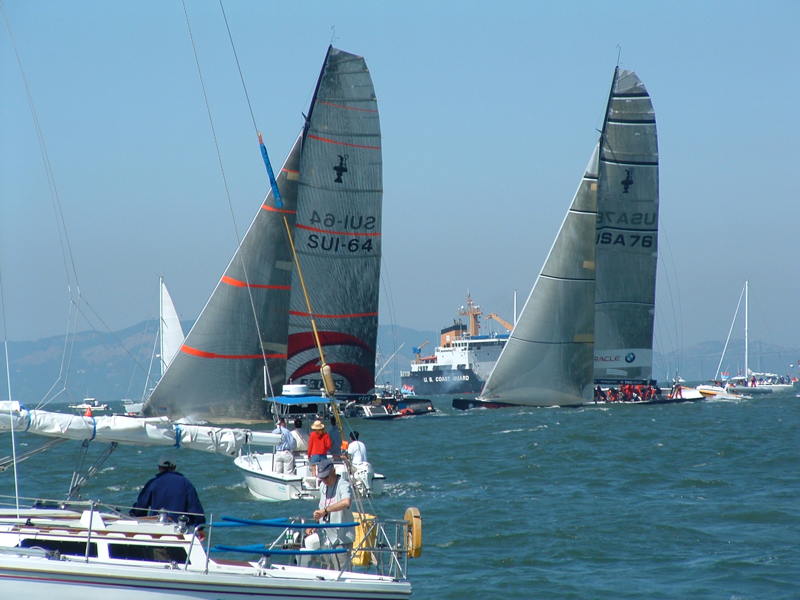
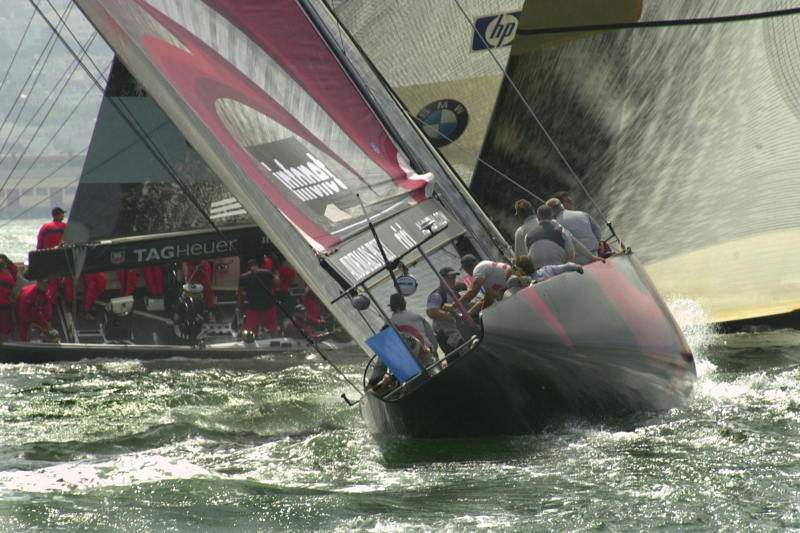
The 2003 Moet Cup on San Francisco Bay, held between Larry Ellison and Ernesto Bertarelli in their IACC boats, was a sailing event loved by sailors. It’s interesting to read some of the comments from Ellison and Bertarelli from that era. You can see some pre-race comments here and a view of the racing here. Those were “the good old days” of racing sailboats with sailors on board the IACC boats. (By the way, Brad Webb’s USA76, which has been chartering for years out of Pier 39, is currently for sale at Rubicon Yachts.)
Tom Ehman went on to clarify some additional comments. One commenter asked what the difference is between the America’s Cup Properties formed by the NYYC in 1983 after they lost the Cup and the new ACPI currently managing the Cup. Ehman responded, “ACPI was formed by NYYC and RPYC after RPYC won the Cup in 1983. It is a perpetual not-for-profit corporation to hold the Cup name, image and likeness, and related IP rights, in accordance with a ‘Pre-Incorporation Agreement’ set forth by NYYC shortly after the 1983 Cup. Every winning Club since 1983 has been required to sign an ‘Assignment and Acceptance’ agreement as set forth in the Deed of Gift, guaranteeing that the Cup would be run in accordance with the Deed, ACPI, etc. In short, ACPI transfers the IP rights with the physical possession of the Cup to the winning club. Yes, I ‘ran’ ACPI as head of ACOC (SDYC’s org cte), and then again for GGYC. There’s not much to it aside from annual corp filing fees and tax returns, as well as preparing and executing licensing agreements from ACPI with the various competing clubs and teams in a given Cup cycle. ACP, on the other hand, is a corp recently formed by the representative teams of the Defender, Royal New Zealand Yacht Squadron (RNZYS), and the Challenger of Record, Royal Yacht Squadron (GBR), for the stated (by them) purpose of managing all aspects of 38th America’s Cup AND BEYOND (emphasis added — a clear violation of the Deed and NY Trust law). ACP is run BY THE TEAMS (not the Clubs, yet another clear violation of the Deed) for the development and exploitation of AC commercial rights, etc. I, and many others, assert that ACP is in and of itself clearly contrary to the Deed of Gift and NY Trust law. It remains to be seen whether the NY State attorney general will take up the related complaint by John Sweeney, and whether the matter ends up in the NY courts.”
Another commenter suggested all this could be set aside because of the “mutual consent” phrase in the deed, to which Ehman responded, “Sorry, but your assertion is false. Only ‘conditions of the match’ may be agreed by mutual consent. Not amendments to the Deed. Yours is a common misunderstanding.”
The ball is in the New York attorney general’s court. It will be interesting to see how RNZYS responds and where it goes from here. Now that this has been cleared up, it’s time to go sailing.
Haven Boatworks: Full Service Boatyard in Port Townsend
Taking a Relaxing Hammock Snooze With the Resourceful Sailor
What do a 1985 Pacific Seacraft Flicka 20 and a Guatemalan hammock have in common? Nothing. That is, until the Resourceful Sailor brings them together, just in time for spring and “boaty-time.” What better way to watch the sailboat races on the Bay, or read the new edition of Latitude 38 while sipping sundowners? In this installment, I demonstrate how Sampaguita’s spars and running rigging are put to work for relaxing. And never mind if that sounds like an oxymoron when you’re lounging in the sun.
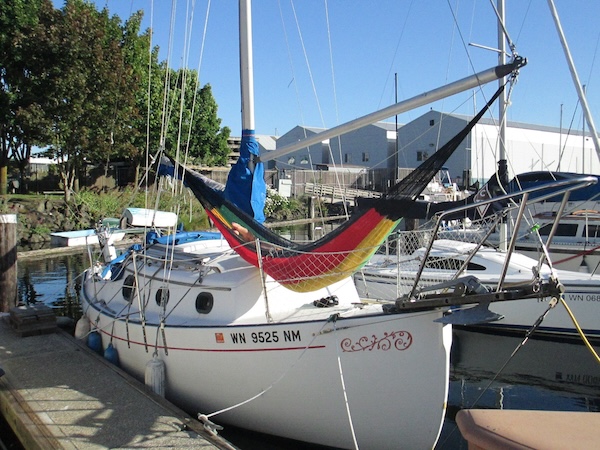
It was a beautiful, sunny day in Seattle’s Ballard Mill Marina when I decided it was time to apply the physical laws of opposing forces for leisure. The Guatemalan hammock had been in my possession for years before I owned Sampaguita, so it was a matter of fitting the boat to the sling.
First, I clipped the whisker pole to its rightful eye on the mast. On the forward end, just to port of the centerline and the headstay, I attached the jib halyard from above and the downhaul from below. After hooking one end of the hammock to this junction, I carried the other end aft, on the starboard side of the mast. I then shackled the main halyard to it from above and a genoa sheet from below. I ran the sheet through the starboard adjustable genoa car and belayed it to a stern cleat.
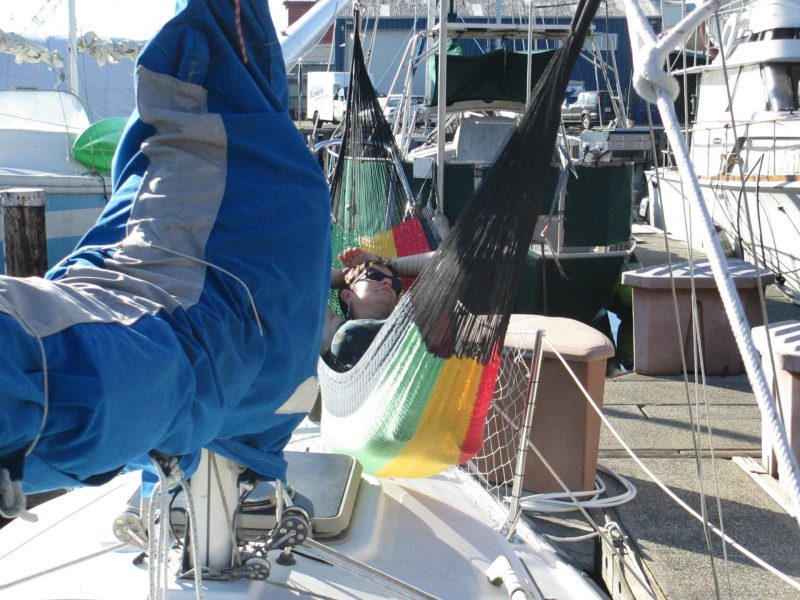
From here, I adjusted each line to find the sweet spots. The halyards determined the height of the hammock. The downhaul provided an opposing force to the jib halyard, keeping the forward end of the pole from swinging around. The genoa sheet determined how far the hammock was pulled aft, and the car adjusted the direction and the angle of that pull. After all that effort, it was time to relax.
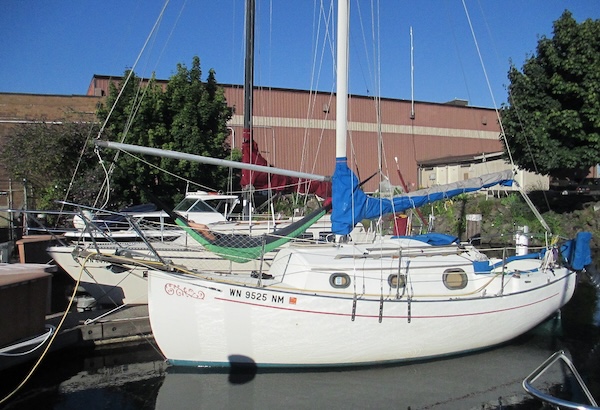
Your hammock may be a little different (you have one, right?), and so will your boat. (You have one of those, too?) You’ll need to exercise your mind to fit the equipment. That should be healthy, fun, and rewarding, both mentally and physically. And don’t forget to share. Remember, keep your solutions safe and prudent, and have a blast. (Or a snooze.)
Closing a Central Coast Coverage Gap
Have you ever felt as if you’re being watched on the water in a way that brings you peace of mind — knowing that at any moment someone can see you, track you, and even call for help if something goes wrong?
The automatic identification system, or AIS, allows vessels to transmit information such as their position, speed and identity. Originally designed for larger commercial vessels, AIS has become a cornerstone of collision avoidance, accountability and overall maritime safety. A critical part of the system is terrestrial AIS, which consists of land-based receiver stations installed along the coast that listen for AIS signals transmitted by vessels offshore. These stations provide real-time coastal vessel tracking and share that information with emergency responders, harbormasters and vessel-tracking platforms. But there still isn’t full terrestrial AIS coverage along the coast of California, or coverage from the Bay Area down to San Diego.
There are two main types of AIS transceivers: Class A and Class B. Class A is required on ships more than 300 gross tons, passenger vessels and most commercial vessels over 65 feet. Larger vessels transmit at higher power, more frequently, and are often required to have their AIS data relayed via satellite, in addition to shore-based receivers.
Class B transceivers are used by pleasure craft and smaller vessels and transmit at lower power and less frequently, and as a result, rely heavily on terrestrial AIS receiver stations along the coast for their position data to be received, shared, and made visible online. Without nearby shore-based receivers, Class B signals often go unseen beyond a limited local range, effectively removing these vessels from wider situational awareness. All classes of AIS transceivers transmit their signals over VHF radio frequencies, the same spectrum used for standard marine communications and received by nearby vessels and terrestrial AIS stations on shore, where platforms such as MarineTraffic and OpenAIS receive information.
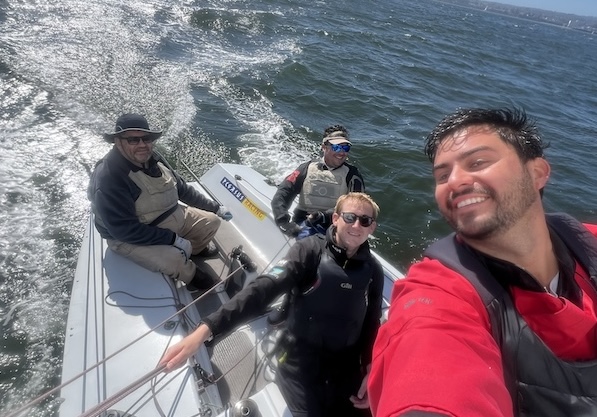
Terrestrial AIS receivers are becoming increasingly important. They are easy to install and can provide up to 80 nautical miles of coverage, depending on location and antenna height. That coverage is critical in areas where AIS reception is limited or nonexistent. I have been sailing along the California coast for the past five years, either in FJs sailing for the UC Santa Cruz Sailing Team or in a Moore 24 sailing for Team Pegasus. I never thought twice about my ability to call for help — I either had a cell phone signal or was within VHF range. But when I went down to Morro Bay to do a delivery back to Santa Cruz, I discovered a large gap in coverage. There were no AIS receivers between Monterey and Morro Bay, which can be one of the most dangerous stretches of coast. Addressing the problem turned out to be much easier than expected. MarineTraffic was willing to supply the necessary equipment. After a short application and a few emails back and forth with a representative, a kit arrived. The plan was to install the receiver somewhere on the Central Coast.
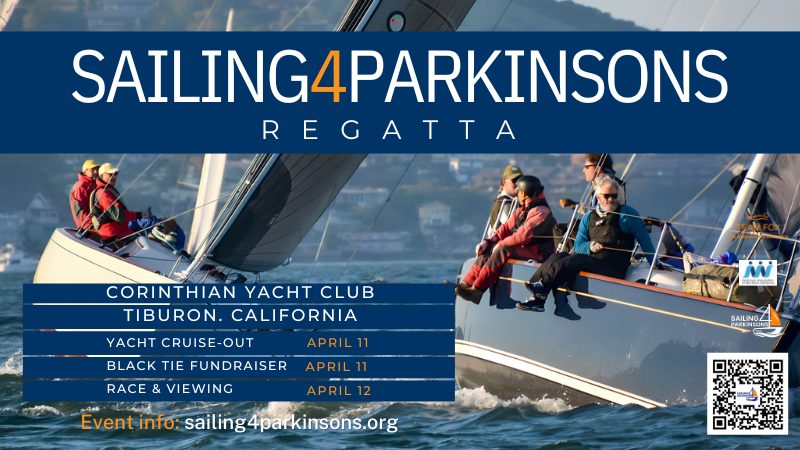
Join the Sailing4Parkinsons Regatta at CYC