

‘Can O’Whoopass’ Reports From the YRA Doublehanded Midwinters
“We love the way you attacked that course,” said the sailors on the Alerion 28 Sapphire (SFYC), as they rounded outside the Can at YRA 6, on the last leg of Sunday’s race — one of the YRA Doublehanded Midwinters. We nodded in thanks, mumbling something like, “When you’re slow, you’ve got to do that.”
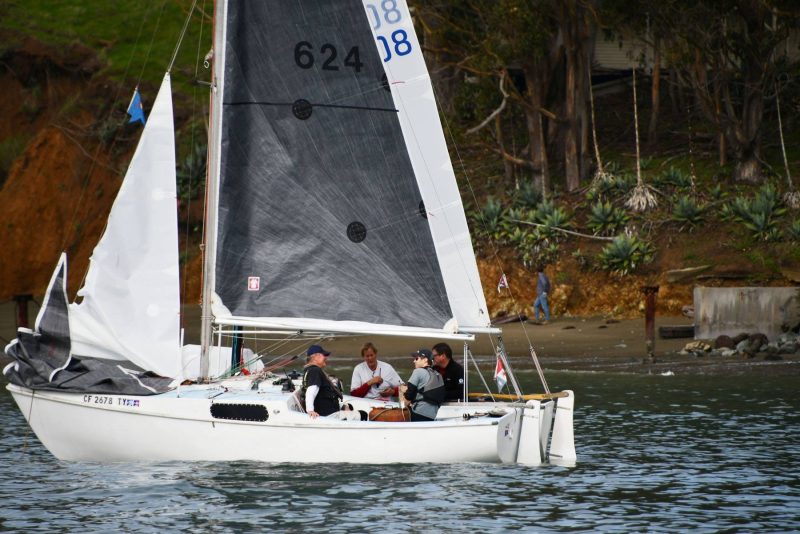
We were half a mile behind our division leader, Pat Broderick’s Wyliecat Nancy (SSS), and our most feared competitor, Dave Gruver’s two-time national champion Olson 25 Sketch (SFYC). The Olson had come off Blackaller, on the YRA 16–17–6 course, and did not jibe immediately against the big ebb, ending up parked over by Yellow Bluff. So we had hopes over Dave. The 10- to 12-knot southerly rendered the course featureless, aside from the ebb.
Rhumb-line vectoring was the key, and my crew Chris Cassell and my Raymarine A67 kept me from spacing out. To veer left off the line while kite-reaching to Harding would take us toward Sausalito, and off right would take us to the west of Alcatraz. We corrected first, a little less than two minutes ahead of Nancy, and ahead of all 18 boats sailing that course, save the Covey 49 Sir Edmund (RYC), which nipped us by three seconds, but in the non-spin division.
The previous weekend, on the Berkeley Circle in the Berkeley Yacht Club Midwinters, we didn’t have the pressure to even be competitive. On Saturday we placed sixth out of seven in a PHRF 141+ division dominated by the well-sailed J/24 [Phantom]. Sunday saw a tighter 168+ division, also dominated by a J/24 [Froglips]. In six to eight knots of wind, a Cal 20 gets eaten up by the J’s and by the more easily driven or taller-rigged vessels, even when sailing a perfect course.
We did not sail a perfect course on Sunday, getting caught on the wrong side of a 30-degree wind shear after the start. Once we got around the windward mark, we were last by a lot. However, once we were on the correct side of the shear, we were able to claw back into fourth of six boats by headstay-reaching with the kite, a Cal 20 specialty in 15 degrees ahead of a beam breeze. Still deep in the tank, to start a series.
The moral of the story, which we on the Can have come to accept, is that on some light days a 273-rater just is too slow to get there from here, tacking through 100 degrees and never reaching hull speed. Some days, if we’re smart, and tenacious, we have a shot.
Good Jibes #219: Lin Pardey and David Haigh on Life Aboard ‘Sahula’
This week we travel Down Under to Brisbane, Australia, where we meet up with third-time returning Good Jibes guest Lin Pardey and her partner David Haigh aboard Sahula. Lin has sailed over 200,000 miles, completed two circumnavigations, and experienced many more adventures of a lifetime.

Join Lin, David, and Good Jibes host Monica Grant as they chat about how Lin’s first time camping in the outback compared to sailing on the ocean, the pros and cons of being connected to technology at sea, the essentials for a cruising lifestyle, how sailing with David aboard the 40-ft steel-hulled Sahula differs from cruising aboard Lin and Larry’s smaller wooden boats, and how to never fall out of love with sailing.
Here’s a sample of what you’ll hear in this episode:
- Why Lin and David choose not to have Starlink
- Being close to nature vs. comfort
- What is David’s background and sailing story?
- Some tales from 47 years of cruising
- Do you ever fall out of love with sailing?
Listen to the episode on Apple Podcasts, Spotify, and your other favorite podcast spots — follow and leave a 5-star review if you’re feeling the Good Jibes!
Check out Lin’s previous Good Jibes episodes: #77: “Lin Pardey on Storytelling for Sailors” and #18: “Lin Pardey on Staying Simple and Just Getting Out There”.
Visit Lin’s website: https://pardeytime.blogspot.com/, and learn more on Lin Pardey’s Facebook.
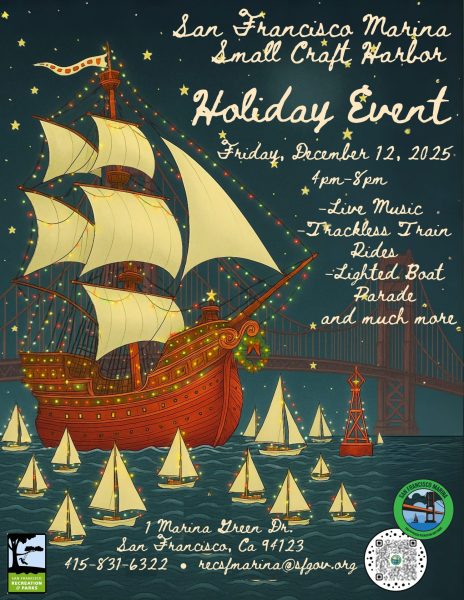
Join San Francisco Marina’s Holiday Event
Another West Coast Classic Yacht Discovered in Europe
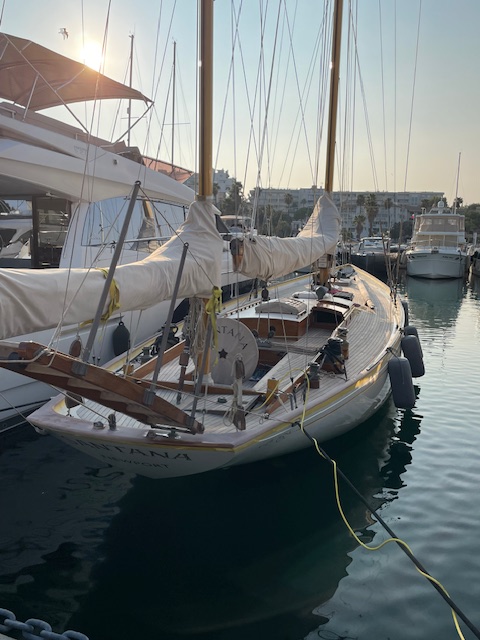
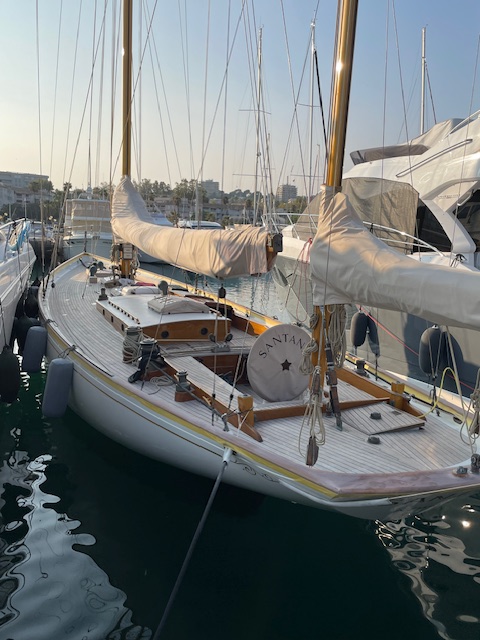
Over the past week or so, we’ve shared a couple of stories about some West Coast classic yachts that are currently being restored in Europe. Master Mariners Wooden Boat Show organizer Randall von Wedel was touring Europe and discovered the cutter Grisette in the Chantier du Guip shop in Brest, France. Also in France, he then visited the former Sausalito classic Pursuit in the Saint-Guénolé Classics Restoration shipyard. Recently we heard from reader Howard Clayman of SV Ciao Mano who discovered another West Coast classic in France, the S&S schooner Santana, which spent a good amount of time on the USA’s West Coast before also heading for a life overseas.
“On a recent trip to the south of France, I regularly took time to wander in marinas nearby and discover some of the beautiful boats at the docks,” Howard writes. “In Antibes I ran across the historic yacht Santana, which once belonged to Humphrey Bogart. Having grown up sailing in California, I had heard many stories of her and the special relationship Bogie had had with her.”
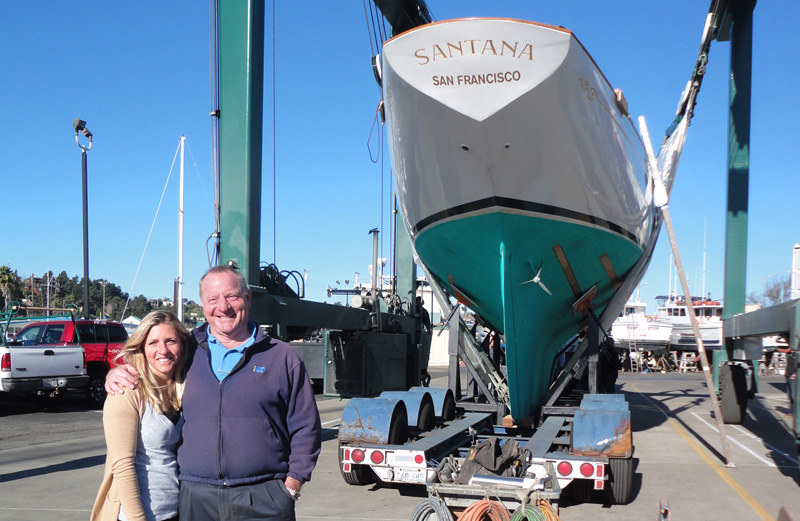
We last wrote about Santana in 2014 when her stewardship was passing from the Kaplan family to Wendy Schmidt (philanthropist and wife of former Google executive chairman Eric Schmidt), who was taking her to the East Coast with plans to race her actively. Paul and Chrissy Kaplan had raced the1935 S&S schooner extensively on San Francisco Bay for 15 years after completing an extensive refit. Prior to that we shared a letter in which a sailor from Lake Isabella reminisced about watching Santana race in the beer cans at Balboa YC during the 1950s and ’60s, adding, “Bogie was a big celebrity at the time, but never acted like it. He always rubbed elbows with other racers at the bar afterward.”
Santana is again undergoing a refresh in France, where Howard says he admired her from the dock, and spoke with the “young man who was sanding her brightwork but who didn’t know the history of the boat.”
But that wasn’t the end of Howard’s historic sailboat tour.
“A few days later in Marseille I found the Pôle Voiliers de Tradition. This is a collection of about 20 traditional yachts docked in a row adjacent to the Société Nautique de Marseille. Among the beautiful yachts that caught my eye was the Bermudan yawl Leopard Normand, a Sparkman & Stephens design from 1965.
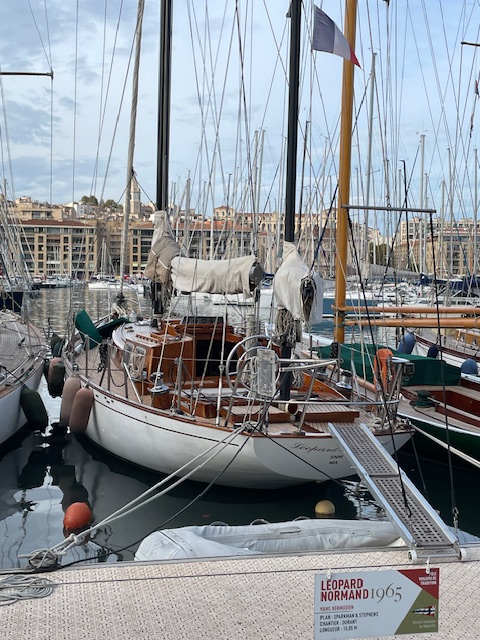
“I’m sure this is a favorite pastime of Latitude 38 readers when they are traveling or sailing in foreign ports, but discovering these treasures certainly was a high point of the vacation.”
Each old boat that survives has a story to tell, particularly the beautiful classics of old. That’s part of why sailors love them. And we love sharing the stories of their discovery.
- Cruising
- Heading South
- Environmental News
- Commentary
- DIY
- Wings & Foils
- Working Waterfront
- General Sailing
We’re Suffering Serious Sailing Sustainable Energy FOMO
Have you ever watched a string drop on a TP52? Seen a foiling Moth? Have you thought about cruising “off the grid” for months at a time? For many, sailing is simply a relaxing Saturday afternoon sail, but the designers, dreamers, tinkerers and innovators behind all the creations that move boats under sail are always dreaming and scheming of creative new ways to harness the wind. This creative energy has often been applied to sustainable-energy solutions pioneered at sea, but today we’re feeling our national leadership in this area is shifting overseas.
One of the greatest things about being part of the sailing community is the creative genius behind it. It could be François Gabart solo-sailing a 100-ft trimaran around the world in 42 days, or Joshua Wheeler creating a clever refinement aboard his Flicka 20. The thoughtful, creative genius behind each of these actions is part of what makes sailors a unique breed. If you’ve toured a boat show, you’ve probably had many moments when you thought, “Isn’t that clever?” Sailboats are fun and relaxing, yet also platforms for a stunning array of innovation.
For years, the innovative DNA of this country has been applied to make sailing better and life better. A national foundation for this is a belief in free markets, where our national leaders encourage innovative thinking and development with scientific and government support for new technologies. Government support has subsidized everything from nuclear power to the oil industry, solar power, wind power, geothermal power and a diverse array of futuristic energy possibilities. Sadly, we’re seeing that innovative leadership shift overseas as our political leaders have shifted toward a central-government-planned energy-market system.

This does not mean there aren’t numerous creative individuals and companies still pioneering new technologies in this country, but they are facing competitors from other countries with a much broader and open-minded view of the technologies that will create a diverse energy infrastructure for a sustainable future. Our former national support of new energy technologies brought us Tesla and also allowed companies like former boatbuilder Tillotson Pearson to become a wind-power pioneer along with companies like Knight & Carver in Southern California. Other pioneers in alternative uses for wind power include local venture capitalist, sailor and legend Tom Perkins, who built the Maltese Falcon, and Richard Jenkins, who has built Saildrone in Alameda.
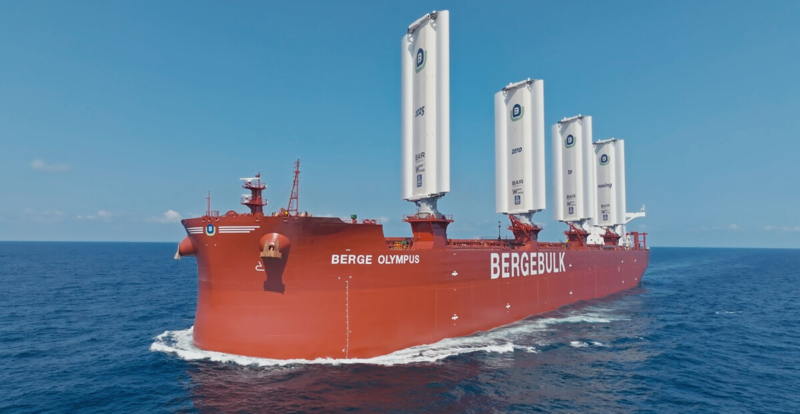
If you go down to the docks during 5O5, Moth, or International 14 regattas, you’ll see the creative work of the “technicians” who are tweaking and sailing these development classes. It’s always been fun to be in a country and community of forward-thinking pioneers who are creating the future. We regularly read the marine trade publication International Boating Industry, which leads its digital newsletter with this line: “Your weekly glimpse into the future of the boat business.” Between IBI and the press releases we get from European companies, we feel a genuine enthusiasm for the amazing new wind, solar, fuel cell and hydropowered vessels they are creating. These innovative companies are charging ahead with their national governments’ and national culture of creative progress. In the States, we are currently led by a regressive philosophy actively trying to slow or eliminate progress on innovative new ideas for the future.
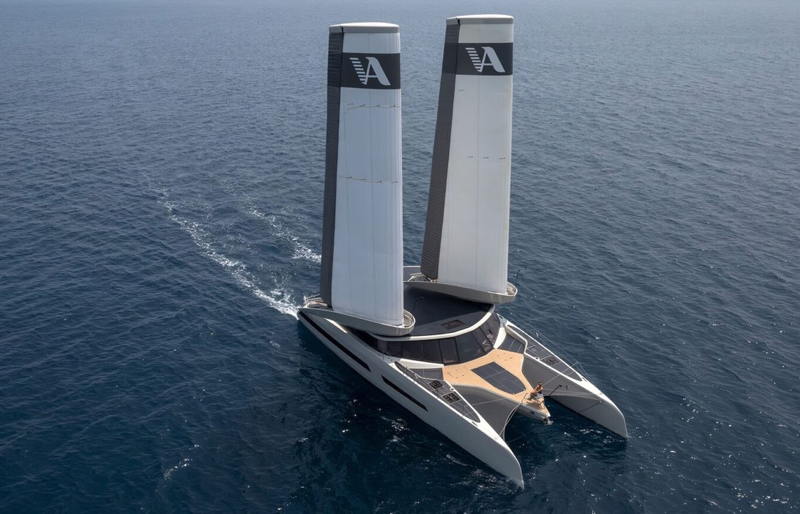
Race for Water Foundation’s Ocean & Climate Odyssey launched the MODX 70 above, saying they aim to deepen the understanding of the links between the ocean, climate and biodiversity, while mobilizing maritime-transport stakeholders around decarbonization. The MODX 70 is intended to be the world’s first zero-emission, zero-noise leisure catamaran. They foster “Scientific and institutional collaborations to deepen the study of climate change impacts on marine ecosystems and to better document the ocean’s role in climate regulation.” So many press releases from Europe include statements like this, though oddly, a statement like this in the States now feels somewhat subversive.
It feels like hanging out with “friends” and saying, “Hey, you guys, I’ve got a really cool new idea.” And the friends say, “That’s stupid.” Who wants friends like that?
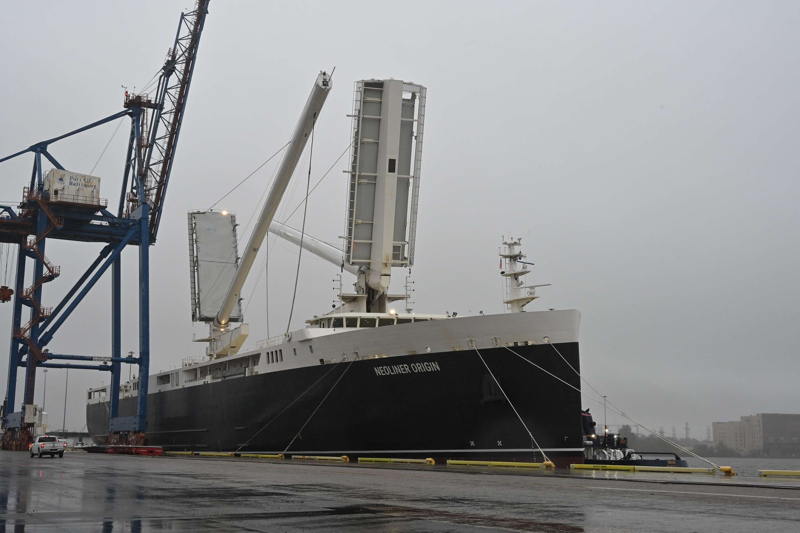
Like the United States, all these innovative countries burn lots of oil and coal, but they don’t see these new technologies as an either/or discussion. They see the future as a “yes and” proposition, so creating cleaner, more efficient and sustainable energy solutions includes all possible technologies. Southern California sailor David Smythe, who electrified his very cool Olson 40 Euphoria, has been working with a company, Terraform Industries, to capture and burn carbon from the atmosphere. That could be amazing.
We read a recent article in the New York Times saying, “Renewables accounted for 93 percent of global power additions — and as of July 2025, 74 percent of wind and solar projects worldwide were being built by China.” In addition, it’s believed that in just the first six months of 2025, China installed more solar capacity than the United States has managed in its entire history through the end of last year, and twice as much solar power as the rest of the world combined. Seeing the 162 square miles of solar they’ve built in Tibet is astounding and another source of FOMO.
Most sailors are highly attuned to watching amp hours and trying to figure out how to generate power cleanly and silently. It makes cruising, sailing and life better. Nothing ruins an anchorage more than a generator that runs all night on a harbor neighbor’s boat. If sailors need to use their diesel auxiliary, that’s fine, but the preference is always to use the engine less and work with nature more.
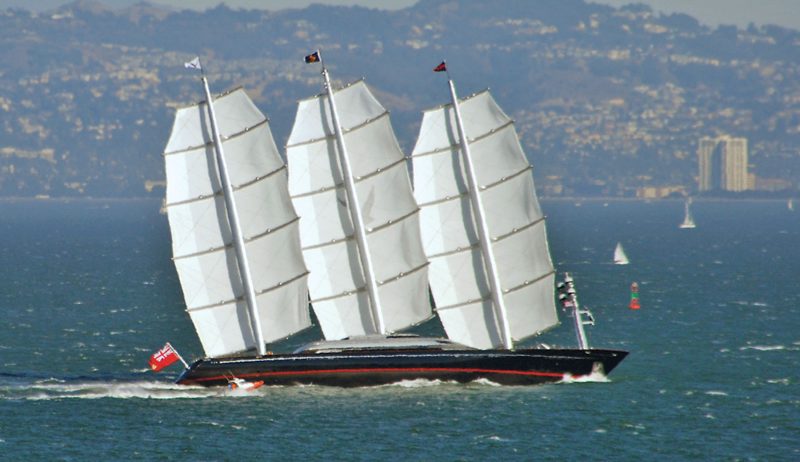
We get an amazing number of press releases, and it’s always incredible to see how sailors are dreaming, developing and building a better future. These days most of them come from Europe or Asia or the Middle East. Over time, these sailors have included pioneers like naval architects Gary Mull, Tom Wylie, Morelli & Melvin, Bill Lee, Hobie Alter and Rudy Choy. There are also currently developing initiatives like the Port of Los Angeles’ AltaSea project. Their mission is stated as, “AltaSea at the Port of Los Angeles is dedicated to accelerating scientific collaboration, advancing an emerging blue economy through business innovation and job creation, and inspiring the next generation, all for a more sustainable, just and equitable world.” How cool is that? There are many San Francisco Bay companies on the same track, often meeting with Martha Blanchfield’s SF Blue Tech group.
The US national sailing community is still flush with creative pioneers. It’s one of the reasons we like sailors and sailing. It’s much more fun to work in a culture that thrives on support for emerging technologies. Sadly, the national leadership of this country is actively undermining the pioneering spirit that built so many of the world’s new technologies. It won’t stop sailors, dreamers, developers or companies from building the next new thing. It just makes it harder.
The press stories we receive from Europe do give us FOMO for the forward-looking cultures of Europe. They have plenty of their own national political and economic challenges, but putting forward the idea of a fossil-fuel-free ship (what idiots, right!?) doesn’t feel like heresy. They’re wrestling with all their challenges, but without leadership that’s actively undermining potential solutions. The venture-capital culture of Silicon Valley promotes a bottom-up search for the future rather than top-down directives. We think this is the spirit of sailing personified by people like Barry Spanier, who built his scow-bowed, junk-rigged Antrim 40 that he and Samantha have now sailed from Berkeley to Australia.
We love hearing about all the very cool pioneering projects with their roots connected to the sustainable ethos of sailing. We’ve mentioned a few. We’d love to hear about more in the comments below. Fair winds.
Yacht Charter Placement with Modern Sailing
