
Two Mariners Rescued From Burning Boat off Santa Cruz
The US Coast Guard and partners responded to a sunken vessel following a boat fire approximately one mile offshore of Santa Cruz on Wednesday morning.
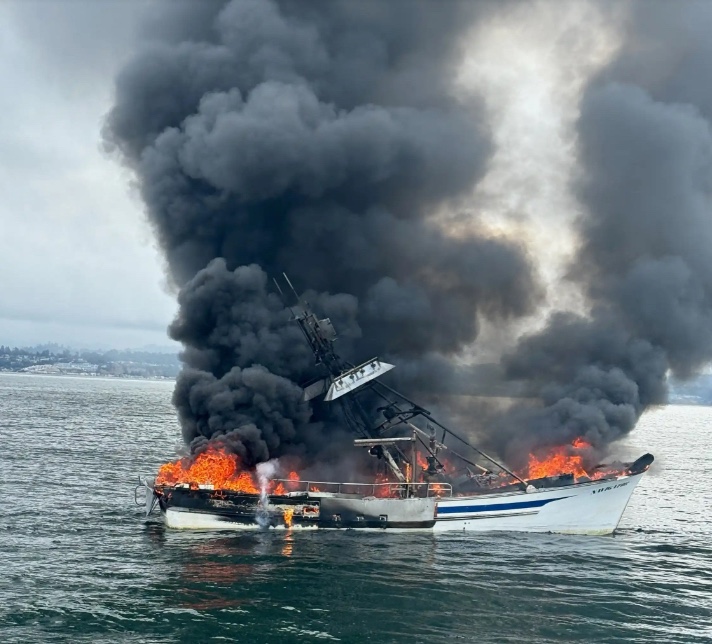
At 7:40 a.m. Coast Guard Sector San Francisco watchstanders received a report of a 45-ft vessel on fire with two people aboard. Watchstanders issued an Urgent Marine Information Broadcast Notice to Mariners, deployed a boat crew from Monterey, and coordinated with partner agencies in the area.
Santa Cruz Harbor Patrol (SCHP) and Fire Boat 12 personnel arrived on scene. SCHP rescued both vessel occupants and transported them to Santa Cruz Wharf with no reported injuries.
The Fire Boat 12 crew extinguished the fire. TowBoatUS attempted to salvage the vessel; however, the vessel began taking on water and sank before towing efforts could be made.
The vessel sank to a charted depth of 47 feet. The vessel has an estimated report of 650 gallons of fuel onboard. No active discharge or apparent damage to the fuel-storage tanks has been observed.
“Our top priorities in any incident are safety of the public and responders and protection of the environment,” said Lt. Cmdr. Mark Leahey, Coast Guard Sector San Francisco Incident Management Division Chief. “We approach every operation with care and deliberate action to mitigate adverse impact to the environment.”
Coast Guard Incident Management Division personnel are working with the vessel owner and monitoring salvage operations.
The cause of the fire is currently under investigation.
Ronnie Simpson Acquires Class 40 for Next Global Solo Challenge
Former California resident and offshore sailor Ronnie Simpson is launching a new campaign for the 2027 Global Solo Challenge race.
The event is a singlehanded, nonstop around-the-world race that begins and ends in Vigo, Spain, in 2027. After sailing close to 80% of the 2023–24 edition in third place out of 16 yachts, Ronnie dismasted far off the coast of Argentina and was unable to finish. Undeterred, Ronnie, who now lives in Portland, Maine, has acquired the Class 40 racing yacht Koloa Maoli from Dave Linger of Seattle and launched a new campaign for the 2027–28 edition of the race. Launching Koloa Maoli at Maine Yacht Center in late June, Ronnie and his team have conducted a successful round of sea trials off Portland during the first weeks of July.
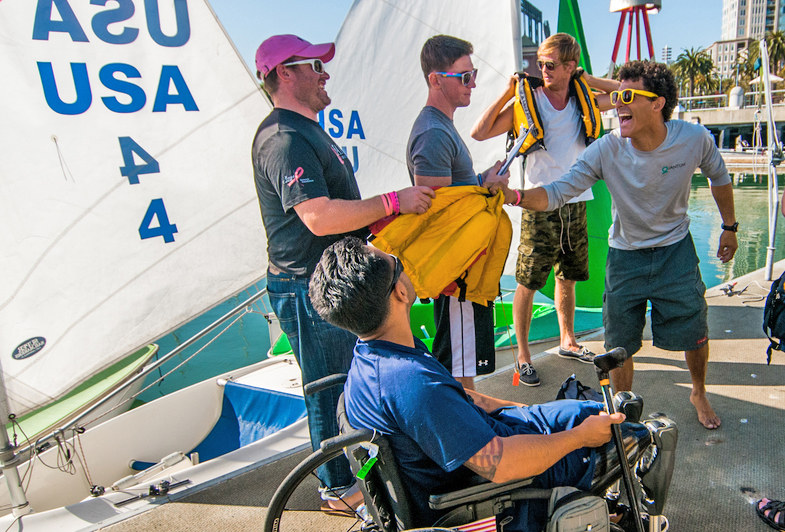
A 40-year-old professional sailor who has sailed more than 175,000 miles at sea, Ronnie aims to become the first American to win a singlehanded, nonstop, around-the-world race. In the 2023–24 edition of the Global Solo Challenge, he sailed the Open 50 racing yacht Shipyard Brewing more than 20,000 miles, rounding all three of the great capes, including Cape Horn, before dismasting some 700 miles offshore of Argentina. He was forced to retire after 106 days at sea, having covered about 80% of the course. A combat-wounded and retired US Marine who served in Iraq, Ronnie is determined to finish what he started and make another attempt to win the Global Solo Challenge race.
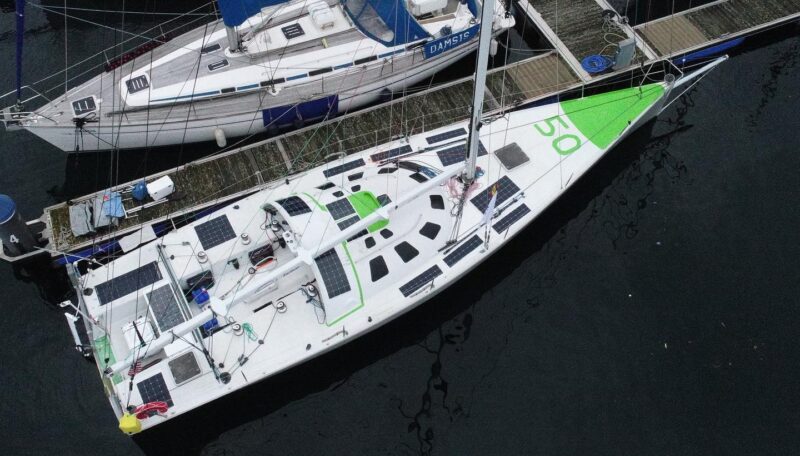
David Linger sailed Koloa Maoli in the last Global Solo Challenge, and Ronnie knows it’s a good platform upon which to base a competitive campaign for the next one. “I feel really good about the boat, and how she has performed during our first sea trials over the course of the past week and a half,” Ronnie said. “Koloa Maoli is a really special and unique boat that is well prepared, very strong, and still in great shape, having just raced around the world in the last Global Solo Challenge. I’m really grateful to be able to base the boat at Maine Yacht Center, and to have such a great partner in preparing a boat like this for the Global Solo Challenge.”
Ronnie joins Bruce Schwab as another former California-based singlehander who is now basing his sailing life out of Maine.
Ronnie is keeping himself busy preparing for the race but also working as a yacht broker for Lyman-Morse yachts out of Camden, Maine, and as a professional captain in the Portland, Maine, area. He also runs a small company specializing in sustainability and energy efficiency, including selling Remoran hydrogenerators.
You can attempt to keep up with Ronnie here.
Andersen Winches: Enduring Strength, Everlasting Finish
Proudly made in Denmark with the care and craftsmanship that comes from 70 years of experience, Andersen Stainless Steel Winches™ reflect the functional needs and aesthetic demands of top-quality sailing yachts worldwide. Andersen winches are built to last, to retain their exceptional finish, and to deliver many seasons of reliable performance. Andersen Winches: Enduring Strength, Everlasting Finish
An Update on Flare Collections and Vessel Safety Check Program
It’s time for another flare collection event, this one in Dana Point, Orange County, on Saturday, August 16, from 7 a.m. to 1 p.m.
Staff will collect items directly from vehicle trunks. OC Waste & Recycling will be joined by the Orange County Health Care Agency, offering a free bilge pad exchange, and the US Coast Guard Auxiliary (Partner Dockwalkers), providing free CA Boater Kits, boating safety info, and E-flare discount coupons (while supplies last).
Accepted Items:
- Handheld Flares
- Aerial Flares
- Smoke Flares
Not Accepted Items:
- Military Flares
- Electronic Flares
- Vehicle/Roadside Emergency Flares
- Hazardous Waste such as Paint, Oil, and E-Waste.
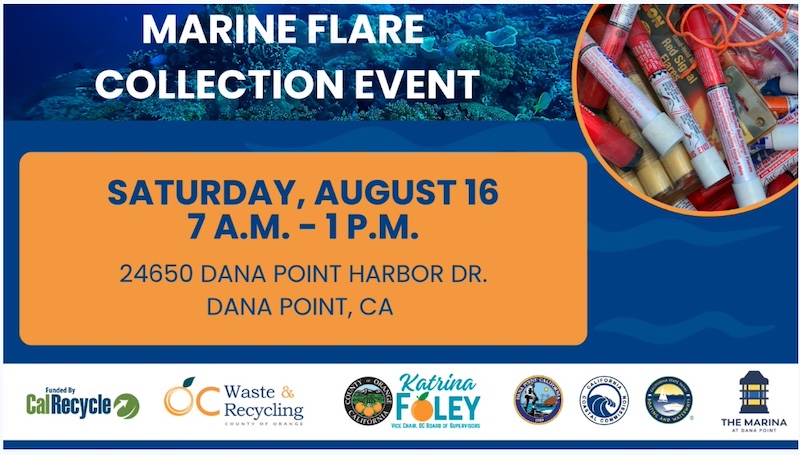
When: Saturday, August 16, 7 a.m.–1 p.m.
Where: 24650 Dana Point Harbor Dr., Dana Point, CA
—————————————
Get Your FREE Vessel Safety Check
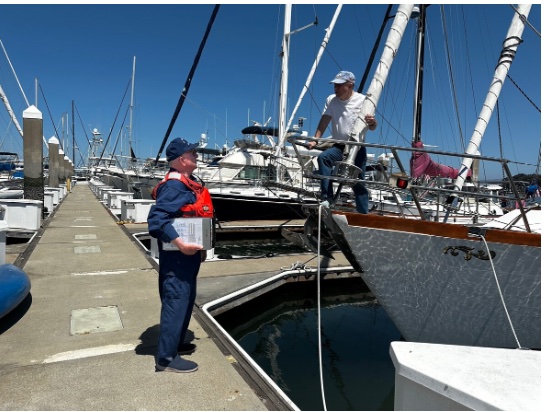
The Vessel Safety Check (VSC) program offers a courtesy examination of your boat (vessel) to verify the presence and condition of certain safety equipment required by state and federal regulations. Examinations are not a boarding or law enforcement issue. No citations will be given as a result of this encounter. You can see the current vessel safety checklist in this link.
The vessel examiner is a trained specialist member of the United States Power Squadrons or the US Coast Guard Auxiliary. These volunteers will also make certain recommendations and discuss certain safety issues that will make you a safer boater.
In California, recreational vessels are required to carry specified safety equipment that may vary according to type of propulsion, type of construction, area and time of use, and number of people aboard. The examiner will supply you with a copy of the evaluation so that you may follow the suggestions given. Vessels that pass will be able to display a VSC decal. This decal does not exempt you from US Coast Guard or law enforcement boarding, but it signals your intent to be prepared. Some mariners agree that display of the sticker eliminates most on-water checks by the US Coast Guard.
You can sign up for your free Vessel Safety Check here.
NOAA and Alcatraz Remain in the Sailing News
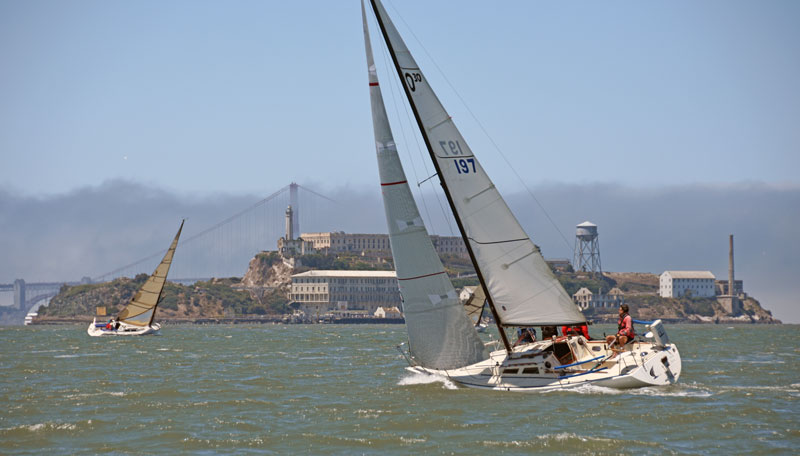
It’s hard to believe that turning Alcatraz into a prison or defunding NOAA could be anything but inefficient. Rebuilding and operating Alcatraz as a prison in the middle of San Francisco Bay would likely make it one of the most expensive prisons in the world. Reducing funding to NOAA would also potentially increase the cost of weather disasters for people and insurance companies. Regardless, the current administration continues to explore both bad ideas.
Yesterday, Attorney General Pam Bondi and Interior Secretary Doug Burgum took a taxpayer-funded junket to the island to continue evaluating it as a possible prison.
Sailors know the expense of maintaining boats in the often-harsh marine environment. US taxpayers already bear the cost of the largest per capita prison population in the world. We are 4% of the world’s population but hold and pay for 20% of the world’s prisoners. And prisoners are expensive. Additionally, California is an expensive place and already holds the dubious title of the state with the highest cost per prisoner of all 50 states. It’s hard to imagine Alcatraz being cheaper than the already-overpriced prisons in California. As a federal prison, Alcatraz would shift from being a visitor center collecting money from foreign tourists to another budget-busting federal expense. Could it really win a competitive bidding process for housing prisoners?
The New York Times reported on the visit, in which both Bondi and Burgum came away with a positive feeling for turning it back into a prison.
Cutting NOAA’s budget also sounds like a way to turn a short-term gain into a long-term loss. Farmers, fishermen, shipping companies, insurance companies, sailors and all citizens rely on NOAA to prepare for weather disasters. One of the ways the cost of disasters shows up is as a hidden tax in everyone’s rising insurance rates. The hurricanes that plague the southeastern and Gulf states like Florida and Texas raise the cost of insurance for everyone.
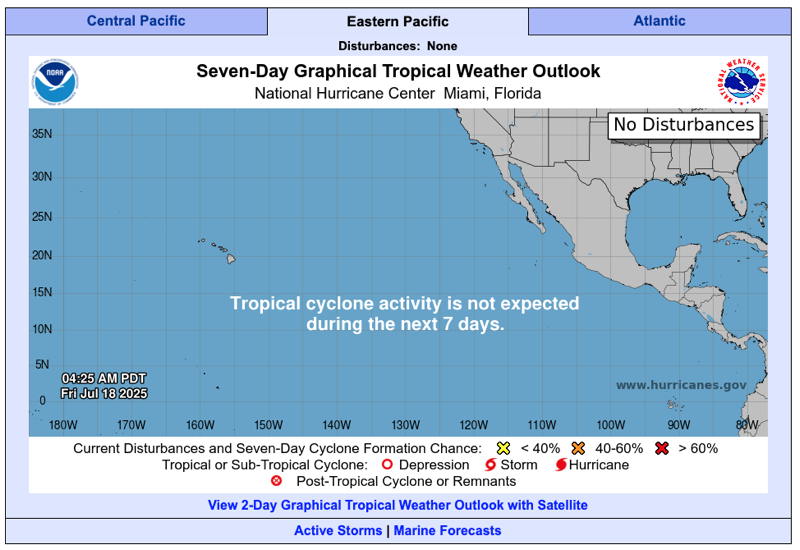
According to Wikipedia, the National Weather Service was established by President Ulysses S. Grant in 1870. Now the National Oceanic and Atmospheric Administration is facing cuts that threaten the ability of sailors and all citizens to get accurate and cost-effective weather information. PBS News reports that much of the cost-cutting would result in the privatization of weather to corporations that would fund their efforts by charging citizens for their forecasts. Naturally, people with the ability to pay more would receive better forecasts.
We’re on board with the idea of efficiency. We’re happy to efficiently sail to the next windward mark or efficiently maintain our boat, but we are also cautious when it comes to being penny wise and pound foolish. It’s easy to feel that these proposals dreamed up by the Department of Government Inefficiency (DOGI) could save money now while the long-term costs are in the future and almost impossible to predict.
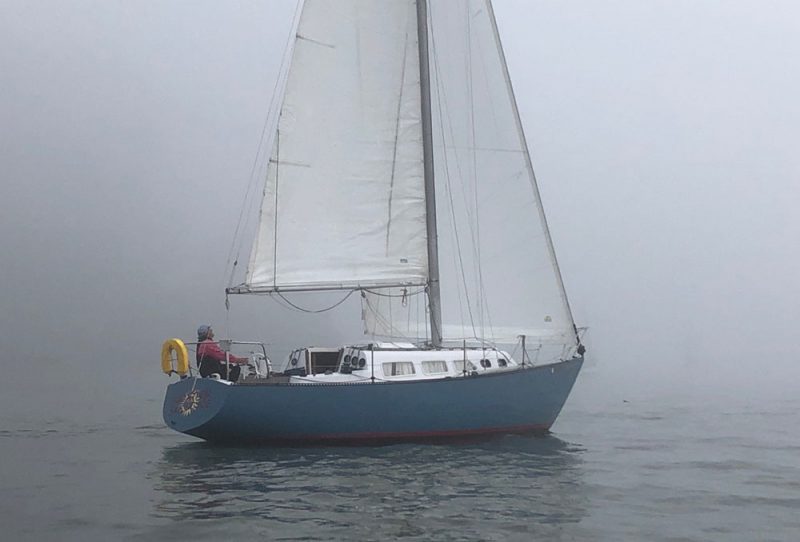
We work on improving efficiency daily in our own lives, and like everyone, we often make dumb mistakes. We also appreciate when our own inefficiencies are pointed out by helpful friends. It’s always valuable for individuals, government agencies, or any entity to be open minded about improving. But too much of that makes us just want to escape to the Bay for a sail.
Hope to see you out there.
The Strange Journey of the Formosa 51 ‘Fair Seas’
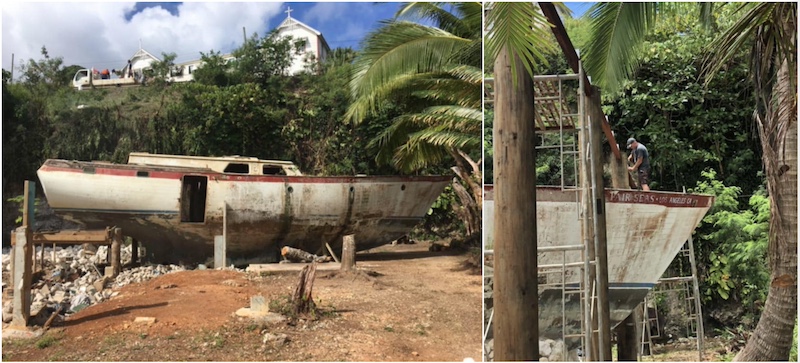
Every boat with a few miles under the keel has a story to tell — of storms endured, long passages made or dreams realized. The Formosa 51 Fair Seas has likely known its share of those sorts of tales. But the most unique part of its story seems to have happened after the boat was hauled out of the water — never to return — more than 30 years ago.
We first heard about Fair Seas in a note from Changes in Latitudes contributor Jim Yares of the Catana 472 catamaran Roam. Early last month, he and wife Pam dropped anchor in Neiafu, Vava’u, Tonga, and dinghied ashore to have a look around. One of the first things to catch their eye was a brand-new waterfront bar/restaurant called The Kraken, which is built around the hull of … Fair Seas! In addition to being the centerpiece of the place, the boat serves as a storeroom and divider between the restaurant and kitchen.
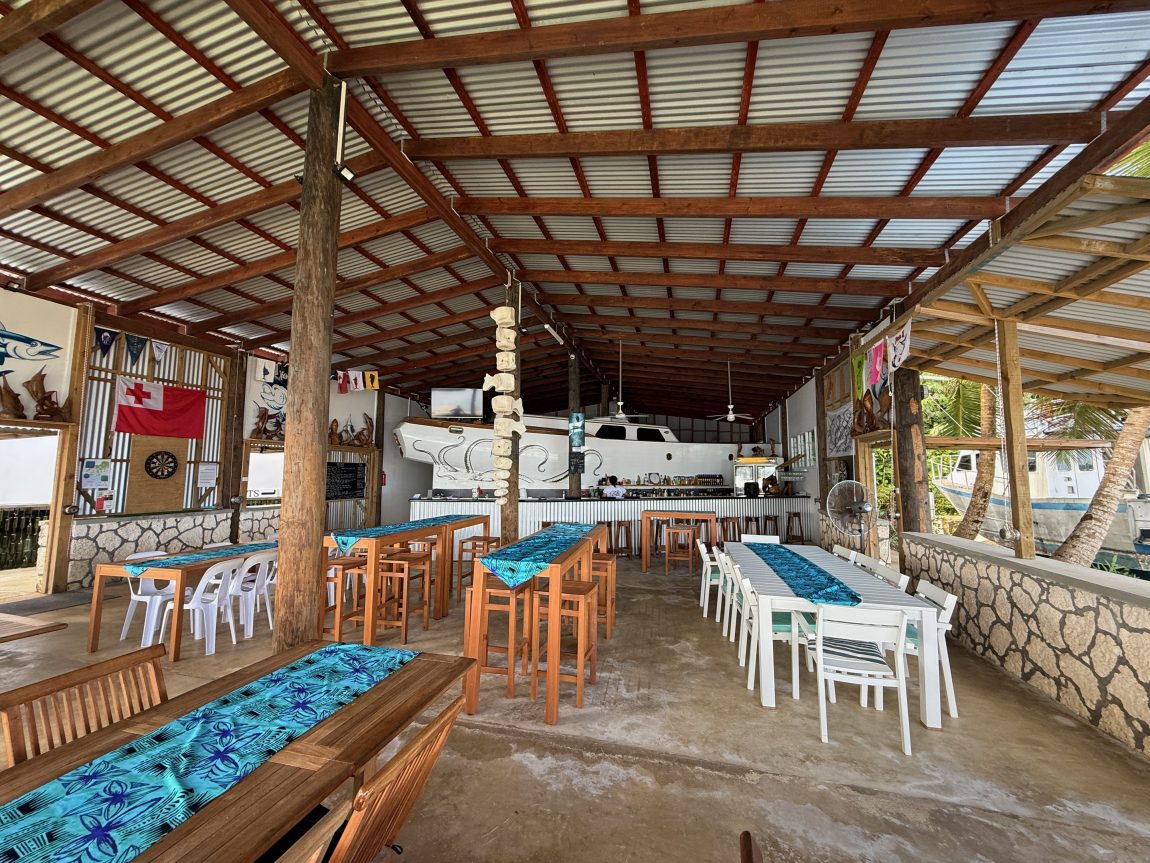
They got to talking with the owner, an Australian expat named Andrew Jones, but he didn’t really know that much about the boat’s backstory, only that it had sailed from California sometime in maybe the late ’80s, and was hauled out in about 1991, and the owners (or perhaps new owners) lived aboard while on the hard.
Jim did what many do who run across such maritime mysteries: He wrote us, noting, “If anyone knew the story of this boat, it would be Latitude 38.”
Or not. While we appreciate the vote of confidence, nowhere in our archives could we find anything about a Formosa 51 (or any other boat) named Fair Seas. None of our usual “C.I.s” knew anything about the boat, and no amount of Prevagen or electroshock could break anything loose from the cobwebbed minds of our most senior personnel.
It was easy to look up the general history of the Bill Garden-inspired Formosa 51 pilothouse ketch. The design was one of dozens of heavy-displacement, “traditional”-looking cruising boats built in Taiwan in the late ’70s and early ’80s. Beyond general specs, we could find no specifics on how many were made, or on one called Fair Seas.
So we turned to the most dependable source of all — our readers. We ran the basic story Jim relayed in the June 2 ‘Lectronic Latitude — and got a reply! It began:
“My name is Stephanie Torres, and my partner is Alekisanita Halahingano Coleman. He is the landlord of the property and he grew up in the boat. His father salvaged that boat and built their childhood house around it. Later when the family relocated to California, The Kraken was built on their family land and the sons insisted on saving their father’s boat and the history along with it.”
Summer Music Series Tonight at Marin Yacht Club