

Latitude 38 August Issue Out Now
Welcome to the August issue! Nestled in the pages of this month’s magazine, we have Andy Schwenk’s wrap-up of the Pacific Cup; revisit the tragic sinking of Volare; share updates about our September Crew Party and the Sausalito Boat Show; hear the tale of a honeymoon at sea; follow Dustin Reynolds’ second passage from Hawaii to Palmyra on his old boat; and say farewell to Jack Van Ommen. Of course that’s not all … here’s a preview.
A Surprise Victory in the Heineken Regatta
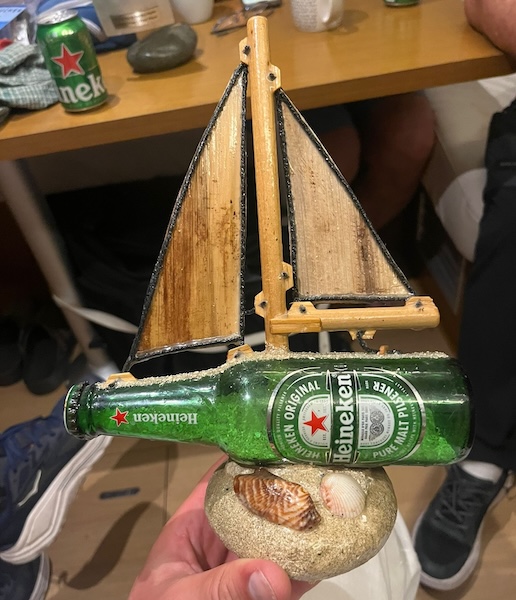
They throw a good party after the Heineken Regatta: Caribbean food trucks and beer, all in a stadium-like arena facing a massive stage. Music, flashing lights and some dancing had us all entranced when we heard the word “Sipsi” over the PA. What, us? What’s going on? We were shuffled up onto the stage and learned our “French Maid Encounters Pirates” display was so admired that we had earned second place in the “Serious Fun” competition. We climbed down from the stage clutching the trophy and more beer cans.
Return to Palmyra
There’s something strange about stepping back onto a boat that used to be yours. A boat you lived on, depended on, trusted across oceans through fear, failure, growth and triumph. A boat that helped define who you became. Being on Tiama again with Jenny was a bit like hanging with an ex and her new lover, which is strangely how Jenny and I met.
High Times in the Pacific — 2026 Pac Cup
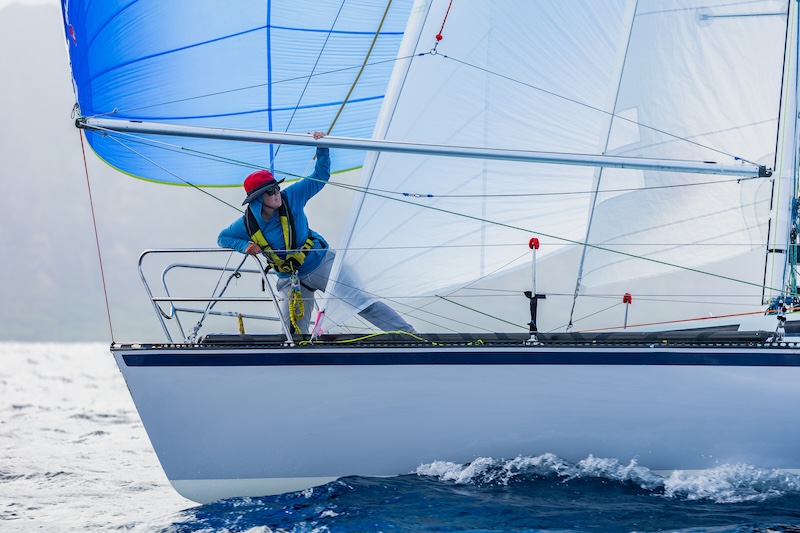
It was my great privilege to be able to compete among Kimo Winterbottom’s excellent crew aboard his sleek, blue Andrews 56 Halawa. Of course, I figured when I wrote my prediction article it would be several weeks before I saw any of the sailors the story was written about. Now in the land of sunshine and coconuts, I’m writing this just as the last vessels get off the course, and more than a few sailors have taken the opportunity to point out that I missed a few top performers.
Plus this month’s regular columns:
Letters: Bouncing Around Post-Ha-Ha and Watching the Stars … Move?; Bureaucracy, Baby; No One Knew What It Was and Doubted It; Old and New Marin; A Correction and an Apology; and stacks more readers’ letters.
Sightings: The Tragic Sinking of Volare; Saving Gashouse Cove; Farewell — Jack van Ommen; The Fourth Annual Sausalito Boat Show; and more.
Max Ebb: “Rally Rules”
Racing Sheet: In this month’s edition of the Racing Sheet, we kick it off with the J/105 and J/88 fleets racing in tricky conditions and crosscurrent at SBYC’s J/Stop Regatta. YRA racers then journey down the coast in the Half Moon Bay Race, and Latitude 38’s racing editor recaps a win in the Woodies Invitational. Readers will then journey to the Sierra Nevada to read about Tahoe YC’s Trans Tahoe Regatta and Fresno YC’s High Sierra Regatta. Summer in the mountains! Finally, we wrap it up with a recap of a Bay Area staple: Bay View Boat Club’s Plastic Classic.
Changes in Latitudes: With reports this month from The Seahorse’s Pacific Puddle Jump; regular contributor Jim Immers’ ARC Europe adventure on Queen Bee II; Tardigrade’s trip to the Marquesas; Into the Mystic‘s first Mexico adventure; and some Cruise Notes, including info on the upcoming Baja Ha-Ha XXXII.
All the latest in sailboats and sailboat gear for sale in Classy Classifieds.
Pick up your copy today at any one of our West Coast distributors. See the full list and map of locations here.
Remember to get your tickets for the Baja Ha-Ha Latitude 38 Fall Crew List Party
— Thursday, September 10, at Spaulding Marine Center, Sausalito.
Details here

West Coast Teams Dominate at Long Beach YC C420 Nationals
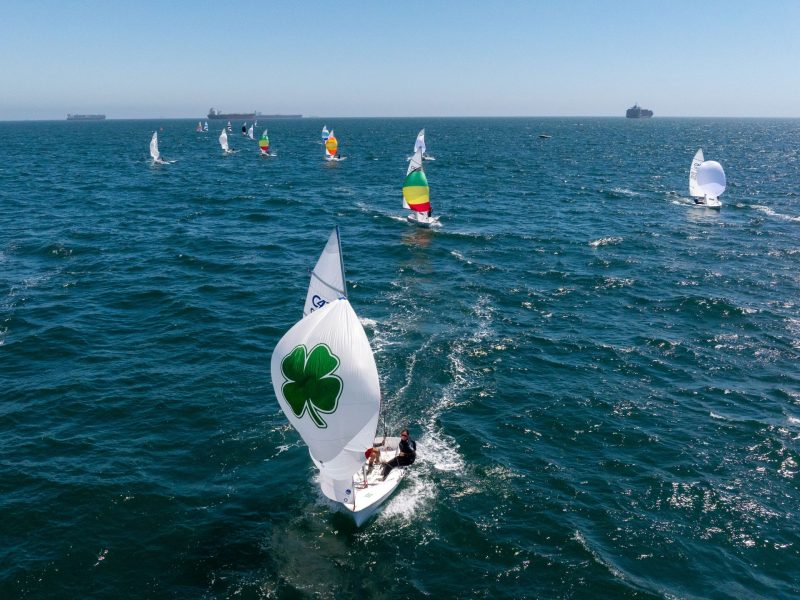
From July 8 through 10, 73 teams of teenage sailors from all around the country duked it out on the Southern California and Long Beach Yacht Club (LBYC) waters for the 2026 Club 420 (C420) National Championship.
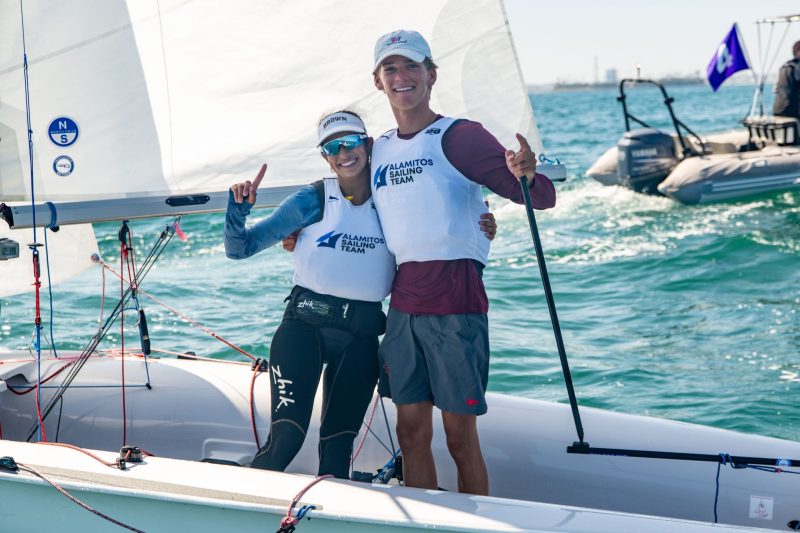
Each team sailed nine races and was afforded one drop. In the end it was a Southern California duo of Gage Christopher and Madison Mansour racing under the burgee of Alamitos Bay Yacht Club (ABYC), and for the 73 Sailing racing team.
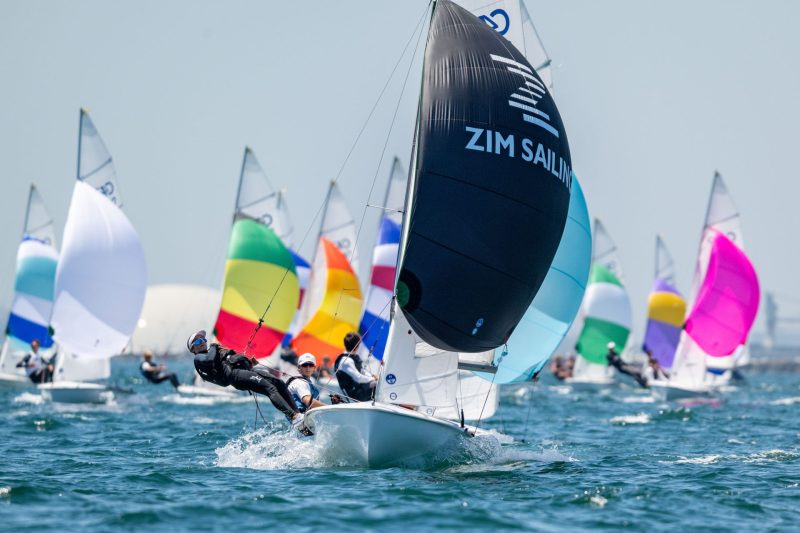
Christopher and Mansour were dominant, recording a net total of 14 points from nine races. They finished outside the top three only once, a fourth-place finish in race seven that would be their drop. They were so dominant, in fact, that their final score was less than half that of second-place Connor Karr and Ella Valentina Agnese (Columbia River YC and One United).
Christopher and Mansour won four races, including three straight between races two and four (their final bullet was in race eight). Second-place Karr and Agnese won the first race of the event and recorded four other top-three finishes. Their drop, an 18th-place finish in race four, forced them to keep two sixths and an eighth.
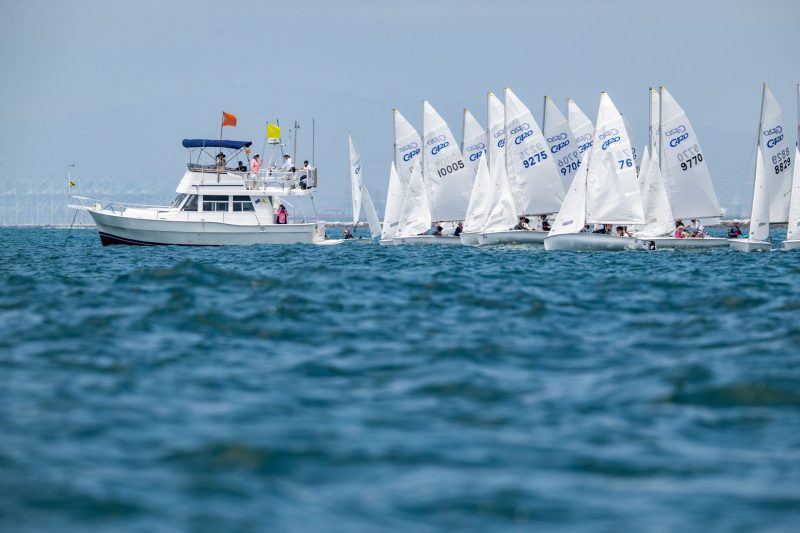
The podium was rounded out by the duo of Wyatt Kelly and Fiona Barbeito, racing for San Diego Yacht Club (SDYC), ABYC, and 73 Sailing. They recorded four top-three finishes, including two bullets, but a 24th in the final race of the event forced them to keep a 16th.
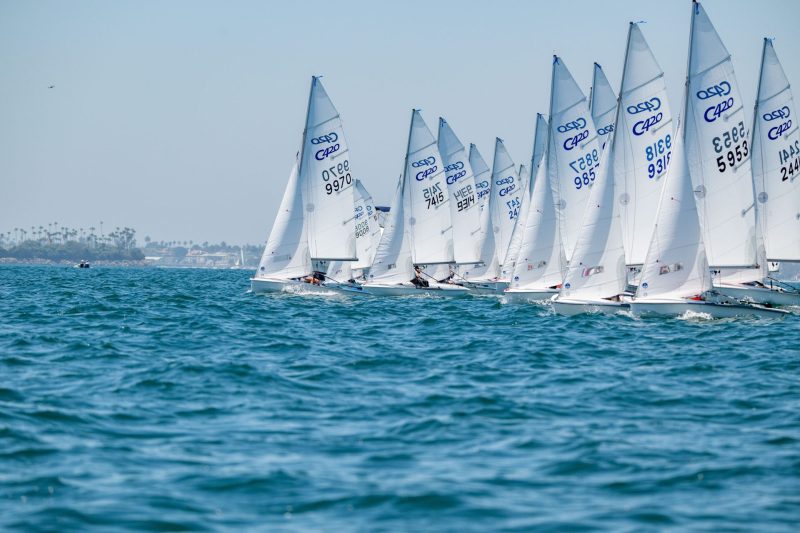
While 73 boats participated in the regatta, there were never actually 73 boats on the start line at once. As has long been a practice of the C420 class at such major regattas, the fleet was split in half at random for the first two days of the event, with scores added up together. For the final day of racing, the fleet was split into gold and silver fleets, with the top 37 boats qualifying for gold fleet and the rest racing out the final day in silver.
The regatta as a whole was a success for West Coast teams, with the top 10 dominated by teams from Southern California, Northern California, and the Pacific Northwest.
You can find the full results from the 2026 C420 National Championship here.
Visit Naos Yachts for Full Sales and Service
A Racing Extravaganza on the Estuary
The Estuary Extravaganza was held Sunday, July 26, and it was a great day for Estuary racing. Encinal Yacht Club, Island Yacht Club and Oakland Yacht Club got together in 2020 and decided to create a jointly developed and managed Sunday Estuary Regatta. It has become an annual race and is now scheduled for the Sunday after the Encinal Regatta.
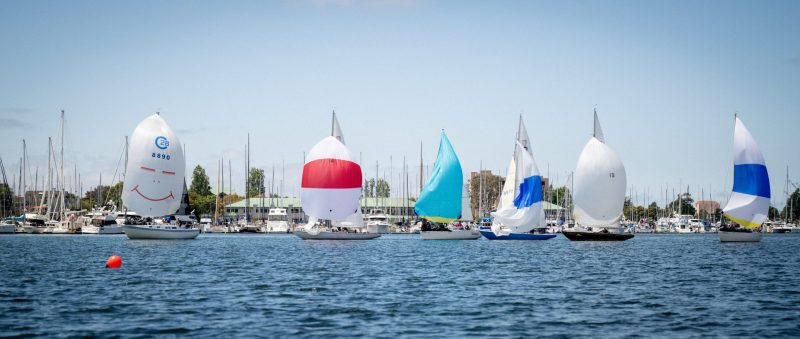
We had sun and a good breeze — around 10 to 12 knots — that stayed fairly constant throughout the two races. There were five fleets, four PHRF and one non-spinnaker fleet, a total of 30 boats with the largest being Express 37s and the smallest being Harbor 20s. There were 10 courses available, ranging from 1.8km (1.2 miles) to 6.0km (3.7 miles) and a target finish time by fleet of one hour.
The races started at Alameda Marina, and starts were managed by Island Yacht Club. Courses covered the Estuary from Jack London Square to Coast Guard Island and a mark set down in Brooklyn Basin. Encinal Yacht Club was responsible for getting the marks placed, and for any additional support as needed for the start and finish race committees (RC). Oakland Yacht Club managed the finishes.
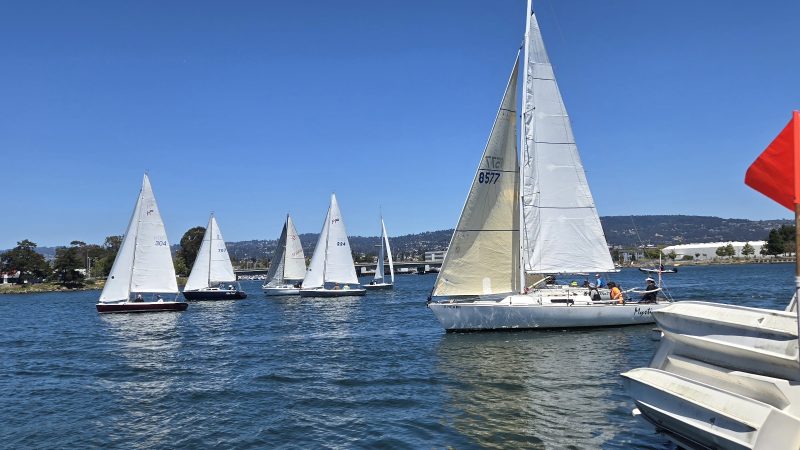
The first race went off on time, first signal at 1200 with rolling starts, and the five fleets were racing using a variety of the courses available. The finish line was not restricted, so boats were racing upwind and downwind through the line, if that was the best approach for reaching their next mark. It added some chaos to the finishes, as the RC sorted out the downwind boats as to which was finishing and which was moving through to their next mark.
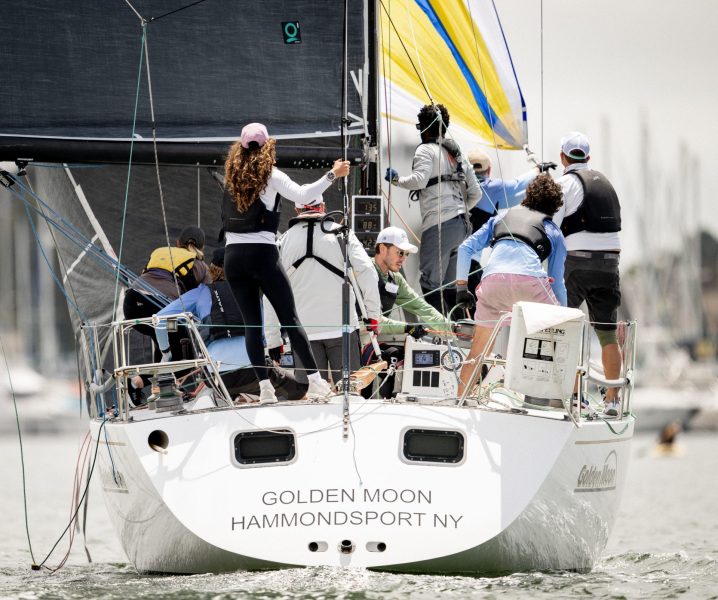
Once a fleet had completed their first race, the race committee was advised, and that fleet would be radioed and readied to start Race 2. Race 1 was completed within the hour target for each fleet, but the fleet was spread out enough that the challenge became distinguishing those completing the first race from those that had moved into Race 2. The Estuary was full of boats moving well, trading tacks, crossing paths, and flying spinnakers.
Encinal Yacht Club hosted the after-event, where results were shared and racers chatted about the experiences of their day. It seemed all had a fun day, and there was talk about having three races in next year’s regatta! It was a nice way to finish up the weekend.
Local Sailor Phil Mills Shares Thoughts on Raising Young Sailors
We all say sailing is a great family activity, unless, of course, your family doesn’t like to sail. In our recent podcast with parent Phil Mills, he mentioned some strategies he’s used to help his young kids learn to love it. We wish we’d heard these ideas when our kids were young.
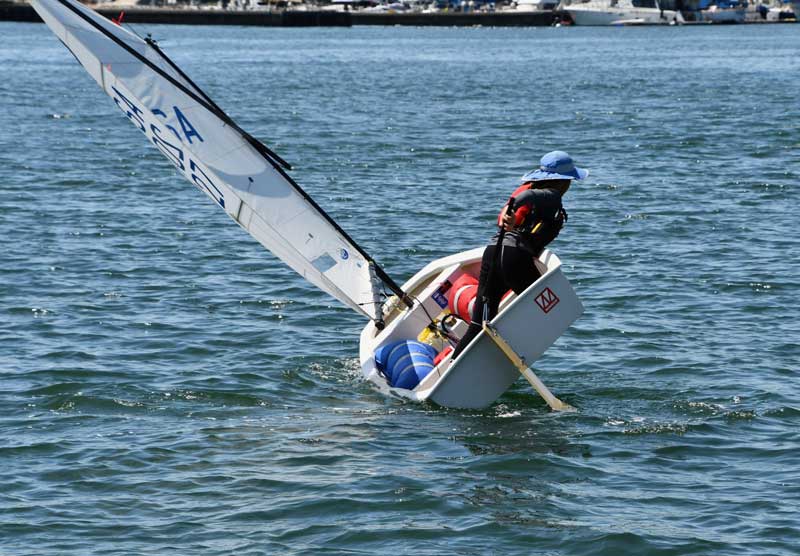
One of the simplest he says he heard from a friend is to make sailing feel special. Phil always brings favorite snacks or treats that the kids do not normally get at home. Sailing becomes a place of special treats.
Another great idea he suggested was to quit while everyone is still having fun. Grown-ups can go out for a day, but Phil reminded us that kids get tired more quickly and head toward a meltdown. His suggestion is to head back to the dock while everyone is having fun and not when the kids are tired, cold, bored or upset. He wants the last memory of the sailing day to be happy and wanting more rather than misery.
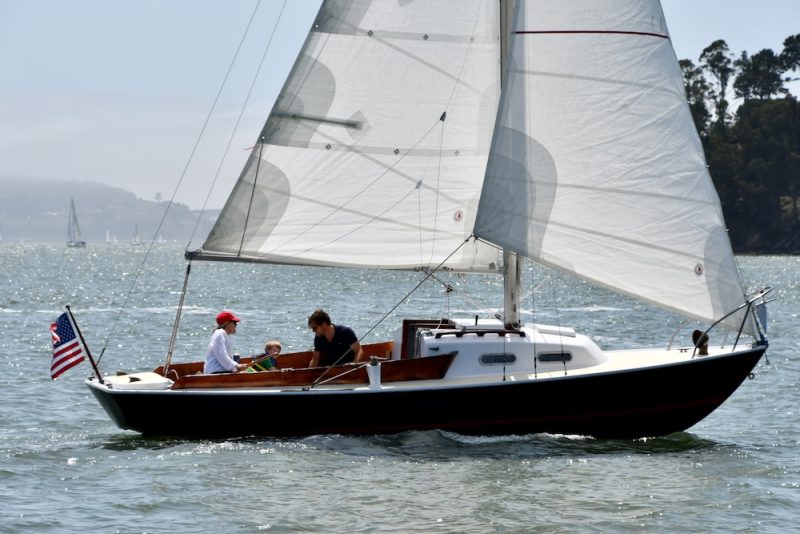
Phil also presents sailing as a privilege, not an obligation. He likes to tell the kids that sailing is the reward you get for doing your chores or homework or something else. It’s a basic word shift of, “Hey, if you do this thing, you get to go sailing.” That comes with good snacks too.
The last step is giving them independence and control. Let kids sail their own small boat when they are ready. Being the captain of an Opti, El Toro or similar dinghy can create a much stronger sense of freedom, competence and ownership than simply riding along with an adult. Phil saw a completely different look on his son’s face as he solo-sailed into Ayala Cove for his first time.
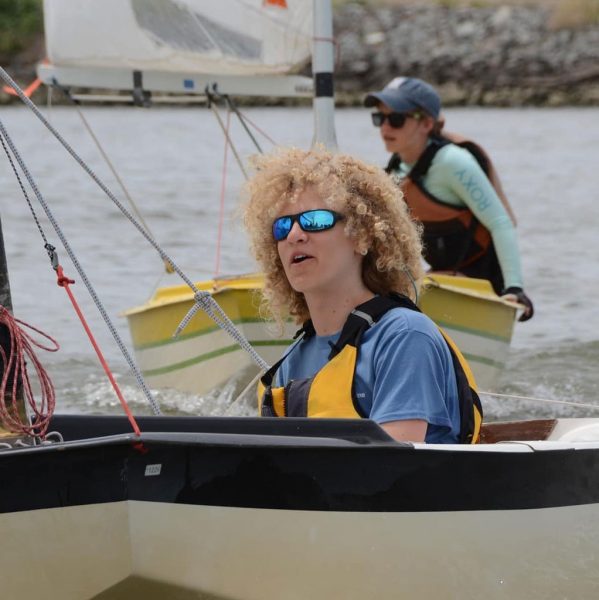
We can’t say we were as thoughtful with our ideas on how to help our kids enjoy sailing with us, so we consider ourselves lucky that our family still loves to sail together. That said, we like to do it for fun and also think time in small boats is important. Big boats are intimidating, and the bigger loads and forces make it harder for young kids to be part of the action. When parents bring young kids on big boats, they find themselves saying, “Be careful” or “Watch out” or “Stay away from that” — all words of danger that make sailing sound scary. Small boats make it much easier for both parents and kids to relax and enjoy a sail.
Everyone is different, so there are no foolproof strategies for success, but we thought these all sounded like good ideas and worth a try.
The Real-Life Ships of ‘The Odyssey’
This current number-one movie at the box office features a story about an event-filled cruise through the Med many years ago.
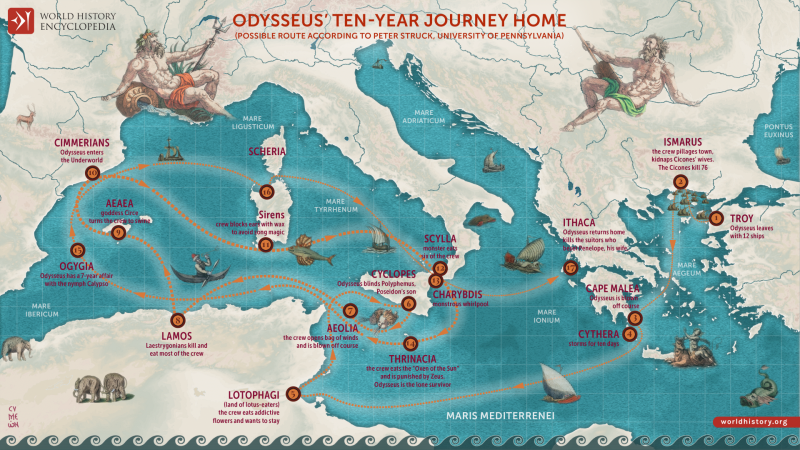
Christopher Nolan’s The Odyssey has made over a half-billion dollars in a mere two weeks, simultaneously thrusting classic literature into contemporary culture while featuring real-life replicas of ancient ships — albeit from another era of sailing. I first read the nearly 3,000-year-old epic poem by Homer in October 2001. I was 26 years old and traveling from Maine to Florida via New York City and an unexpected visit to Ground Zero, where the skeleton of the World Trade Center towers still stood.
I recently found my beat-up copy of The Odyssey and a few highlighted passages, including “wine-dark sea” and “The tumultuous deep-voiced waves.” My favorite passage was where Homer writes of Calypso, who finally allowed Odysseus to leave her island on his schedia, or raft. “She called forth a kindly warm wind in his favor. The delighted Odysseus spread wide his sail to this fair breeze and sat down by the stern oar, most skillfully steering. Nor did sleep once take possession of his eyelids, so continually he kept gazing on the Pleiades, or on Arcturus that goes down so late, or on the Great Bear (they call it also Wain) [which we also call the Big Dipper], which resolves in constant narrow watch upon Orion and alone of stars will never enter the bath of ocean.”
The Odyssey is also an epic feat in terms of movie production. Locations spanned the globe from Greece to Morocco, Italy, Iceland, Scotland, Malta, Western Sahara and of course Los Angeles, here on the West Coast. Nolan, who reportedly owns neither a computer nor a smartphone, uses practical effects whenever possible. That fidelity to capturing the movie “on camera” included the use of real-life ships. Vessels included Glad av Gillberga, a nearly 58-ft replica of a Viking longship run by the Swedish nonprofit Vikingaleden. (The owners of that vessel say that Universal Pictures has failed to pay $6,000 in damages sustained during filming.)
But the starring ship of The Odyssey is Draken Harald Hårfagre, a ship I’d discovered on Instagram nearly a decade ago. Launched in 2012, the 115-ft clinker-built Draken — which roughly translates as Dragon Harald Fairhair — is a “reconstruction of what the Norse sagas describe as a great ship, created through a combination of historical knowledge, traditional craftsmanship and real-world testing at sea,” according to the nonprofit that operates the vessel. With a nearly 80-ft mast, with an approximately 2,800-square-foot sail and 25 pairs of oars, Draken is “not only visually impressive, but truly capable at sea.”
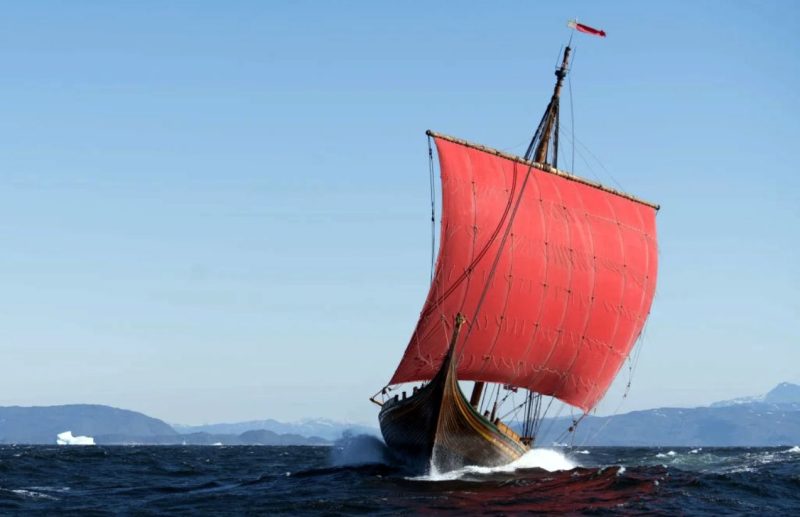
“That boat is beautiful and that crew is amazing,” Matt Damon, the star of The Odyssey, said of Draken. “All the actors had to learn how to row that ship. There were a lot of times when we were practically rowing that boat.” Nolan said that many of the full-time crew were in wardrobe and collaborating with the actors.
In the strange way that the tendrils of culture circulate through the zeitgeist, the “Viking Row” had its own moment in the spotlight this summer. After scoring two goals in Norway’s July 5 win over Brazil, the “Striking Viking” Erling Haaland grabbed the drum at MetLife Stadium in New Jersey and led thousands of fans through the primal chant.

But what do ancient Scandinavian ships have to do with ancient Greek ships?
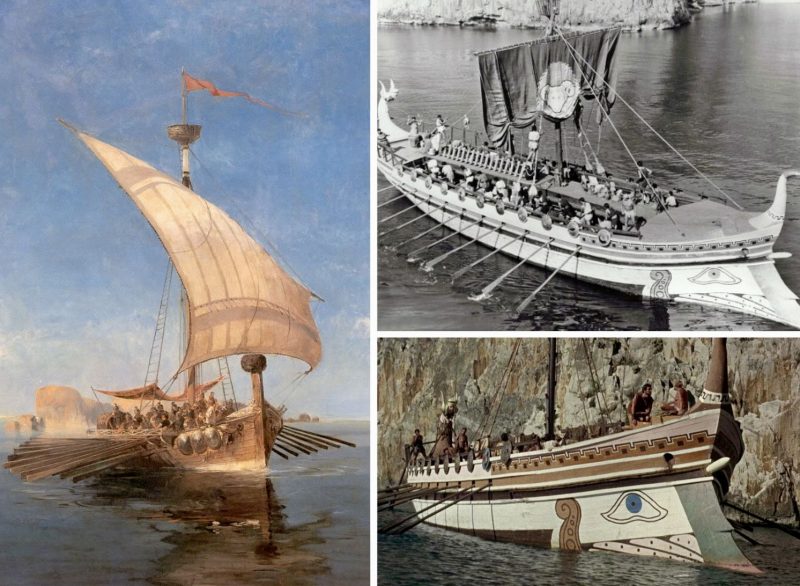
Very little. Greek galleys such as the 50-oared penteconter predated Viking longships by roughly a millenium. But Nolan’s commitment to capturing as much of The Odyssey on camera made the Viking replicas, long proven to be seaworthy, a natural choice.
Many classicists have argued that The Odyssey is often remembered as a grand adventure, whereas Homer was far more interested in what happens after everything goes wrong, and in Odysseus as someone deeply scarred, restless and perhaps haunted.
Said Homer, “I give you my oath that for wreaking havoc upon a strong man, even the very strongest, there is nothing so dire as the sea.”
Latitude 38 Baja Ha-Ha Fall Crew Party — Get Your Tickets Now