

The Real-Life Ships of ‘The Odyssey’
This current number-one movie at the box office features a story about an event-filled cruise through the Med many years ago.
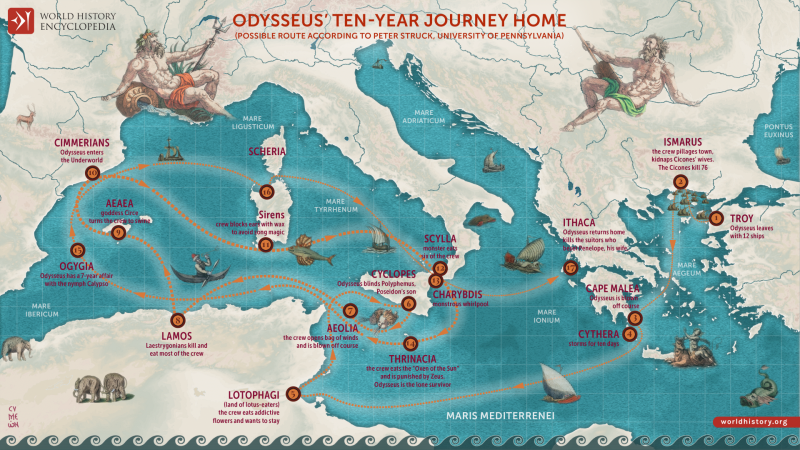
Christopher Nolan’s The Odyssey has made over a half-billion dollars in a mere two weeks, simultaneously thrusting classic literature into contemporary culture while featuring real-life replicas of ancient ships — albeit from another era of sailing. I first read the nearly 3,000-year-old epic poem by Homer in October 2001. I was 26 years old and traveling from Maine to Florida via New York City and an unexpected visit to Ground Zero, where the skeleton of the World Trade Center towers still stood.
I recently found my beat-up copy of The Odyssey and a few highlighted passages, including “wine-dark sea” and “The tumultuous deep-voiced waves.” My favorite passage was where Homer writes of Calypso, who finally allowed Odysseus to leave her island on his schedia, or raft. “She called forth a kindly warm wind in his favor. The delighted Odysseus spread wide his sail to this fair breeze and sat down by the stern oar, most skillfully steering. Nor did sleep once take possession of his eyelids, so continually he kept gazing on the Pleiades, or on Arcturus that goes down so late, or on the Great Bear (they call it also Wain) [which we also call the Big Dipper], which resolves in constant narrow watch upon Orion and alone of stars will never enter the bath of ocean.”
The Odyssey is also an epic feat in terms of movie production. Locations spanned the globe from Greece to Morocco, Italy, Iceland, Scotland, Malta, Western Sahara and of course Los Angeles, here on the West Coast. Nolan, who reportedly owns neither a computer nor a smartphone, uses practical effects whenever possible. That fidelity to capturing the movie “on camera” included the use of real-life ships. Vessels included Glad av Gillberga, a nearly 58-ft replica of a Viking longship run by the Swedish nonprofit Vikingaleden. (The owners of that vessel say that Universal Pictures has failed to pay $6,000 in damages sustained during filming.)
But the starring ship of The Odyssey is Draken Harald Hårfagre, a ship I’d discovered on Instagram nearly a decade ago. Launched in 2012, the 115-ft clinker-built Draken — which roughly translates as Dragon Harald Fairhair — is a “reconstruction of what the Norse sagas describe as a great ship, created through a combination of historical knowledge, traditional craftsmanship and real-world testing at sea,” according to the nonprofit that operates the vessel. With a nearly 80-ft mast, with an approximately 2,800-square-foot sail and 25 pairs of oars, Draken is “not only visually impressive, but truly capable at sea.”
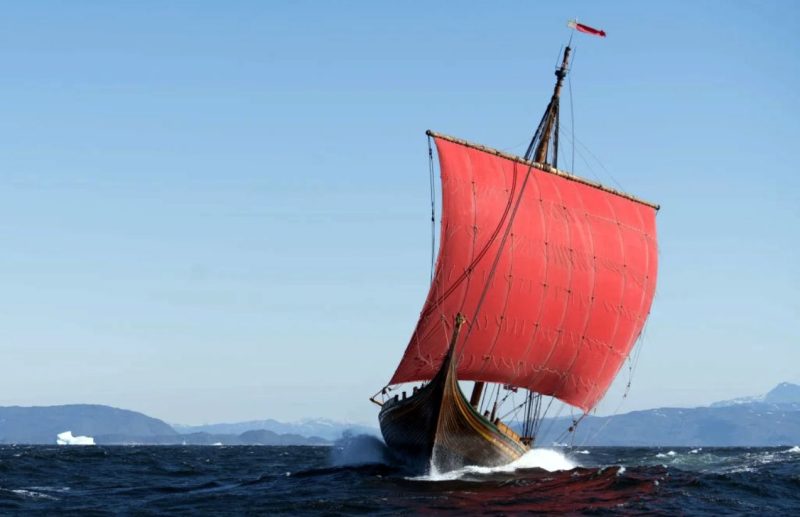
“That boat is beautiful and that crew is amazing,” Matt Damon, the star of The Odyssey, said of Draken. “All the actors had to learn how to row that ship. There were a lot of times when we were practically rowing that boat.” Nolan said that many of the full-time crew were in wardrobe and collaborating with the actors.
In the strange way that the tendrils of culture circulate through the zeitgeist, the “Viking Row” had its own moment in the spotlight this summer. After scoring two goals in Norway’s July 5 win over Brazil, the “Striking Viking” Erling Haaland grabbed the drum at MetLife Stadium in New Jersey and led thousands of fans through the primal chant.

But what do ancient Scandinavian ships have to do with ancient Greek ships?
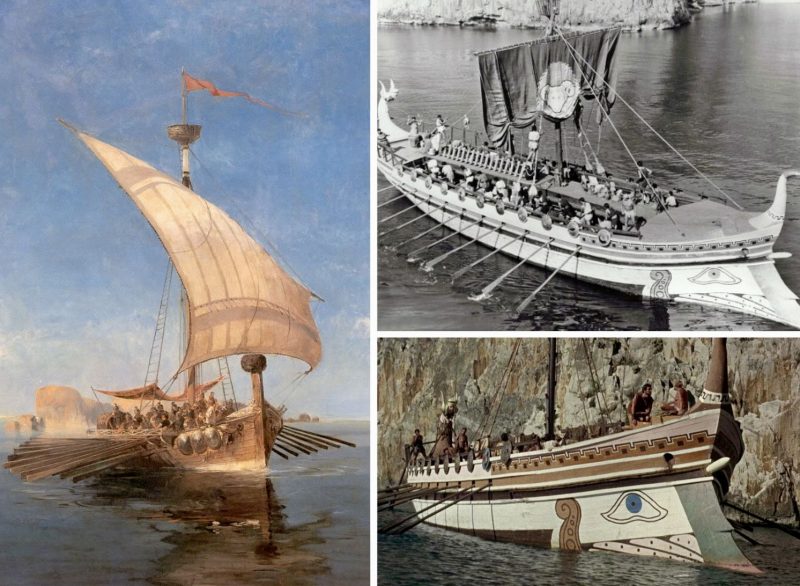
Very little. Greek galleys such as the 50-oared penteconter predated Viking longships by roughly a millenium. But Nolan’s commitment to capturing as much of The Odyssey on camera made the Viking replicas, long proven to be seaworthy, a natural choice.
Many classicists have argued that The Odyssey is often remembered as a grand adventure, whereas Homer was far more interested in what happens after everything goes wrong, and in Odysseus as someone deeply scarred, restless and perhaps haunted.
Said Homer, “I give you my oath that for wreaking havoc upon a strong man, even the very strongest, there is nothing so dire as the sea.”
Thanks, Tim,
I quite enjoyed the movie, and that you have recognized it. Thanks for the ship identifications.
I thought Nolan did a good job of making the film accessible to both the grand adventure and the human interest story. The former is the easy thing for people to talk out loud about, but it is just an exciting way to tell the latter, more internal conversation.
I admit there was a time when I would have interpreted your last quote strictly from a physical angle. Small boat cruising and single-handing have wisened me to my error.
Jason and the argonauts ,was an amazing movie ! Harry Hunthausen ? And his animation in 1962 was mind blowing to a 15 year old teenager ! And still holds up nicely !