
Three Bridges and Quite the Fiasco
The final day of January will mark one of the great sailing traditions on San Francisco Bay: the Singlehanded Sailing Society’s (SSS) Three Bridge Fiasco (TBF). Last year’s Fiasco featured a whopping 328 entries. With a little more than a week until the first signal at the time of this writing, there are 236 entries for the Fiasco this year.
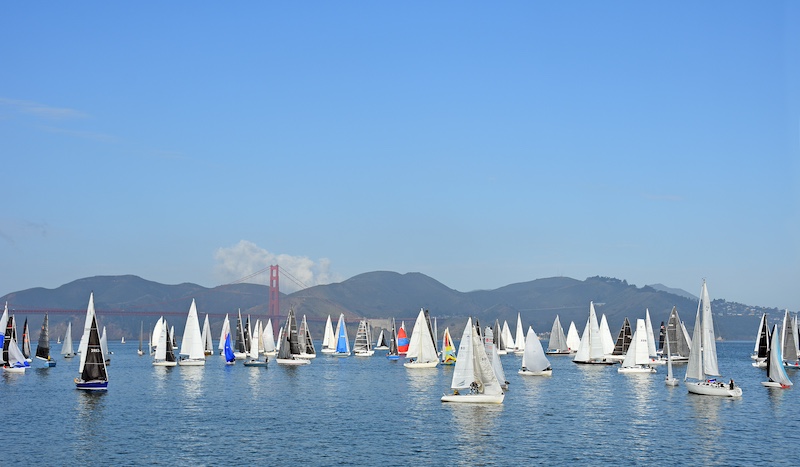
The race is an exercise in chaos and fun, hence the name “Fiasco.” Boats have the freedom to choose which mark they sail to first, and which way to go around each mark. The pursuit race element of it all (staggered starting times) means that, theoretically, most boats will be crossing the finish line around the same time.
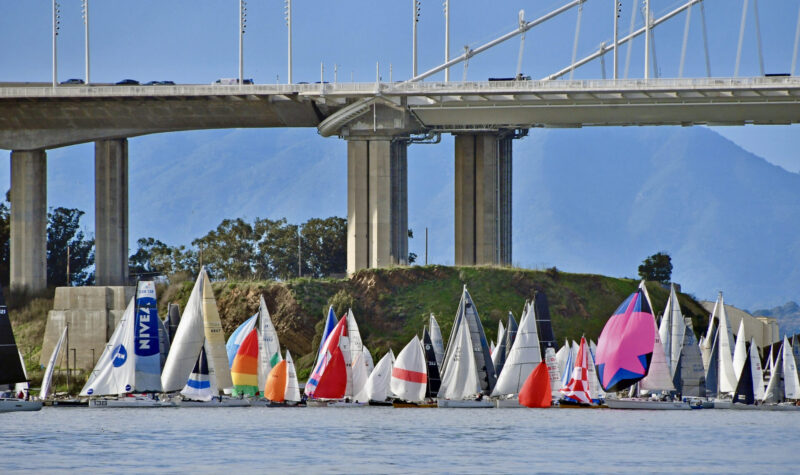
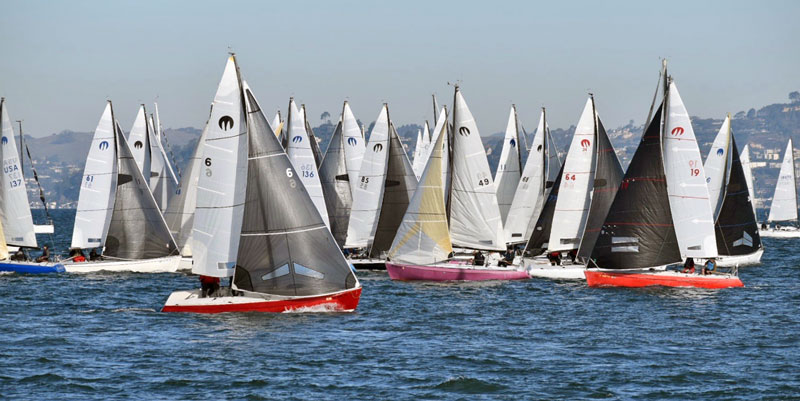
The TBF is the largest annual sailing race on the West Coast, and is exclusively for doublehanded or singlehanded racing. With that in mind, it’s important to have a plan and sail smart around all of the hundreds of other boats. With the first signal for the race just before 9:00 a.m. at the Golden Gate Yacht Club, the first portion of the race will be sailed in a flood, with the with the ebb starting along the shore around 11. [This is a correction thanks to Richard von Ehrencrook’s comment below.]
The SSS will be holding a Competitors’ Meeting on the evening of Wednesday, January 28, at Oakland Yacht Club at 7:00 p.m.
Stay tuned for more coverage of the Fiasco here in Latitude 38. Sign up to race here.
Good Jibes #227: Baja Ha-Ha To-Do List, Then and Now, Sailing Dad, and A Long Sailing Life (Verbatim), With Host Monica Grant
Welcome to this week’s Good Jibes. Today we bring you four stories from the January issue of Latitude 38 Sailing Magazine.
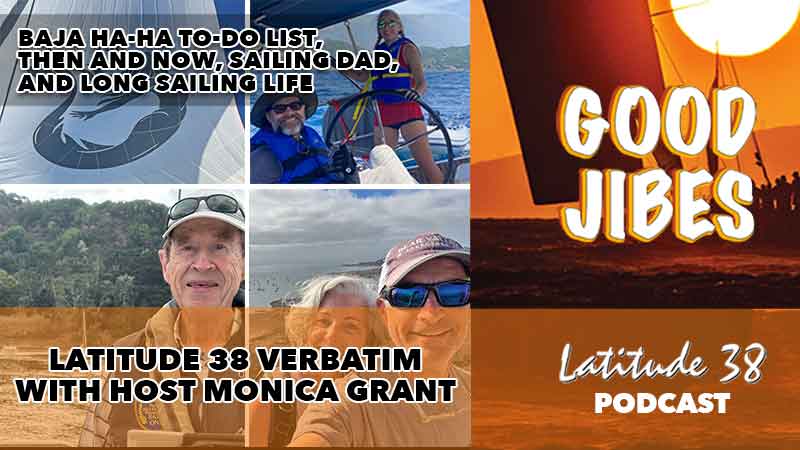
Tune in as host Monica Grant reads, “The To-Do List en Route to the Ha-Ha” by John Walsh, “Then and Now” by Liz Newkirk, “A Sailing Dad’s Family Charter” by Pippin Brehler, and “The Secret to a Long Life? Sailing” by Thea Yoshida.
Here’s a small sample of what you will hear in this episode:
- Preparing and provisioning for the Ha-Ha
- Marine life encounters
- BVI Yacht Charters
- League of Gentlemen Sailors
- Virgin Gorda
Follow along and read the stories:
“The To-Do List en Route to the Ha-Ha” by John Walsh; “Then and Now” by Liz Newkirk; “A Sailing Dad’s Family Charter” by Pippin Brehler; “The Secret to a Long Life? Sailing” by Thea Yoshida.
Listen to the episode on Apple Podcasts, Spotify, and your other favorite podcast spots — follow and leave a 5-star review if you’re feeling the Good Jibes!
Life is Better With a Boat
‘Kahoots’ Prepares to Sail the Pacific Cup
With 2026 being a Pacific Cup year, Latitude 38 is previewing the race from San Francisco to Hawaii with profiles of the some of the teams and sailors who will be making the crossing. In this edition, we check in with Greg Mitchell and his team aboard Kahoots.
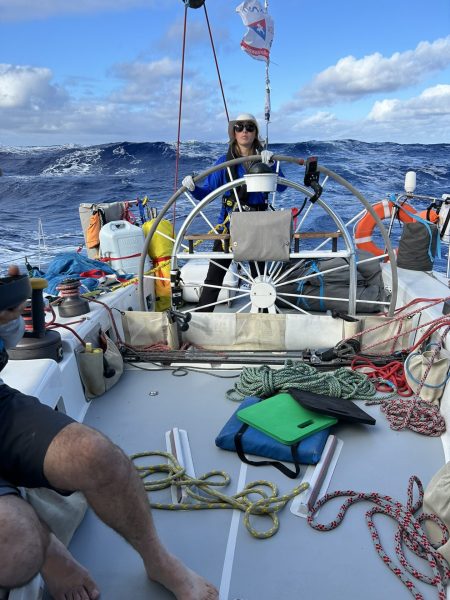
The Kahoots program started as some chatter among the volunteer coaches for the Richmond Yacht Club (RYC) Winter Junior program — basically a bunch of dads who were working to educate our kids and others on how to sail. But 16 Sundays a year, and kids in the program, build friendships too, and we all wanted to sail a Pacific Cup.
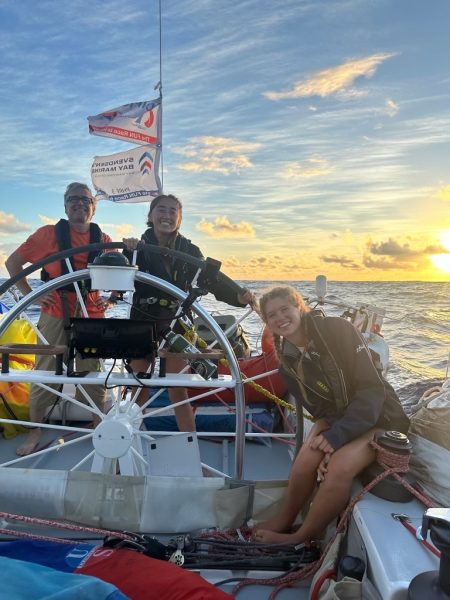
With Miles Englehart’s help, I started looking for a boat, and found Kahoots on a mooring in Newport Beach Harbor in 2018. Kahoots is an Andrews 43, a first-generation IMS design built by Dencho Marine in 1990. The basic idea was two Pac Cups: 2022 and 2024 with some of us dads, and some of the kids.
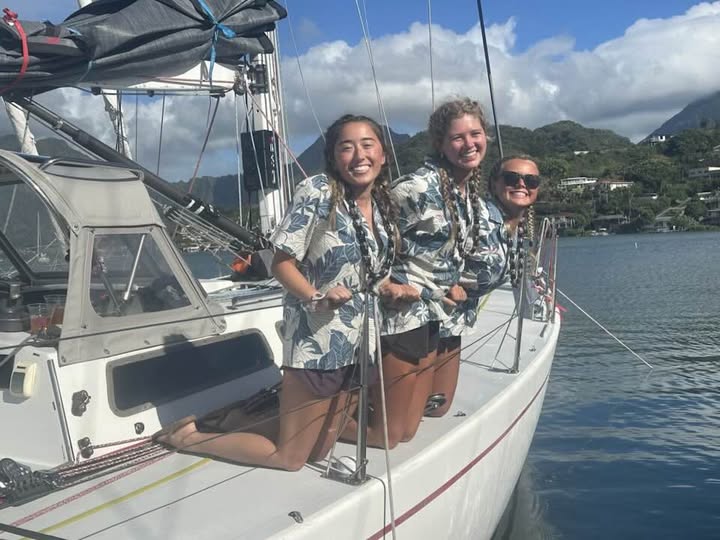
2020 was delayed due to COVID, which wasn’t awful for us as it offered us the opportunity for a full rebuild. We did everything: dropped the keel, removed all deck hardware, and fixed some core issues here and there. Instruments, repowering — it seemed endless. Sadly, one of our group, Dick Loomis, had a recurrence of cancer and passed away before the 2022 race.
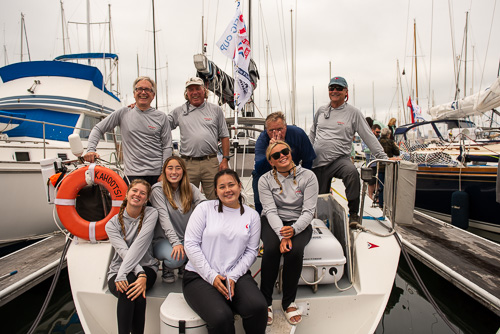
Miles and I, with fellow RYC instructors John Amen, Mark Phillipps and Jim Wheeler, sailed with two 17- year-old RYC juniors: Chase Englehart and Portia Brown. We brought Dick with us and had a memorial/scattering at the halfway location, and then another after arrival in Kaneohe Bay. Of course our families met us in Kaneohe, and now that Chase and Portia had done it and were all smiles, our younger kids expressed interest in the 2024 race.
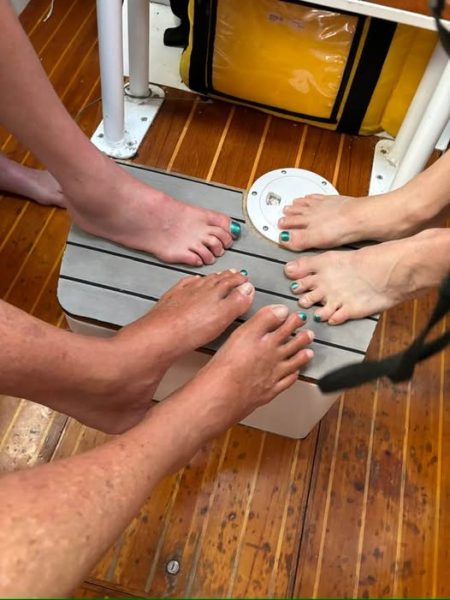
In 2024, we sailed “Dad’s and Daughters” — Miles, Jim, Mark and I with Abby Mitchell, Jenna Englehart, Amanda Wheeler and, returning for another go, Portia Brown. While 2022 was all about the race, 2024 was all about the experience. The four young ladies, from 17 to 19 years old, went through a season-and-a-half of OYRA racing to get ready, and took over for Spin Cup 2024. That was our real test, and they came through great. In the actual race, we found out that young eyes and balance skills more than made up for experience, and I would say they were the best drivers at night; they just kept plugging along. And how many crews had a mani-pedi day on the crossing?
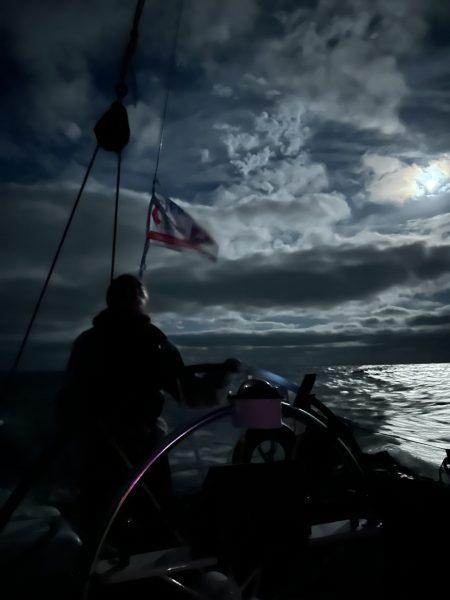
After some time passed, two of the girls wanted to give it one more shot, and focus more on the results than just the experience. So we’re going again. Miles and I, with our daughters Jenna and Abby and three-time repeat offender Portia, will be joined by two of Kahoots‘ other core crew, Rosanne Scholl and Gabe Serafini. Since it’s our third Pac Cup the prep seems a little less onerous this time around, but we do have a few projects underway: spreader tip replacement, a couple of sails, updating some of the running rigging, and a few other changes like Starlink instead of Iridium GO! Will we have another mani-pedi day?
Trash or Treasure? Abandoned and Derelict Vessels
We’ve written a lot about the enormous problem of abandoned and derelict vessels in the Oakland Estuary. However, it’s not just an Oakland problem, a Bay Area problem, or a California problem. It’s truly nationwide, and something states from Maine to California to Texas and Florida are trying to solve.
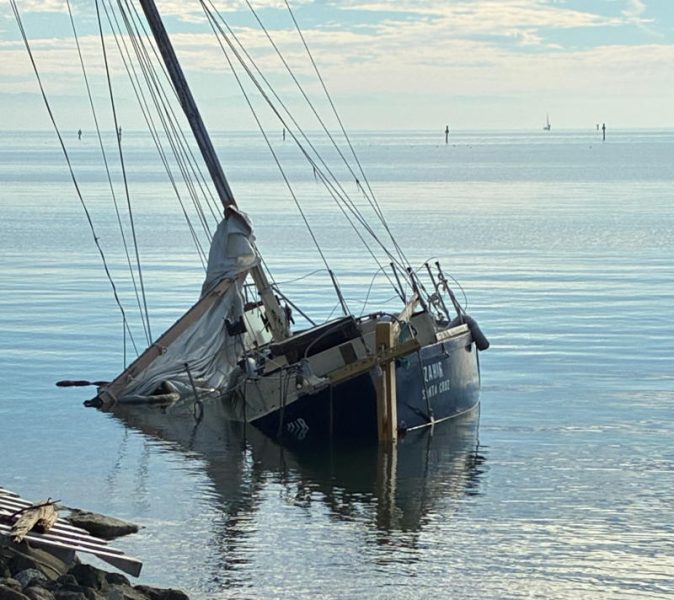
We’re reminded of this once again after our Peninsula-route magazine delivery driver Bob Bodnar sent in a few photos of a sunken boat on the shores of Oyster Cove, below the gleaming office towers in Brisbane and South San Francisco. There were a couple of other raft-ups anchored out in the same cove. Fortunately, the weather has been nice for the last few weeks. This is the same area where three boats burned in early November 2023.
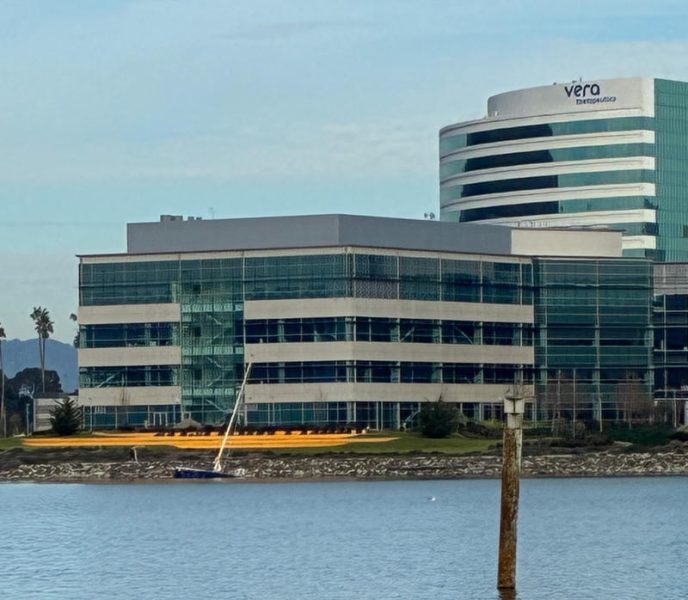
We see this as a two-part problem. There were tons of fiberglass boats built during the boom years of the ’60s–’80s. It pains us to say this, but there are many in need of disposal. Unfortunately, this is currently very expensive, meaning collective action is needed from government agencies to help provide funding and a cost-effective plan for the disposal of boats. There are enormous industries built around recycling or disposal of automobiles, electronics, construction materials, tires and many other discarded items from modern life. Boats don’t easily fit into this waste stream, so creative ideas are needed to generate market or policy mechanisms to manage the process.
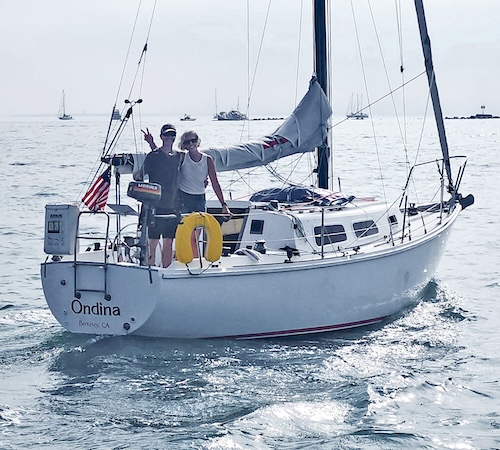
Alternatively, we still believe many of these old boats are an opportunity for future owners with the right skills and attitude. We still share a 1964 Rhodes 19 and a 1966 Pearson Ensign with family, sailing in Maine. They both need work, but both sail every summer. In the right hands, many of the boats built in that era, currently sitting idle, can be made very serviceable for years to come. The smallest boat in this year’s Baja Ha-Ha was the 1978 Cal 29 Ondina, which was covered in both Sightings and Changes in Latitudes in our current January issue.
There are lots of older, inexpensive boats available. The important thing is to go into a project with eyes wide open. Some owners would love to have you simply help them maintain and sail a boat. A boat partnership can help make fixing up an old boat much more fun and manageable. Listen to our podcast with Terry Castleman who, with three friends, bought a catamaran in Stockton for $2 (50 cents each). Since then, they’ve spent about $25,000 but have also sailed it from Stockton to Southern California, and had fun rebuilding it. They also discovered a hidden treasure of silver coins aboard during the clean-up.
As they say, one person’s trash is another person’s treasure. We admit many boats do need disposal, though many can be saved. We hope the right policies and the right people can help solve the difficult riddle of getting these boats into the right hands before they become derelict and abandoned vessels strewn about the shoreline.
Jules Vernes Trophy Contestants Headed for the Finish
Two 100-ft French trimarans departed the French coast last year in an attempt to break the approximately 40-day circumnavigation record set by IDEC in 2017. The all-female crew of The Famous Project (aboard the maxi trimaran IDEC SPORT) left first, and Thomas Coville aboard Sodebo left about 17 days later. They’re both back in the North Atlantic and heading home. Sodebo has been burning up the planet and catching up to The Famous Project. If Sodebo can cross the finish line in the next five days, they’ll set a new record for the fastest time sailing nonstop around the planet. Sodebo has been out 35 days and The Famous Project is closing in on home after 52 days.
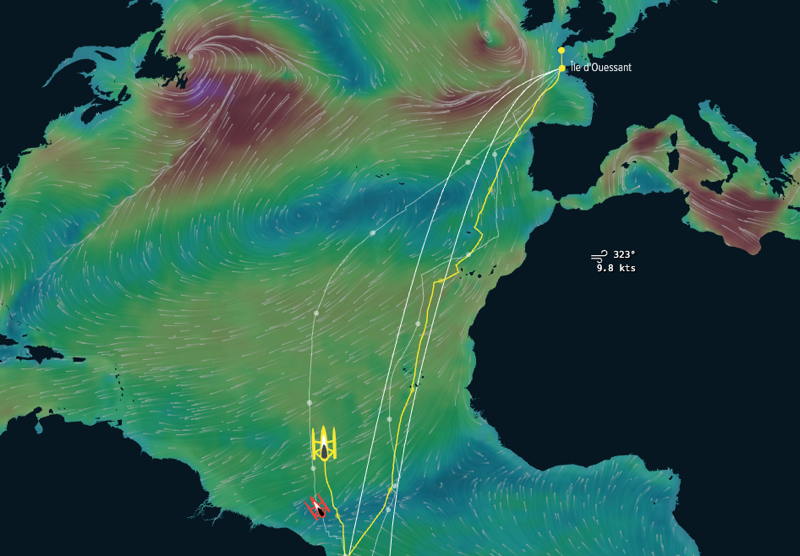
They’re using different tracking and weather maps, so it’s a bit hard to compare exactly where they are and assess the weather conditions, but currently Sodebo is rocketing north while The Famous Project is attempting to find their way around the big blue blob of light air between them and the finish line. If the weather gods smile on Sodebo, the conditions will change for them between their current position and the finish. The red boat in the graphic above is the location of Francis Joyon in his record-setting run in 2017. Sodebo will need to finish within five days to beat the record.
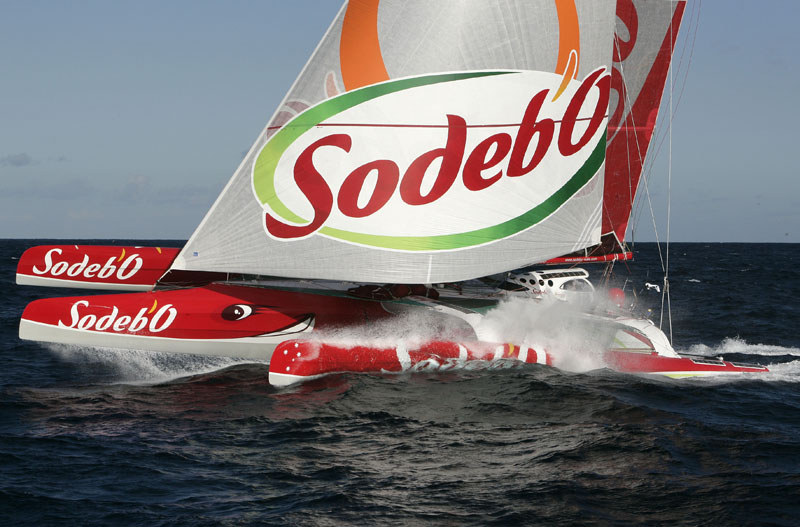
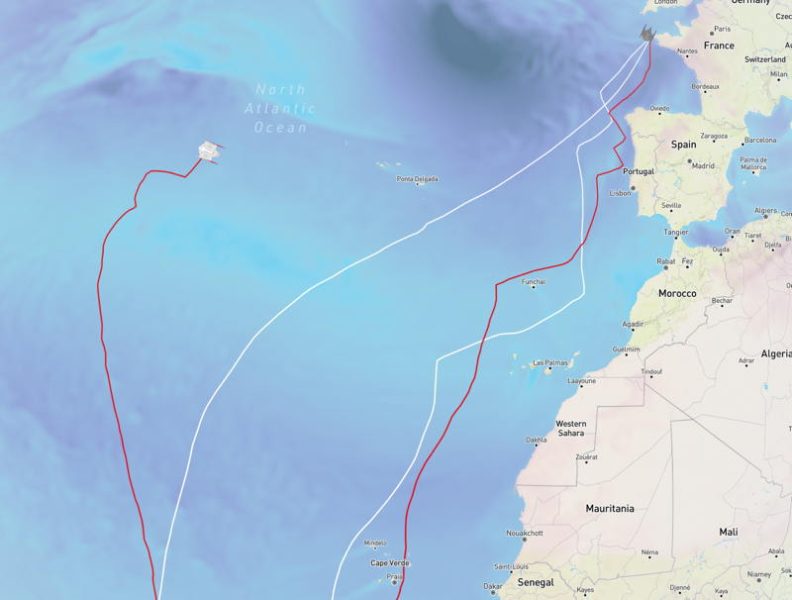
While The Famous Project is out of contention for setting the all-time Jules Verne Trophy record, if all goes well, they’ll set the record time for an all-female, nonstop race around the world. However, both boats face challenging North Atlantic weather systems in the days ahead. You can follow The Famous Project here and Sodebo here.
What have you been up to for the last 40 days?
Spaulding Marine Center — Full-Service Boat Yard and Education Center