

Mercury Class National Championship Sailed at LAYC
The 2025 Mercury Class Championship, held on the weekend of September 27/28, will go into the books as one to remember. The conditions saw abnormally light wind on Saturday, while still light and building on Sunday.
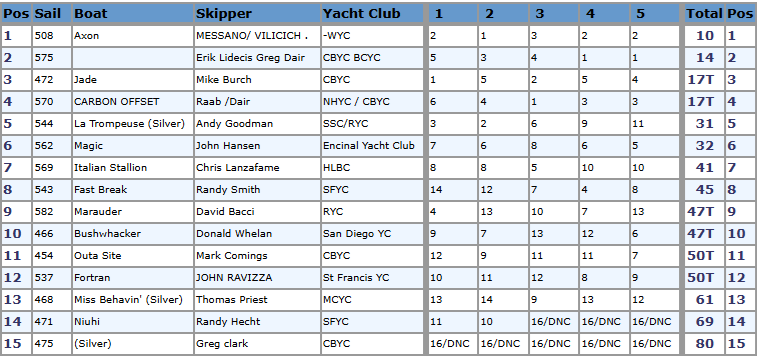
Saturday racing had a long postponement, and only two races were completed in the light conditions. On Sunday the sky cleared, and while still light, the breeze was solid and continued to build to maybe 10 mph. Three races were completed.
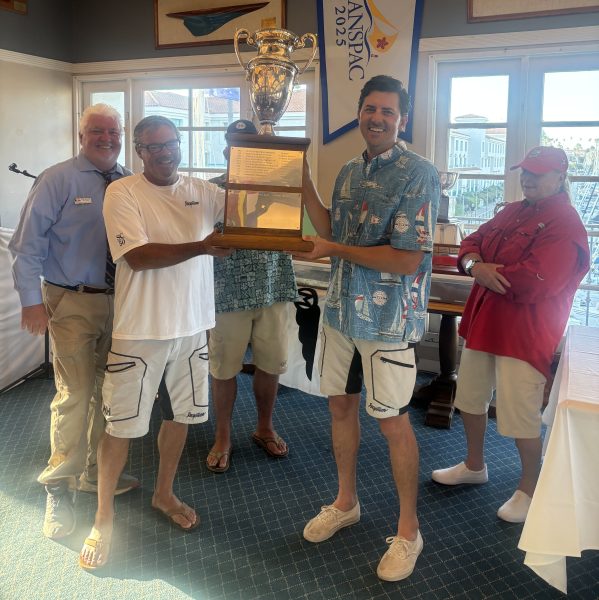
Congratulations to Chris Messano and Chris Vilicich for their decisive win with 10 points, never finishing below third in any race.
Second place went to Erik Lidecus and Greg Dair with 14 points. This was Erik’s first Mercury regatta. He finished very strongly, winning races four and five. And welcome back to Greg Dair, who has been absent from Mercury sailing for a while.
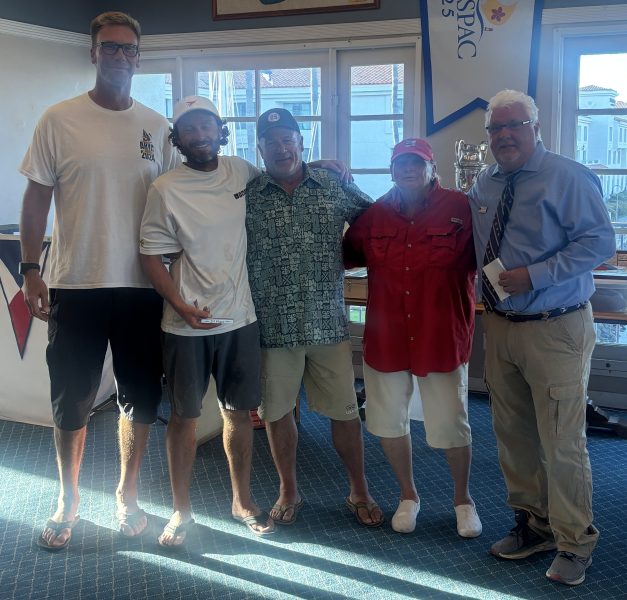
Tied at 17 points were Mike Burch and Chris Raab, with Mike taking third on the tie breaker.
The highlight of the series saw Andy Goodman and Elijah Sanford winning the Silver Fleet and finishing fifth in the Gold Fleet. After a long absence from sailing Mercurys, Andy and Elijah raced at Huntington Lake and had so much fun they decided to come to the championship.
In looking at the scores after the top five, you can see the conditions were challenging and the scores were mixed. The boats were battling in the middle of the fleet, and it was easy to slide back in the light conditions.
A big thanks to LAYC, Sean McMillen, and his team for their hard work in setting and moving courses as required this weekend. Also thanks to LAYC commodore Marjorie Irwin and the club’s hospitality. Commodore Irwin was on the race committee boat each day and at the club every night!
This One Is for the Birds: An Update From ‘Cetacea’
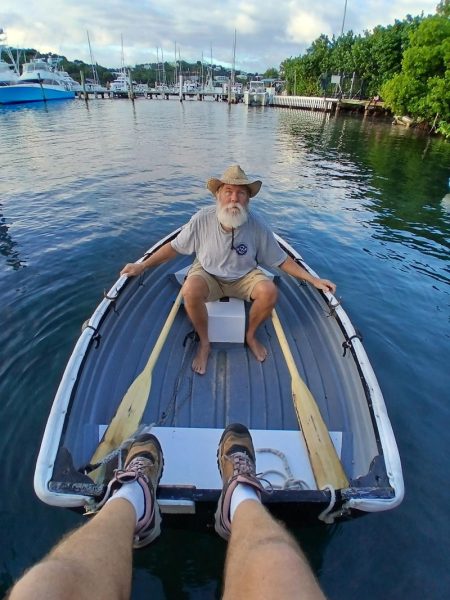
West Coast cruisers James Lane and Dena Hankins have been out cruising for over two decades. They’ve been living in the USVI and wrote in about birds, and taking flight for an opportunity at the Panama Canal.
Soooo, the crew of the electric Baba 30 SV/SN-E Cetacea, James, Dena, and Beluga Greyfinger, the cat, are officially underway once again! We’ve been offered an amazing opportunity in Panama, so we’re sailing there as soon as we get a decent 10-day forecast out of Windy.
But, man, am I going to miss the resident avians of St. Thomas, USVI!
The pelicans who dive between the giant sport-fishing boats and the docks they’re moored to are so fascinating. I can’t imagine that shit ever getting old.
The royal terns, who started showing up just a few miles east of Martinique, really are the very definition of royalty at sea, and they swooped and dove around us all throughout the Caribbean islands. And then there are the boobies. The big, brown, blue-billed boobies are quite a sight to behold. They vie for position on the spreaders while offshore, and catch free rides on the ferries between all the Virgin Islands. They are incredible fishers, handsome as all hell, and very nice neighbors. Another resident of the North Atlantic Caribbean chain is my favorite of all the flying freaks, the magnificent frigatebirds. They have this tiny little body, a long, split tail, a sharp, slightly curved beak, and a seven-and-a-half-foot wingspan! This is an incredible animal. They spend most of their lives in the air and at sea. These giants would swoop down and catch flying fish just inches off the surface of the ocean between the Cabo Verde Islands of West Africa and the entirety of the Caribbean island chain. They, the magnificents, are nonstop entertainment when sailing east to west across the Atlantic Ocean.
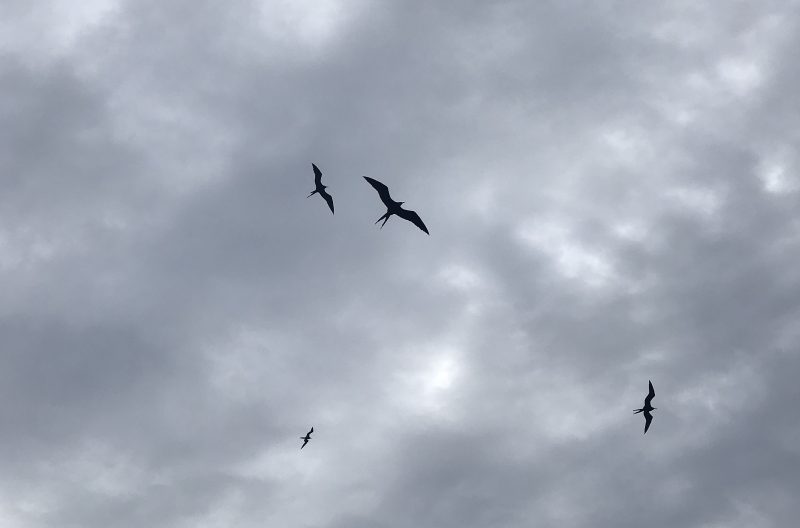
I’ve been a photographer of our natural world for 46 years, but I have never really considered myself a bird photographer. Let’s face it, those freakishly fast little fuckers are hard to shoot without a serious investment in modern lens technology, so you just have to catch them at the perfect moment, and how often does that happen? When we were in Eagle Harbor, on Bainbridge Island, Washington, I could only watch in awe as the bald eagles caught the baby salmon and got chased through the sailing rigs of Winslow Wharf by the squalling hordes of overfed gulls, while the pelicans of Alameda, only 800 miles to the south, never failed to blow me away with their grace aloft and their goofiness on land.
As we sail our tiny electric sailboat to Central America, we are actually thrilled by the idea of all the new avians we will meet along the way; but first, let’s get the rig aloft.
James Lane, SV/SN-E Cetacea
Don’t Get Behind — Schedule Your Service With KKMI Today
Flare Collection Events and a Coast Guard Auxiliary One-Day Boat America Class
Free Expired Marine Flare collection events are being offered at several locations in November. Alameda, Del Norte, West Contra Costa, Marin, and Santa Cruz counties, the cities of Santa Barbara and Oceanside, the ports of L.A. and San Diego, and the California Product Stewardship Council have partnered with CalRecycle, California State Parks and the Coastal Commission’s California Boating Clean and Green Program to collect expired marine flares and educate residents about marine flare management safety, including the advantages of reusable distress signals, to protect California communities and the local environment.
Collection dates and locations are as follows:
Northern California
West Contra Costa County Cities include: El Cerrito, Hercules, Pinole, San Pablo, Richmond, El Sobrante, Kensington, Crockett, Port Costa and Rodeo, and unincorporated West Contra Costa County.
Dates/Times: Wednesday, Oct. 29–Saturday, Nov. 8, 9 a.m. to 4 p.m. Address: 101 Pittsburg Ave., Richmond, CA 94801
Del Norte County
Date/Time: Saturday, November 8, 2025, 10 a.m. to 2 p.m. Address: 1700 State St., Crescent City, CA 95531
Marin County
Date/Time: Sunday, November 9, 2025, 8 a.m. to noon. Address: Clipper Yacht Harbor, 310 Harbor Dr., Sausalito, CA 94965
Alameda County
Date/Time: Sunday, November 9, 2025. By Appointment ONLY. 9 a.m. to 1 p.m.
Sign up for an Oakland appointment at: www.stopwaste.org/marineflares
Santa Cruz County
Date/Time: Sunday, November 9, 2025, 8 a.m. to noon. Address: 425 Brommer St., Santa Cruz, CA 95062.
Check and share the NorCal Regional Flier
Southern California
San Diego County
Date/Time: Saturday, November 15, 2025, 8 a.m. to noon. Address: 2210 Shelter Island Dr., San Diego, CA 92106
Los Angeles County
Date/Time: Saturday, November 15, 2025, 10 a.m. to 2 p.m. Address: Cabrillo Way Marina, 2293 Miner St., San Pedro, CA 90731
City of Oceanside
Date/Time: Saturday, November 15, 2025, 8 a.m. to noon. Address:1850 North Harbor Dr., Oceanside, CA 92054
Santa Barbara County
Date/Time: Sunday, November 16, 2025, 8 a.m. to noon. Address: City of Santa Barbara Waterfront,
132-A Harbor Way, Santa Barbara, CA 93109
Check and share the SoCal Regional Flier.
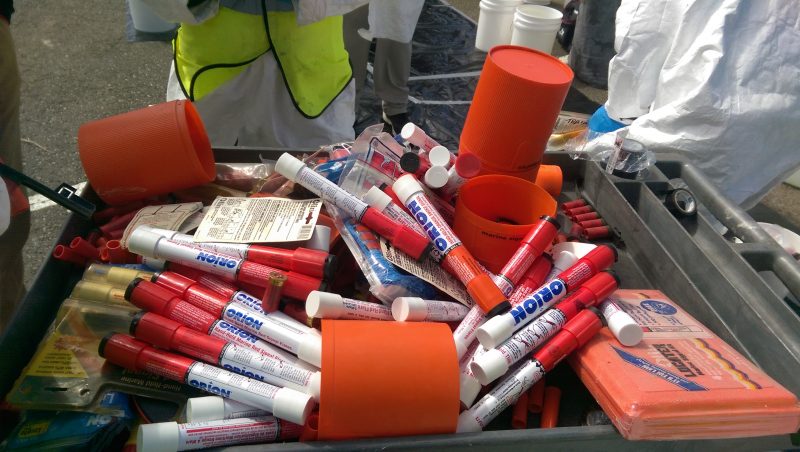
Only expired marine flares from residents and boaters berthing their boats in the covered areas will be accepted. No marine flares from commercial craft or an organization, or other forms of household hazardous waste (HHW), will be accepted during the special event. Proof of residence or eligibility is required (i.e., license, registration, or slip fee receipt).
The United States Coast Guard (USGC) requires boaters to carry several unexpired visual distress signals on board, day and night. Pyrotechnic marine flares are a common type of distress signal, but they are explosive and contain toxic chemicals, and must be managed as hazardous waste when expired or no longer needed. To assure safety and protect the environment, it is essential to manage single-use pyrotechnic marine flares carefully. Boaters should never throw expired or unneeded flares overboard or into the trash.
Single-use pyrotechnic marine flares expire and must be replaced every 36 to 42 months after their manufacture date, and recreational vessels generate about 174,000 expired pyrotechnic marine flares every year, according to the California Expired Marine Flare Working Group estimate in 2011. However, California boaters do not currently have access to an ongoing statewide disposal program for expired marine flares. To avoid the difficulties of safe disposal for pyrotechnic marine flares, the partners encourage boaters to consider an electronic visual distress signal device (eVDSD) as a reusable, safe, and cost-effective alternative to buying the single-use pyrotechnic marine flares.
For more information about expired marine flares, visit dbw.parks.ca.gov/marineflares, and to learn more, check DBW’s podcast about this topic
——————————————————————–
Coast Guard Auxiliary One-Day Boat America Class
California law now requires boaters of all ages operating a motorized vessel (boat) to carry a California Boater Card. The US Coast Guard Auxiliary is accepting signups for the one-day Boat America Class offered on October 25 at the San Rafael Yacht Club, 200 Yacht Club Dr., San Rafael 94901. Successful completion of the course and passing the test qualify the participant for the California Boater Card.
All instruction is by members of the US Coast Guard Auxiliary.
Details:
- The fee for the class is $25 payable by cash or check made out to US Coast Guard Auxiliary Flotilla 14. San Rafael Yacht Club (SRYC) members will be charged by the SRYC.
- Lunch will be available for a cost from the SRYC, or you can bring a bag lunch.
- Coffee is provided. Please arrive between 8:15 and 8:45 to give yourself time to pay the class fee and pick up the class materials at the San Rafael Yacht Club, and to order lunch if you choose.
- Instruction begins promptly at 9:00 a.m.
- The class and test should be finished between 5:00–5:45 p.m.
USCG Auxiliary Boat America class expected schedule:
0900–0905 Welcome
0905–0910 Introduction and Logistics
0910–0940 Chapter 1: Know your boat
0940–1025 Chapter 2: Before you get Underway
1025–1110 Chapter 3: Operating Your Boat Safely
1110–1200 Chapter 4: Legal Requirements
1200–1300 LUNCH (Probably Working)
1300-1345 Chapter 5: Boating Emergencies
1345–1430 Chapter 6: Enjoying Water Sports
1430–1515 California-Specific Supplement
1515–1600 Q&A/Pre-Test Review
1600–1615 Break
1615–1745 Final Exam. Most participants should finish in about 30 minutes but they have up to 90 minutes.
For questions and to register for the class, please contact US Coast Guard Auxiliary Public Educational Officer Andy Graham at [email protected] or (415) 490-7349. You can also learn more here.
Pacific Puddle Jump — The Planning Versus the View From the Trip
The good news is the bolts to the Hydrovane are tight on the inside of the hull. The other side of the coin is that I am hauling along through swells in the middle of the Pacific Ocean and I am not sure how I will extract my body from the lazarette! Maybe more interesting is how I got into this situation.
My long-held goal has been to sail across the Pacific. With planning, and discussions at home and work, I had the opportunity to take off from Memorial Day to Labor Day 2025. Below is my “messy, mistake-riddled, missed-chances” experience. This flawed approach may be useful to those planning a similar sail, or may simply be entertainment as you realize what not to do.
In order to get hold of the dream before it evaporated, I channeled the concept that big trips start with simple steps. For me, it was key to merge the three Ps and hopefully build a successful trip: Plan the concept, prep the boat, pick the people.
PLAN: After many early iterations, the final version laid out a three-month trip with the mantra of “start where you are, use what you have, do what you can.” Spreadsheets on time of year, average wind, distances, average speed turned to days needed, etc., were built. While a three-month plan does not allow for all the awesome side trips one reads about, it allowed me to throw off the dock lines, which may be the hardest part of a successful trip. The plan envisioned heading down the coast from S.F. to SoCal and heading offshore to the Marquesas, the Tuamotus, Tahiti, Tonga, Fiji, and then Australia.
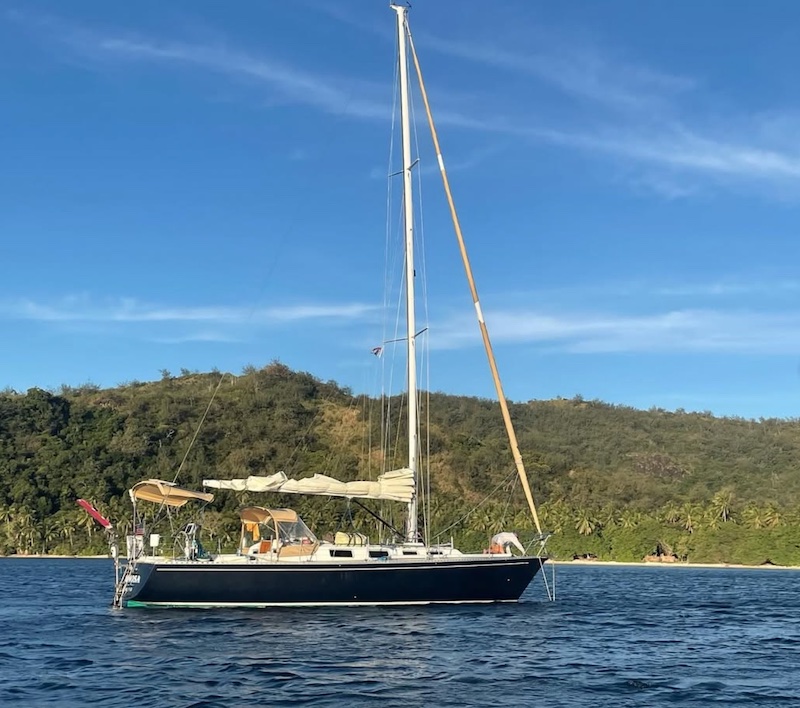
PREPPING THE BOAT: Mimosa is my 1989 J/40. The name was inspired by an Irish ancestor’s boat and is also the name of the left star in the Southern Cross constellation. Taking an objective view, I realized I had a boat that was great on the Bay, had made it to Hawaii and back, but needed some serious attention for this adventure. Fortunately, the S.F. Bay Area is full of knowledgeable and helpful sailors and craftsmen.
Basic principles are keep the water out, the mast up, and the keel and rudder attached. To this end, I began a spreadsheet with those goals, and which continued to expand with a list of projects to be completed at the top and finished items at the bottom. Such lists can be daunting, so I put down all that had been done in ’21 for the HI run under the “Accomplished” column!
Step one was to sort out the steering and rudder bearings. The steering quadrant had snapped as I sailed up Raccoon Strait one sunny afternoon; hence the priority. Fortunately, I’d had the emergency tiller close at hand and was able to return to the dock with only minimal heart palpitations while learning that the emergency steering devices are awkward! A new quadrant and rebuilt upper and lower rudder bearings completed that step.
Next order of business: Keep the water out. The sail to Hawaii in 2021 had been pleasantly downwind, but the return exposed some leaky ports to be fixed. The J/Boat owners’ group and J/Boats HQ were quite helpful. However, when the company that makes your boat has come out with the “new and improved” version, you know replacement parts will be a challenge.
Westwind Yacht Management — Washing, Waxing and Varnishing
Westwind Yacht Management: Premiere Yacht & Fleet services for the San Francisco Bay Area.