
“My Name Is Leo, I’m a Boatbuilder and a Sailor” Who Restored ‘Tally Ho’
For the past seven years Leo Gooldon has been rebuilding the classic cutter Tally Ho in the Pacific Northwest. Along the way he’s generated a tremendous following on his YouTube channel for his patient, down-to-earth coverage of the enormous project of bringing Tally Ho back to life.
To the delight of all classic-boat lovers, Leo has completed the project and set sail. The past week he arrived on San Francisco Bay, where sailor Wayne Edney of the Bristol Channel Cutter Odyssey caught Tally Ho just as she was coming under the bridge.
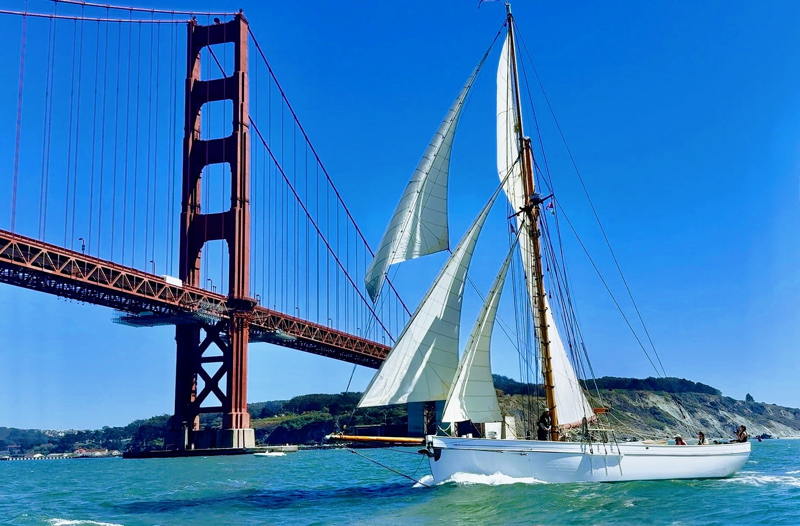
Wayne wrote in that he was out with his son and wife outside the bridge on their Bristol Channel Cutter when Tally Ho sailed in last Monday. He added, “I have been a reader since 1990 and appreciate the magazine’s contributions to Bay Area sailing.”
Heres a video of Tally Ho sailing into the Gate, shared by “Where in the World with Karen and Wayne.”
You can follow the seven-year rebuild of Tally Ho here.
Thanks, Wayne, for sending this spectacular shot and video. Looks as if you were able to have a fabulous day of sailing along with it.
Six S.F. Knarr Teams Travel to Copenhagen for 55th IKC
While the Knarr class is one of the biggest and most competitive on San Francisco Bay, racing Knarrs can be found in only two other countries in the world. Originally designed and built in Norway, the Knarr class arrived in San Francisco in the mid-20th century with Danish immigrant Knud Wibroe.
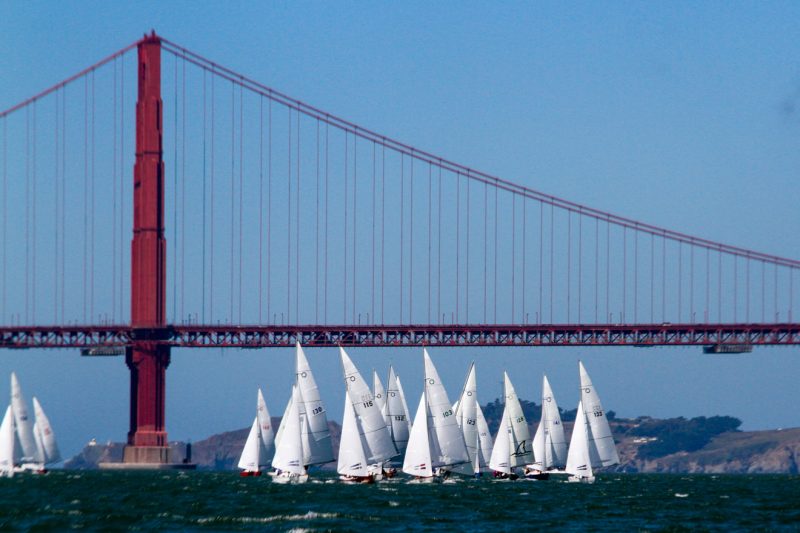
With racing fleets in San Francisco, Copenhagen, Oslo and Bergen, a unique International Knarr Championship (IKC) was founded. The IKC is Wibroe’s brainchild. It rotates every year among the three countries with racing Knarr fleets.
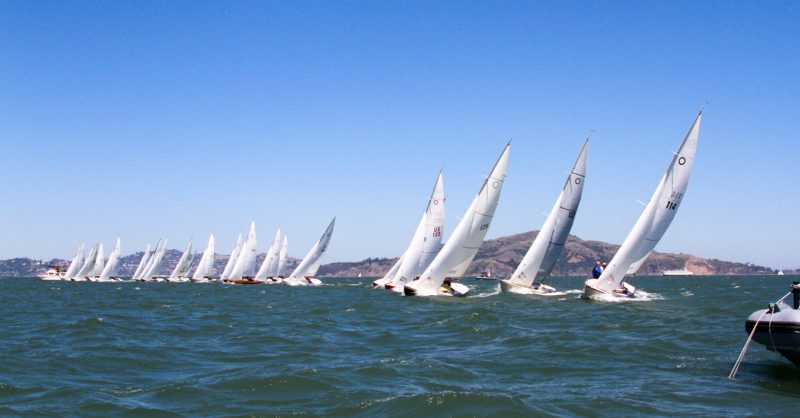
The host country is given half of the berths in each year’s IKC, while the two visiting countries are given roughly 25 percent each of the remaining bids. IKC bids are decided by the season scores from each of the local fleets’ prior season, while the defending IKC winner earns an automatic berth. Last year’s winner was Jens Christiansen and his team from Danish team Johanna (DEN 124) after a dominant showing in San Francisco.
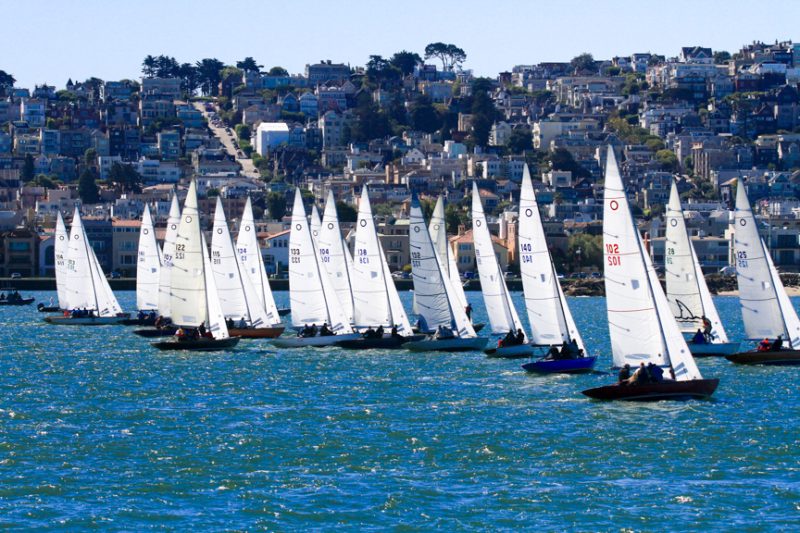
Thirty-eight of the 54 prior IKCs have been won by Danish teams, while 14 have been won by Americans and two by Norwegian teams.
This year’s IKC is taking place in Copenhagen at the Kongelig Dansk Yachtklub (KDY, Royal Danish Yacht Club in English). Last year’s championship was sailed at St. Francis Yacht Club (StFYC). Per IKC tradition, the host fleet will provide the boats, and teams will sail a different boat every day, decided by a draw before the regatta. Of the different Knarr fleets, the Danish fleet is the closest to a true one-design. Fourteen races are scheduled between August 25 and 30, with a lay day on August 27. There will be a practice race on August 24.
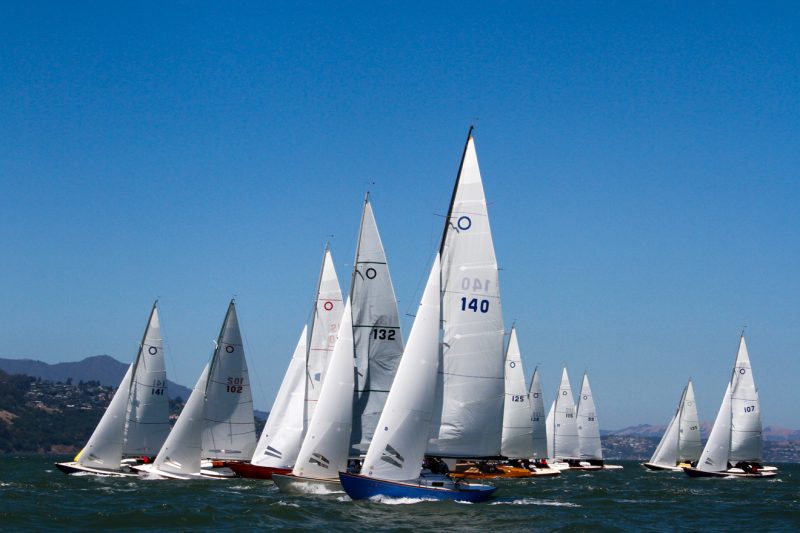
San Francisco Bay’s Knarr fleet normally draws between 14 and 20 teams per weekend regatta and features in a very competitive Wednesday evening series throughout the summer. Six of those teams will be joining seven Norwegian teams and 20 Danish teams to compete for this year’s IKC title.
The San Francisco skippers are as follows: Don Jesberg and team VIVA (SFYC, USA 133), Jeffrey Spoering and team Thor (StFYC, USA 39), Jon Perkins and team Aquavit (StFYC, USA 125), Mark Dahm and team Benino (StFYC, USA 102), Randy Hecht and team Niuhi (StFYC, USA 128), and Risley Sams and team Kraken (StFYC, USA 47).
Jon Perkins will be joined by his brother Chris, normally the skipper of Three Boys and a Girl (StFYC, USA 141). The Perkins brothers are the only two active skippers from the San Francisco fleet to have won the IKC, having won a combined nine times (five for Jon and four for Chris). The last time the brothers sailed an IKC — 2023 in Bergen — they won.
“We are expecting a very close regatta,” Chris said. “Conditions look great. The boats with provided identical sails will be closer than ever. At least seven of the skippers have won one or multiple IKCs in the past so the competition will be tough …. Fifteen races scheduled with a possible three throwouts. What could go wrong?”
You can follow the scores for the 55th International Knarr Championship here.
Learn More About the Smarter Way to Own a Boat With Club Nautique
UCB’s RecWell Makes Sailing Easy and Fun in Berkeley
Learning to sail on San Francisco Bay can be a challenging exercise to access the right boat, to acquire the proper gear, and to find the best instruction for your skill set and interest. UC Berkeley Recreation and Wellbeing Adventures, or RecWell (part of the UC Berkeley athletic department), meets these challenges with a friendly enthusiasm at their outdoor adventure center adjoining the Berkeley Marina at 124 A University Ave. on alternating weekends. These facilities are open to both the UC Berkeley student body — at a deeply discounted cost — and the Berkeley community at large, with the simple mission of providing meaningful recreation on the water to enhance daily life of study or work.
The adventure center offers instruction and watercraft for the sports of sailing, kayaking and windsurfing, with the sailing program offering instruction using the RS Venture 17-ft centerboard sloop. Introduction to the sailing program can be made by taking a two-hour class that spends the first hour going over boat terminology and rigging with the boat in the adventure center yard, and the second hour spent on the water with an instructor at the helm, using three students as crew. This class is offered to the public for $60, and is free for students at UCB.
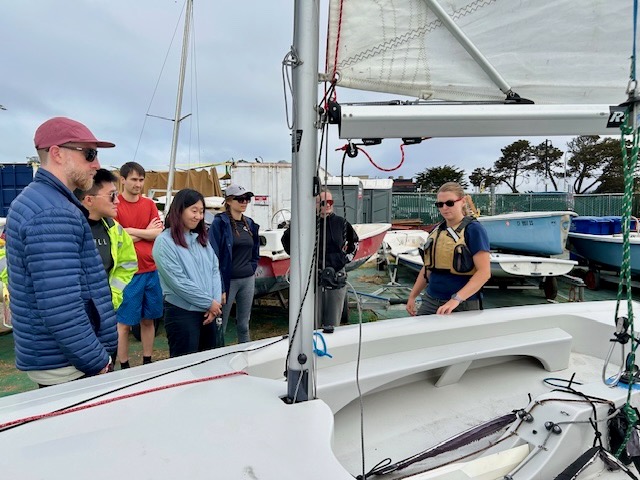
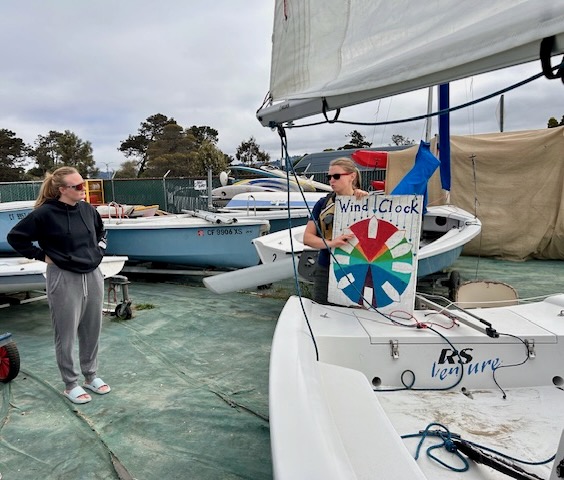
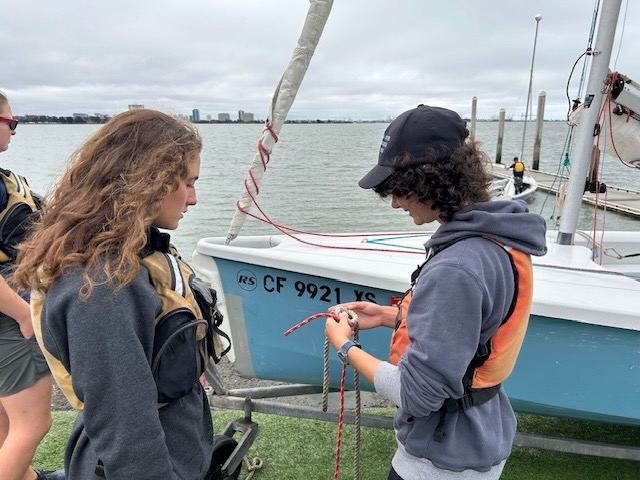
The next step in course progression is to take a four-day, two-weekend course, which allows students to qualify for access to the sailing fleet at the discretion of the instructor at a cost of $300 for the public and $200 for UCB students. The sailing area south of the Berkeley peninsula offers both protected waters on windy days, and full exposure to winds from the west through the Golden Gate, providing exciting opportunities for learning to manage both high winds and strong currents in controlled circumstances. All boats are required to stay within sight of onshore observers to facilitate rescue by outboard-powered inflatable craft.
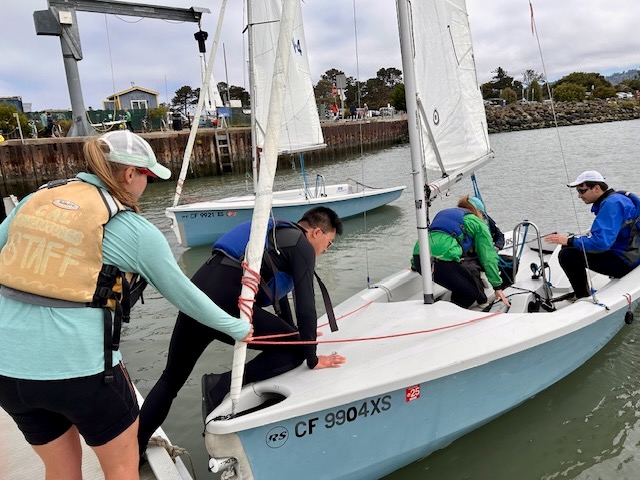
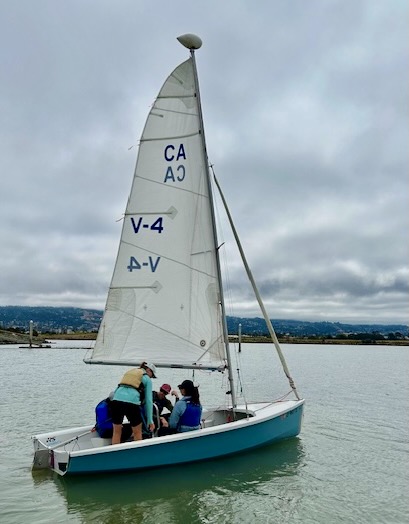
The adventure center provides wetsuits and life jackets in all sizes to ensure every student is comfortable onboard, and safe in the event of immersion in the Bay. This gear is included in the cost of instruction or rental fee. Safety procedures are well taught, including capsizing recovery techniques with instructors joining students in the water! Dockmasters provide logistical support for instructors and staff, managing registration, gear fitting, rescue assistance and observation duties, and is a great volunteer opportunity for anyone interested in getting exposure to on-water activities.
The ”vibe” of the adventure center is “magical,” in the words of Bruce Katz, windsurfing director, who has been with the adventure center for over 30 years. The leadership and organizational skills provided by program director Morgan Collins during the last five years has created a staff that is both knowledgeable and full of infectious enthusiasm that makes everyone eager to get out on the water.
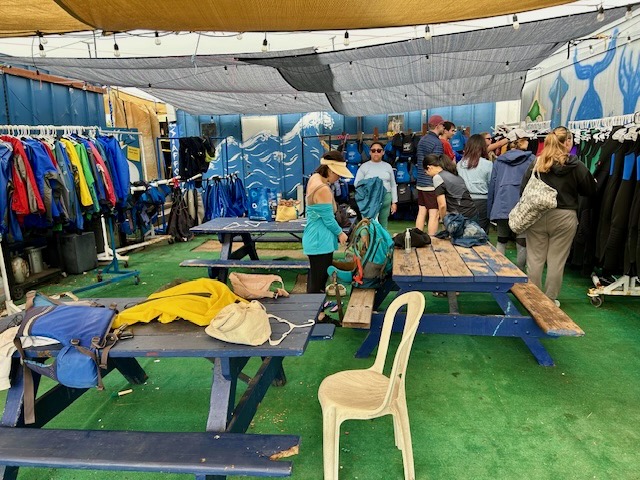
The future of the adventure center depends on increased participation from both the public and student body, as University budget constraints put pressure on recreational and wellbeing funding.
A visit to the adventure center on an upcoming weekend is a great way to sample what the Berkeley waterfront has to offer as a recreational choice, while supporting this great program.
Here are details on how and when you can participate: UC Berkeley Recreation and Wellbeing Adventures/Sailing.
Is DIY D.Y.I.N.G?
There was a time not long ago when cruisers earned their sea legs headfirst in a lazarette, elbow-deep in bilge muck, and armed with a questionable socket set and the unwavering confidence of someone who read a single forum post about diesel engines. DIY was not only a necessity, it was a rite of passage. You weren’t just fixing a leaking portlight, you were forging character — one stripped screw at a time.
Fast forward to today, where cruising YouTube looks a lot different. Solar arrays are installed by subcontractors, interiors are refit by teams, and bottom jobs are outsourced to the tune of five figures. The DIY spirit hasn’t disappeared, but it is being drowned out by the sound of orbital sanders run by someone else’s hands.
Let’s start with a shining example: the YouTubers of Sailing ‘Avocet’. Chris and Marissa Neely took a tired 1979 Cheoy Lee 41, and through sheer grit (and gallons of epoxy), turned her into a floating work of art. No gold-plated sponsorships, no magic wands — just a couple with a deep toolbox and deeper patience. From stringers to stanchions, nearly every inch of Avocet has felt the business end of their effort. Their story proves that success isn’t measured in dollars spent, but in splinters earned.
Their following isn’t just built on beautiful sailing shots — it’s built on relatability. Because if they can rip apart a cabin sole and put it back better than before, maybe we can fix our leaky chainplate without calling the boatyard.

Then there’s Sailing ‘Uma’. Dan and Kika famously tore out their diesel engine and rebuilt their boat from hull to mast using an electric motor and little else but vision and tenacity. They didn’t just embrace the DIY ethos, they evangelized it. Their channel is a masterclass in doing it yourself even when it might be easier, cheaper and definitely cleaner to pay someone else — or replace the boat entirely. They are living proof that you can go far with less, especially if you’re willing to make a few mistakes, film them, and share the lesson.
And that’s the core of DIY: not perfection, but process.
Another honorable mention? MJ Sailing. Jessica and Matt have been refitting boats for over a decade — sometimes in freezing Michigan winters, sometimes in blazing Florida yards. Their newest aluminum build is a testament to staying the DIY course even when you’re surrounded by yard workers with clipboards offering to “just take care of that for you.” They’re methodical, meticulous and honest about the mess.
Now let’s look at the other side of the anchorage. The “new wave” of cruisers, armed with fat budgets, pre-launch production deals, and little desire to turn a wrench unless it’s part of a sponsored toolkit review.
Plan Your Trip to Annapolis Sailboat Show This Fall