

Transpac Racers Back Into the Breeze for Home Stretch
2025 Transpac racers are crossing the halfway mark while also trying to navigate their way around the Pacific High. Greg Dorn of TP52 Favonius 2 wrote in with some comments from the course.
“Current conditions are 14 kts of breeze at 50 degrees of direction, sunny with temps in the mid-70s.
“The last 24 hours were defined by avoiding a high-pressure ridge that broke off from the Pacific High and moved through the race course. High pressure means no wind. Some boats went very low to skirt the danger zone while others worked around its margin seeking a shorter course, and some fell into the high-pressure system.”
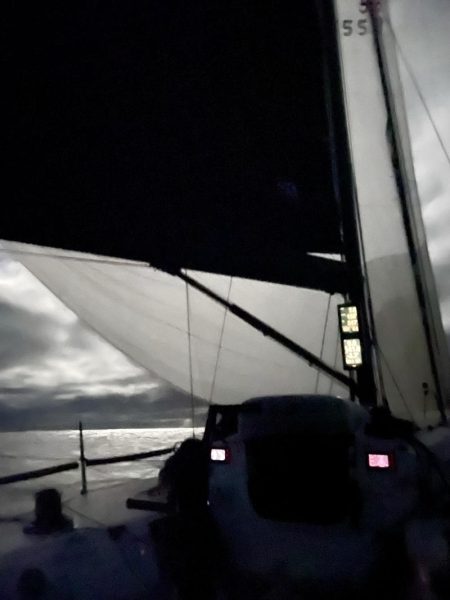
“We elected to sail a shorter course and successfully skirted the high-pressure ridge. But to do so we jibed 14 times flawlessly at night, emerging in the morning in a new synoptic breeze and pointing toward the mark (Hawaii), which is now approximately 1500 miles away. The boat is ripping along nicely in mid-double digits of speed, thereby consuming distance easily.
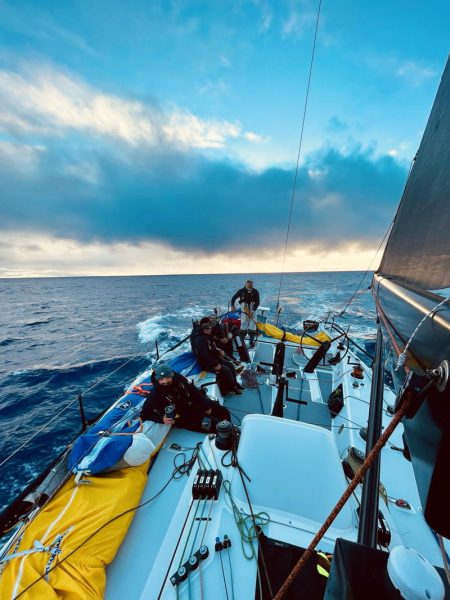
“So after an unusually rough start followed by a demanding, light, technical section, we are now settled onto a starboard tack with an A2 spinnaker, spinnaker staysail and full main. The main is holding its repairs well. To get to this sail plan we performed a few peels with some very agile crew members venturing out onto the end of the bow prod to release sails and rearrange the tack lines. Top speeds have been around 20 kts with regular speeds in the teens. The boat thrives in these conditions.
“Along the way we have seen humpback whales, a turtle and a brown booby who was remarkably friendly — I was able to touch the bird as it sat on our windward starboard rail. Fortunately, the booby did not leave any gifts on deck once it decided to fly away.”
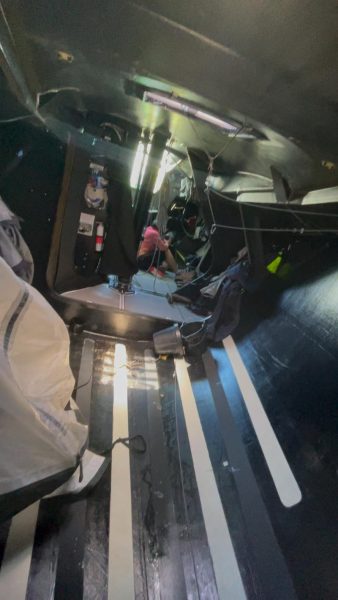
“Down below one is surrounded by the sound of rushing water against the thin carbon fiber hull. Although it’s warm down below, the white noise and lack of lighting make for decent sleeping at all times of day and night. So the crew is well rested and consuming plenty of calories and fluids to keep up with the work the boat requires. At this stage of the race we encourage the crew to bathe, but not all are compliant. so we are thankful for the effect of 15 to 20 kts of wind on body odor. Our diet so far has been composed of freeze-dried rations, oatmeal (pre-made by Jane Dorn and which everyone has loved), fruit, pre-packaged salads, protein bars and a plethora of random snacks.”
“There are still many miles left in the race, so we are doing our utmost to position ourselves for the best possible outcome.”
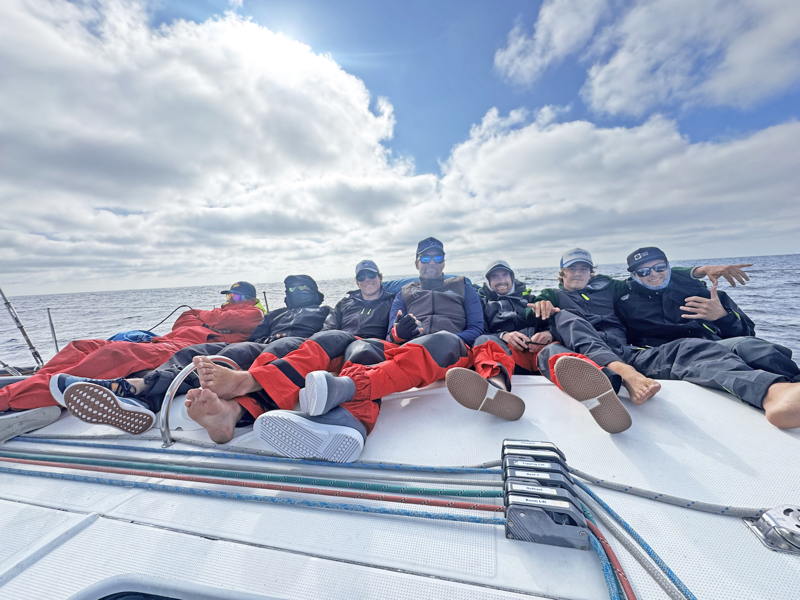
As the rest of the racers close in on Hawaii with steadier breezes, the passing lanes will get harder to find. Most boats have extracted themselves from the wayward Pacific High slowdown and are now in steadier breezes trying to find the fastest track downwind. Those that got south of the high pressure may have more distance to sail but enjoy hotter angles, while those that went north will have a shorter course but less apparent wind.
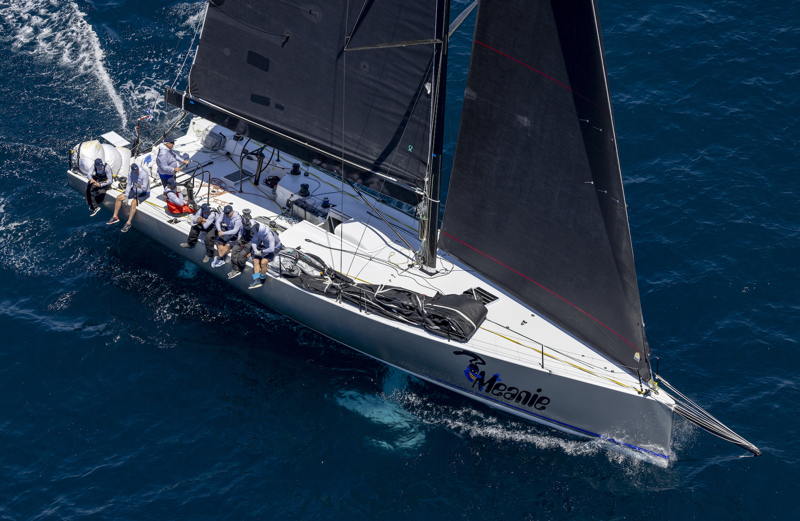
As of Tuesday evening, the 10 boats “wearing the crown” on the tracking chart by leading their divisions were:
● Boatswain’s Locker/Yanmar Division 1: Bryon Ehrhart, Lucky, Juan K 88
● Mount Gay Division 2: Thomas Akin, Meanie, TP52
● Whittier Trust Division 3: Dave Clark, Grand Illusion, Santa Cruz 70
● Cal Maritime Division 4: Rich Festa, Groundhog Day, Rogers 46
● Cabrillo Boat Shop Division 5: Dave Moore, Westerly, Santa Cruz 52.
● Garmin Division 6: Thomas Garnier, Reinrag2, J/125
● Suntex Division 7: Fred Courouble and Charles-Etienne Devanneaux, Rahan, Beneteau First 36
● Pasha Division 8: Barry Clark, Blackwing, Grand Soleil 44
● Bridger Insurance Division 9: Alli Bell, Restless, Cal 40
● smithREgroup Multihull Division 10: Don Wilson, Convexity2, GB 68
This year’s Transpac has 10 percent of the starting fleet commanded by women. “I’m really excited about the number of women skippers,” said Alli Bell, skipper and owner of the Cal 40 Restless. She also serves as Transpacific Yacht Club’s rear commodore and communications chair, as well as vice commodore of San Diego Yacht Club, and said this evolution of more women skippers happened organically. “We didn’t do anything specifically to attract more women— we just try to attract sailors.”
As noted above, Alli Bell and Restless are currently leading Class 9 and the race overall!
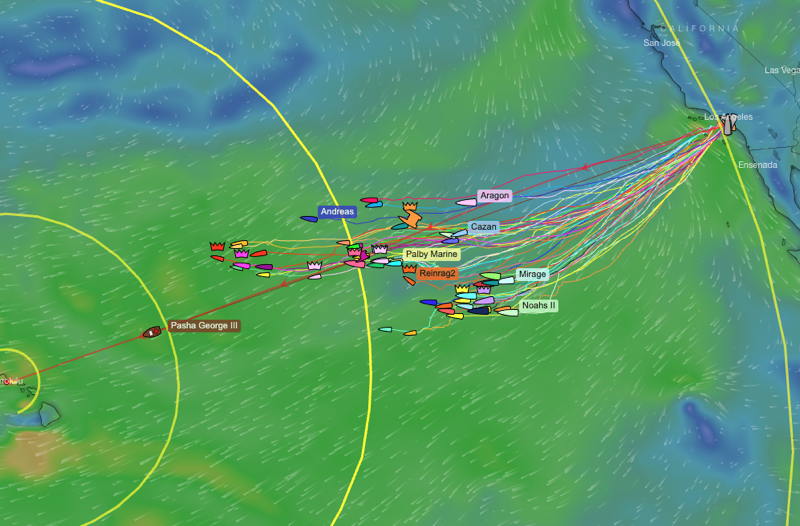
Right now the big boat, Lucky, is back up to 20 knots, while the Beneteau First 36 Rahan remains out front, surfing along at 10+ knots with less than 800 miles to go but big boats coming up from behind. The wind is filling in for everyone so it’s pedal to the metal at the best angle possible all the way to the Molokai Channel and Diamond Head.
Follow along to the home stretch.
Good Jibes #199: Bill and Suzette Lewis Retiring To Cruise the World
This week we chat with Bill and Suzette Lewis about truly going “Where the Wind Blows.” Bill and Suzette are Blue Water Cruising Club members (BWCC) who retired so they could cruise the world.
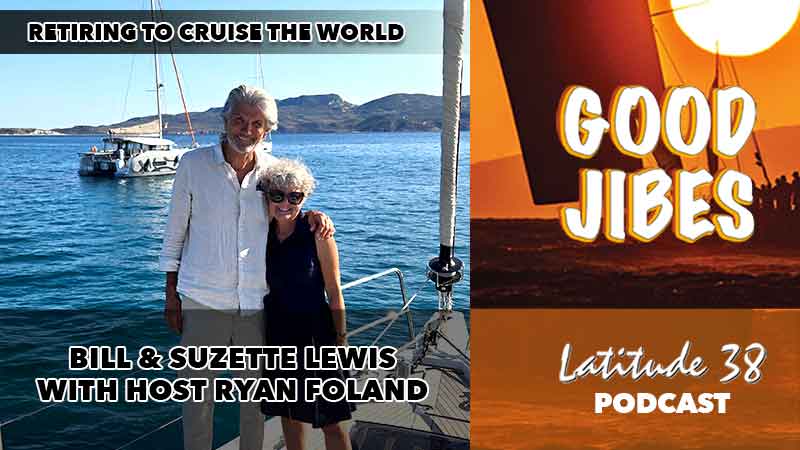
Tune in as Bill and Suzette chat with Good Jibes host Ryan Foland about how a boat played a part on their first date, how to find a suitable cruiser, their brilliant 90-day on-off schedule, their favorite moments and spots around Europe from the past three years, and how to avoid boredom during retirement.
Here’s a sample of what you’ll hear in this episode:
- Why Bill and Suzette don’t let teenagers do their dock maintenance
- The purpose behind their 90-days-on, 90-days-off cycle
- What makes their story a boatmance?
- What was the planning process for retiring and cruising?
- What does Bill do when he can’t stand up in tiny boats?
Listen to the episode on Apple Podcasts, Spotify, and your other favorite podcast spots — follow and leave a 5-star review if you’re feeling the Good Jibes!
Connect with Bill and Suzette at Raffaellesco.Blogspot.com, the Blue Water Cruising Club at BlueWaterCruisingClub.com, and Ryan at Ryan.Online.
Free Documentation Assistance at Hutchison Port ECV Marina!
Hutchison Port ECV Marina: Free assistance with your documentation at the port! Enjoy Mexico from the safety of our tides with the best of services.
Halfway to Hawaii Aboard Andy Schwenk’s Ketch ‘Sir Edmund’
Often when people ask me about ocean racing, they’re curious about what we do overnight. Do we anchor? Are there marinas? How can you sail in the dark? Well, we add another to that list as we close on the halfway point in our 2025 Transpac Race from L.A. to Honolulu. One thing is that we make tea at night. They’re all kinds of teas and we put them in a big bag, and often in a dark galley on a rolling sea, you just get what ya get; raspberry, Lemon Zinger, Earl Grey, whatever. In this case, like chips made with sea salt, our illustrious galley staff makes tea with the seawater spigot rather than fresh water. Unless you have a watermaker, once you shove off the dock in L.A. ye’re carrying all the water you are going to have until you reach Honolulu and drink Mai Tais instead. In order to conserve water we wash with salt water and apparently, on occasion, make tea!
Today marks Day 6, and the fast boats that started days after us are quickly catching up to our draft. With Lucky averaging just over 22 knots (what?!), they will soon leave us in their dust … or not [they hit a slow spot with speed dropping to 5 knots — Ed]. The ocean is an ever-changing lady and lots can happen with 1200 miles left to go. [Now under 900.]
We are currently skipping from one rainy squall to another, winds 8–14 on the beam, and rainbows forming here and there as the vessel gets a much-needed freshwater rinse.
Two boats have returned to port with rudder bearing issues. [And two with crew injuries — Ed.]
On this vessel the stove gas alarm would not shut up, then a pencil zinc fitting in the refrigeration system let go. Besides our taking on a prodigious amount of water in the bilge, it was as if the fridge was trying to make our food warm and the stove was trying to keep our food cool.
Those boat gremlins will just have to try harder, and they did last night. The sailors’ time-honored enemy, chafe, was afoot. Around midnight the tack on the A5 let go. This sail is set ‘tween the masts, and this owner hates drilling holes in his teak decks to mount hardware, so the tack was secured to the weather shroud turnbuckle, which apparently has some sharp edges. Around midnight this sail was flying like a flag from the mizzen masthead. Oh, bother! A little shouting and use of colorful sailor jingo and she was reset in a jiffy.
We figured at daybreak we should probably check the forward kite, an A2, but the decision was made for us around 2 a.m. when the afterguy chafed through. The kite shook the lazy/takedown line off and left us the remaining sheet for recovery. We letter-boxed it behind the main, rousted some crew in sleepwear and harnesses, and were under full sail about 10 minutes later with a new afterguy and a disgruntled offwatch (opposite of gruntled).
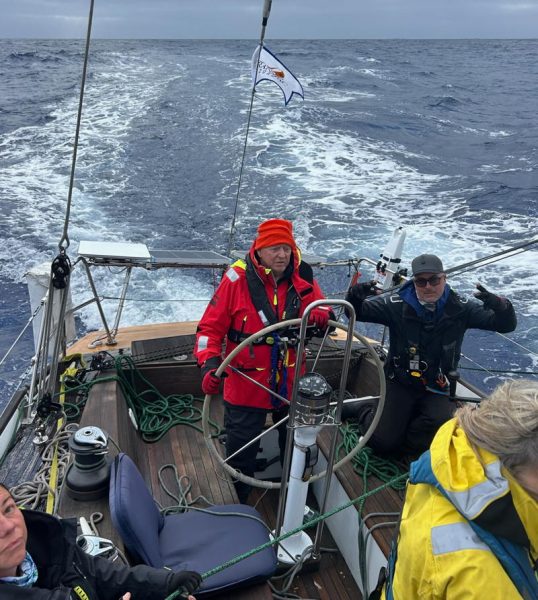
Dawn broke cold and dark. Then squalls, rain and periods of near calm. A slice of fresh pineapple for the crew and they were back to avoiding the lash and carrying out assigned duties with a sense of urgency.
The second half of this regatta usually features some of the best ocean surfing any regatta anywhere has to offer. But not always. Fingers crossed, here’s hoping.
The finish line off Diamond Head is legendary: stories of bagpipers, boats finishing with jury rigs, and even a boat finishing backward still under sail.
Stan Honey, the legendary navigator who also gave us the virtual line of scrimmage and first-down line on T.V., claims there are three ways to lose this race. 1.) Fail to clear Catalina cleanly on the first day. 2.) Twist off into the Pacific high pressure zone of no wind about halfway across (trying to avoid that right now). 3.) Make a hot approach to the islands without overstanding.
Transpac 2025 will be remembered as a “good one,” maybe not the best ever or record breaker, but fine sailing just the same.
Interested?
I understand they are already accepting applications for the “Fun Race to Hawaii,” the 2026 Pac Cup. Sign up now before it’s too late and all the good crew are gone.
This story was submitted by Andy Schwenk via Starlink. Andy is a busy Bay Area marine surveyor and delivery captain.
Follow the Transpac to the finish here.
Richard Gordon-Rein and Angi Lungu’s Second Chance Cruise
This year’s Puddle Jump was the second time I have left La Cruz, Mexico, bound for Hiva Oa, but it was my first time actually making it there. On March 10, 2020, I sailed from La Cruz on my Pearson Triton 28 Darwind, bound for the South Pacific and beyond. I was 19 years old. I had already sailed 4,000 miles alone from my home in Seldovia, Alaska, to get there. But for me, the voyage really started here, with my first solo ocean crossing, and departure from North America
The wind was light but fair, and Darwind, with her six-hp outboard removed and lashed to the pulpit, made good time through the light winds near the coast, out past the Islas Revillagigedos, and into the NE trades. Meanwhile, and completely unbeknownst to me, the COVID-19 pandemic was beginning, and the first shutdowns and closures began to take effect.
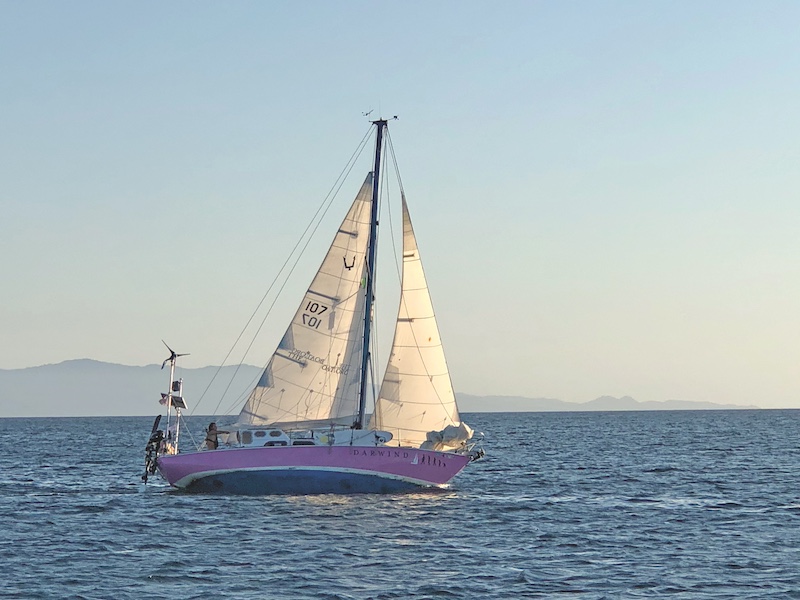
I use a Garmin inReach as my primary communication with shore. Eventually, I began to get the news — 160 characters at a time. Ten days and 900 miles out from Mexico, I learned that French Polynesia had closed its borders. It was time to alter course. I ended up sailing to Hawaii, and from there attempted to sail back to Alaska. After a knockdown in a westerly gale halfway there, I eased the sheets and in June made landfall in Washington, completing the 11-month voyage.
After returning to life on land in the first year of the pandemic, I moved back on board Darwind while attending university in Washington, and started looking for a bigger boat. When I found Mistral, I knew she was perfect: a medium-displacement cruiser, built in 1970 by Harry Hallberg’s yard in Sweden, just before it became Hallberg-Rassy. At 33 feet, she seemed spacious compared to Darwind, well laid-out with plenty of storage, and with the extra waterline, sharp bow, and fin keel providing decent performance to windward. Off the wind, the large skeg protecting the rudder and propeller keeps her tracking like an arrow. The other thing that made Mistral so appealing was that she is a veteran circumnavigator, having sailed from Seattle to Seattle via the Suez and Panama canals in the ’80s and ’90s. Over the course of this voyage, nearly everything useful on board had been strengthened and improved, while anything unnecessary or cumbersome had been stripped away.
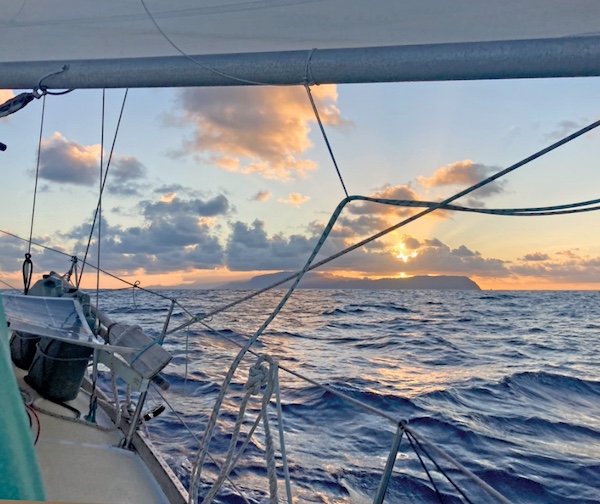
The lack of a chartplotter was most intriguing to me, as it is considered practically essential equipment these days. But the previous owners had reasoned that if they could sail around the world without a GPS, why would they need it now?
Read.
Get Your Pre-Season Boat Health Check at San Francisco Boat Works
