

Blue Water Foundation Practices Five-Minute MOB Recovery
The Blue Water Foundation (BWF) was founded in 1992 as an all-volunteer nonprofit for the purpose of giving at-risk and underrepresented youth an opportunity to experience the joy, wonder and collaboration of sailing on San Francisco Bay. Using the sea as a mentor, learning opportunities are designed to enhance self-confidence and develop sailing competencies with a strong emphasis on teamwork, while aboard one of the foundation’s three bluewater sailboats. Captains and crew serve as models for the more than 500 kids who are drawn from youth programs, school districts, law enforcement and probation in the Bay Area each year. Crew training, therefore, requires each boat to successfully complete a competency checklist. Recognizing that the behavior of high-energy, easily distracted kids on a sailboat for the first time could put them at risk for going overboard, the MOB procedure has been carefully crafted by BWF over the years to achieve a recovery in five minutes or less.
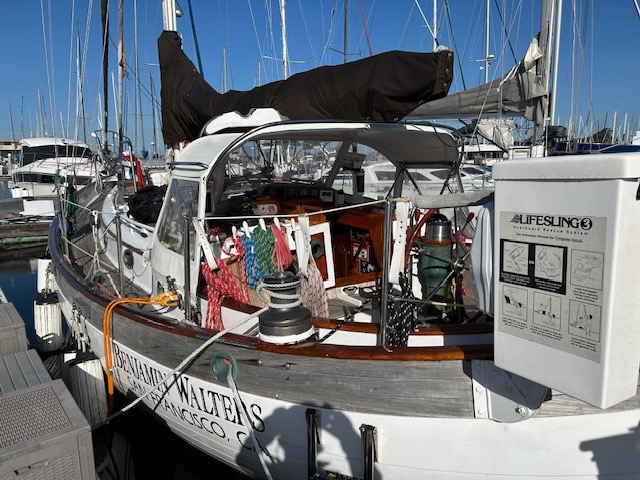
Latitude 38 was invited to join a crew certification sail aboard Benjamin Walters, BWF founder Lee Stimmel’s Hans Christian 43 cutter, in which four crew became certified in MOB recovery. Lee donned a drysuit and wore the Foundation’s orange watch cap to fall overboard four times, while volunteer Renata Zakhvatkina enthusiastically played the part of a teenage girl in distress by falling overboard twice! Thus the crew participated in a total of six live MOB drills.
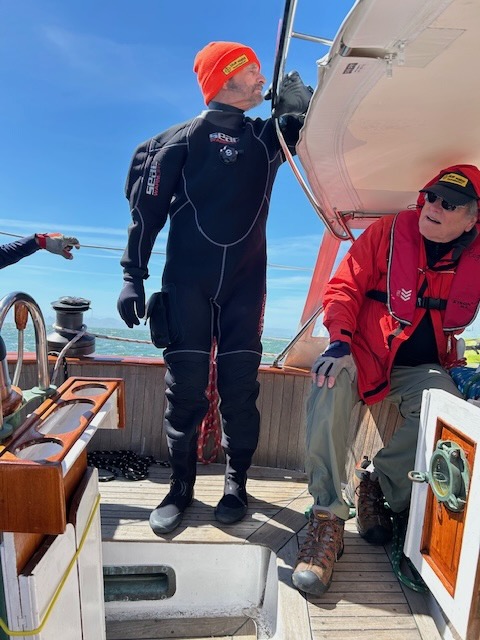
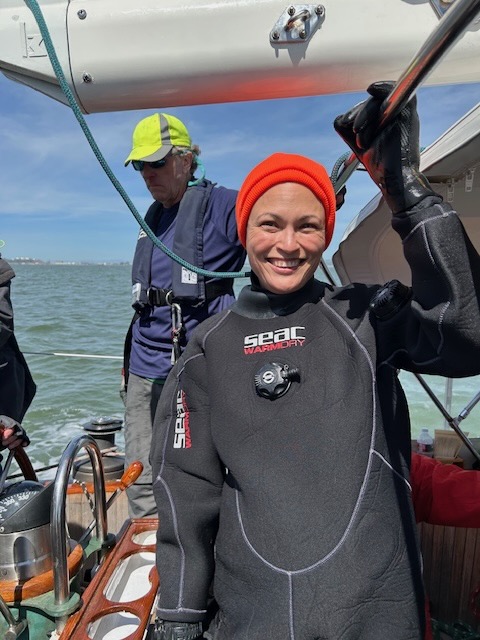
The Blue Water staff for each trip consists at a minimum of five crew — a first captain, second captain, and three certified crew members whose roles are precisely defined in each MOB drill. At the core of this procedure is the proper deployment of the Lifesling horseshoe and the yellow propylene line connecting it to the boat. The inference is that the sling is being brought to kids who are panicked and shocked by the water temperature. So encouragement is shouted out first, followed by instruction later.
It’s a testament to the high regard Lee Stimmel has for his crew and BWF’s MOB procedure that he would put himself at risk by repeatedly falling overboard in the choppy, busy waters off Berkeley Marina. What is their procedure that allows for such a rapid MOB recovery?
It begins when any of the crew shouts, “Crew overboard,” which causes the first captain to issue a series of commands:
- A spotter is appointed to maintain visual contact with the MOB and continuously point at the MOB location.
- As the first captain brings the boat head-to-wind to stop the boat, the second captain leads a crew member onto the foredeck to assist in the furling of the jib, executed by other crew in the cockpit.
- The first captain then directs the engine to be started, after which he directs the mainsail to be dropped and begins the turn back to the MOB location.
- The Lifesling is then deployed from its aft location and is trailed behind the boat during the approach to the MOB location, while the foredeck crew prepares a 5:1 block and tackle with jam cleat attached to a spare (spinnaker) halyard.
- The first captain approaches the MOB location, and circles so as to bring the yellow line alongside the MOB. Instruction is shouted out by the spotter to the MOB to ensure the proper fit-up of the horseshoe to the MOB.
- Once the fit-up is complete, the foredeck crew rapidly draws the MOB alongside the boat, attaches the block and tackle to the Lifesling, hoists the MOB above the lifelines, and slowly lowers the MOB to the deck.
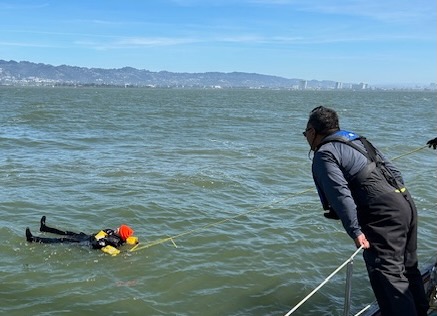
The first two recovery attempts were error-filled, and took eight to nine minutes to execute. After each attempt, a review session was held in the cockpit, with each participant making an assessment of corrective action needed for the next attempt. Errors included: halyard not properly secured, causing slippage during the hoist; block and tackle got caught in the shrouds and didn’t work; block-and-tackle angle was too shallow and required too much effort to hoist; the boat failed to go head-to-wind quickly and sailed too far away from the MOB; and current at the MOB location required the engine to be in reverse to maintain position with the MOB in the water.
Happily, all remaining MOB drills succeeded in being executed in five minutes or less, even though crew members changed their roles during each drill. At the end of this five-hour exercise, Lee Stimmel reminded the crew that the first priority for a MOB situation is to stop the boat, followed by the proper sequencing of each task. Collaboration by the crew corrected errors and allowed for successful and timely MOB recoveries.
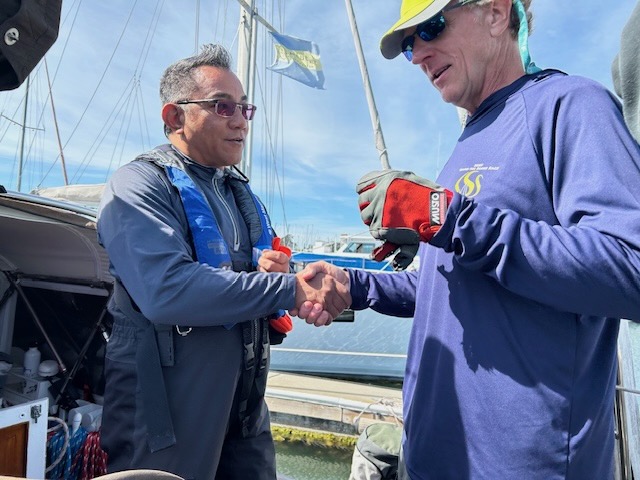
Few organizations place this emphasis on live MOB drills, but Blue Water Foundation believes that a kid in the water justifies the extra effort it takes to develop these skills! To get involved or to learn more, see here.
The best sailing organization in the Bay! Lee and the volunteers do an exceptional job.
A great sailing organization! However I (and US Sailing and ASA and RYA) believe and require that the MOB recovery be executed under sail – though we do advocate starting the engine but only as a possible back-up – there have been fatalities in the SF Bay with recoveries attempted under engine o and the engine has failed or become inoperative (the most well known of these fatalities was a 13 year old girl-and yes she was wearing a pfd). Please rethink this and do not certify students or crew unless the recovery is accomplished under sail