

Eight Years Later: What Happened to Alameda Marina’s Working Waterfront?
As Sausalito voters consider a ballot measure that could have lasting implications for the city’s historic working waterfront, a recent example just across the Bay offers a cautionary tale. Alameda Marina was once home to a broad collection of boatyards, marine trades and maritime businesses. Its redevelopment came with the promise that housing and maritime commerce could coexist.
Almost a decade later, we went back to see what’s left of the working waterfront.
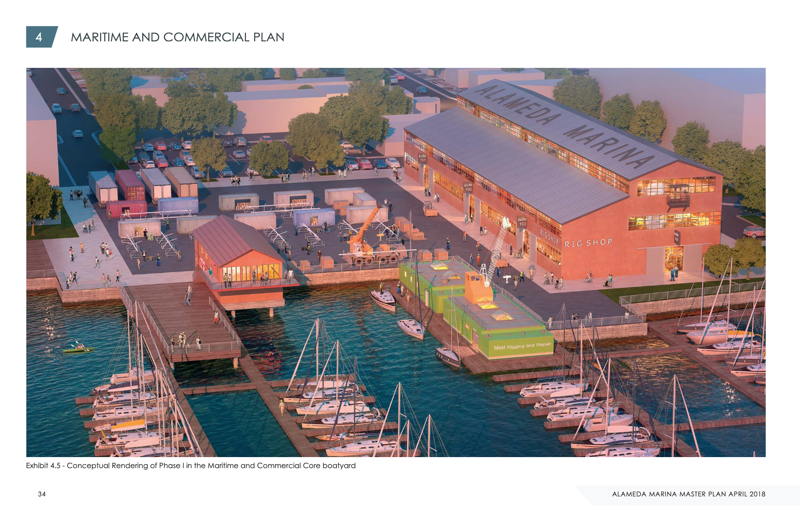
Though every situation is unique, Alameda Marina was an active commercial maritime property that was home to Svendsen’s Boatyard along with its chandlery, welding shop, workshops and a marine bookstore, Island Yacht Club, yacht brokers, naval architects, sailmakers, riggers, maritime electrical, ocean research consulting firm DOER and marine dry storage.
Somewhat underutilized and in need of capital investment to shore up its crumbling waterfront seawall, Alameda Marina was approved for redevelopment by Pacific Development. The plan drew opposition from Save Alameda’s Working Waterfront, which argued that despite the developer’s promise of a mixed-use development combining housing and maritime commerce, the project would ultimately displace the maritime trades.
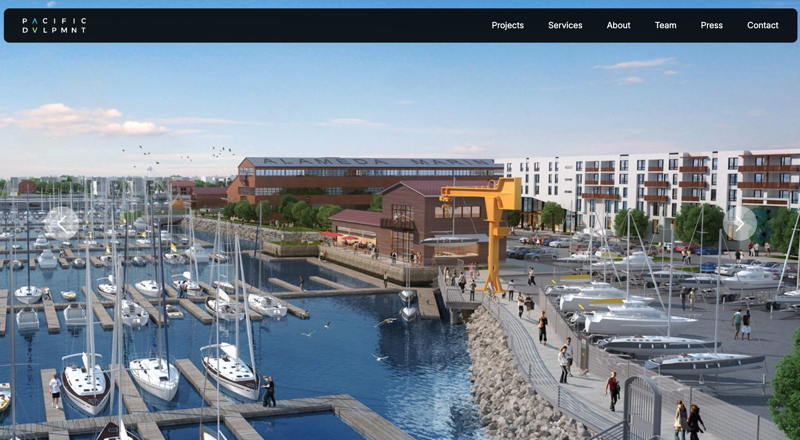
In 2018, the Alameda City Council approved a mixed-use redevelopment with 760 housing units while retaining a maritime-commercial core and working-marina facilities. Eight years later, the development is far from complete, though the large residential project is rapidly growing.
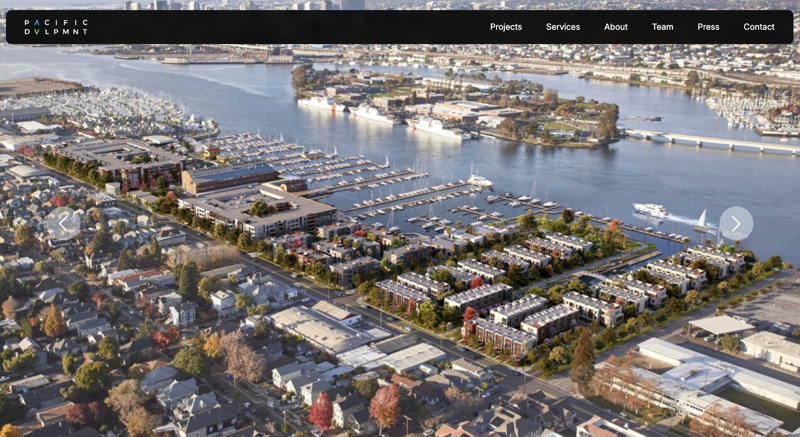
Very few people expect to ever see the commercial maritime facilities shown in the artist renderings.
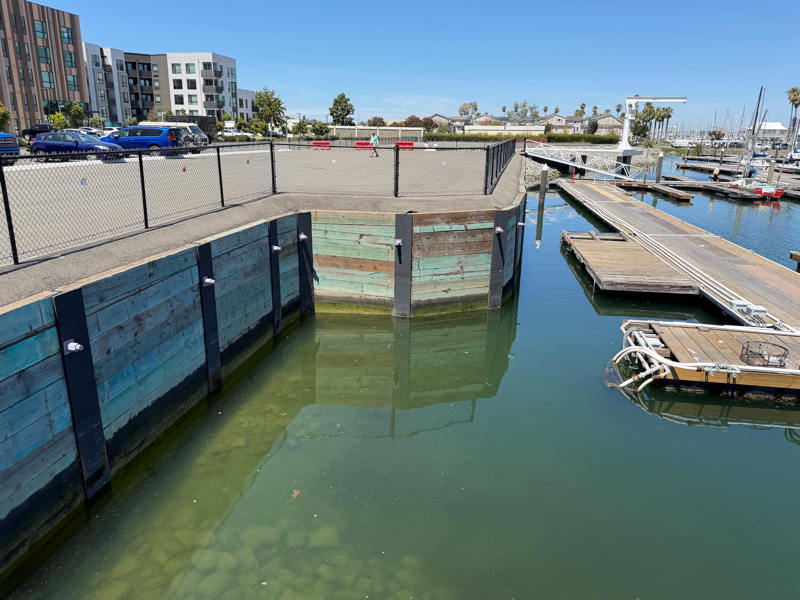
The photo below is of the dry storage area in the rendering above. Today, the hoist does not work and there are no boats in dry storage. The large yachts shown to the City Council in the developer’s rendering were certainly not going to be served by the hoist in the image.
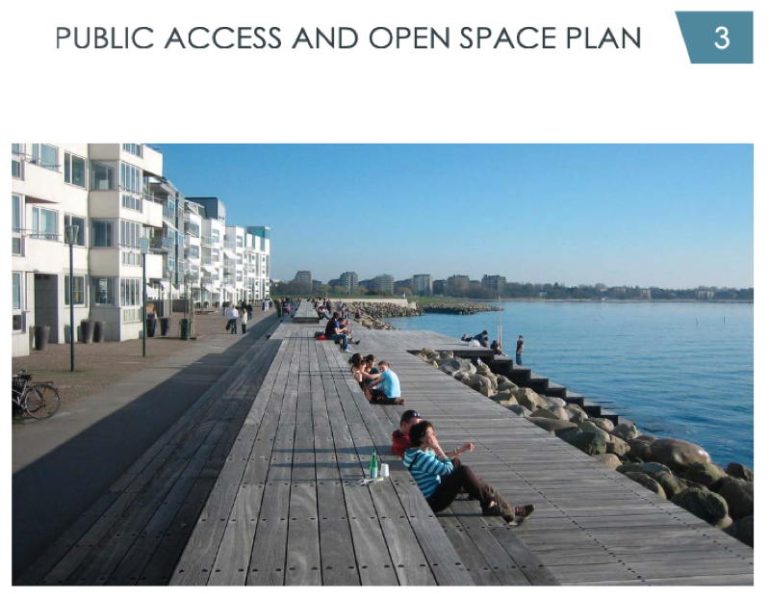
Reading through Pacific Development’s proposal, it was suggested that the former Alameda Marina did not allow public access — something its mixed-use project would expand. All boaters know, however, that the marina was as open to the public as any shopping mall. Everyone was welcome to drive in, walk along the waterfront, or do business with the many marine businesses on the property.
Today, much more of the property is occupied by private residences, though the development will include a public shoreline promenade with views of the water. Many municipalities, as well as BCDC, often appear to equate/confuse shoreline bike paths and walkways with public access to the Bay.
But access to the shoreline and access to the water aren’t necessarily the same thing.
The image below is possibly the most accurate artist rendering of the completed mixed residential/commercial maritime redevelopment of Alameda Marina. The entire land portion of Alameda Marina is perhaps 90% residential, with the former DOER building still visible in the proposed maritime commercial core area, though no actual commercial maritime businesses can be seen.
What used to be one of the core centers of the island of Alameda’s maritime culture and marine-trades businesses has been completely overwhelmed by the housing approved by Alameda’s City Council.
We reached out to Pacific Development to ask if they anticipated any marine-trades businesses returning to Alameda Marina, but did not hear back. Since the project is still under construction, we can’t completely discount the possibility that maritime businesses could return, though we’ve spoken with some former tenants who can’t imagine moving back.
Unlike the Alameda Marina redevelopment, Sausalito’s Industrial & Maritime Preservation and Improvement Initiative, or Measure X, does not change the city’s current zoning to allow housing in the Marinship. Instead, it would allow future changes to certain zoning and development standards to be made by the City Council rather than requiring approval from Sausalito voters.
Like many working waterfronts around the country, the Marinship has aging roads and infrastructure in need of maintenance, upgrades and investment. Measure X is intended in part to encourage that investment by giving maritime and industrial businesses greater flexibility to improve and develop their properties. But it would also leave future zoning decisions largely in the hands of the City Council — and the ultimate effect on the Marinship will depend not only on what the measure allows today, but on what future councils, property owners and developers choose to do with that flexibility.
Greed ,engulf and devour . Bob Dylan said it best money doesn’t talk it swears!
Note: City counsel members usually do not own or spend their money on the areas they vote on. They are there for last ditch efforts to hold up a passing ego or try and get money (not earned). This is fact not just fluff. I have visited and worked and supported the marine areas in question and greed will always take over in places like these. Plus the fact that California is the worst state in the country for mixed use planning. Just self interests without vision of lively hoods and enjoyment.
Sadly, this dilemma is happening to waterfronts up and down the coast. Learn more about what is happening in your area to help prevent this. Get involved.
I was both a wet slip renter and a dry storage renter, a patron of Svendsens boat yard, and many of the Marine businesses at Alameda Marina for 20 years. I really miss the good times I had, the friendships, and experiences, of the vibrant maritime community that once was. Recently, I went to see how things were going at the development. I went by the Harbor Masters office to inquire about the dry storage yard and the crane. She said the crane didn’t work, as there was no power run to it, and there were no plans to do that , or dredge the slipway to accommodate dry storage boats. It was very quiet , just a person walking their dog, no boating activity at all. Such is progress.
Oyster Cove Marina SSF suffered a similar fate.
Remember how the developer sold the concept that the existing “wall” of buildings that blocked views of the Estuary would come down and new vistas would attract the public to the waterfront? Bwhahahaha!
Very sad happenings over in Alameda.
We are currently in the throes of Measure X and Sausalito’s Working Waterfront.
The next City Council Meeting is tomorrow, September 15th. It would be incredible for anybody willing to reach out via Zoom and voice their opinion / concern or story of Alameda or the like as it relates!
For over four years I had a sailboat in dry storage. It was used almost weekly and I did business in Alameda at restaurants and other shops since being excited and moving the sailboat to Richmond , I’ve had no reason to go to Alameda
text correction:
For over forty years I had a sailboat in dry storage at Alameda Marina. It was used almost weekly and I did business in Alameda at restaurants and other shops. Since being evicted and moving the sailboat to Richmond, I have had no reason to to go back to Alameda for shopping.
This article should be required reading for every Sausalito voter considering Measure X.
What happened at Alameda Marina is especially concerning to me because it demonstrates how decisions made today can permanently change a working waterfront. Promises were made that maritime commerce and redevelopment could coexist. Eight years later, housing dominates the property, while much of the maritime infrastructure and the community of marine trades that once existed there are gone.
Measure X does NOT authorize housing in Sausalito’s Marinship, and I think it is important to be clear about that.
What concerns me is what Measure X does to our ability as Sausalito residents to have a direct say over future changes.
For more than 40 years, Ordinance 1022 has required voter approval for certain changes that increase commercial development and density. Measure X would change that. Outside the Downtown Historic District, future City Councils would be able to modify zoning without bringing those changes back to the voters for approval.
At the same time, Measure X itself would significantly increase what can be built in portions of the Marinship and waterfront. In the Industrial zone, the height limit would increase from 32 feet to 47 feet. Allowable floor area and lot coverage would also increase substantially. It would repeal the Marinship Specific Plan and expand the types of uses permitted in these areas.
My concern isn’t that our waterfront should never change. Of course it needs investment. We need thriving maritime businesses, artists, craftspeople and industries, and we need to address aging infrastructure and sea-level rise.
My concern is who makes the decisions about what comes next.
City Councils change. Property owners change. Developers change. Economic pressures change. Buildings, once constructed, may be with us for generations.
Alameda is a powerful reminder that the ultimate result of redevelopment may look very different from what a community believed it was approving at the beginning.
I don’t want Sausalito to discover 10 or 20 years from now that we gave away something we cannot get back.
Whatever happens to the Marinship and our waterfront, I want the residents of Sausalito to retain a meaningful voice in the major zoning decisions that determine their future.
For me, that is the fundamental issue raised by Measure X: I don’t want the future character of my community decided solely by a City Council. I want Sausalito voters to continue to have a direct vote on major changes to the development rules that shape our city.
A letter from reader Andy Greer:
Under the Guise of Progress: Another Waterfront at Risk
What has happened to the sentiment surrounding a working class of individuals, small local
economies that contribute value to the community, character, and a solid tax base — real
businesses? Is this not worth fighting for?
After reading the Latitude article, “Eight Years Later: What Happened to Alameda’s Marina’s
Working Waterfront?”, it made me aware of how similar a situation Sausalito’s Marinship faces
with the proposed Measure X, soon to be voted on this November.
How eerie and similar are the renderings of Alameda Marina — while they were proposing their
sleek mixed-use proposal to the City Council in late 2017/2018 — to the renderings drafted by
Measure X/Sausalito Thrives, showing “What Could Be.”
How eerie and similar is the language used by the developers of Alameda Marina seeking City
Council approval years ago — “Reimagining Alameda Marina,” “Taxpayers off the hook for
Seawall and Shoreline Repairs,” “Help Us Revitalize and Restore Alameda Marina” — to the
slogans now being chanted by the creators of Measure X.
This Measure depicts the Sausalito Working Waterfront as a place that’s struggling, claiming that
the current zoning laws are holding it back from “adapting.” Yet Alameda now stands as a
reminder that, despite seemingly good intentions, changes to a working waterfront can have
consequences that extend far beyond the original vision. Without voter approval and control, the
local marine and industrial economy that proudly carries on throughout the Marinship could soon
disappear.
I hope Sausalito residents and the general boating community can see the trend that’s happening
all over the Bay Area, California, and the West Coast, as these working waterfront communities
continue to become gentrified out of existence.
All That Shimmers Is Not Gold.
The Alameda City Council let us talk for hours in public comments with objections to the atrocious project, and later approved it unanimously, while one of the council members was a partner in the project.
Who was the partner in the project?
Boaters and Marina workers are an independent group of people. The type of people the new world order cannot allow. California has been working for years to take away city, town, county power and individual rights. The latest take away was imposing State housing goals, that allows developers to override zoning requirements if a city or town does not have a state approved plan in place to meet state mandated new housing goals. I have been boating for over 60 years, love sailing on SF bay, watched boating and Marinas in Alviso, Palo Alto, Redwood City, San Leandro, all but disappear. So what is happing in Alameda does not surprise me. I wish all the best for boating and the Marina industry on the Sausalito Working Waterfront. The issues with water front development is happing all-round the Country. Read George Orwell’s “1984”. Grass root movements still have chance to make a difference.
A letter from reader Sami Shubert:
A Working Waterfront Needs More Than New Buildings
As someone who cares deeply about Sausalito’s waterfront and the maritime community that still calls it home, I’m concerned that Measure X could fundamentally change the character of the Marinship.
The argument for Measure X is that more development will revitalize the waterfront. But a working waterfront isn’t simply a collection of buildings that happen to be near the water. It is the boatbuilders, marine trades, fabricators, artists, chandlers, welders, designers, mechanics, and small businesses that depend on access to the waterfront, and on being able to afford to remain there.
That is where Measure X concerns me.
The measure would substantially increase what can be built on waterfront properties, repeal the Marinship Specific Plan, and allow a broader range of commercial uses. It also removes existing protections that have helped preserve the industrial and maritime character of the Marinship.
Once land becomes more valuable because substantially larger and more profitable buildings can be developed on it, rents tend to follow. A marine business that needs a large, affordable workspace cannot necessarily compete with an office tenant, retail operation, or other higher-paying use.
The same problem applies to artists. Sausalito’s artists are not decorative accessories to the waterfront. Their studios and workshops are part of the working fabric of the community. If redevelopment causes commercial rents to rise, many artists will simply be priced out.
And once those people leave, they are difficult to bring back.
There is a legitimate need to address Sausalito’s aging infrastructure, flooding, and deteriorating waterfront buildings. But we shouldn’t confuse redevelopment with preservation. We can improve the waterfront without making it economically impossible for the people who currently work there to remain.
If Measure X is supposed to preserve Sausalito’s arts, industrial, and maritime heritage, then those protections should be explicit and enforceable — not dependent on hoping that new development will somehow benefit the people who are already here.
A working waterfront should continue to work.
Let’s make sure we don’t “revitalize” it by pricing out the very people who make it a working waterfront in the first place.
– Captain Jaz
Another letter from a reader:
Don’t Lose Our Voice Along With Our Waterfront
Sausalito’s working waterfront belongs to more than the people who own the property. It belongs to the artists, boatbuilders, marine trades, working businesses, residents, and community members who have spent decades building the character of this place.
That is why Measure X concerns me beyond its proposed changes to height, density and land use.
It changes who gets to have a voice in what happens next.
For decades, Sausalito voters have had a direct role in major changes to commercial zoning. Measure X would remove that safeguard and give future City Councils substantially more authority to approve changes without returning them to the voters.
Whatever one’s position on individual development projects, that is a profound change in how our community makes decisions about its waterfront.
Once that voice is gone, it is gone for everyone: the artist whose studio may be threatened by rising rents, the boatbuilder who needs affordable industrial space, the marine business that depends on waterfront access, and the resident who simply wants a say in what the Marinship becomes.
And what are we giving up that voice for?
Measure X would repeal the Marinship Specific Plan, increase allowable development standards in the industrial and waterfront zones, and permit additional land uses.
Those changes may create opportunities for investment and redevelopment. But redevelopment by itself does not preserve a working waterfront.
If we want to save, preserve, and enhance Sausalito’s working waterfront, we should be asking a different set of questions:
How do we keep artists in their studios?
How do we keep boatbuilders and marine trades in business?
How do we make sure waterfront land remains available for businesses that actually need a waterfront?
How do we address flooding, deteriorating infrastructure and sea-level rise?
And perhaps most importantly: How do we make sure the people who live, work and create here continue to have a meaningful voice in those decisions?
Measure X is presented as a way to revitalize the waterfront. But there is a difference between revitalizing a waterfront and transforming it into something that the people who built its character can no longer afford to participate in.
Sausalito doesn’t have to choose between preserving the past and planning for the future. We can improve infrastructure. We can address sea-level rise. We can allow thoughtful redevelopment. We can support artists and maritime businesses.
But we should do it through a process that protects the working waterfront and keeps the community’s voice at the table.
Once we surrender our ability to have a direct say in the future of the waterfront, we may discover that the hardest thing to preserve isn’t a building, a boatyard or a studio.
It’s our voice.
And without that voice, how can we be certain that the waterfront we’re enhancing will still belong to the working waterfront community that makes Sausalito what it is?
– Leao
I’m not disputing the above conclusions but Svendsen’s (now Llewellyn Marine Supply) and Doer are still alive in Alameda. I was part of the Northern Waterfront redevelopment committee as well as the Brag (Base reuse and Redevelopment committee) in its various iterations. I finally got the message that it is all just window dressing. Developers Rule!
Writ large, this is the story of quantity over quality. I’m guessing that the new development provides more tax income to the city and certainly more profit to developers, and that the quasi-industrial boatyards and dockage and the riff-raff in chandleries are not only not coming back, but were always intended to be eliminated. But the quality of life and the opportunities to enjoy it have no dollar value. This is the why local control is so important, so that the people who are directly affected by decisions have primary input into the decisions. Let’s end “developers rule.”
Lauren de Remer sent a comment:
“Such an amazing article, thank you so much for this piece, as an active sailor and credentialed mariner who grew up in Sausalito, I can confidently say this is so spot on!! Particularly the disconnect on what “public waterfront access” means to different people. Measure X is dangerous for Sausalito, and Alameda is a direct example of what could happen if it passes. One must “follow the money” to see the truth behind proposed legislation; it’s a wolf in sheep’s clothing. Just ask the former Alameda Marina marine trades business owners. Thank you, Latitude!!”