

Oakland Yacht Club Wraps Up 2026 Sweet 16 Series
It’s hard to believe that Oakland Yacht Club’s 2026 Sweet 16 Series is complete.
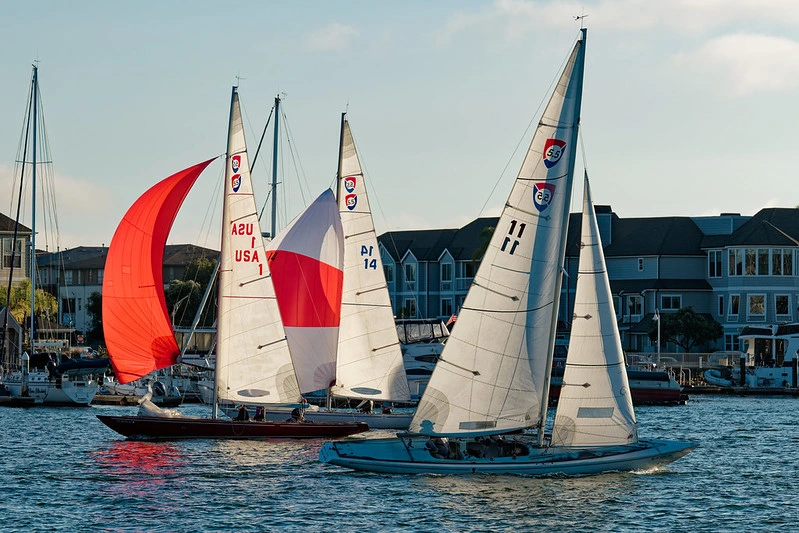
The second half of Sweet 16 started on July 8. The wind was still a bit light at the starts and dying off too quickly to race both legs of the courses for races nine and 10. Ah, but for race 11, there was wind, and with daylight still on our side, we went for racing both laps of the courses called. It made for a later finish, but we didn’t hear any complaints about the time on the water.
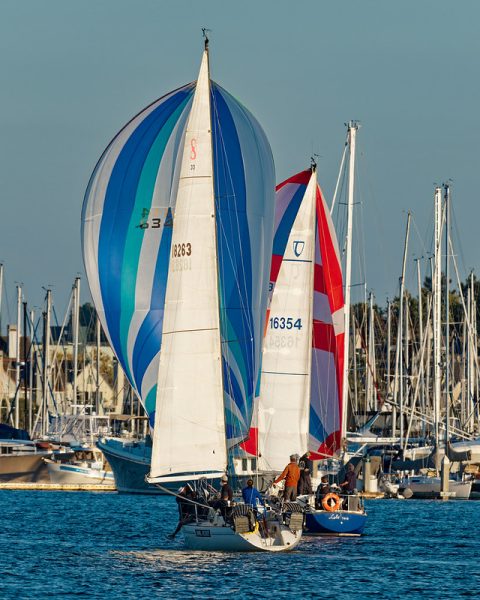
The wind for the last four races was around 10 knots and steady throughout the race. In race 13, 35 boats competed. We raced only the first lap, as sunset was earlier and a fog bank rolled up — best not to press our luck and finish in the dark. Interestingly it was very similar for race 14.
This has gotten some of the race committee thinking that maybe we need to have [the option for] a short and long second lap on the courses. It would have been great to have a short second lap to extend the race a little, while not pushing it to sunset.
We finished up with a strong turnout, with 40 boats to the line for race 16.
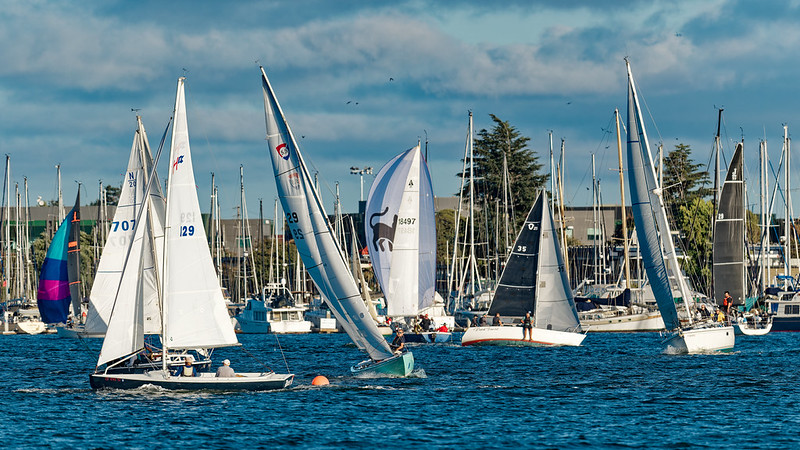
The crowds have been good up at the club after the races — lots of chatting, a libation or maybe two, and a buffet for dinner. The results are read, the prizes given out, and an all-around good time is had by all.
Great racing, great camaraderie, and it doesn’t get much better.
Creating Yacht Rock + B-Roll on the Bay
Latitude 38 advertising and marketing manager Maddy Garcia got out on the Bay for some sailing with friends aboard Jon Price’s S2 Adagio. She made this fun video of her time on the water. We thought it would be a great way to sail into the weekend. Enjoy!
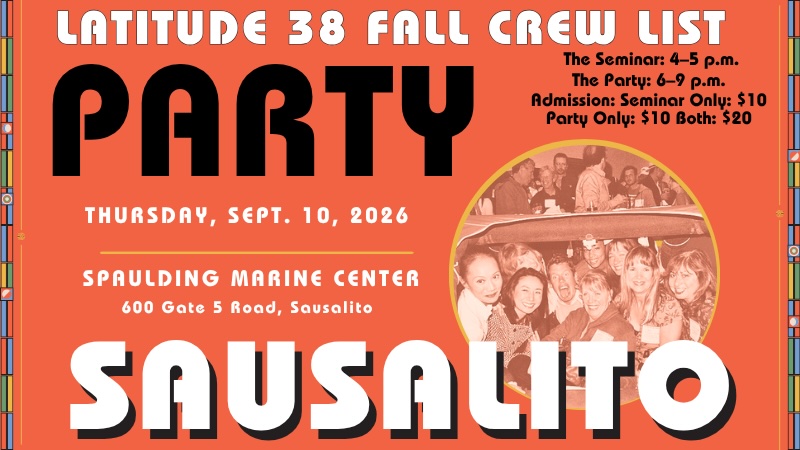
Latitude 38 Baja Ha-Ha Fall Crew Party — Get Your Tickets Now
On-Board Reporting on the Woodies Invitational
One of the great perks of covering our wonderful sport is that in almost every edition of Latitude 38, I get the privilege of writing about a regatta in which I participated. I think that’s pretty unique. The 49ers beat writers don’t get to suit up in the red and gold on Sunday. The Giants columnists don’t get to take at-bats every day (though they can’t be much worse than the Giants this year), but as Latitude 38’s racing editor, I get to compete in the sport I write about regularly.
I was out on the water for the 2026 Woodies Invitational at St. Francis Yacht Club on June 26 through 28, racing on Three Boys and a Girl (StFYC), the Knarr that my dad, Hans Baldauf, has co-owned with legendary Knarr skipper Chris Perkins since well before I was born.
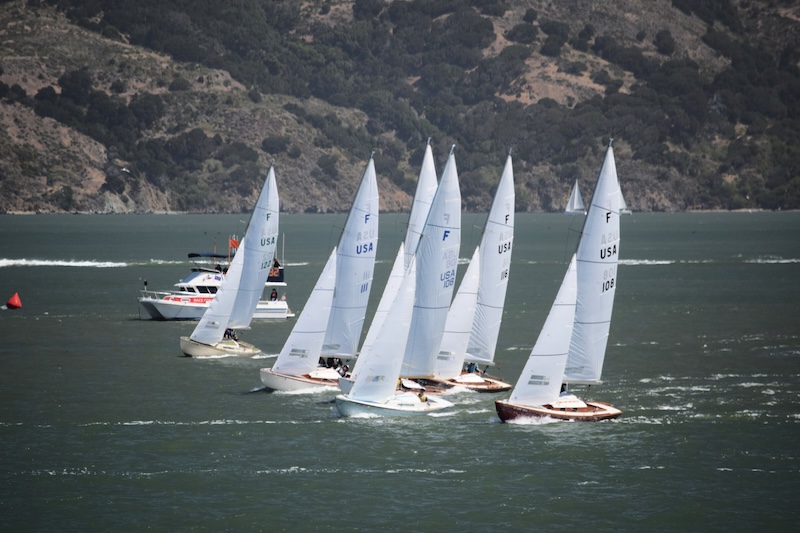
This weekend, I was in my normal position on the bow of the boat. My dad was in his usual jib-trimmer spot, and Chris, as ever, was driving. The main trimmer role was filled by my good friend and former Connecticut College sailing crew, Alejandro Amezcua. Alejandro flew out to the West Coast for the weekend to come and race with us, an idea that he and I devised at a karaoke bar in Boston.
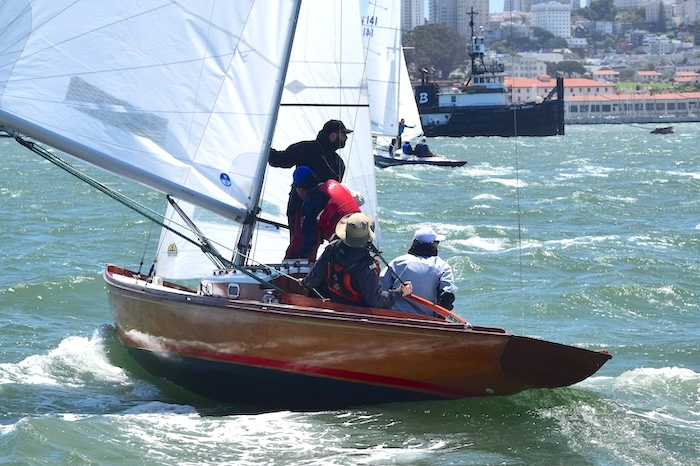
With StFYC’s Wednesday Evening Series, we were able to get in a warm-up race on Wednesday to get Alejandro accustomed to the Bay. Wednesday’s race was a promising start to the ever-enjoyable Woodies weekend, as we won the race, giving us a good feeling.
The Woodies have always started with a single Friday evening race (followed by a raucous Friday night party), followed by two full days of racing on Saturday and Sunday. In the past few years, we had consistently finished between second and fourth in the Woodies.
We have often joked in the past that you can’t win the Woodies on Friday night, but you sure can lose them.
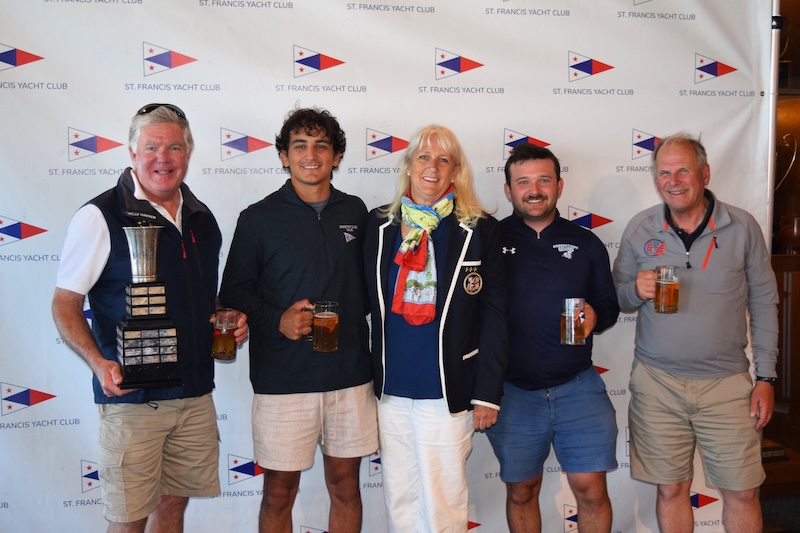
Continue reading to find out how they did it.
The Timeless Blue Bubble of Maddie Zug and Jeremy Snyder
Almost exactly one year since we cut the dock lines in Berkeley and started full-time cruising, we left La Cruz, Mexico, and pointed the bow toward French Polynesia. Even though our Tayana 42 Tardigrade was kitted out and provisioned, our stomachs churned with nerves and anticipation as we bashed out of Banderas Bay under a glowing sunset.
In the past year, we’d sailed from San Francisco to British Columbia, cruised the Pacific Northwest, and returned south to Mexico. With our longest passage yet having been just five days, the jump to a multi-week, 3,000-mile crossing felt big, but it was something we were eager to experience.
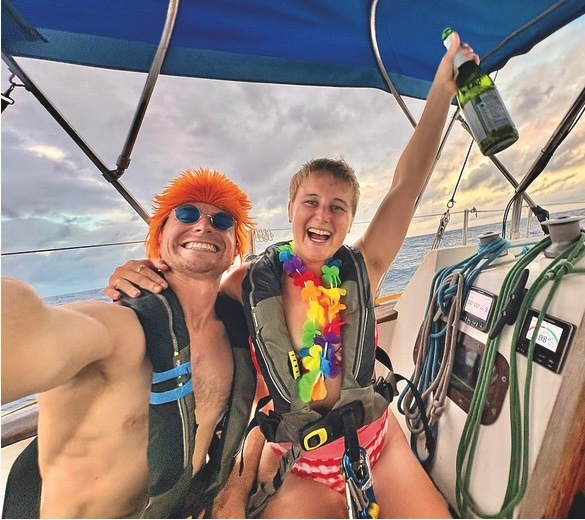
Our first couple of days passed in a sapphire rush. We had near-perfect sailing, 10–15 knots, 60 degrees off starboard. With all three sails up, Tardigrade galloped forward, chewing through miles as we approached Isla Socorro, the last land we would see for the next three weeks.
We struggled at first to relax into the stillness, our internal flywheels still spinning from the intense months of prep in La Cruz. Jeremy channeled his energy into little tasks like splicing several dozen Dyneema soft shackles. Evidently he wasn’t replacing the metal fixtures fast enough, because on the third day we heard a loud BANG as the boom vang snapped clean off its padeye. We fixed it by Dyneema-lashing it to the mast base, with a WhatsApp consultation from our buddy boat Dogfish.
Despite the stress of the first breakage, we felt the ocean was being kind to us with a relatively easy fix and a playful pod of speckled dolphins at our bow that evening. By week’s end, we’d settled into our watch rhythm: three- and four-hour shifts from 8 p.m. to 10 a.m. Jeremy liked his night-owl time, meditating, writing, and winding down. I loved mornings making tea and watching the sun rise. We both liked the “bonus” time on midnight watches, feeling like kids reading under the covers with a flashlight.
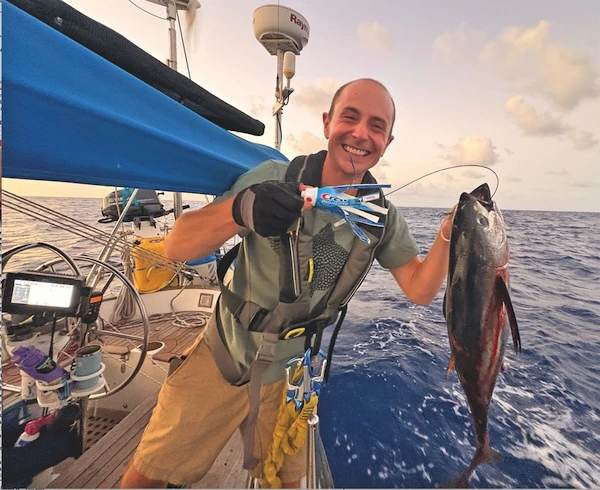
Deeper into the northern trades, clear skies gave way to puffy cumulus. One night we realized the four-star constellation dead ahead was the Southern Cross, a small, stellar signpost of our progress that made us feel connected to seafaring traditions spanning millennia.
Pumpout on the Go with the Pumpout Nav App
Boat sewage spreads disease, harms aquatic life & ruins water. Let’s put waste in its place. Get On Board with the Pumpout Nav app to find the nearest sewage pumpout, dump station, or floating restroom. Download it today at www.boatcalifornia.com/pumpout