

Call of the Sea Gets Ready for Summer Sailing
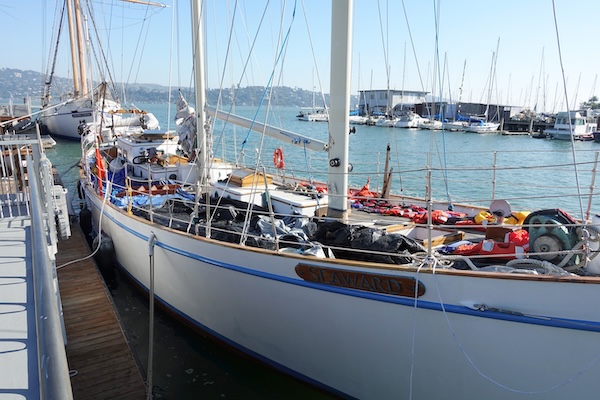
We’ve been busy this winter with projects on both the Matthew Turner and the schooner Seaward. On Seaward, one of the major undertakings has been removing the old diesel engine and installing a new Tier 3-compliant diesel to meet California’s updated emissions requirements for commercial vessels, which include inspected passenger vessels. The old Yanmar engine was still running well, but as of 2026 the new standards apply. As with most repower projects, the real challenge isn’t just the engine itself, it’s fitting everything around it. Engine mounts, pumps, inlets, exhausts and accessories all have to line up precisely. Fortunately, Call of the Sea has a deep bench of talented and highly capable volunteers who are doing the bulk of the work. We were also able to secure a grant to help cover the cost of the new engine, with installation being handled by the crew and volunteers.
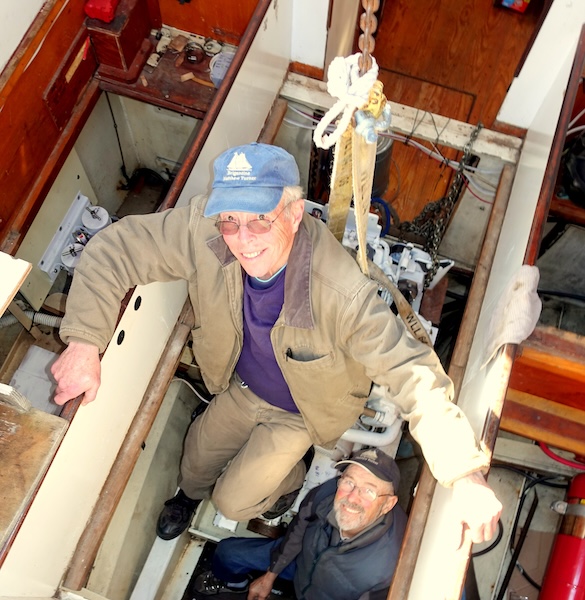
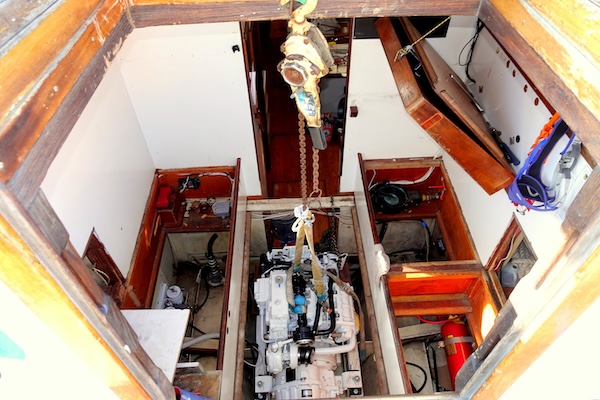
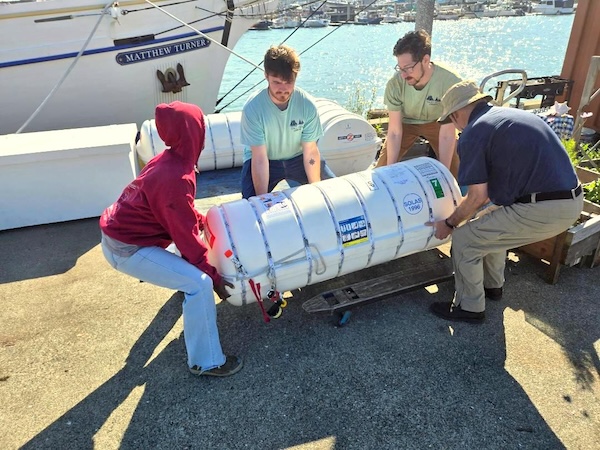
Other winter projects on Seaward include recaulking the deck, refinishing varnish and paint where needed, inspecting safety equipment and life jackets, and unloading three newly certified life rafts just delivered by Sal from Sal’s Inflatable Services.
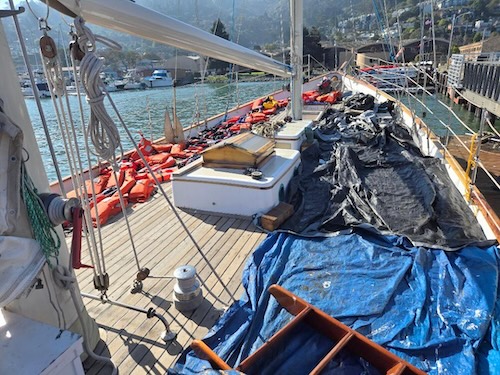
On the Matthew Turner, the crew has been focused on annual maintenance: servicing the yards, inspecting and renewing rigging as needed, and taking care of paint and brightwork. Volunteers have also built new custom tables and seating for the crew — practical, well-made additions that will get plenty of use during the season.
Last but certainly not least is a photo of Sylvia Stewart Stompe serving her legendary Wednesday Volunteer Lunch. Sometimes I think volunteers show up just for Sylvia’s cooking (I know I do). I bring the cookies.
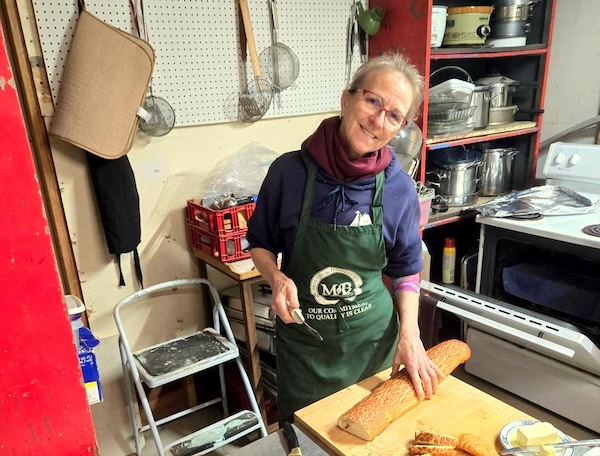
A few other people help with the cooking as well, and the meals are for both volunteers and crew, many of whom are now starting to arrive for the new season. These lunches have become an important gathering point: a chance to connect, talk through projects, plan what’s next, and often head right back to work together. Many of the volunteers have been involved continuously since we laid the keel in 2013, now more than 13 years ago, which says a lot about the commitment and community behind these boats.
More to come as the season gets underway.
Good Jibes #231: Reed Boat, 50 Destinations, and a Challenging Passage
Welcome to Good Jibes, where you can experience the world of sailing through the eyes of the West Coast sailor, featuring stories and tips from West Coast sailors on topics from our sailing community about cruising, racing, adventure, exploration or just plain sailing.

This week’s host, Monica Grant, reads three articles from the February 2026 issue of Latitude 38. Hear “Crossing the Pacific on a Reed Boat” by Monica Grant, “One of 50 Destinations in Seas Less Traveled” by Nick Coghlan and “The Most Challenging Passage” by Jim Yares.
Here’s a small sample of what you will hear in this episode:
- What is Expedition Amana?
- Where is Twitchell Island?
- What’s Pampatar like?
- When was Alexander von Humboldt in Venezuela?
- How do you use MetBob?
Follow along and read the articles:
“Crossing the Pacific on a Reed Boat”
“One of 50 Destinations in Seas Less Traveled”
“The Most Challenging Passage”
Listen to the episode on Apple Podcasts, Spotify, and your other favorite podcast spots — follow and leave a 5-star review if you’re feeling the Good Jibes!
Westwind Yacht Management — Washing, Waxing and Varnishing
Westwind Yacht Management: Premiere Yacht & Fleet services for the San Francisco Bay Area.
What’s Happening With “The Last Express 37” Hull #63
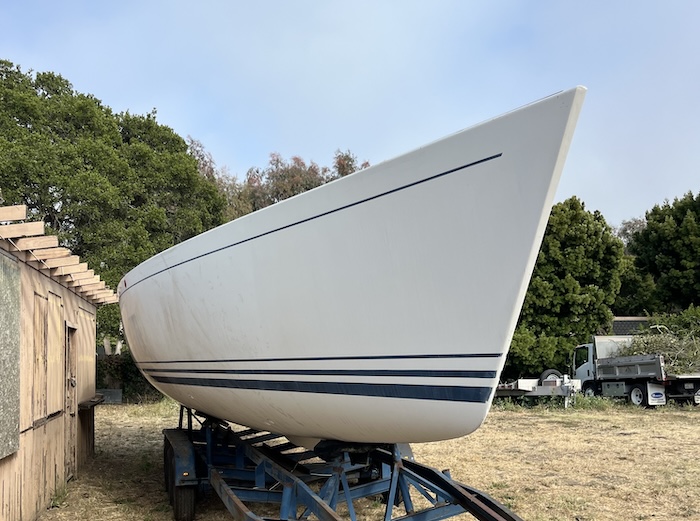
Last August we shared the story of the last Express 37, hull #63, that was partially built and living in a barn in Washington state. Sailor Darrel Louis tracked down the boat and brought her home to be completed. (You can read that story in the August 2025 issue of Latitude 38.) Recently, Darrel sent us an update of his progress.
“Phase 2” The Build!
Fast forward six months and progress is being made, significant progress! After we got the Express 37 to Santa Cruz in July from Stevenson, Washington (thanks, Andy Schwenk), it ended up blocks from the Santa Cruz Harbor with a “professional” wood shop at our disposal. Fate-destiny-providence best describes where the Express 37 ended up for the build. I was priced out of a location at the harbor and set out to find a location for construction, convenient to the harbor. As I mentioned in the August article, I scoured the neighborhood and ended up off 7th Avenue, near the harbor, after spotting an Express 27 sitting in the back of a property. Thanks to owner Mike DiBella, who offered up the build space.
Over the course of the past 20 years Mike has been involved with a number of boat rehab projects, most recently an Express 27, which is showroom-perfect and available should one be looking for a pristine Express 27. Fate had me bump into Volker Wuestenhagen a German engineer I met at Riva on the Wharf here in Santa Cruz. Volker just happened to be a woodworker and a perfectionist. In May last year I happened to mention the project to a real estate contact, Joe Zaug, an engineer from Lawrence Livermore Labs, also a perfectionist. Joe mentioned he was retiring in October and would like to assist as well. Volker joined in July and Joe in October, and as of this article being published, all wood components for the interior have been constructed, installed and glassed in, thanks to Whitney Brooks, who came highly recommended by Bill Lee. Between Bill and Homer Lighthall, any questions I have I just source them for wisdom and direction, thankful they are available!
Most recently I made a presentation of the build at the Santa Cruz Yacht Club’s Wednesday night information series, and what do you know? After the presentation I was approached by yacht club member Gustavo Guimaraes, a retired electrical engineer. Of course during the presentation I asked for an electrician and up popped Gustavo, who now is involved in the project. Additionally, thanks to Malcolm Brown for being available to preview, map and design the boat’s electrical system. With Gustavo and Malcolm the nav system will be state of the art! And thanks to Gustavo for his knowledge of image-based 3D modeling and reverse engineering for CNC machining, as he made fabrication of several components simple. Larry Tuttle of Water Rat is on board and has the elliptical rudder in the queue, expecting to deliver by the end of May.
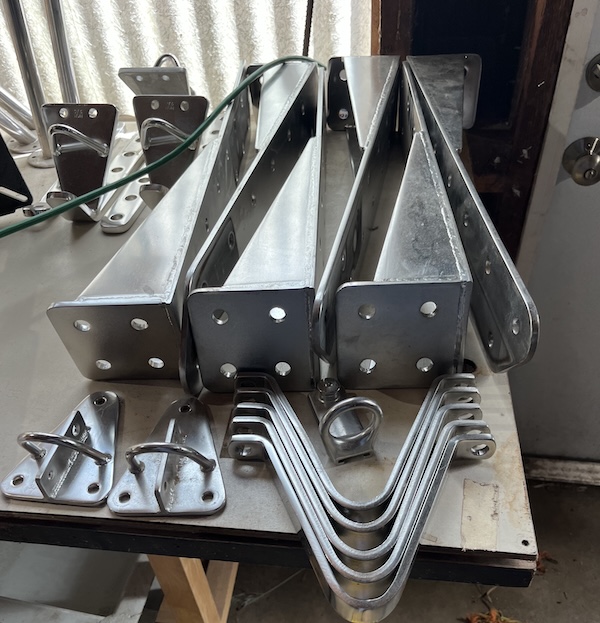
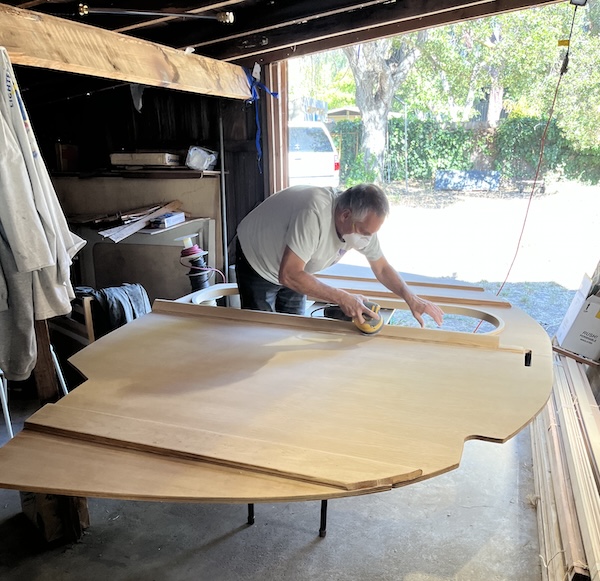
Of significance has been Larry Baskin, formerly of the Express 37 Bullet. Larry downsized, having sold Bullet, and happened to have a dozen perfectly good sails, which I negotiated moments after he posted them for sale. Currently, I am expecting to splash the boat I now call Carl, of Schumacher fame, in June or July, provided rigging can be completed. I did put in a call to Jesse Corlett of KKMI, whose father Chris sold the Express line of boats back in the day. I will see where that goes. And of course Brendan Busch is to be involved with rigging, final deck layout and fine-tuning of all the critical final sailing components.
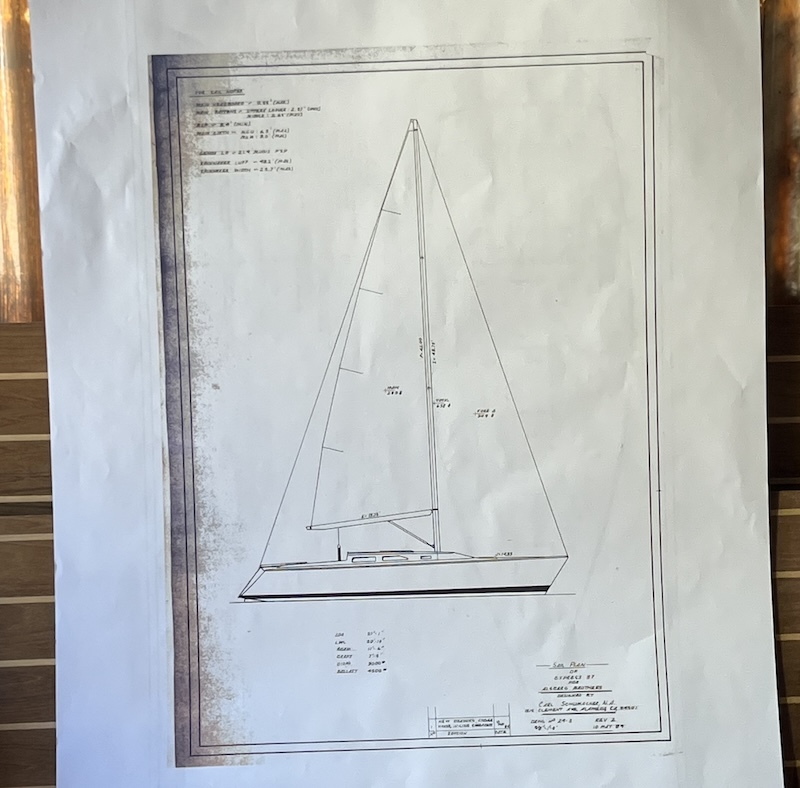
Thanks, Andy Schwenk, for letting me know about this $Free Boat$. And of course the “Pauls” — Paul Yost my Express 37 stablemate with True Love in the Harbor, and Paul Wallace, a sailing student in S.F. at Spinnaker Sailing, for contributions they have made along with others at my GoFundMe account, which is titled Help Float Carl, Thanks, guys!
At completion and launch, I will have a perfectly good triple-axle trailer for sale, so speak up and let’s talk about your owning it! Six new tires, six new axle bearings and new electronic brakes. If you would like, you can follow Carl’s progress on Instagram Express_37_Carl, and if you are inclined to Help Float Carl you can donate to the cause at the GoFundMe account: Just type in Help Float Carl.
PS: Next up, the “Launch and the Starting Line” — Capt. Darrel Louis/ASA#2023205618-Merchant Mariner Credential #3572843, Santa Cruz Yacht Club #0133 since 1982.
Max Ebb: Lunacy (The Art of Celestial Navigation)
I am not very big on major-league sports, but when there’s a big game on at the yacht club, it’s a major-league social event. People who are genuinely interested in the game usually stay home, where they can watch it uninterrupted. But down at the club, even though we roll out the giant high-definition screen, it’s more about food, friends and sea stories.
I was surprised to see the TV in the bar instead of the usual dining venue for a recent game. I took a peek into the dining room to see what event might have caused the sports fans to relocate, and I didn’t have to look far. A big sign at the door read “Football Widows Celestial Navigation.” This was a free, weekend crash course in celestial, given by one of the club’s old salts who had actually used a sextant in anger. The room was cluttered with empty sextant boxes, half-filled-out work forms and plotting tools, but not students. They were all out on the back deck, each with a sextant to practice with. And the old salt was nowhere to be seen. Instead, Lee Helm was giving sextant-handling advice, apparently subbing for the usual instructor.
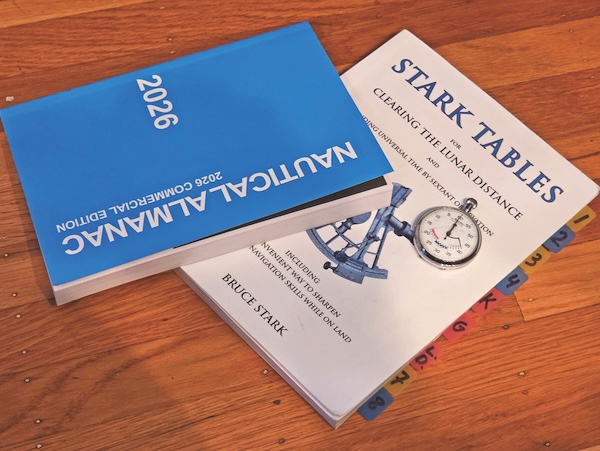
“I like to switch them between left and right hemispheres,” she explained after confirming that she was indeed the instructor that day. I was about to respond to the effect that the Eastern Hemisphere is harder for beginners, because you have to subtract east longitude from 360 to get Greenwich Hour Angle. Just in time, I realized she meant brain hemispheres.
“We do an hour of theory first,” she said. “I start them off with the navigational triangle and ways to get the calculated altitude, and the reasons for using an ‘assumed position.’ That’s the hardest concept, so it goes first while they’re still fresh. Then we get some welcome relief by switching to sextant practice, where they try to pick up the muscle memory of swinging the instrument to get an accurate measurement.”
It was nice to hear the students vocalize their “aha!” moments when they finally figured out, usually after some help, how to see the sun and the horizon at the same time.
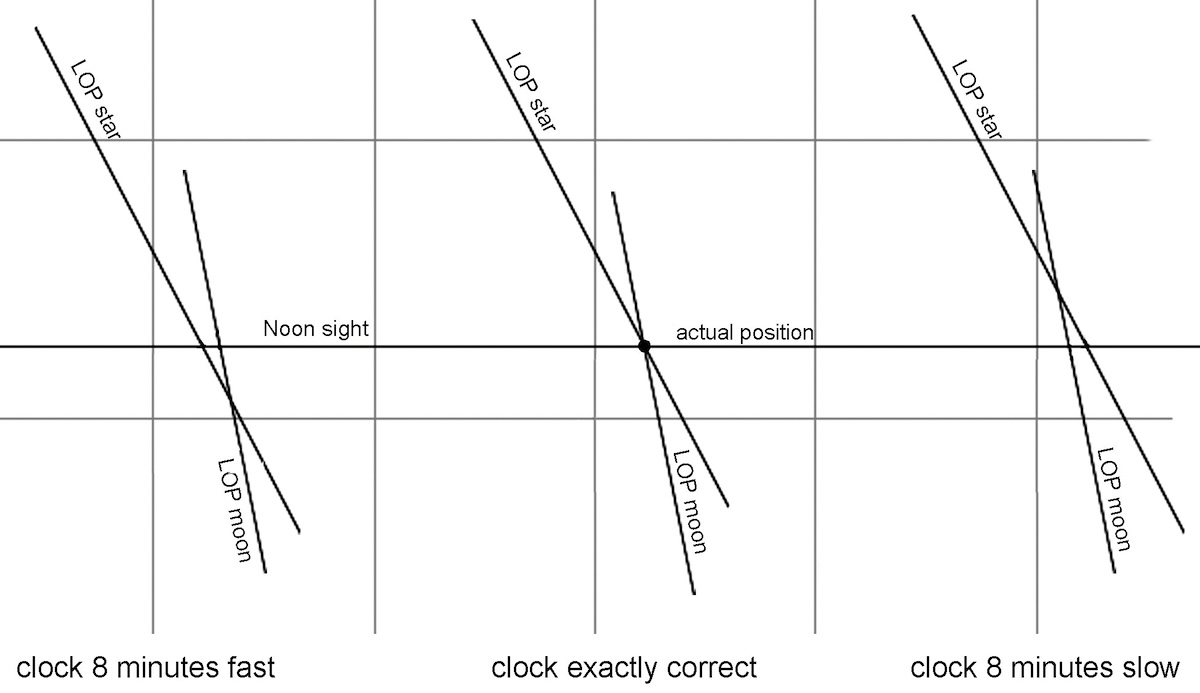
“Interest in celestial has been, like, way up in the last few years,” Lee observed. “The prices for usable instruments on eBay have almost doubled since before COVID. Plus, people seem to think that GPS is more likely to be hacked.”
“The Airbus software recall is what made me take this up,” said one of the students as he handed off his instrument to another navigator-in-training. “If we have another coronal mass ejection like the Carrington event in 1859, it’s not just the satellites that get fried. Every electronic gadget could be damaged. Even my digital watch. So I’ve been shopping for a good used mechanical chronometer.”
San Francisco on the Bay: “The List”

Dine, Drink, Smoke, Stay, Play and Shop. Discover San Francisco Bay and all that inspires those of us who live or visit here.