

Nikki Barnes and Ryan Squires Continue Push Toward L.A. 2028
The American 470 duo of Nikki Barnes and Ryan Squires took a big step toward their goal of sailing in the 2028 Los Angeles Olympic Games by finishing second in the 470 Midwinter Championship in Miami. The duo, who go by the name of “Team American Wave,” won two out of eight races in the event, and finished outside the top four only once (an OCS in race five that would become their drop). Barnes and Squires’ campaign is supported by, among others, the St. Francis Sailing Foundation.
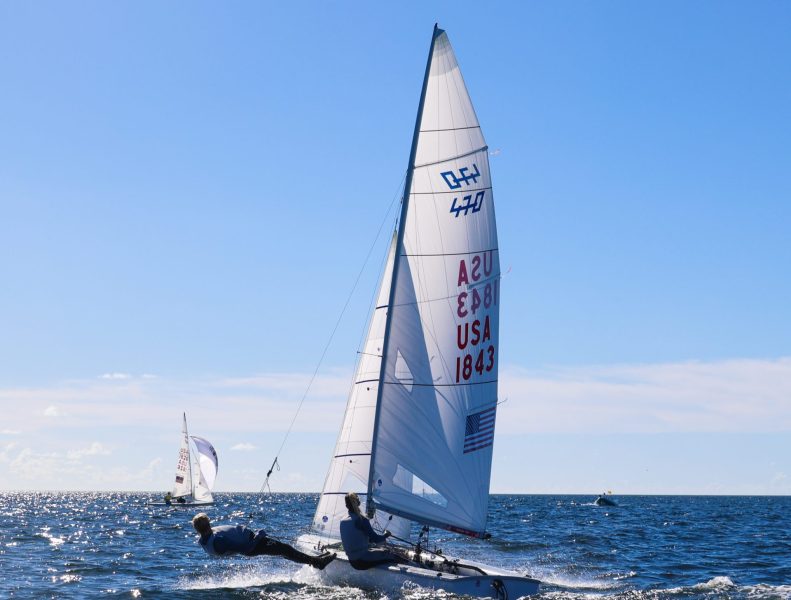
The event was won by another American duo: 2025 College Sailor of the Year Justin Callahan and two-time Olympian Lara Dallman-Weiss. The winning duo finished with a net total of 11 points, winning races four through seven and finishing sixth in race eight (which would become their drop).
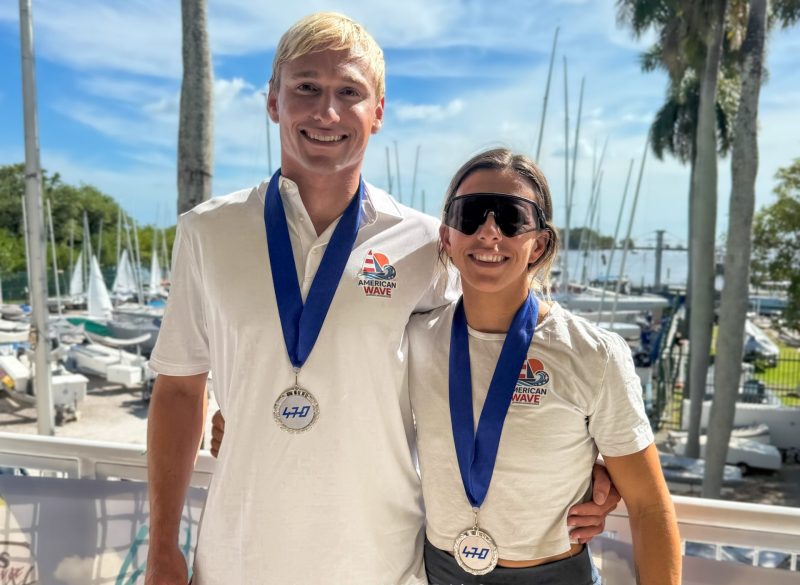
“This event was a great opportunity to get back on the starting line and race against the U.S. fleet,” Barnes says of the regatta, per the Team American Wave press release. “While we were disappointed not to race on Sunday due to the wind delay, we’re excited to have another chance to compete next weekend at the 2026 470 North American Championship.”
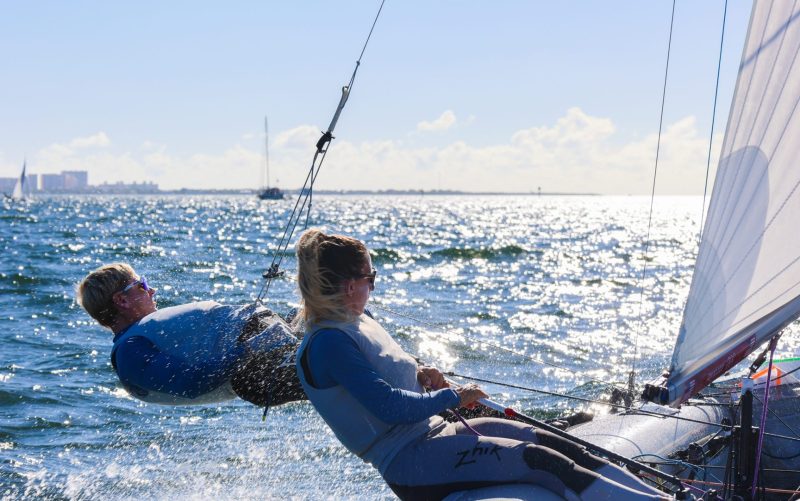
“This was a valuable event for us to practice new skills we’re developing as a team,” Squires adds. “We’re making significant progress, and there are a lot of exciting opportunities ahead as we continue to build momentum.”
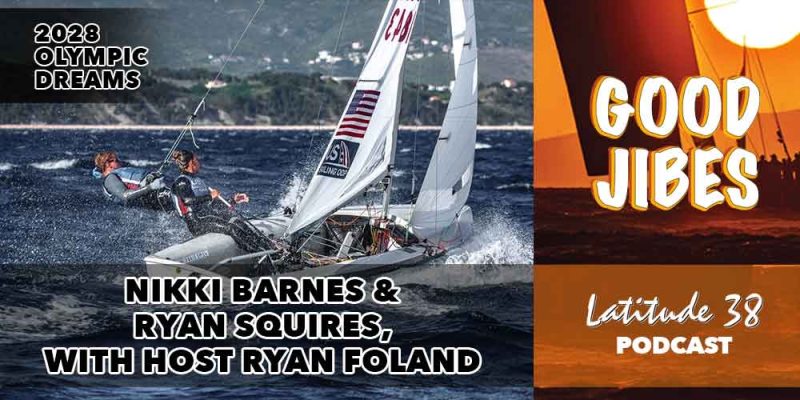
Barnes hopes to make her second Olympic appearance, having sailed the 470 in Tokyo. She is also the first-ever active member of the US Coast Guard to compete in the Olympics. Squires campaigned for Paris 2024 in the ILCA 7, but has switched to the 470 for the L.A. campaign. The duo sat down with Good Jibes podcast host Ryan Foland in September 2025 to talk about their campaign. You can listen to the episode here.
You can find the full scores from the 470 Midwinter Championship here.
[Editor’s note: Nikki and Ryan have withdrawn their 470 campaign for the 2028 Olympics.]
Sausalito Yacht Broker Robert Marotta Threatened in Office
A recent headline in the Marin IJ caught our attention: “Sausalito Dispute Over $1.6M Yacht Lands Suspect in Jail.” After a few calls, we found yacht broker Bob Marotta of Marotta Yachts, who, in fact, was involved in the “dispute.” As Bob explained, a gentleman accompanied by his pit bull came into his office Monday afternoon, explaining that he had just bought the Farallon Islands and wanted to buy a large yacht that was in Sausalito Yacht Harbor to go out to his islands. He claimed to have a “manifest” for the vessel and wanted to buy it in the next 20 minutes and sail off.
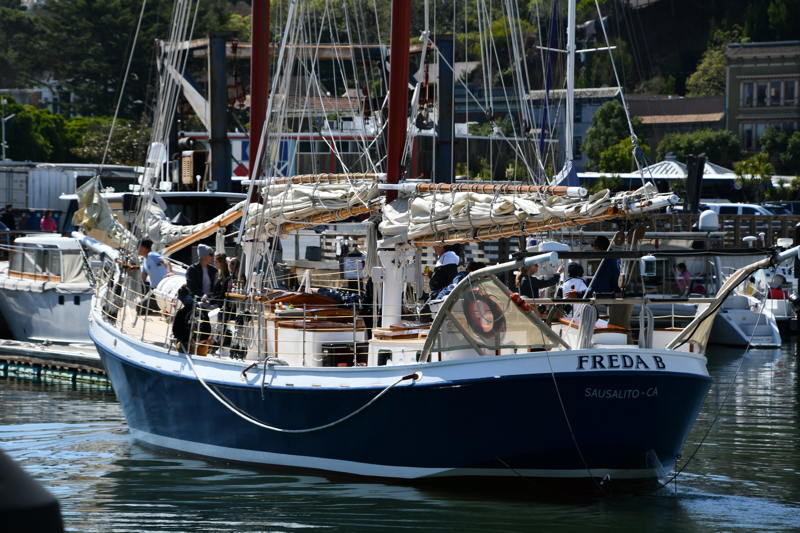
As a very experienced yacht broker, Bob knows you never want to prejudge someone who comes into the office, but there were obvious signs that concerned him. After he explained that the yacht in question was not actually for sale and that he couldn’t help the person buy the boat, the man took a swing at him, which Bob luckily avoided. The person was clearly disturbed and agitated, so Bob called the police, who were able to respond promptly. Though the person was very aggressive, the police managed to de-escalate the situation while the accompanying pit bull wagged its tail. The pit bull turned out to be a very friendly companion.
The Sausalito police arrested the man, 39-year-old Scott Michael Swan of San Francisco, and took him off to the Marin County Jail (while this writer’s wife was sitting in the jury pool that day).
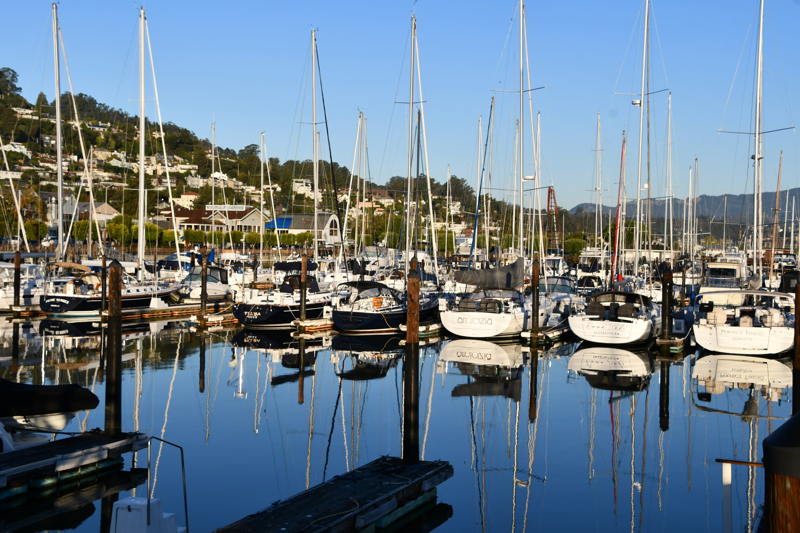
All’s well that ends well, right? But the story continues. After being booked into jail, the suspect was released on bail. The police called Marotta Yachts to let them know that the suspect had been released and was not considered dangerous. But it appears he still wanted to buy a boat. Bob’s partner, Mark Catell, told Bob that the next night the police were back in force to retrieve the suspect a second time, as he had boarded another boat he wanted to buy. The police were able to talk him off the boat, keep the situation under control, and rearrest Swan, who was again taken away.
Bob went on to say, “Most of the time we’re dealing with happy customers who are looking forward to a new boat, so this was a very unusual situation.” He recalled what he thought might have been a similar story when he ran into another person on the docks who expressed interest in buying a $1.2 million yacht, though his attire and demeanor left Bob with some doubt about the sale. Nonetheless, he engaged with the individual and took down the information, because you never know. Shortly after, the gentleman’s administrative assistant was in touch to find out how to wire them the $1.2 million! The sale went through.
Both Bob and Mark gave kudos to the Sausalito police for defusing and managing the situation each time. Fortunately, no one was hurt, and they hope the suspect can find the help he needs.
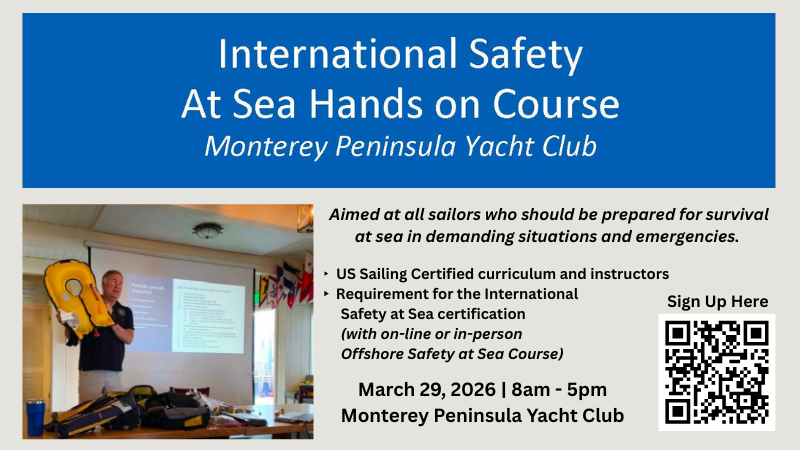
Monterey Peninsula Yacht Club to Host Safety at Sea Course
As the Crow Flies — A Tale From Up High on San Francisco Bay
 O’Neil Dillon, the captain and owner of the pristine Ericson 38 Lagniappe (meaning, in New Orleans, something given as a bonus or extra gift), decided that the upcoming season demanded a larger genoa. He chose to make the exchange just before departing on a trip to Angel Island. With 67 years of sailing on the Bay behind him, it seemed unlikely that any decision he made would require more from me than attention.
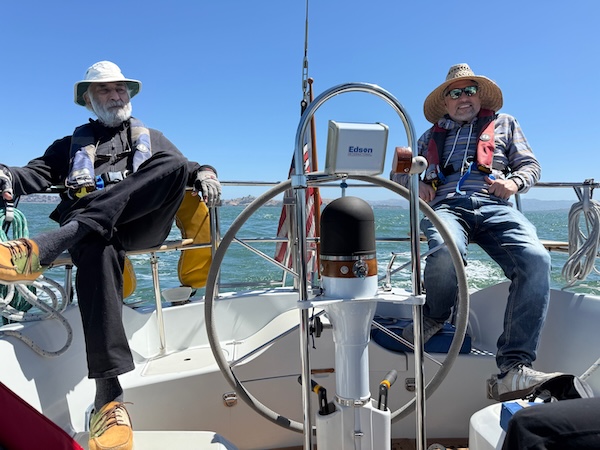
As we hoisted the bigger genoa, the job became increasingly difficult until a screeching sound halted everything. O’Neil raised his binoculars and diagnosed a wrap at the pulley located at the very top of the mast. He began barking directions, convinced that he would be the one going up the mast in a bosun’s chair.
That day we were a crew of four: Dick, Peter, O’Neil and me. Being the youngest of the group by a few decades, I volunteered to go up. Reluctantly, O’Neil accepted. They hoisted me using the mainsail halyard.
I started gaining altitude, feeling every turn of the winch in my rump. My distance from the deck increased, soon exceeding a third of the mast height. My heart began to race, and my limbs felt cold. A few months earlier, I had frozen in fear halfway across a pedestrian suspension bridge in the Swiss Alps.
As I rose, I silently counted what was keeping me alive. The equipment was in excellent condition. The three men hoisting me had a combined 150 years of sailing experience. Two of them were retired medical doctors. Still, as I reached two-thirds of the way up, my legs clamped against the mast; only the fear of embarrassment prevented me from asking to be lowered.
Then, suddenly, a bird with its wings fully extended flew past, just a few yards away. Had it been moving any slower, I might have made eye contact. The interruption broke my mental spiral, and I turned my attention to my breath, the air moving into and out of my belly.
The view from up there was completely unobstructed. I noticed more birds tracing paths in the distance, San Francisco’s skyline stretched along the horizon, the Golden Gate Bridge faint behind it all. I looked up. I was only an arm’s length from the pulley where the halyard was jammed. I could clearly see the problem. Reaching up, I pulled the halyard free, releasing it from its entanglement.
With the halyard freed, we sailed on to Angel Island, the hull displacing water with a steady, rhythmic sound, the new genoa full of wind. The repair had taken less than half an hour, yet the climb stayed with me long after my feet were back on deck. I had gone up expecting a technical fix. What I carried down instead was the quiet knowledge that breath can take you farther up than you can imagine, and beyond. .
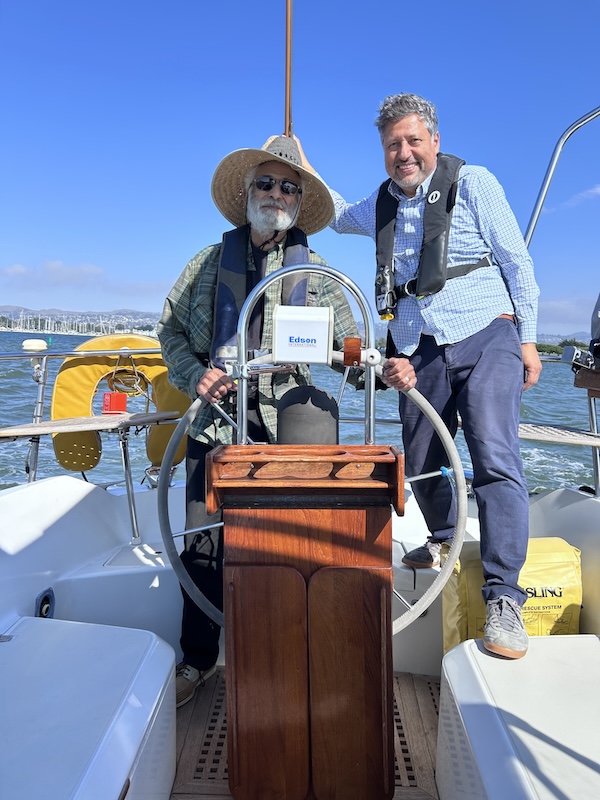
This story’s author, Oscar Luna, began sailing over 20 years ago on lakes Union and Washington, WA, as well as in the open waters of Seattle and Puget Sound. “After moving to the San Francisco Bay Area I met a few boat owners through the Berkeley Rotary Club, where we all belong, and I have been sailing with them for more than a decade,” he tells us.
Oscar learned to sail with the University of Washington’s sailing club and says, “My first sailing boat at that club was a Laser.”
Although he doesn’t own a sailboat, and isn’t a member of a yacht club, he has a good amount of sailing experience through cruising across a wide range of locations. “On the California coast, I have sailed to Drake’s Bay, Monterey Bay, Bodega Bay, Tomales Bay and the Delta. I have also sailed in Puget Sound up in Seattle, the Sea of Cortez, and Reykjavik, Iceland.”
It goes to show that you don’t need to own a boat or join a club to get your sailing fix. (Though if you do want a boat of your own, check out what’s on offer in Classy Classifieds.)
Pacific Cup “Primavera” — Get Ready Early and Have Fun Sailing
Primavera literally means “spring.” The Pacific Cup 2026 starts July 6; that’s summertime. The winning strategy is to have the boat, crew and details sorted by spring so you can focus on sailing and doing well this summer. Plus it’s supposed to be fun! Don’t forget that. Even if your goals don’t include winning, you will have more fun if you’re actually sailing the boat, not chasing electrical gremlins and arbitrary deadlines, and fighting traffic to get more somethings while everyone else is often enjoying the send-off party sponsored by your own dear yacht club.
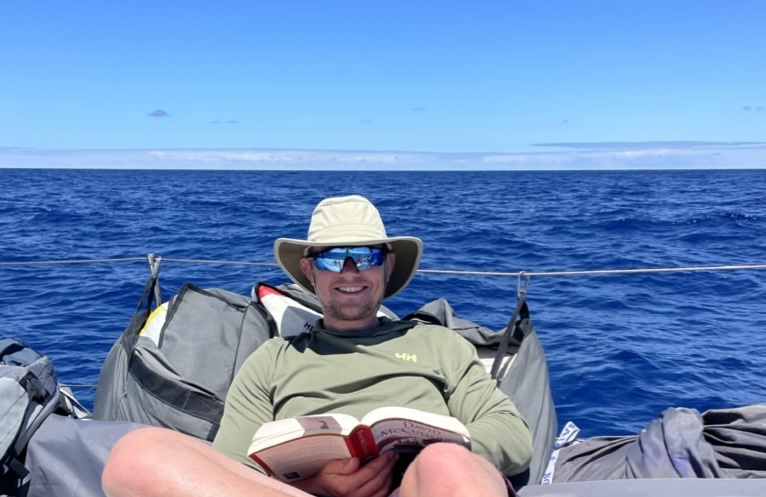
Set a goal to have the boat, crew and safety equipment finalized and race-ready by April 1. It’s the perfect day. What kind of fool spends all those greenbacks when the wind is free? Even if you miss your goal of April 1, May 1 is the day the circuses used to hit the road, so it still makes sense. May 1 still gives you time to slip your mooring lines and slip under the bridge to sort out details.
Race preparation breaks down into several categories. If you are doublehanding, it’s easy to assign duties: It’s up to either you or your wing person. On larger boats, you can spread the load to your crew’s strengths. Typically, the foredeck ape takes charge of the sails and rigging. This is an important category aboard a sailing vessel. Chow varies from freeze-dried mush to steak and seafood, depending on what vessel you are aboard and what the plan is. Pressure cookers are popular to speed up cooking processes. Other vessels plan a daily cocktail hour and wine pairing with the main course. Best to know if your expectations match the vessel’s chef’s talents.
Navigation has changed since the days of sextants, HO 249, pilot charts and plotting sheets. Now, thanks to Elon and his cronies, weather updates and wind predictions are available 24/7, and that coupled with powerful navigational software can easily show you in retrospect where you strayed off course. Charging systems and batteries to drive all this technology require an individual who understands electrical wizardry. It may say “Plug ‘n’ Play,” but the reality seems to mean the definition of “Play” includes calibration, recalibration, rebooting and adjustment. The ability to connect, interpret and apply the technology available to your vessel is directly proportional to your chances of a podium finish.
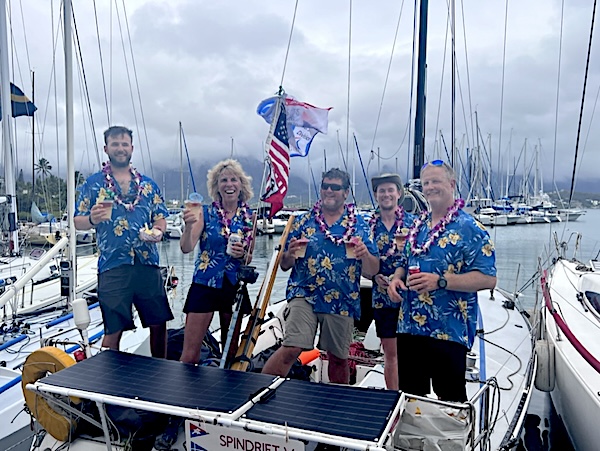
Drive the boat! This seems obvious, but it’s probably one of the biggest keys to success.
Chuck Hawley Recalls an Ugly Delivery on ‘Zamazaan’
We all learn from experience, and I just thought of an incident that occurred about 45 years ago when I was lucky enough to sail on Zamazaan regularly. Here is my story:
Around 1979, I crewed on Zamazaan, which was a 52-ft Bruce Farr sloop built out of kauri wood. It was a blast to sail, with small cockpits scattered on the deck so that the mainsheet trimmer (me) had his own little cubbyhole from which to trim. If you needed to go somewhere inside the boat, you were constantly at risk of bonking your head, since the only places with decent headroom were the saloon and galley. Farr, in an attempt to keep the center of gravity low, had tucked multiple fuel tanks under the sole, each of which held very little fuel, so you were always changing tanks if you powered for any distance. After an Año Nuevo Race, I delivered Zamazaan from Monterey to San Francisco under power, at night, upwind, with three other crew. The engine was placed in the forepeak so that the weight distribution would put the boat in bow-down trim, as was the trend in the days of the IOR Rule. I think the engine was a Perkins 4-236, which seems big, but, hey, there was a credit for having a big engine. And the boat powered like a steam locomotive.
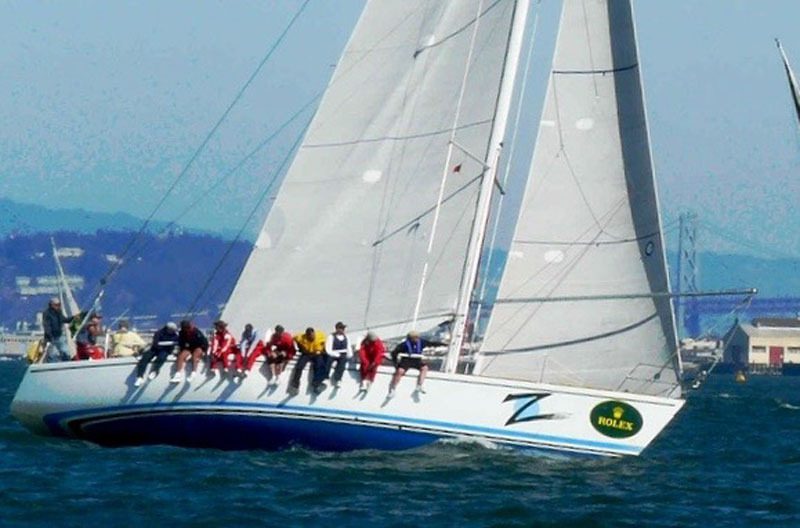
We ran out of fuel about 8 miles from the Golden Gate. We had no wind, big swells, and no electric fuel pump. So, for about 30 minutes, I sat next to the Perkins, flipping the little priming lever on the engine’s fuel pump, in a forepeak that must have been 120 degrees. Big engine, small forepeak. Eventually, I was able to suck fuel to the forepeak from somewhere around the galley, where a full tank was located, probably 20 feet aft. It was sweaty, bouncy, and reeked of diesel. It’s a wonder I didn’t get violently sick.
After that, I appreciated electric fuel pumps (even if only used for priming), short fuel-hose runs, larger, taller tanks, and better engine access. But I remember Zamazaan as being one of the best boats to race around the buoys. Great Fun was our nemesis at the time.
Send your ugly delivery story to [email protected].
San Francisco on the Bay: “The List”

Dine, Drink, Smoke, Stay, Play and Shop. Discover San Francisco Bay and all that inspires those of us who live or visit here.