

Estuary Anchor-Outs, Raft-Ups, and Wrecks — The Problem Keeps Growing
We keep talking about it, and we keep sharing the photos, and we can’t help wondering what will happen — and when — regarding the numerous (and increasing) illegal anchor-outs and derelict and sunken vessels in Oakland/Alameda. We shared two posts recently, and now, we have another, with a bunch of photos suggesting that the situation is getting worse.
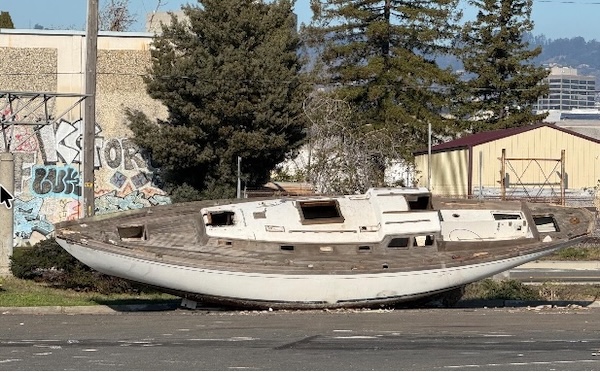
First up, last Friday we received the following photo from Latitude 38 delivery driver and sailor Bob Bodnar, who snapped a shot of the latest boat to join the growing fleet of wrecks along the Oakland shoreline. It doesn’t take being hit by a container ship for boats to meet their fate on the calm waters of the Estuary.

The blue sky and sunshine look inviting, but there are still troubles on the waters of the Estuary — and not just on the water. Last week, former harbormaster and Estuary activist Brock de Lappe shared photos of rafted-up anchor-outs, wrecked and abandoned boats littering the shore, and the mess in the Jack London Aquatic Center parking lot.
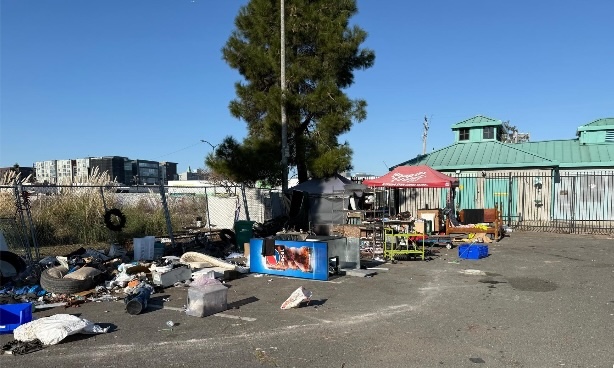
Brock sent the following email to the BCDC’s Enforcement and Compliance manager, Isabel Chamberlain, along with numerous people both within and outside of government.
“Today I completed an updated photo survey of the illegal anchor-outs on the Oakland Estuary.
“The number of boats has increased in the Brooklyn Basin, many are rafted up.
“This is an extreme hazard and quite likely many will break loose during our next winter storm.
“There are new anchor-outs adjacent to the Best Western Bayside Hotel on the Embarcadero and off the east parking lot of Union Point Park.
“Likely only a matter of time before these join the other sunken wrecks along the shore.
“It is incomprehensible that this is allowed to happen.”
The City of Oakland has posted a notice that it intends to clean up the parking lot, starting today, December 15.

As for the rafted anchor-outs, they appear to be multiplying. Brock writes, “The number of anchor-outs off JLAC has continued to increase over the past several months. These boats present a severe safety hazard to youth rowers and have resulted in both capsizes and unwanted harassment. There are now a minimum of 18 vessels anchored in the basin. It is entirely predictable that when a winter storm hits, with a 35-knot SE wind, several of these vessels will break loose and end up on the rocks. At that point the owner walks away and it becomes yet another expensive public cleanup.”

The following photo looks alarmingly similar to one we shared in October — only now there’s another derelict vessel in the mix.
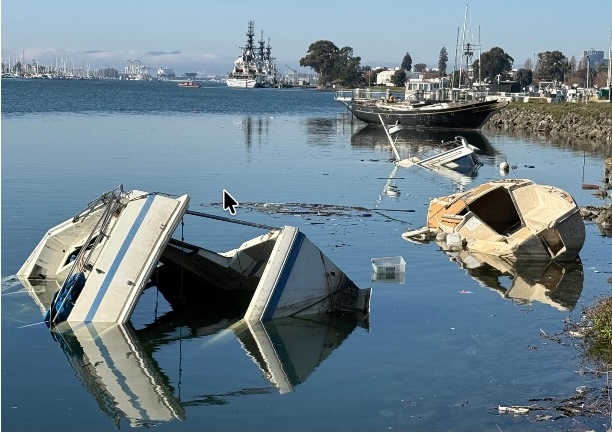
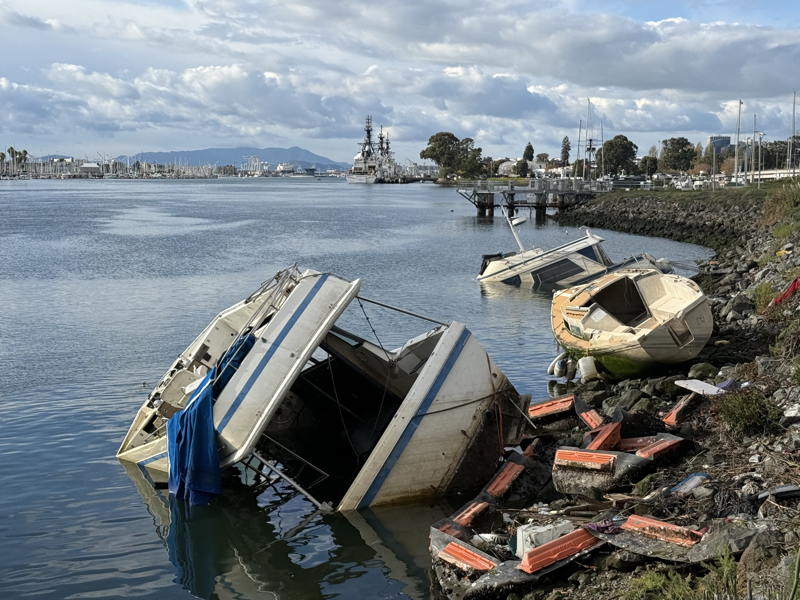
If the grounded boats aren’t removed, and they then multiply, so too do the problems. Add to that the seemingly increasing number of anchor-outs, raft-ups and derelict vessels, and it appears that things are going to get a whole lot worse before they get better.
The Resourceful Sailor Asks: “Are Your Dock Lines Ready for Winter?”
The North American winter will soon arrive, and with it, inclement weather. In the Pacific Northwest and Northern California, that means high winds, rain, a chill, and shorter days. These and the holiday season may conspire against many boaters’ will to get out on the water; a boat may float in its slip, unused and unattended, during a time when it needs monitoring most. In this installment, the Resourceful Sailor addresses the preparation of dock lines for the winter conditions.

Fall is a good time to inspect your dock lines to ascertain that they are up to the task for winter and have adequate chafe protection. If your dock lines aren’t nylon, I’ll go out on a limb and say they should be. Nylon provides considerable elasticity, mitigating the shock loads on a boat’s hardware and a dock’s cleats as the boat wiggles in the weather. Some sailors like double-braid nylon lines due to increased strength and durability. I wouldn’t argue with that, but it doesn’t mean it is invincible. Take a walk down nearly any marina dock, and you will see double-braid lines chafed and in need of retirement.
Personally, I prefer three-strand nylon for my dock lines. It is even more elastic and less expensive than double braid, if not quite as durable. Having lived on a boat in a marina for many years during the winter, I have observed how different boats using different lines ride in the weather. Additionally, I have spent many a storm aboard a boat tied to a dock, feeling the sometimes alarming motion and hearing the groaning of the lines under strain. This research has convinced me my choice is best for my boat.
Correctly sizing the line to the boat, taking its weight and windage into account, is key. While it may seem counterintuitive, oversized is not better. An oversized line, though stronger, with more margin for chafe, will not provide the proper elasticity to prevent shock loading. Manufacturers and vendors often have charts for sizing your dock lines appropriately to a boat’s length and weight. These provide a good starting point that can then be fine-tuned using experience and observation.
Nylon’s elasticity can also be its Achilles heel. The stretching fibers in constant motion chafe against each other and anything they touch. Common culprits are chocks, cleats and other lines. Chafe wear is often easily seen. The bummer is that once it occurs, it can’t be undone. The art is in being able to eye potential problem spots and protect the line before it happens. Another consideration is that nylon line has a lifespan. Even if chafe is avoided, repetitive stretching will cause the line to reduce elasticity over time. It will permanently elongate the line and, in the process, make it visibly thinner. The fibers will stiffen and become brittle over time from UV radiation.
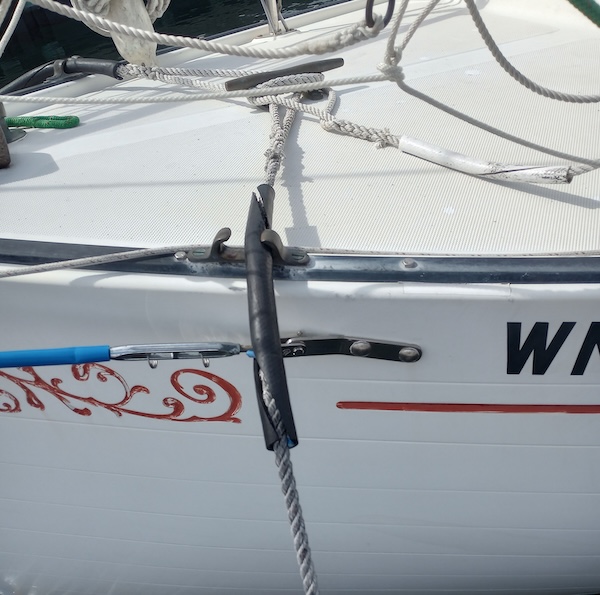
We can’t win against time, but we can win against chafe. Here are a couple of tips for protecting your lines throughout the year. Chafe-protection devices can be purchased, but that is not the Resourceful Sailor way. I prefer to repurpose discarded automotive, garden, or RV hoses for the job. When an acquisition opportunity arises, I seize it and always keep some on hand, ready for when I need it. I might add a solid segment before I put in eye splices, or a spiral-cut segment afterward.
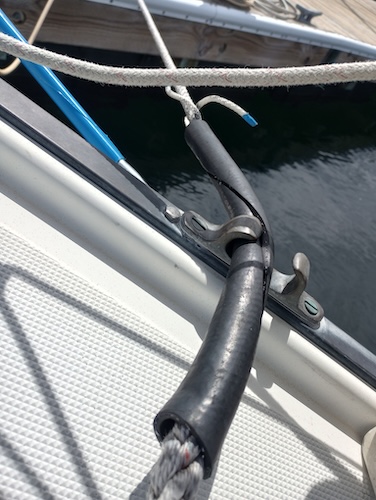
One problem that can occur as the boat squirms around at the dock, flexing the lines, is that the hose can shift over time. Observation has noted this to be a downhill shift. Since I use three-strand line, a simple solution is to thread small stuff through it on the downhill side of the hose, blocking its shift.

Take some time this fall to make sure your boat is prepared for winter weather. New lines will make the boat look good, and chafe protection will make its steward look seamanlike. It will provide confidence (and an example) for marina managers and slip neighbors. When the wind is raging and the cats and dogs are falling, and you are cozy, warm, and dry in your abode (or away on holiday), you can enjoy the peace of mind of knowing that your vessel is secure. The Resourceful Sailor believes that prevention is the best medicine, and with a boat, the least expensive. Remember, keep your solutions safe and prudent, and have a blast.
Haven Boatworks: Full Service Boatyard in Port Townsend
2025 Season Champions — December Edition
As Thanksgiving passes and November turns to December, there are many annual traditions that must be observed. Holiday decorations go up, you will be forced to listen to Mariah Carey’s “All I Want for Christmas Is You” several thousand times, and at Latitude 38 we will be highlighting the season champions from various fleets and yacht clubs.
Latitude’s “Season Champions” feature is an annual tradition in which we briefly highlight the sailors and boats that won their various season championships throughout the course of the year. With this feature, we hope to highlight as many champions as we can, starting with the first 10 featured here. More season champions will be featured in the January and February issues.
J/105 — Blackhawk, Ryan Simmons, SFYC
The biggest one-design fleet on San Francisco Bay was won by a familiar name in 2025. Ryan Simmons and his team on Blackhawk (SFYC), winner of four of the past six Rolex Big Boat Series (runner up this year), won the season title.
“We entered the 2025 season with the utmost confidence; we had ended last season winning our second consecutive Big Boat Series and four of the last five, returning with five of six of our long-term crew,” Simmons tells Latitude of the team’s season. “What a wonderfully humbling sport sailboat racing is! We opened the season with a 12th and 18th place in our first two races, more points than we’d accumulated in seven races at RBBS. It was an immediate reminder how hard it is to win in this fleet. Fortunately for team Blackhawk, that would be our low-water mark for the season.”

“We were able to start putting some more consistency atop the scoreboard as the season went on,” Simmons continues. “What is probably the best stretch we have ever had, over a 25-race stretch we finished outside of the top three only twice, once due to an exploded spinnaker and subsequent shrimping. True to form for the J/105 fleet, RBBS proved to be a battle, and we found ourselves in eighth place at the end of day one. Full credit to the crew for staying positive and committing to our system; we worked hard and finished with a proud second-place finish in the RBBS and locked up the season championship.
“Off the water, this was also a celebratory year for us: Kristin and I welcomed our daughter, CC Simmons, in early July,” said Simmons of exciting off-the-water happenings. “Further enforcing the fact that I have the best and most supportive wife, I was on the water racing in the July regatta 10 days later.”

“Our core crew this season was Brent Draney, Nico Colomb, Collette Zaro, JR Rosenlicht, Jeremy Herzog, Jon Rosen and Lindsay Browne,” Simmons continues. “Sailing with us at times we welcomed Liz Pino, Jessica Brownlow, Rex Cameron, Scooter Simmons and Blaine SooHoo. Next year is going to be our 20th season as a member of the J/105 class, and it is currently as exciting, competitive and cohesive as ever. A member of our local fleet has won the North American Championship five of the last six years, only one of which was contested in San Francisco. With a regular 25+ boats and six sailors on board, the fleet is always looking to add to our crew lists. If interested check out the website www.sfj105.org.”
Continue here to read about the J/24 Tenacious Cuttlefish; ILCA 6 with Toshinara Takayanagi and Ernie Galvan (RYC); the West Coast Sailing Grand Prix ILCA 7 won by Al Sargent (StFYC), and more.
Slow Down, You Move Too Fast … Go Sailing
Besides Elon Musk, very few people want to leave this planet. Though it can be challenging, Earth is one of our favorites. Sailors know that when you are ready to scream and get off the planet, the best solution is to go sailing. And most sailors enjoy their weekend sailing because they get to slow down.
We were reminded of this when a quote in a “tech utopian future” newsletter twisted our saltwater-infused brains. The quote: “I have to spend nearly 24 hours trekking from Abu Dhabi to L.A. What a waste. Instead of being crammed in a seat for 20 hours, I could’ve been home with my kids, reading one more bedtime story. I want supersonic flight, and I want it now!”

People who can never have enough or never go fast enough can forget that the people who spend the most time with their kids, reading books and magazines, or having fun together, don’t get onto a plane. The people who want to spend quality time with their kids slow their lives down and take their family cruising.
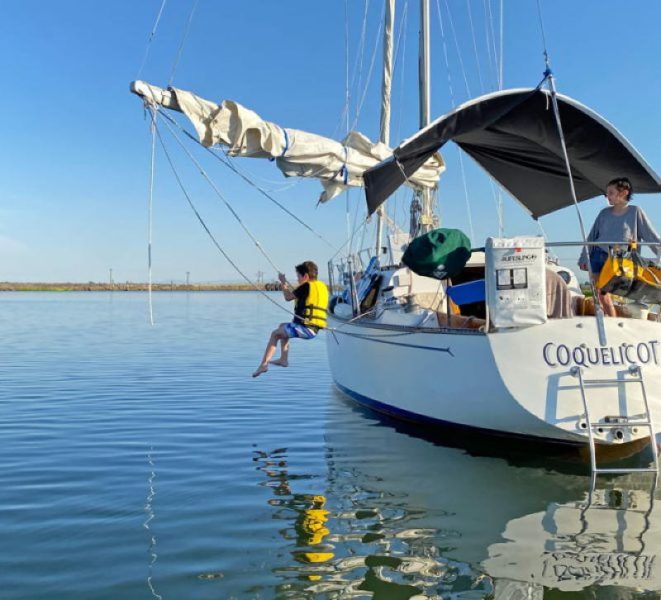
The best way to spend more time with your kids is to travel at about six knots, not 600 or 1200 knots. Moe Roddy’s podcast with the van Dycks, who are currently cruising with their kids, is an ideal example of how slowing down is actually better for family bonding. We just finished a podcast with Commodore Tompkins, who’s sailed about 600,000 miles, the vast majority of which is probably between five and 10 knots.
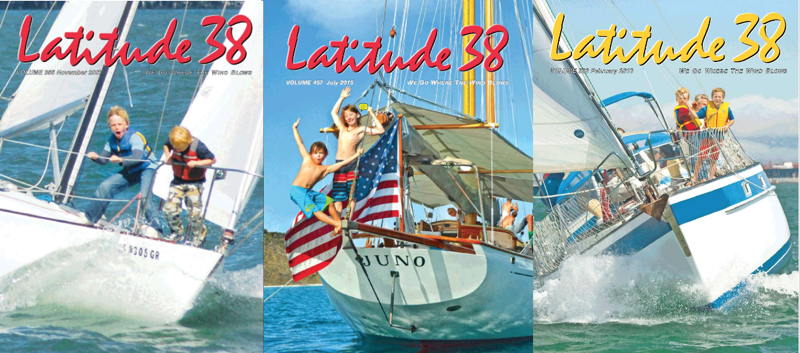
Conversely, at last year’s boat show, we were standing next to a twin-600-hp-outboard powerboat when we overheard a mother saying to her child as she stepped aboard the aft swim platform, “Look, honey, we could get to Tinsley Island in an hour-and-a-half with this.” We’re not sure this was a top-of-mind concern for the 6-year-old, but it would be a way for a parent to minimize family time in nature and maximize time for adult socializing while the child is in the sailing program.
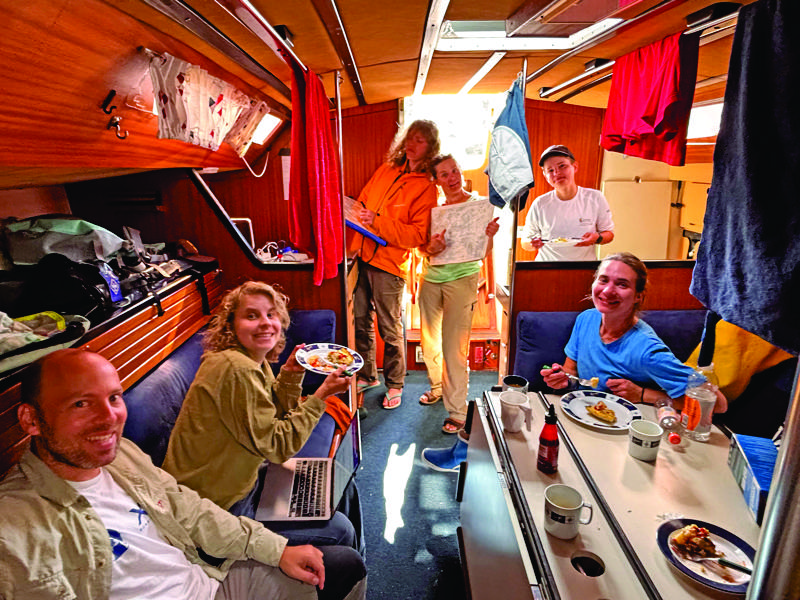
Typically, the reason people love weekends is that they get to slow down. History’s lesson is that all the technology designed to help us save time has largely been a failure. The tech world, in particular, has had workers spending five days a week working to create faster services so everyone can slow down on the weekend. If it worked, three or four days a week the Bay would be covered in sailboats sailed by tech workers enjoying their leisure time after creating all these digital-efficiency tools we all use. The Bay Area is the epicenter of AI and technology productivity, yet it feels hard to find a technology worker who has time to relax and go sailing on the weekend. Or time to spend with the kids varnishing the rails of their classic sailboat.

We recently read the tagline for a magazine called In Formation: “Computers make humans so much easier to use.” It’s a good reminder of our “relationship” with tech. There is no speed of life that is fast enough for anyone to be able to slow down. Legislatures everywhere are trying to figure out how to get kids off devices and off social media so they can connect with each other and their families. Legislation will help, but so will the example of us adults choosing how to use our own time. Sailing the world or sailing the Bay with your kids is an alternative to leaving the planet, and a good way to slow down and spend more time with your kids.
San Francisco on the Bay: “The List”

Dine, Drink, Smoke, Stay, Play and Shop. Discover San Francisco Bay and all that inspires those of us who live or visit here.