

StFYC J/22 July Summer Series Brings Fun Vibes and Good Racing
Wednesday night racing is a long-standing summer tradition at the St. Francis Yacht Club (StFYC). When one thinks of the StFYC Wednesday racing, likely the first image that comes to mind is of the classic wooden Knarr and Folkboat fleets crashing through chop out in the ebb, or short-tacking up the Cityfront.
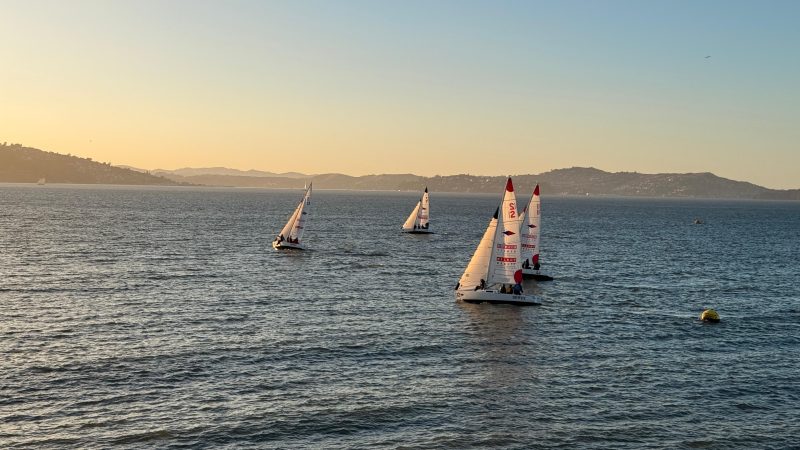
Another fleet you’ll see over the summer is StFYC’s J/22 fleet, which sails almost every Wednesday night. During June and August, the J/22s are usually the third start after the two wooden fleets (of note, this year is the first year in which the J/22s are also competing with the Knarrs and Folkboats for the summer series Degnan Trophy). July, however, is when the 22s get the Wednesday night spotlight to themselves.
With the old wooden fleets taking a break, the J/22 fleet sails a very different type of Wednesday evening series. Instead of the one long race that constitutes most beer-can-style races, the July series has two, three, four, or even five races in one evening, making for an evening series that completes 12 races over four Wednesday nights. Needless to say, the races are quite short. Reminiscent of college or high school dinghy racing, each race is just about 15 to 20 minutes in length — sometimes only a start, windward mark rounding, and finish.
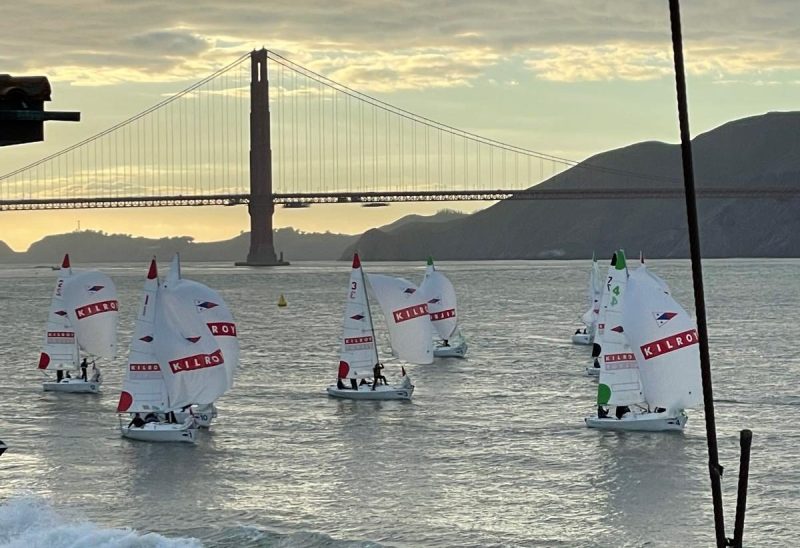
“It’s a very competitive series,” Michael Coholan of team Cookie Skillet tells us. “Skippers and many of the crew are primarily former and current college racers. We’re grateful for the use of the StFYC member-owned boats and the opportunity to race them, even for those of us who don’t have college-level racing experience.”
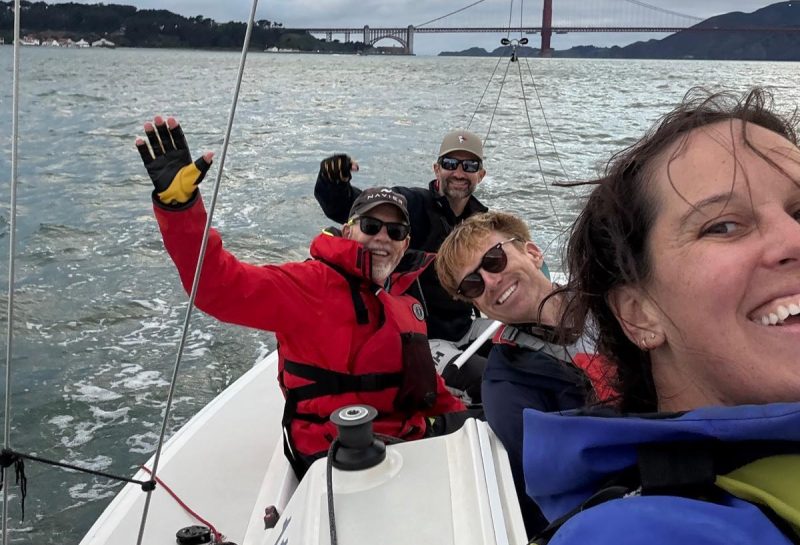
After the 12 races were completed, Katie White’s team of herself, Hope Wilson, Chris Long, and Kate Shiber was victorious in the series, totaling 19 points. The team finished outside the top two in only three races in the entire series. On a personal note, this writer would like to thank Katie’s team for pulling him out of the water during the last race of the series, after he unexpectedly became detached from his own boat (causing the final race to be abandoned). Should readers want to hear that story, they will have to track him down in person and ask for it.
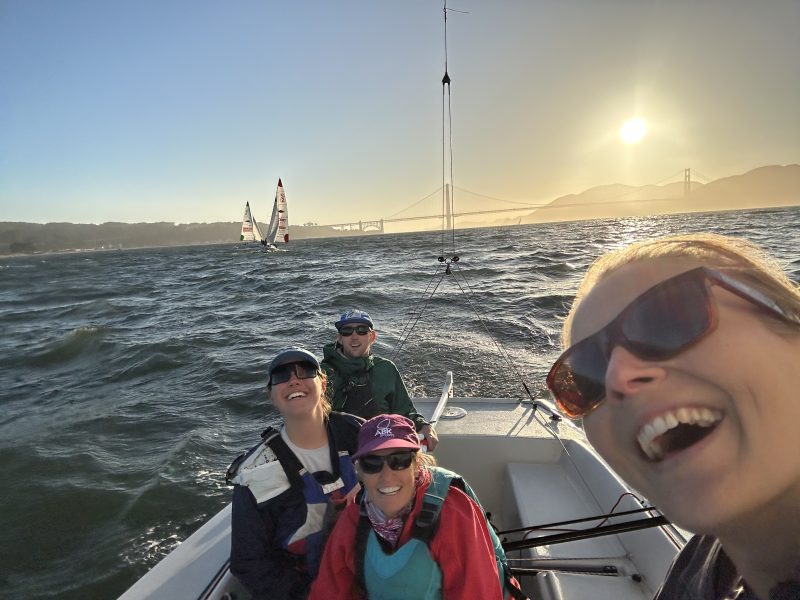
“The Wednesday J/22 racing is low-key but competitive racing with a variety of levels,” White says. “The series encompasses highly skilled high school racers, collegiate racers, new racers just wanting to learn the finer details of racing, and a lot of old timers out there that just want to have a good time. There can be some squabbles on the course, but everybody is very supportive. I would love to see a small meeting after each race to see what everybody thinks they did well (or not), and ask about rules and what they can improve on. The volunteers and race committee are awesome, and none of this could happen without them!”
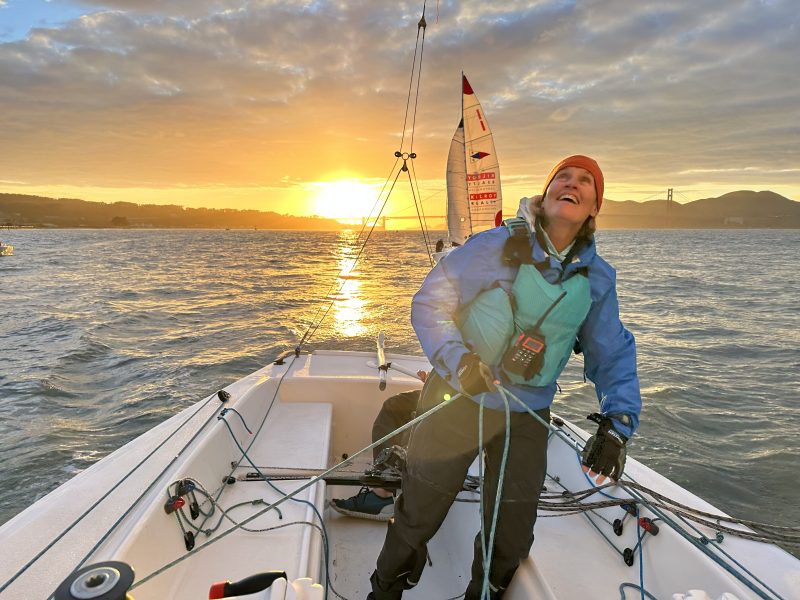
Alberto Rivera, whose team finished third for the series, adds, “They were great summer racing conditions with enough wind to keep things sporty but manageable. The series got increasingly more competitive every week as crews gelled together and got comfortable with the J/22 and the sailing conditions in the Bay.”
You can see the full results for the J/22 Summer Series here.
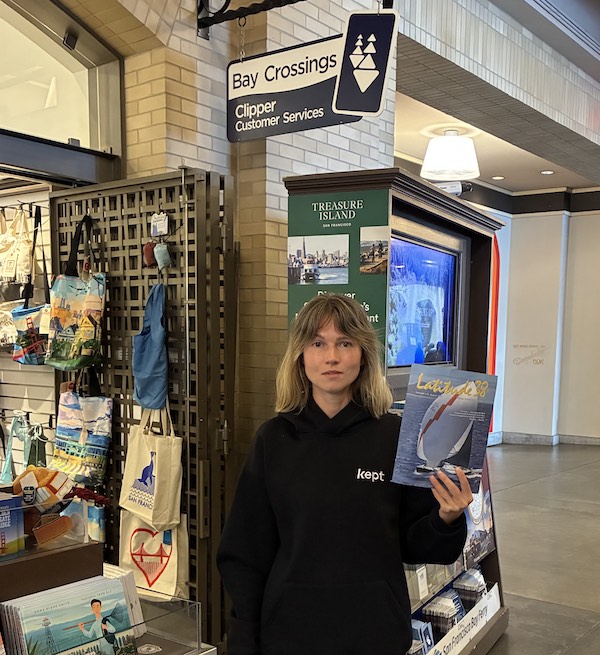
Latitude 38 August Issue Out Today
Welcome to the August issue of Latitude 38. July was a busy month on the Pacific, with sailors heading to Hawaii and back for the Transpac and Singlehanded Transpacific races. We cover those and more in this month’s magazine. Here’s a preview.
Transpac 2025 — Unplugged No More
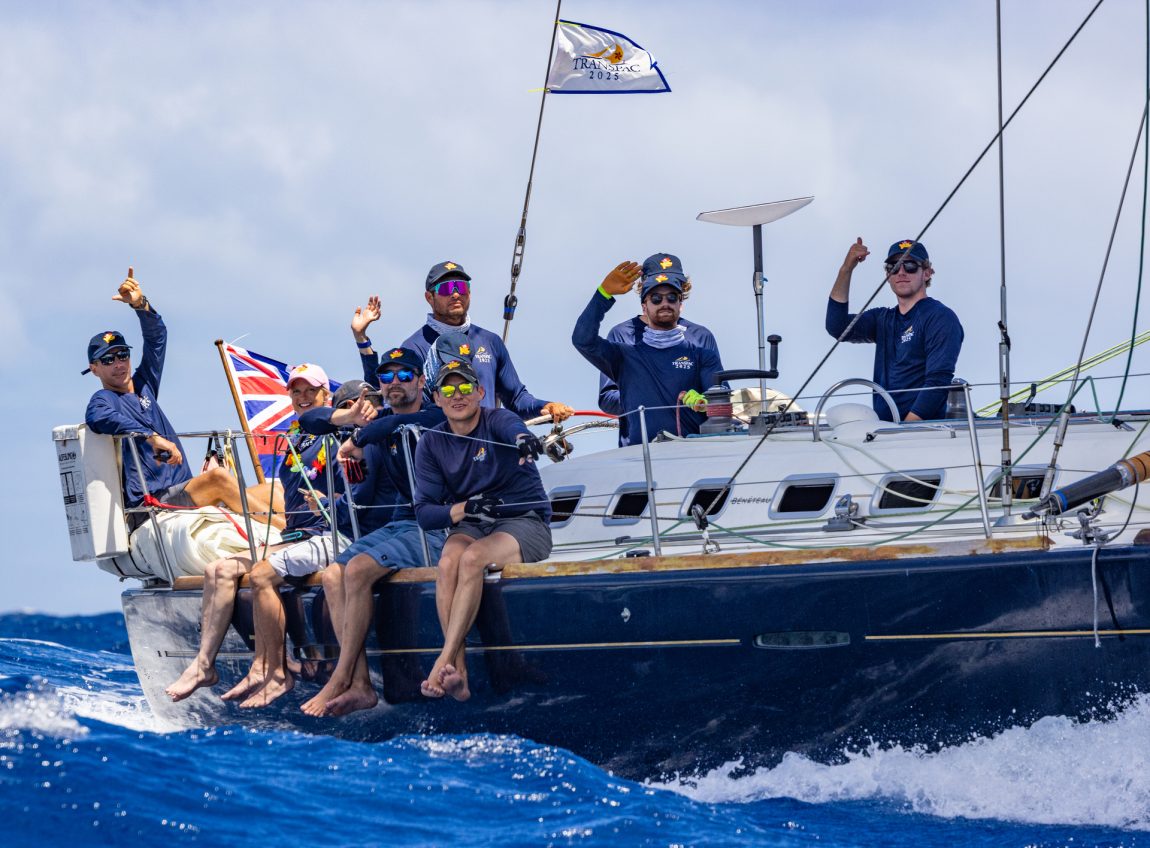
Define “high speed” and where in the world you are, and maybe there’s more to the story. I can tell you this: Internet accessibility changes the ocean racing game. The Transpac YC committee puts strict limits on what can be accessed. If it provides you with information that will help you win the yacht race and it costs money, then it is off limits. If the information is free and publicly available, have at it.
Singlehanded Transpacific Race — Victory Over Adversity
Most yacht races start with a bang (or, these days, more likely a horn). Two bangs instead means a postponement, which might last from five minutes to two hours. On June 20, the Singlehanded Sailing Society took a show of hands at the mandatory skippers’ meeting for the 2025 Singlehanded Transpacific Yacht Race and postponed for 25 hours.
Whatever Happened to Express 37 Hull #63? — Phase One
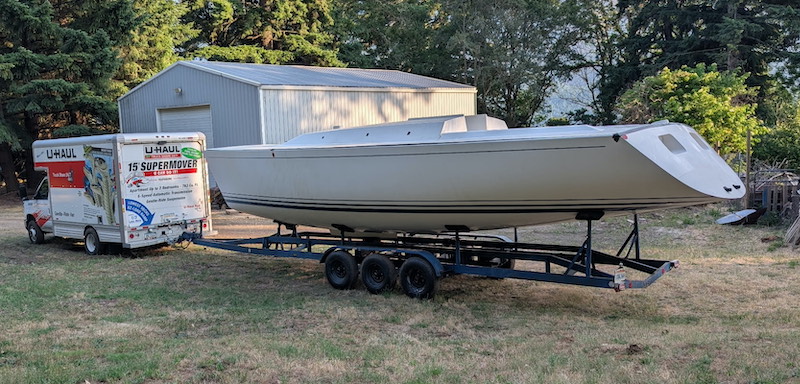
Somewhere in a forgotten barn in Washington, a sailing legend waited, wrapped in dust and silence. My heart pounded as we drove east along the Columbia River Gorge to rescue the last Express 37 ever built, and whose ultimate fate was to be the landfill. Whichever the case, the Discovery-Recovery and Delivery is an anomaly, as I came across this “yet-to-be-assembled” hull #63 in Stevenson, Washington, thanks to Andy Schwenk. I’m not sure if I should thank him or curse him for the information he passed on about this “free mystery boat somewhere in Oregon or Washington.”
Letters: Memories Can Still Be Made on Lake Merritt; Operation Covering Eagle; Foreign-Flagged Cruisers Have To Pay Up in Washington State; From a Washington State Attorney; plus a mail sack full of more readers’ letters and comments.
Sightings: Fall 2025 Crew Party, Last Ha-Ha; Sausalito Boat Show Coming September 19–21; Is DIY D.y.i.n.g?; 2025 Wosser Trophies; Accidental Mexico Cruisers; and more.
Max Ebb: “Puzzled”
Racing Sheet: Peak season regattas and championships covered here include the Moore 24 Nationals and Long Beach Race Week; the YRA’s Half Moon Bay Race, In the Bay Series, and new Women’s Championship Series; the US Wingfoil Championship; the ILCA PCCs; the Mercury Hart Nunes Regatta; the El Toro Nationals; StFYC’s Woodies Invitational; and the WA360. See much more in Box Scores and Race Notes.
Changes in Latitudes: With reports this month on Keeldragger’s long-delayed Great Pacific Adventure; Lochinvar’s long Pacific Puddle Jump; Tardigrade’s northern adventure; and a tasty selection of Cruise Notes.
All the latest in sailboats and sailboat gear for sale, Classy Classifieds.
We appreciate all readers and all our supporters — you keep Latitude 38 in print. Please show your appreciation by supporting the advertisers who have made this issue possible. Shop here.
Now, go get your copy! Here’s a map of Bay Area distributors.
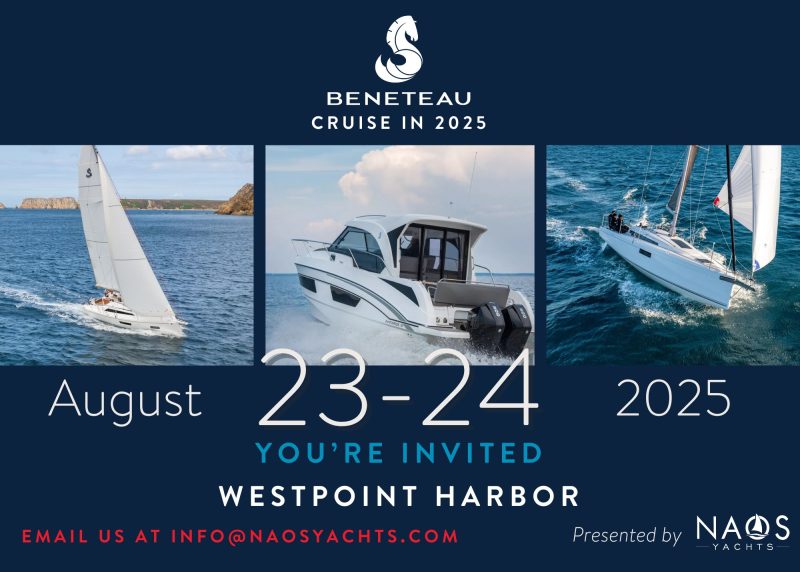
Beneteau Cruise-In 2025: Westpoint Harbor With Naos Yachts
USCG Conducts Survey for WAMS Study of Central West Coast
Bay Area sailor and friend of Latitude Jim Haussener takes great interest in our local waterways. So he is quick to let us know of any current issues that require the sailing community’s attention. Jim’s latest notification is about a Coast Guard review on the system of aids to navigation and other waterway safety concerns, and mariners are encouraged to have their say.
The US Coast Guard is conducting a Waterways Analysis and Management System (WAMS) study of the waters spanning Point Conception to Point Sur, Estero Bay, Morro Bay Channel, and Port San Luis. Mariners are invited and encouraged to assist by completing a short survey.
This study focuses on the area’s aids-to-navigation system, waterborne commerce, marine casualty information, port/harbor resources, emergency response plans, routine and emergency communication capabilities, and future development projects.
“Your input is critically important to this process and the Coast Guard greatly appreciates your time and attention to this 18-question survey.” Responses are required by August 16.
Any interested company or individual wishing to provide comments or participate in a user survey may do so via this link: https://www.research.net/r/DVXSR7B; or email Lt. Rubymar Sebastian at [email protected]; or phone (571)-613-2930.
The Resourceful Sailor: Unstepping a Small Boat’s Mast With a Bigger Boat’s Yard
I have sailed with Bertram on Murrelet a few times. When he asked if I would assist him in trailering the boat, of course I agreed. He explained he would be unstepping the mast in the morning using the schooner Alcyone’s yard. I thought, “That is classic Resourceful Sailor fodder.” and excitedly asked if I could film it. Bertram agreed. Sugar Flanagan, Alcyone’s co-owner, and Erik Brown, co-proprietor of Port Townsend’s Left Coast Charters (and Sugar’s son-in-law), also graciously agreed.
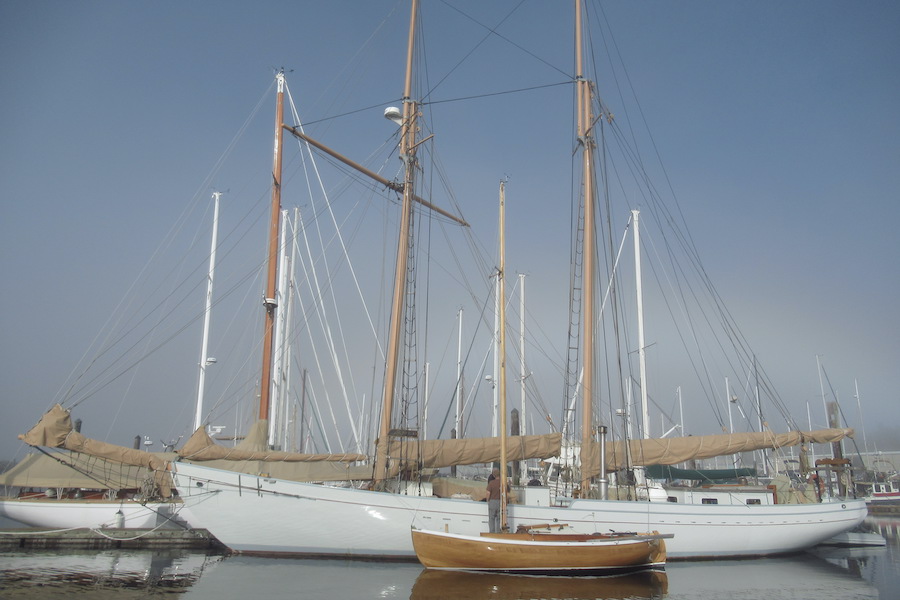
When you’re small, it pays to have big friends. In this case, big is Alcyone, a 65-ft-on-deck, wood-hulled, gaff-rigged schooner built in 1956 by Frank Prothero on Lake Union in Seattle and now moored in Port Townsend, WA. The small is Murrelet, a 19-ft modified Augie Nielsen Spitzgatter-design sloop. Built by Bertram Levy in Port Townsend from a toppled neighborhood locust tree (and milled by a local sawyer), Murrelet was launched in 2019. Trailerable, she was due for her yearly haulout and needed her mast removed for transport. Bertram, at 84 and with a lifetime of maritime resourcefulness, has a boat shop at his house, where Murrelet and several others have been built. She and her mast were headed back home for their yearly varnish refresh. Sugar offered to help unstep Murrelet’s mast using Alcyone’s foremast yard.
Bertram tells the story of his father teaching him to varnish. His watchful eye always found the drips and holidays, and Bertram would be instructed to make it right. He mastered it. He says varnishing is Zen for him. To hear him describe his meticulous and methodical approach to dipping the brush, allowing the excess to drip off, three strokes per brush side, the wet edges, the feathering, the tipping, the repeating, it’s easy to believe. So it is not particularly out of place that Murrelet has more than her fair share of varnish, including her topsides and mast. Every year, this varnish needs one to two coats to battle the effects of ultraviolet radiation. According to Bertram, even then it will require a complete re-do every 10 years. Bertram’s daughter, Madeline, will inherit Murrelet. He’s taught her how to varnish.
Murrelet cozied up next to Alcyone on the misty morning of June 5, rafting up amidships, while Sugar and Erik prepped and secured Alcyone’s foremast yard. Murrelet’s rigging was unpinned and strapped to her keel-stepped mast. The lifting line was led from Alcyone’s deck up to a single block on the yard above — which protruded outboard over the mast — and back down, and tied with a bowline around Murrelet’s spar. This loop would slide up the mast to near the base of the jumper stays. A subtle, clever trick incorporated another line acting as a choker from below. A round turn and a bowline around the outside of the lifting line’s mast loop allowed for cinching it around the mast to help it bind in the right spot. Many masts have spreaders that act as good lifting and balance points. Murrelet’s does not.
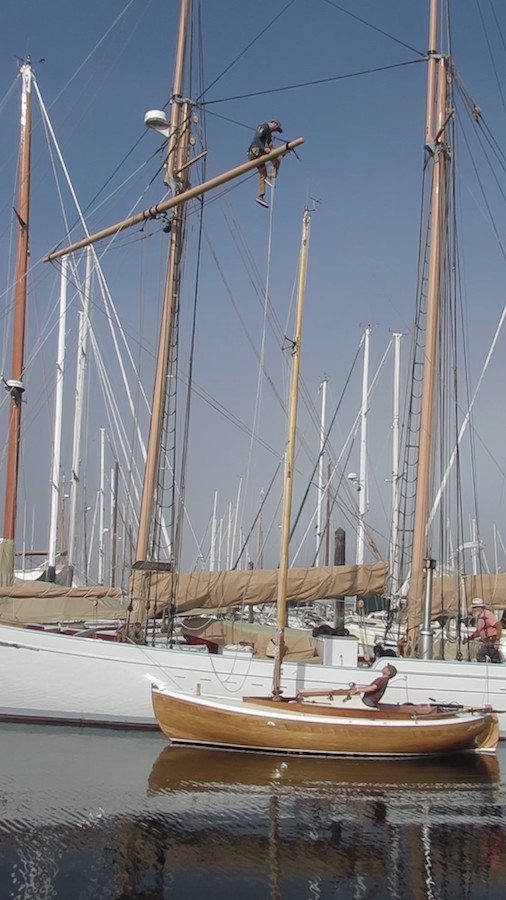
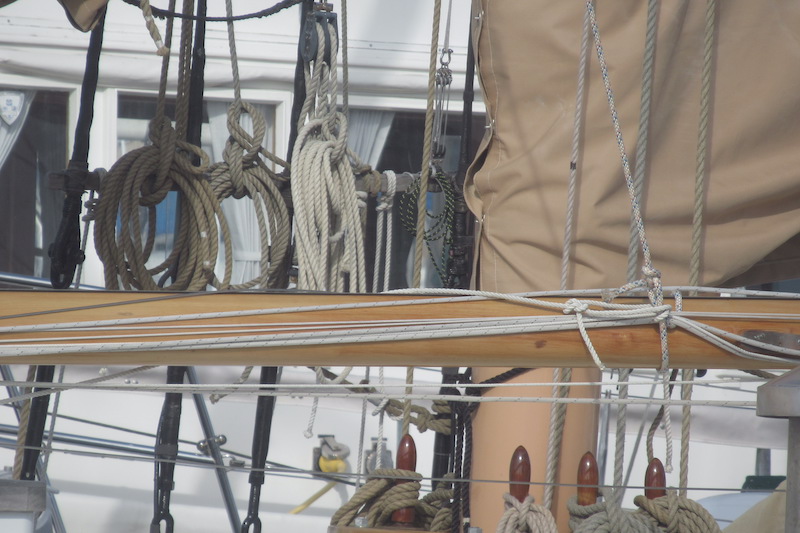
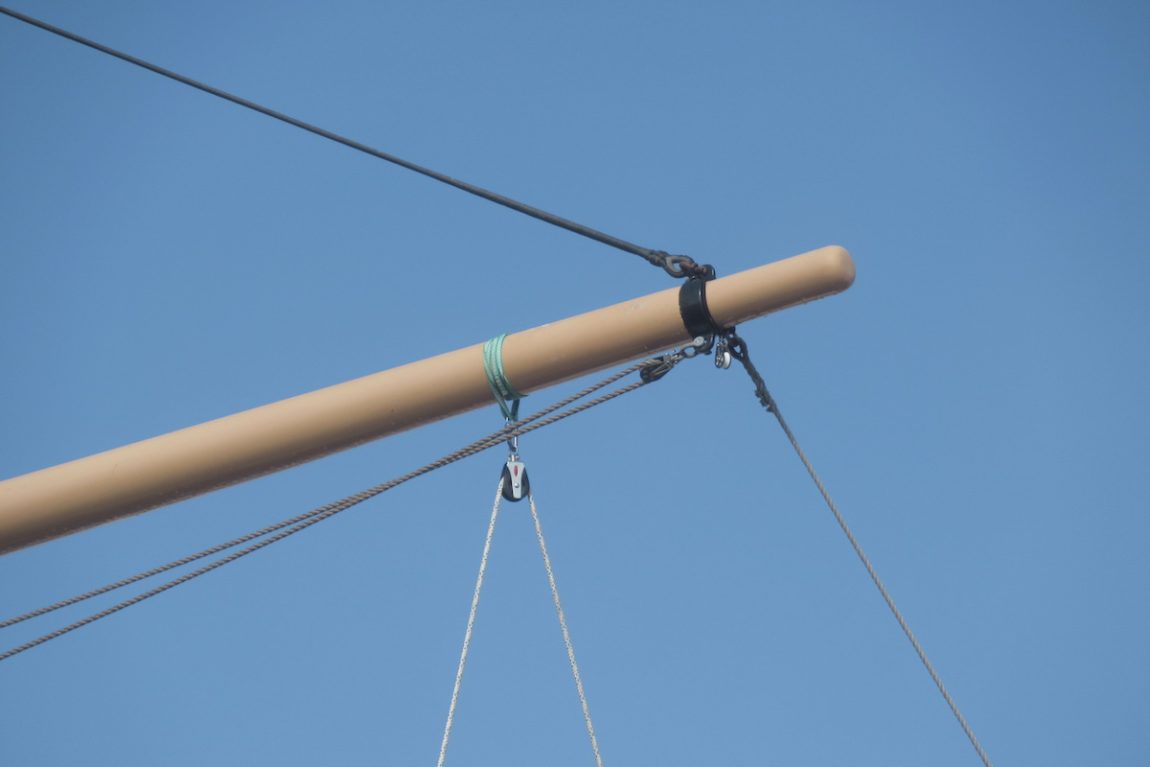
Then it came down to heaving on the line. Murrelet’s mast is maybe 100 pounds. Sugar didn’t feel the need to gain purchase with extra block and tackle, though the mast wanted to stick in its base. Swelling, if wood, or corrosion, if metal, is not uncommon. A little rocking of the boat eased it out. The mast needed to be raised only a few feet to clear Murrelet’s deck. The base was moved forward while the top of the mast was angled and finessed through Alcyone’s rigging and lowered to her deck.
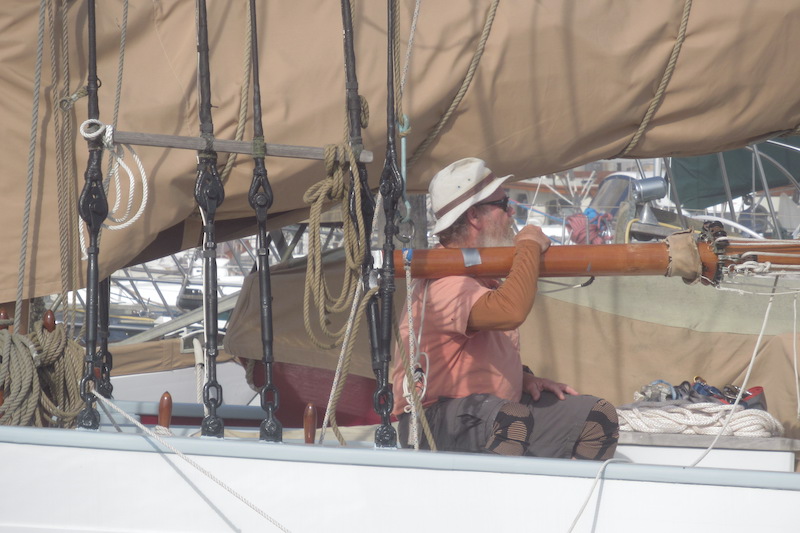
A vertical spar rigged on a sailboat is tidy and majestic. That same spar horizontal on a 65-ft schooner? Cumbersome. I put my cameras away and gave the extra needed hands to move the mast around and through the schooner’s maze of rigging, tenders, stove pipes, and housetops, down the dock, and onto Bertram’s classic rack-topped mid-’80s Toyota pickup.
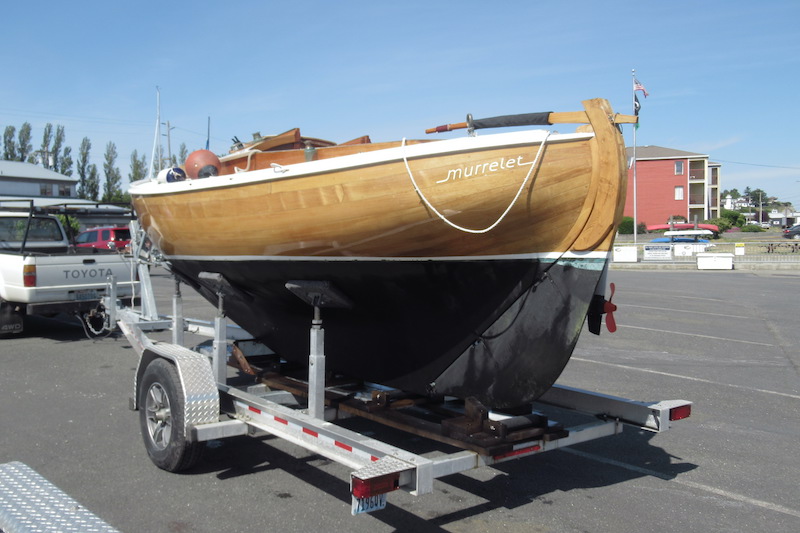
Salty sailors, riggers, and boatbuilders know how to be resourceful. Unstepping Murrelet’s mast was simple, relaxed, and efficient from beginning to end. Sugar and Erik had good rapport, confidence, and experience, while Bertram mostly waited on standby. He has his work cut out with some 240-grit sandpaper and a can of Epifanes, but he gets to do it out of his shop at home. And lest we forget, it’s Zen for him. No lift or yard charges, and with the help of some bigger friends, no crane fees. Though, in true resourceful-sailor fashion, Bertram also has a special tripod to step and unstep Murrelet’s mast in the marina parking lot. With experience, a spring in your step, and good connections, you get to mix it up for fun.
Check out this video of the entire process.
Remember, keep your solutions safe and prudent, and have a blast.
Summer Music Series Tonight at Marin Yacht Club