

West Marine Declares Chapter 11 Bankruptcy
We have received a number of emails and comments with questions from readers about West Marine’s recent decision to go through a Chapter 11 reorganization. CEO Paulee Day assures vendors and customers they are not going out of business and says, “Chapter 11 is a legal process that will allow us to restructure by reducing our debt and putting us on a more sustainable financial footing.…”
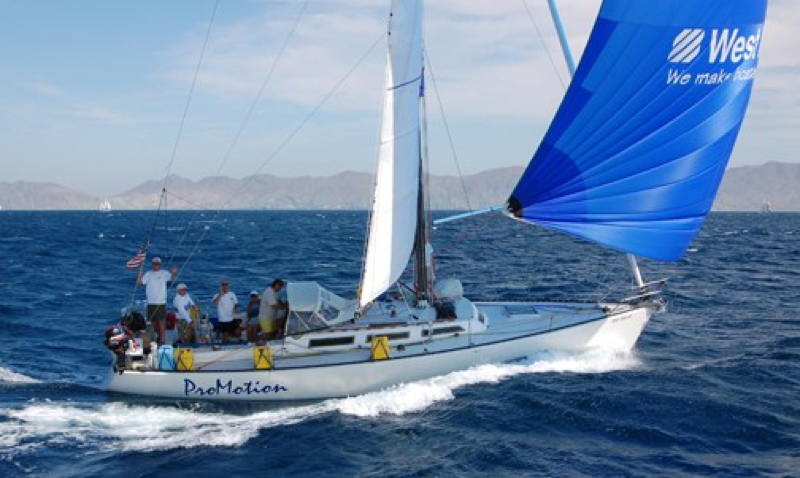
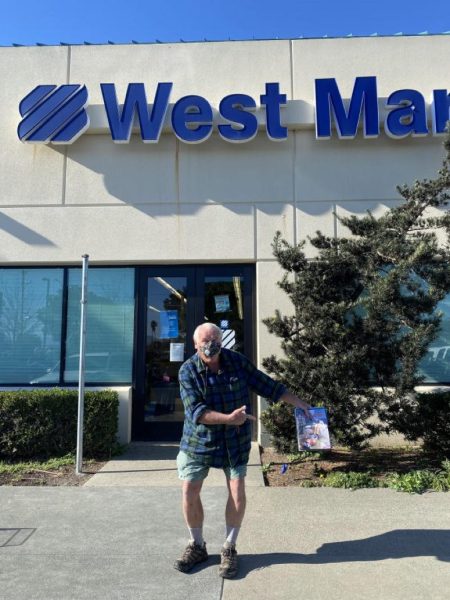
For Bay Area and West Coast sailors who know this local company, founded in 1968 in a garage in the heart of Silicon Valley (Palo Alto) by sailor Randy Repass, it’s a disappointing fall from its early days when it was a central player in the booming California sailing market. Randy was selling rope out of his garage until he opened his first retail store in the busy sailing area of Palo Alto in 1975, under the name West Coast Ropes. That was two years before an ad (with $125 CQRs) for the store appeared in the first issue of Latitude 38.
The West Marine company history page shares: “I decided from the beginning that I wanted to take care of people,” says Mr. Repass. “The high-tech industry I had been working in didn’t provide me with an effective way to do that. But the boating industry gave me the opportunity to really enjoy my work and interact with customers who shared my interests. I was having a blast and building a business at the same time.”
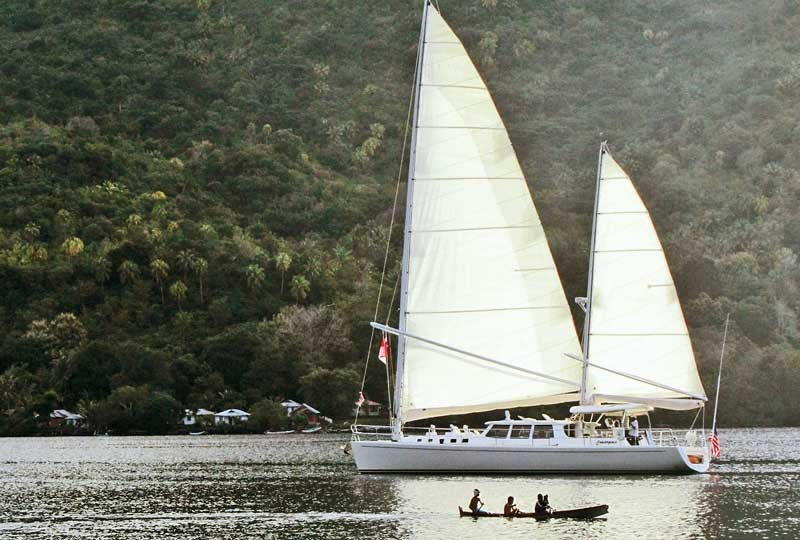
Times have changed. There are many factors contributing to West Marine’s current headwinds. They face the same challenges that all “big box” retailers face from Amazon and other online retailers. West Marine started when sailboat builders in Santa Cruz, Costa Mesa and across the US were building the vessels as fast as they could. Sailboat building barely exists in the US today. West Marine’s administrative offices, the staff on the shop floor and most of the patrons were predominantly passionate sailors who were deeply involved in the sailing community. Thousands of people in the marine industry got their start at a West Marine store.
The company went public in 1993 until it was taken private again in 2017 by private equity company Monomoy Capital Partners. In 2021 it was bought by L Catterton, headquartered in Greenwich, CT, which calls itself “The World’s Leading Consumer Growth Investor.” In 2022 they moved the headquarters from Watsonville, CA, to Florida. Interestingly, L Catterton is backed by Louis Vuitton, which, as all sailors know, is a major investor (sponsor) in the sailboat race called the America’s Cup. L Catterton, LVMH and Groupe Arnault (the holding company of LVMH CEO, Bernard Arnault) says they are the largest diversified, consumer-dedicated private equity firm in the world.
L Catterton’s purchase appears to have followed the normal private-equity playbook of loading the company up with debt just as we were all emerging from COVID and the fresh-air-powered boating market was having a bit of a boom. Nothing lasts forever. Since the COVID boom faded and consumers have been buffeted by inflation, tariffs, wars and oil-price shocks, retail sales have slowed. That makes it hard to cover those private-equity-induced debts.
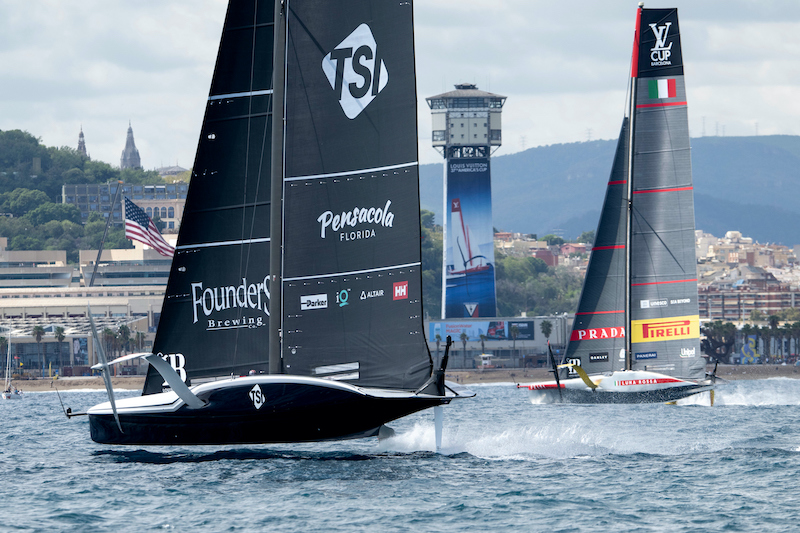
One might think that LVMH’s premier role in the America’s Cup would give L Catterton a chance to utilize the high visibility of the America’s Cup to promote sailing, along with the world’s largest marine retailer and retail marine hardware sales, and connect with the passionate sailing community that supported West Marine from its inception in 1968. That does not appear to be the LVMH vision. The America’s Cup is now an entertainment “property” that has also lost touch with sailing, making it difficult to connect with the average West Marine customer.
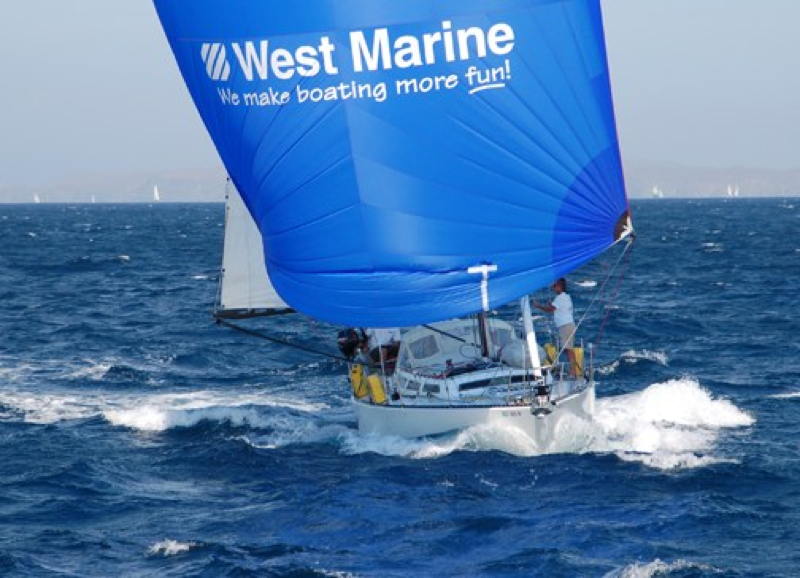
Most sailors we talk with feel that, somewhere along the way, West Marine lost their local, personal connection. They used to sponsor local events and offer life jackets to youth sailing programs. The Pacific Cup used to be called the West Marine Pacific Cup. The changing world has definitely made it harder for companies like West Marine to offer the kind of support they used to, but private equity has increased the distance and diminished the connection between the owners and the customers.
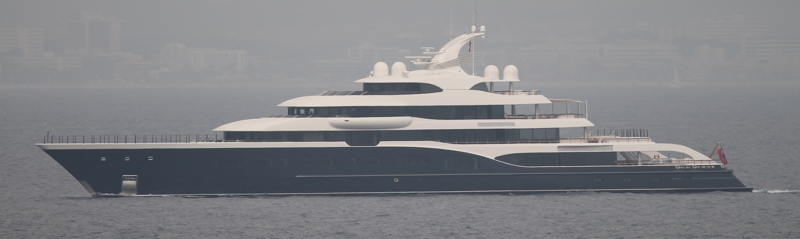
The LVMH CEO currently owns the 333-ft Feadship Symphony, pictured above, and he is rumored to be the billionaire behind the construction of a 470-ft Feadship at an estimated cost of $650 million. It’s supposed to be a secretive project, and though we shouldn’t believe AI, “Claude” believes it’s true. That would be quite a bit more than that another sailor and marine retailer, Jeff Bezos, spent on his 417-ft, $500 million sailing yacht, Koru, which is now rumored to be for sale. As far as we know, Amazon has never sponsored a sailing event and is a primary reason West Marine and many companies can no longer sponsor either. You can’t shop at Amazon and expect local marine retailers to support your youth program.
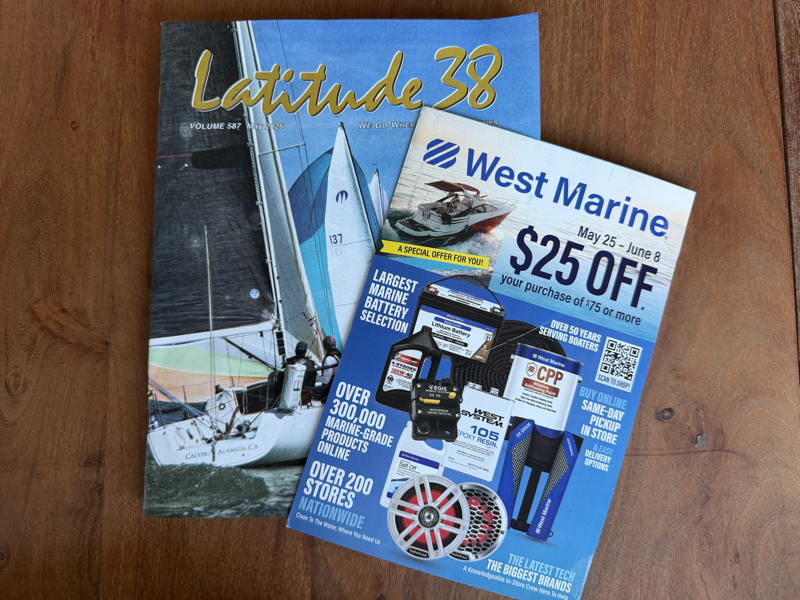
Back on the California waterfront, there continue to be local chandlers, riggers and boatyards to serve local boaters. We give shout-outs to those who support local sailors and Latitude 38. The retailers include Whale Point Marine Supply, Fishery Supply and Sailing Supply/Downwind Marine, and you can find gear, paint, polishes, rope and hardware in many boatyards, engine shops, rigging shops and other marine stores that line the coast. You can find great boatyards and other local suppliers in the current issue.
We know many sailors are lured in by the price and convenience of Amazon, but we also know the ultimate price we’ll all pay when we’re left with a single source for our marine goods. Most yacht brokers today are in a similar bind as the private-equity-owned YachtWorld has become the default multiple-listing service for boats for sale. Ultimately, like Amazon, they grew big because they provide an excellent service, but unsurprisingly, the price of that service has become extreme.
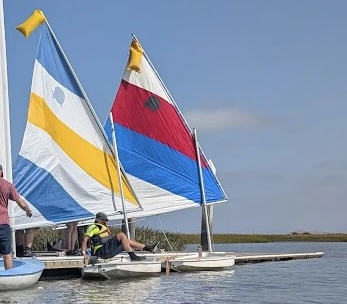
It’s frequently hard to correlate cause and effect, but over the past decades, we’ve watched an incredible boom in the internet, private equity, wealth, efficiency and apps to provide connection, communication and convenience, all with an apparent concurrent reduction in people’s free time to relax and sail. Simple things like roller furling have made sailing so much easier. There’s lots of improved technology, but seemingly less time to hoist the sails. Sailing and West Marine were booming when people were sailing Sunfish and Hobie Cats. The challenges faced by West Marine may be the same as those faced by sailing itself. We may soon be able to have marine products delivered by drone to our slip or 3D-print them at home, but how will we ever have time to use them? Spreadsheets, data sets and metrics all show us how to earn a penny or save a penny but don’t how us how to have free time.
West Marine CEO Sandra Day says the Chapter 11 should help them get stronger and, hopefully, get back to a level of service that will support the boating market. They hope to emerge from bankruptcy in August. All of us sailors think we know what they should do to improve business prospects, though these are challenging times for most brick-and-mortar retailers and it is surely daunting. It will be good for sailing if Randy Repass’s Palo Alto-founded retailer finds its way back to providing the expertise, support, convenience and products that keep sailing fun and accessible.
It’s Memorial Day weekend! Buy some boat polish at any local marine retailer, give the boat a quick buffing, then get the boat out and go sailing!
> it was taken private again in 2017 by private equity company Monomoy Capital Partners
Ah, there it is
Private equity groups, the blood suckers of American Enterprise. I’m not holding my breath for West Marine’s recovery..
It’s sad to see West Marine having to file bankruptcy. When I first discovered sailing and had moved our boat to Pt Richmond I would often shop at WM in Pt Richmond as it was convenient and on the way to the boat. When the Pt Richmond store closed I have shopped less at WM, mostly online and picked up the merchandise at the local WM Store. Their pricing has always seemed to be a little higher than others which has caused me to be more selective and look for the best deal online before making a purchase. After reading this article I will soon head to the local store and hopefully find that unique item I am now searching for.
Whale Point Marine Supply became my go to local source since since West Marine became too expensive.
I remember buying my first pair of sailing gloves at their Palo Alto store when I was sailing Hobie Cats as a teenager. I also remember the huge banks of catalogs they kept to special-order whatever oddball part you needed for your boat. Their staff used to bend over backward to ensure that customers’ problems were addressed before they left the store. Those days ended abruptly when they went public, circa 1994.
Whale Point is awesome ! I wouldn’t buy a toothpick from Amazon- the way they treat their employees and what they have done to retail. I was in WM Sausalito lately and was happy to see that the bikinis have given way to boat tools and gear.
Sad, but true. Well written synopsis. I sort of grew up with Proper Tighe, Svendsen’s and West Marine and would feed them with my nickels and dimes, and shiny $$ bills.
Now, I am old and decrepit and feel like the retail marine industry, slowly fading away.
West Marine drove lots of smaller chandleries out of business or bought them out then turned itself into a shoe and clothing store. That is where the profits were. West Coast sailing is a small market compared to the river, lake, and fishing powerboat markets of the rest of the US. The carrying cost of stocking the thousands of small run bits and pieces that make up the overall boat market is a very large number. Specialty on-line businesses that drop ship are and will be difficult for any retailer to compete with.
I raced my two Schock 35’s throughout Southern CA for 14 years. West Marine was my go to store for equipment I needed for that days racing. It was comforting knowing regardless if I was in Marine Del Rey, Redondo Beach, Long Beach, Dana Point or San Diego, I could find a West Marine store close by to buy what I needed for that days racing.
It seems to me part of our problem is the difficulty of getting young people involved in sailing, especially since soccer has morphed from after school to now include weekends. How do we develop the next generation of sailors?
I learned a great deal from my five decades of sailing, from my first boat opening up a seam at the mast step and sinking, to great charters in exotic waters, to high end Schock 35 one design racing learning from nationally recognized sailors. This type of experience builds solid citizens.
It would be great if we could revitalize sailing and sailboat racing. How do we do that?
Fred Young, PerfectCircleSailing.com.
When too few have too much, everyone on the planet loses.
Laws are our rudder, and we have become rudderless.
When I bought my first boat in 2000 my first trip to West Marine involved a shopping cart for all the parts and pieces I needed. It was expensive and exciting. Over many years, 3 boats, a Ha Ha, sailing in Mexico and the South Pacific, I left a lot of dollars at West Marine up and down the west coast. They even shipped me a very specific and important part when we were stuck in Bodega Bay on the way down the coast. It was disappointing when they began switching their focus from sailing/boating supplies to clothing. The last time I walked into a West Marine fully half of the store was clothing. There is just something special about wandering through West Marine or the local chandlery that no billionaire owned private equity corp. does not understand. For them it is only about how much money they can extract before they close it down.
Land’s End used to mainly sell sailboat hardware. The only clothing they sold then was foul weather gear. Now …
You used to be able to buy a canoe from L. L. Bean.
I guess that clothing must be very profitable or move fast.
Well said as usual. Thanks for voicing the truth about technology and its effect on us all.
I was just about to order from West Marine, and during a search for a store close to me, I turned up the bankruptsy story. West Marine has always been my go to store when I really needed something and needed it fast…. guess I will not place that order……
Have been sailing for over 60 years. When I started my dad said if you have to ask how much,
you cannot afford it. I was part of the late 1960’s and 1970’s change in boating. People started buying
boats on the book of the month club. Business started doing the same. Just look the national
credit card dept. Sorry to say where we are today as a debtor nation has been in the making for
over 50 years. I still only buy a boat I can pay cash for, so I only have a 26-footer. But I truly enjoy it.
Young people are having issues just paying for day-to-day expenses. What I do now is take as many
young people out sailing as I can. Of course at my age that is not hard to do, most people are younger.
such a shame ,i started with west when they purchased cal marine a northwest chain in seattle 2 locations and portland where i was the store manager. west then had 13 west coast locations. i worked for 26 1/2 years in what i consider the marine industrys most exciting times. sailed the pacific cup with tony gasparich the sail hardware buyer at the time and the baja haha with pepe parsons a phone sales tech at west. all on the santa cruz 40 promotion. i was a boat show manager, new store build project leader for 61 stores. left in 2006 when the fun had seemed to end. they are closing the only two stores they have in oregon very soon. shame they couldn’t have regrouped and built a smaller store not to leave portland in a lurch.