

Santa Barbara Moves Ahead With Paid Moorings at Seasonal Anchorage
Santa Barbara boaters were told in June to clear out of the city’s Seasonal Anchorage to make way for a new field of paid moorings.
The change had been under consideration for two to three years following concerns from the city’s Public Works Department about anchoring near underwater infrastructure. But the June 1 notice made the city’s plans concrete: Boats had to leave by June 15, and roughly 20 city-owned moorings were expected to take their place.
But the conversion hit a snag. Environmental surveys found eelgrass in the proposed mooring field, delaying installation while the city redesigns the layout. Boats are currently allowed to drop the hook without a fee, with the moorings now expected to be installed this fall. Once installed, the moorings will cost $30 a night, $200 a week or $500 a month.
Though Santa Barbara will still maintain a large anchorage, part of which is free year round, another piece of the California coast is set to become a little more regulated and considerably more expensive.
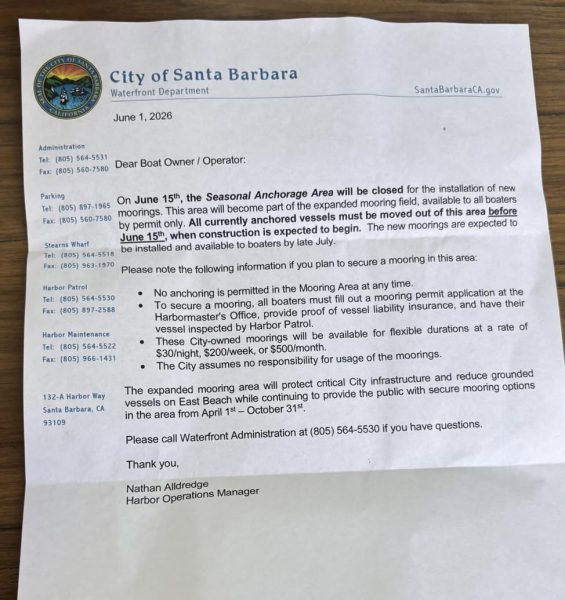
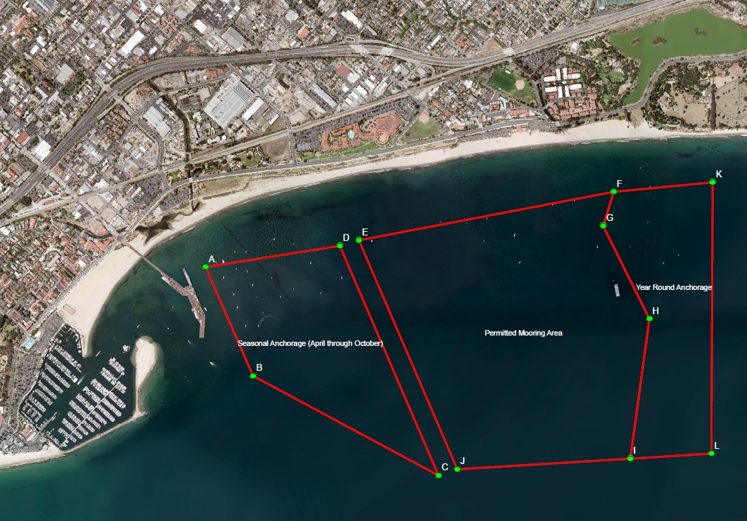
The waters east of Stearns Wharf include several areas where boats can anchor or moor. Closest to the wharf is the Seasonal Anchorage, where boats have traditionally been allowed to anchor for free from April through October. Farther east is an existing permitted mooring field, followed by the year-round anchorage commonly known as Fools Anchorage, where boats can still drop the hook for free. The city’s plan would effectively extend the mooring field into the Seasonal Anchorage, replacing free anchoring there with paid city-owned spaces.
The city said it does not track use of the Seasonal Anchorage, but Santa Barbara Waterfront director and harbormaster Mike Wiltshire estimated that roughly a dozen or more boats are anchored there on average. “It is a mix of transient and local/liveaboard, but the majority is likely liveaboard and/or unattended vessels,” Wiltshire told Latitude 38.
As of January 1, Santa Barbara began requiring liability insurance for vessels in city waters. Wiltshire said the requirement has already helped the city recover cleanup costs after two or three vessels came ashore earlier this year. “Those vessels were insured, and we successfully received insurance claims from them,” he said. (A staunch opponent of the city’s plan to install moorings told Latitude that requiring insurance was “probably a good idea.”)
Wiltshire said most vessels that break free and wash ashore on East Beach originate in the Year-Round Anchorage during winter storms; vessels that have gone aground are usually anchored rather than moored, he said.
In 2023, Latitude reported that Public Works raised concerns about the potential for anchors to damage the desalination intake line and wastewater outfall pipe beneath the area. The city had installed a large buoy marking the infrastructure and directing boaters not to anchor nearby, and was still looking for ways to protect the infrastructure while preserving free anchoring.
Public Works has since asked Waterfront to prohibit anchoring in the Seasonal Anchorage altogether, citing past damage to the underwater infrastructure that it attributed to anchors — though no specific anchor strike has been confirmed.
“They had already spent a pretty significant amount of money with damage to their undersea infrastructure that they assumed or thought was from anchors dragging over it,” Wiltshire told Latitude. “I don’t know if that’s actually the case.” Public Works later told Waterfront that the damage was “consistent with anchor strikes,” he said.
Public Works nevertheless considers the risk significant. Wiltshire said the department is concerned about not only repair costs and downtime, but the potential for wastewater leaks or spills.
Wiltshire said he sees the new moorings as a compromise. “It would be unfortunate to have no use of the space. In my opinion, having mooring balls is better than no access at all,” he said.
The installation is expected to cost $250,000 to $300,000, with annual inspections estimated at another $15,000 to $20,000.
“I have my doubts that it will be profitable,” Wiltshire said. “A success to me would be if there’s enough demand and interest in it [that] it can essentially sustain itself in the long run, where we generate enough revenue to pay for maintenance and upkeep of the mooring balls.”
Wiltshire said the conversion has gone through a two- to three-year permitting and public process, including review by the city’s Harbor Commission and approvals from the California Coastal Commission and US Army Corps of Engineers.
The plan has drawn opposition from some boaters, who have questioned the need to eliminate free anchoring in the Seasonal Anchorage, the cost of the project and the city’s justification for the change. At least one opponent has also challenged the city’s permitting and environmental review, arguing that converting a longstanding public anchorage into a paid mooring field represents a more significant change in use than city filings acknowledge, and questioning whether the project received sufficient review under the California Environmental Quality Act.
The city maintains that it has received the necessary approvals. Latitude has not independently evaluated the project’s compliance with CEQA and did not contact the California Coastal Commission for this story.
From Latitude’s Northern California perspective, it’s worth noting that Santa Barbara will still have something that is increasingly rare on the California coast: a large and partially free year-round anchorage. Replacing a historic Seasonal Anchorage with moorings costing as much as $500 a month, however, is no small change.
Whatever the merits of the city’s compromise, the Seasonal Anchorage is set to become a fundamentally different place.
I think this is a good idea. When I was there a few years ago, I had a difficult time anchoring because the seasonal anchorage was overcrowded with liveaboards and derelict boats. Making a paid mooring field makes the destination more accessible to visitors and cruisers. Liveaboards and full-time residents should keep their boats in the year-round anchorage (which remains free) and visitors should have access to convenient moorings that can be paid for.
Please. The place is not even 1/4 full.
That’s too bad. Money marches on. My small experience with passing through Southern California revealed that cost-conscious cruisers heading south to Mexico might try to skip as much of it as possible. They don’t seem to want them there, anyway.
My data shows the two nights I spent in Santa Barbara in Oct. 2023 were in where the new mooring field will be. I have a list of shore chores I was able to take care of, including Trader Joe’s, gasoline, propane, and a specialty fastener store purchase for an outboard repair, among others. While I anchored for free and enjoyed it, I did spend money in the community. I was also insured.
My dinghy was an inflatable kayak. They did not let kayaks at the dinghy dock, and warned of confiscation, regardless of its purpose. I did speak with the Harbor Patrol about this, and they were responsive and cordial. They suggested I could use the ladder at Stearns wharf, which I did. Talk about dangerous and thrilling! I didn’t mind, but was surprised that with all the regulations, they would then suggest this was acceptable.
Leaving my PFD in the kayak, climbing 10-20(?) feet up the ladder with my tie line and my propane tank, and later my groceries. Popping over the railing, coming and going, surprising the tourists while doing so. It was notable enough that I took pictures. I wish I could add one. A great adventure, but not for everyone!
Send the photos our way.