

- Cruising
- Heading South
- Environmental News
- Commentary
- DIY
- Wings & Foils
- Working Waterfront
- General Sailing
We’re Suffering Serious Sailing Sustainable Energy FOMO
Have you ever watched a string drop on a TP52? Seen a foiling Moth? Have you thought about cruising “off the grid” for months at a time? For many, sailing is simply a relaxing Saturday afternoon sail, but the designers, dreamers, tinkerers and innovators behind all the creations that move boats under sail are always dreaming and scheming of creative new ways to harness the wind. This creative energy has often been applied to sustainable-energy solutions pioneered at sea, but today we’re feeling our national leadership in this area is shifting overseas.
One of the greatest things about being part of the sailing community is the creative genius behind it. It could be François Gabart solo-sailing a 100-ft trimaran around the world in 42 days, or Joshua Wheeler creating a clever refinement aboard his Flicka 20. The thoughtful, creative genius behind each of these actions is part of what makes sailors a unique breed. If you’ve toured a boat show, you’ve probably had many moments when you thought, “Isn’t that clever?” Sailboats are fun and relaxing, yet also platforms for a stunning array of innovation.
For years, the innovative DNA of this country has been applied to make sailing better and life better. A national foundation for this is a belief in free markets, where our national leaders encourage innovative thinking and development with scientific and government support for new technologies. Government support has subsidized everything from nuclear power to the oil industry, solar power, wind power, geothermal power and a diverse array of futuristic energy possibilities. Sadly, we’re seeing that innovative leadership shift overseas as our political leaders have shifted toward a central-government-planned energy-market system.
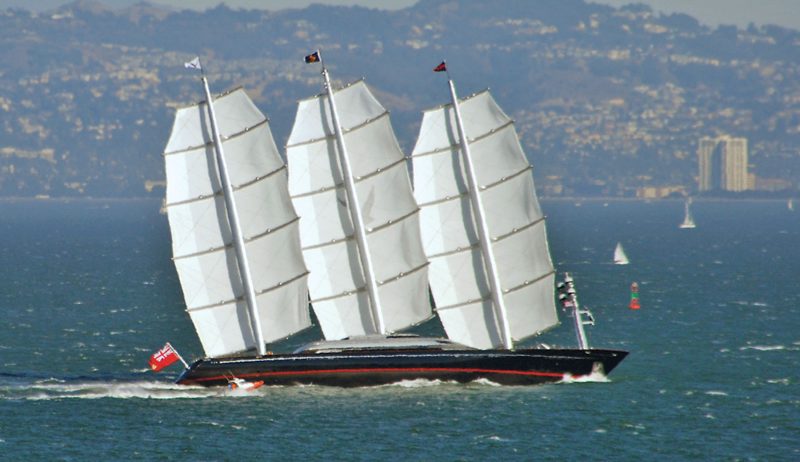
This does not mean there aren’t numerous creative individuals and companies still pioneering new technologies in this country, but they are facing competitors from other countries with a much broader and open-minded view of the technologies that will create a diverse energy infrastructure for a sustainable future. Our former national support of new energy technologies brought us Tesla and also allowed companies like former boatbuilder Tillotson Pearson to become a wind-power pioneer along with companies like Knight & Carver in Southern California. Other pioneers in alternative uses for wind power include local venture capitalist, sailor and legend Tom Perkins, who built the Maltese Falcon, and Richard Jenkins, who has built Saildrone in Alameda.
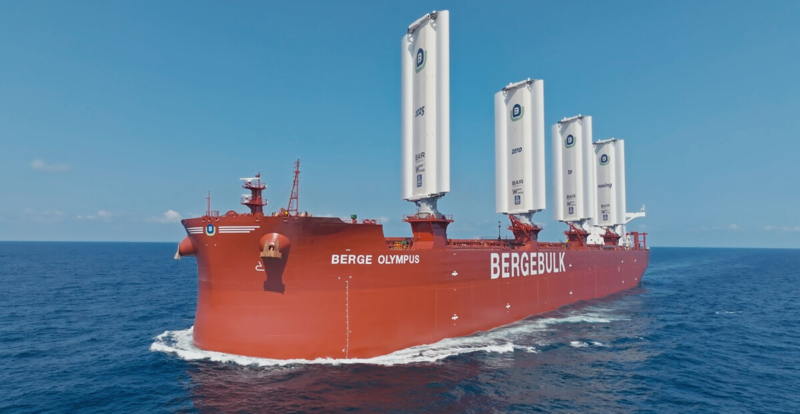
If you go down to the docks during 5O5, Moth, or International 14 regattas, you’ll see the creative work of the “technicians” who are tweaking and sailing these development classes. It’s always been fun to be in a country and community of forward-thinking pioneers who are creating the future. We regularly read the marine trade publication International Boating Industry, which leads its digital newsletter with this line: “Your weekly glimpse into the future of the boat business.” Between IBI and the press releases we get from European companies, we feel a genuine enthusiasm for the amazing new wind, solar, fuel cell and hydropowered vessels they are creating. These innovative companies are charging ahead with their national governments’ and national culture of creative progress. In the States, we are currently led by a regressive philosophy actively trying to slow or eliminate progress on innovative new ideas for the future.
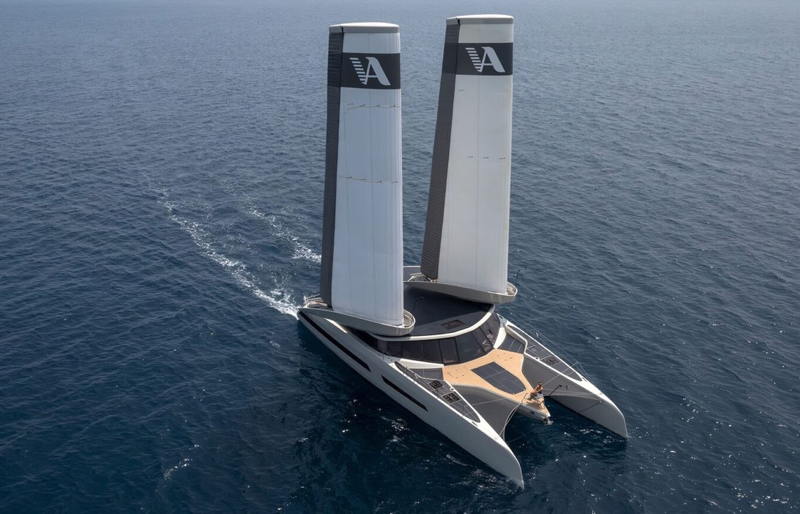
Race for Water Foundation’s Ocean & Climate Odyssey launched the MODX 70 above, saying they aim to deepen the understanding of the links between the ocean, climate and biodiversity, while mobilizing maritime-transport stakeholders around decarbonization. The MODX 70 is intended to be the world’s first zero-emission, zero-noise leisure catamaran. They foster “Scientific and institutional collaborations to deepen the study of climate change impacts on marine ecosystems and to better document the ocean’s role in climate regulation.” So many press releases from Europe include statements like this, though oddly, a statement like this in the States now feels somewhat subversive.
It feels like hanging out with “friends” and saying, “Hey, you guys, I’ve got a really cool new idea.” And the friends say, “That’s stupid.” Who wants friends like that?
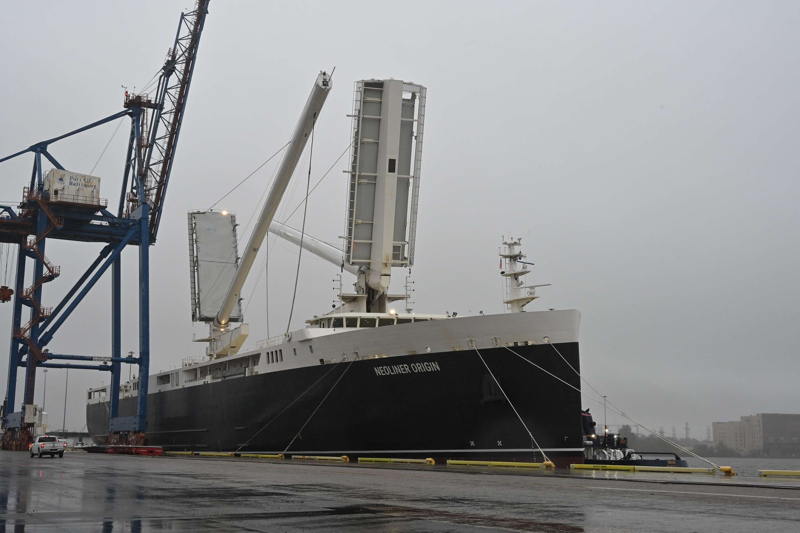
Like the United States, all these innovative countries burn lots of oil and coal, but they don’t see these new technologies as an either/or discussion. They see the future as a “yes and” proposition, so creating cleaner, more efficient and sustainable energy solutions includes all possible technologies. Southern California sailor David Smythe, who electrified his very cool Olson 40 Euphoria, has been working with a company, Terraform Industries, to capture and burn carbon from the atmosphere. That could be amazing.
We read a recent article in the New York Times saying, “Renewables accounted for 93 percent of global power additions — and as of July 2025, 74 percent of wind and solar projects worldwide were being built by China.” In addition, it’s believed that in just the first six months of 2025, China installed more solar capacity than the United States has managed in its entire history through the end of last year, and twice as much solar power as the rest of the world combined. Seeing the 162 square miles of solar they’ve built in Tibet is astounding and another source of FOMO.
Most sailors are highly attuned to watching amp hours and trying to figure out how to generate power cleanly and silently. It makes cruising, sailing and life better. Nothing ruins an anchorage more than a generator that runs all night on a harbor neighbor’s boat. If sailors need to use their diesel auxiliary, that’s fine, but the preference is always to use the engine less and work with nature more.
We get an amazing number of press releases, and it’s always incredible to see how sailors are dreaming, developing and building a better future. These days most of them come from Europe or Asia or the Middle East. Over time, these sailors have included pioneers like naval architects Gary Mull, Tom Wylie, Morelli & Melvin, Bill Lee, Hobie Alter and Rudy Choy. There are also currently developing initiatives like the Port of Los Angeles’ AltaSea project. Their mission is stated as, “AltaSea at the Port of Los Angeles is dedicated to accelerating scientific collaboration, advancing an emerging blue economy through business innovation and job creation, and inspiring the next generation, all for a more sustainable, just and equitable world.” How cool is that? There are many San Francisco Bay companies on the same track, often meeting with Martha Blanchfield’s SF Blue Tech group.
The US national sailing community is still flush with creative pioneers. It’s one of the reasons we like sailors and sailing. It’s much more fun to work in a culture that thrives on support for emerging technologies. Sadly, the national leadership of this country is actively undermining the pioneering spirit that built so many of the world’s new technologies. It won’t stop sailors, dreamers, developers or companies from building the next new thing. It just makes it harder.
The press stories we receive from Europe do give us FOMO for the forward-looking cultures of Europe. They have plenty of their own national political and economic challenges, but putting forward the idea of a fossil-fuel-free ship (what idiots, right!?) doesn’t feel like heresy. They’re wrestling with all their challenges, but without leadership that’s actively undermining potential solutions. The venture-capital culture of Silicon Valley promotes a bottom-up search for the future rather than top-down directives. We think this is the spirit of sailing personified by people like Barry Spanier, who built his scow-bowed, junk-rigged Antrim 40 that he and Samantha have now sailed from Berkeley to Australia.
We love hearing about all the very cool pioneering projects with their roots connected to the sustainable ethos of sailing. We’ve mentioned a few. We’d love to hear about more in the comments below. Fair winds.
Port Townsend’s Northwest Maritime Center’s Race to Alaska and WA360 have driven auxiliary pedal-drive innovation over the past ten years.
Glad to add that to the many creative solutions you’ve already offered our readers. Thanks.
Tom Wylie’s concept of the ” Sailing Workboat” has huge potential. He has designed boats that can sail as fast as a motorized workboat and be handled by as few as two people. Why would you choose to take a fuel guzzling, exhaust beltching workboat out to Cordell bank to study whales, when you could sail out there silently and cleanly ? His wonderful boat Dereck Bayliss takes kids out to teach scientific research, pick up plastic- etc- all under sail. Learn more at his nonprofit’s website, opexplorers.org