

“Mayday, Mayday” — That Sinking Feeling on the Oakland Estuary
It’s hard to keep up with the count, but during these first few winter storms in November, it appears another four to six boats have washed up onto the shores of Oakland and Alameda. Citizens are calling out “Mayday” to the various agencies that share some responsibility for preventing the problem. So far, the calls for help have gone unanswered. It’s a reminder that when you need help, don’t call a bureaucracy.
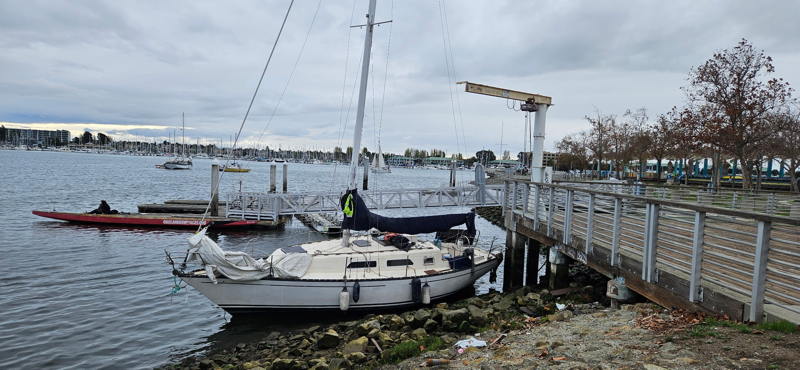
Mariners should be thankful that in an actual life-threatening emergency, the US Coast Guard has a clear responsibility to respond immediately to prevent the loss of life. They’re well trained, well equipped, and very capable. When it comes to preventing boats from sinking on the Estuary, there is no clear line of responsibility. Illegally anchored boats seem to be able to set their hook in a patch of water that falls precisely between the jurisdictions of all agencies. Once they blow ashore, the City of Oakland, Cal EPA, the Army Corps and others now spend 10 times the amount to clean up a problem that might have been much easier and cheaper if the boats had still been floating.
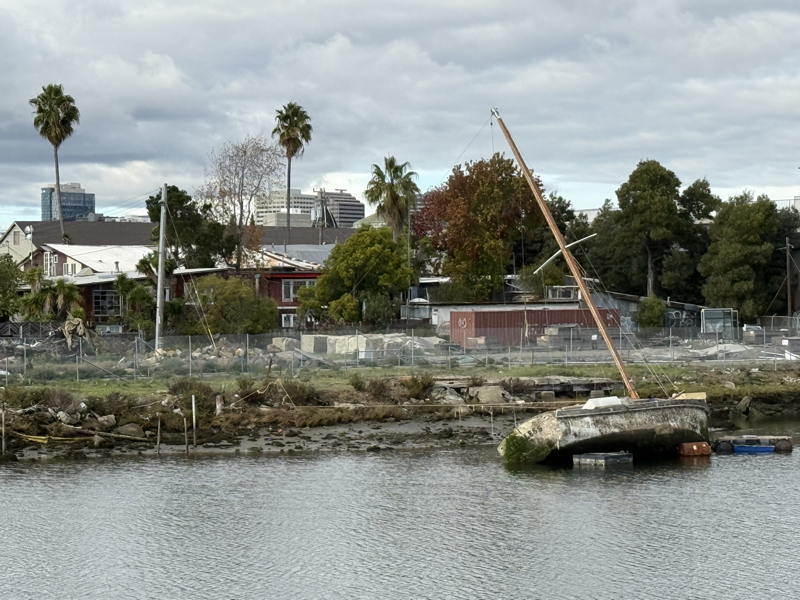
To be fair, this is not just an Estuary problem. It’s happening across the country. Like mattresses on the side of the highway, boats are being abandoned everywhere. As we reach out to various agencies to explore what is being done, we discover everyone is doing something but none appear to see this matter as urgent.
As the photos show, Mother Nature isn’t going to wait for the glacial pace of bureaucracy to solve the problem before she does. The winter storm season shouldn’t surprise anyone involved, and the predictable results are well underway. We are great believers in our country’s democracy, but when you watch government in action (or inaction), it’s easy to understand why people might like authoritarians. An apocryphal assertion is that least “Mussolini made the trains run on time.”
BoatUS has partnered with the National Oceanic and Atmospheric Administration (NOAA) Marine Debris Program to create a national database that will allow visitors to report abandoned and derelict vessels on their coastlines, to create a national view of the scale of the issue. BoatUS will also be offering grants for boat removal. In addition, the California Department of Boating and Waterways has the SAVE program, which also offers funds to support the cleanup and disposal of abandoned and derelict boats.
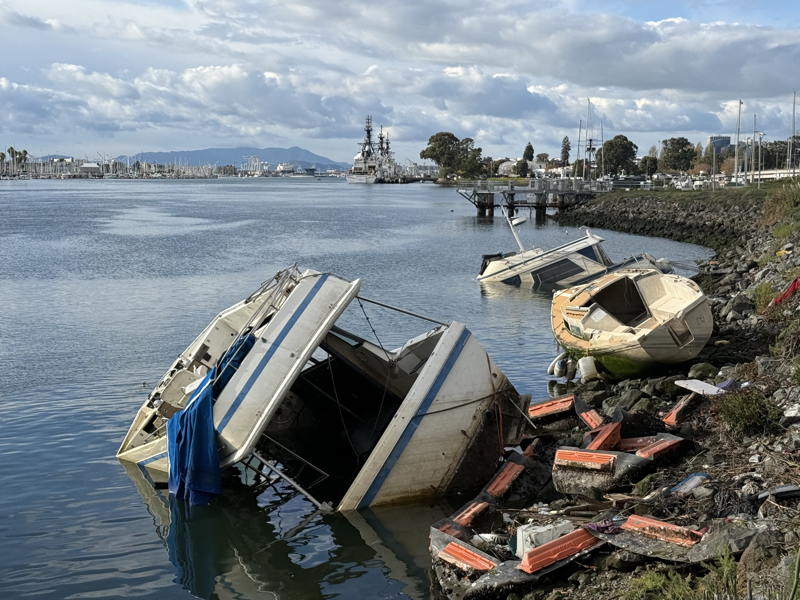
It’s frustrating, because most of the agencies involved don’t have boats and trained marine personnel to go out to manage the illegal anchor-outs. The Coast Guard has both but doesn’t have the time, or they have more important things to do than help clean up their own backyard. Once the boats are not a threat to navigation, not a threat to life, and not pollution, the Coast Guard is off the hook. Then other agencies take over.
We don’t really blame the anchor-outs. They need a home, and Oakland appears willing to tolerate their presence and willing to clean up after them. There needs to be a better alternative for those living aboard, and better ways to dispose of end-of-life boats. Additionally, the people who are “selling” these boats need alternative ways to dispose of them. We’d actually like to see capable boats and sailors be able to cruise and anchor in the Bay and have managed mooring fields like San Diego and Newport Beach. It’s not easy, but there are plenty of municipalities that know how to do it. The municipalities surrounding Richardson Bay have done an admirable job cleaning up the anchorage. It’s possible.
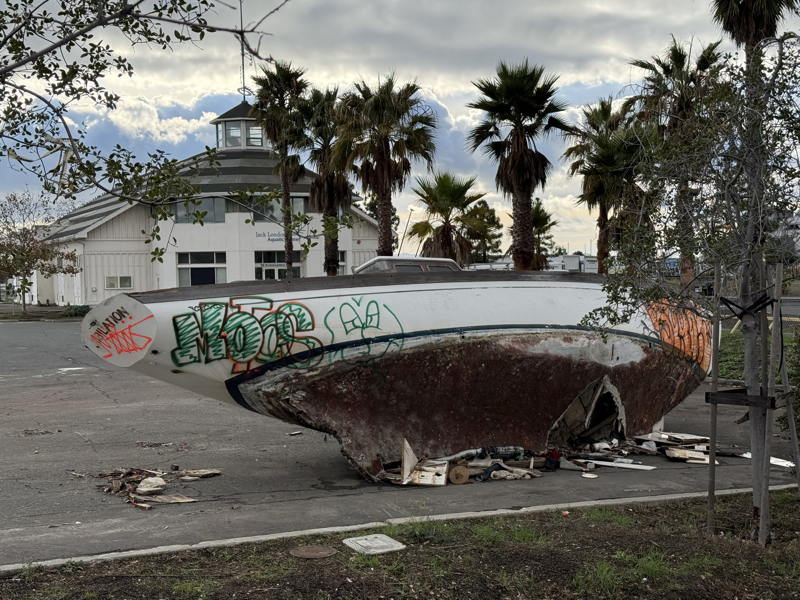
One of the great lessons of the 9/11 tragedy in New York was the communications challenge among all the first responders and other agencies. We have dedicated, capable people in all the agencies, but like New York on 9/11, they’re not practiced in working together. This suggests there is an opportunity to collaborate on a solution.
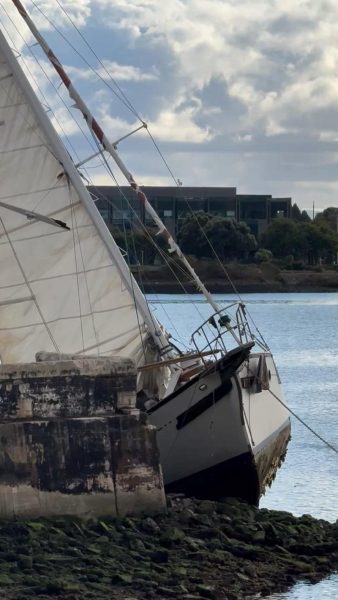
Our understanding is that the boat above was dragging around the Estuary with nobody aboard for a couple of days. It finally fetched up on the shoreline, and someone came by one night and managed to get the mainsail partly raised. So far not much damage, though Mike Gorman noted in the next tidal swing the boat could lie down in the other direction and fill with water during the next flood. If only some agency had people, budgets and boats, the possible sinking of this boat could be prevented.
While Oakland is short on the budget, boats and manpower, the USCG website for Coast Guard Island describes the assets in the Coast Guard’s control. Coast Guard Sector San Francisco includes nearly 600 active, reserve, and civilian Coast Guard men and women operating three cutters, seven small-boat stations, an Aids to Navigation team, a Vessel Traffic Service, and a Marine Safety Detachment in addition to more than 1,000 Coast Guard Auxiliarists. Its area of responsibility extends from the Oregon border to the San Luis Obispo County line and includes much of Nevada, Utah, and parts of Wyoming, as well as over 2,500 miles of shoreline within the San Francisco Bay and its tributaries.
That’s a huge area of responsibility, though the waterfront outside the front door remains a black eye amidst the many good things the service does for mariners and the country. Cleaning up the Estuary is the responsibility of Oakland, but the support and active engagement of the Coast Guard would be a critical component of managing this federal waterway.
We recently asked the current USCG base commander, Capt. Jordan M. Baldueza, to let us know what they’re doing about the problem. He responded, “The Coast Guard remains dedicated to working with our partners for a clean, safe, and thriving Oakland Estuary. In 2025, the Coast Guard has conducted 60 harbor patrols and responded to 30 reports of pollution within the Oakland Estuary, including leveraging the Oil Spill Liability Trust Fund for over $30,000 to mitigate and safely clean up the discharge of 340 gallons of oil and hazardous materials. Sixteen (16) Notice of Federal Interests and six (6) letters of warning were issued to vessels posing a pollution threat to the Oakland Estuary. The Coast Guard strongly encourages mariners who notice a discharge of oil or sheen into any navigable waterway to make a report to the National Response Center 24/7 at (800) 424-8802. To report a discharge of sewage or solid waste, please make a report to the California Environmental Protection Agency here. While there are limitations on Coast Guard authority to salvage and remove abandoned and derelict vessels from the waterway, we look forward to supporting the City of Oakland, Oakland PD, Alameda PD and other stakeholders to support potential cleanup operations leveraging the state of California’s Surrendered and Abandoned Vessel (SAVE) and the National Oceanic and Atmospheric Administration’s (NOAA) Marine Debris removal grant programs, acting within the confines of our authority and jurisdiction under federal law. For further information regarding this project, please contact the lead agency, the City of Oakland.”
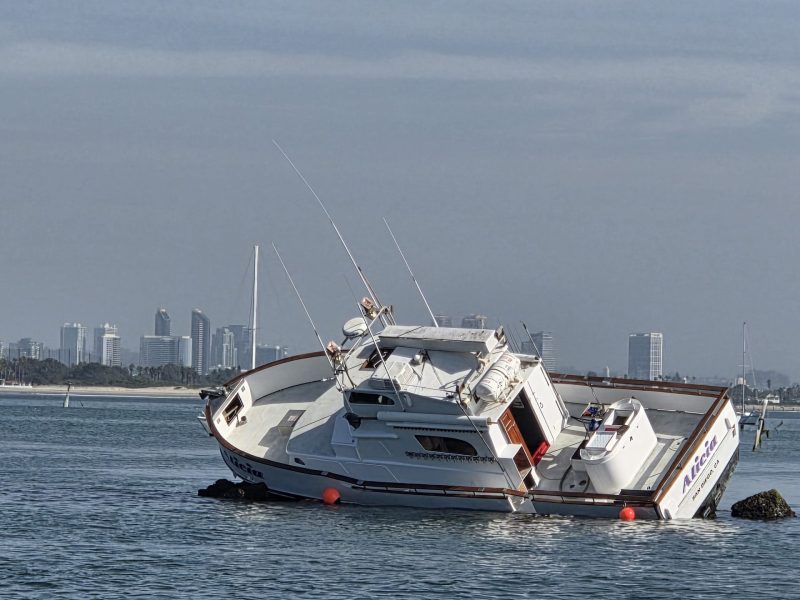
The current 10-day forecast looks good, so perhaps the sinkings will slow down. Regardless, it’s unlikely that’s enough time to prevent groundings in the next storm.
Question about the boat you mention that ran a ground near Brooklyn Basin. You state the
the boat had been dragging around the Estuary with nobody aboard for a couple of days,
Who saw this boat moving around the estuary with nobody aboard? Did they call the
the USCG to report a boat adrift in the Estuary and did they give a description of the boat and its
location? If they did not call to let the USCG know a boat was adrift, the issue is on them and not the USCG, I think the USCG would have a least checked to see if the captain was ok. The real issue is many people do not want to make that call, but are ready to complain after the fact.
You’re right. We all try to follow, ‘See something, say something,’ thought it sounds like you’re saying this boat went aground because concerned citizens and volunteers aren’t doing enough. And you’re saying the agencies with staff who are paid to handle these problems would do something if only all these volunteers would let them know. We know the Coast Guard, the Port of Oakland, the Oakland police have been hearing very frequently for years about almost all these incidences. Generally, there has been no response.
It’s possible that no one called this in, however, the boat should never have dragged anchor in the first place since it was illegally anchored. Agencies should be patrolling the estuary to enforce the laws on the books so that none of these boats have a chance to drag up onto the rocks.
The story on each boat and boat owner is unique. The overall issue is the same, these agencies have been hearing regularly from citizens about the problems on the estuary and, so far, they have been unresponsive.
If you are also concerned about all the sinkings and derelict boats polluting and damaging the estuary you can join the chorus of volunteers expressing your concerns. You can call the Oakland Police here: 510 777 3333, the Coast Guard by calling one of the numbers here: https://www.dcms.uscg.mil/Our-Organization/Director-of-Operational-Logistics-DOL/Bases/Base-Alameda/Alameda_Phone_Directory/ (for some reason they include a number for Subway Sandwiches 858-336-8851 on that page), Captain Baldueza also suggested people call about oil spills here: 800-424-8802, call the Oakland Mayor’s office (510) 238-3141. Call you’re elected representatives.
Everyone who wants to see a clean, save and thriving estuary would love your help in delivering the message.
“…it sounds like you’re saying this boat went aground because concerned citizens and volunteers aren’t doing enough.” John, JJ’s comment seemed to refer specifically to the boat you referred to in the photo, and that by being observed pilotless for several days – but not being called in to any of the appropriate agencies – that approach helped to ensure the resulting wreck. While USCG appears to have the staffing and funds to solve a known problem… no agency can monitor all 1600 square miles of SF Bay. Solving this issue will require a combination of better communication between agencies, better options than allowing an anchor-out free-for-all, stronger political will to follow the law *and* create better societal safety nets, and a community of citizens who as JJ points out) seems to often prefer the joy of complaining… to the inconvenience of helping with prevention.
We reported this boat to the USCG, along with others, but the USCG has been consistently unresponsive. I believe they left it alone because it was not in the main channel.
Here is the dark underbelly of fiberglass hulls that last forever. The number of boats in the Oakland Estuary pales in comparison to those getting moldy and growing underwater vegetable gardens in marinas everywhere (it would be interesting to get an estimate of the number of these boats in Bay Area marinas alone). Like many problems, it comes down to money. Until boatowners and marinas get an affordable disposal program (not one controlled by a government bureaucracy), the numbers will continue to grow.
I was out in the Bay yesterday, and returned to my marina when the Coast Guard called about a vessel in distress on the Estuary on channel 16. This was around 3 pm. Description of the vessel was “white hull, 32 foot, north to northwest of Coast Guard Island.” That got me a bit rattled since my own vessel is 32 foot white hulled. I motored around Coast Guard Island but couldn’t see anything, so I went back to my marina and tied up my sailing vessel.
Last week I called the USCG to report an oil spill coming out of one of the recently sunken vessels depicted above. They responded very quickly.
The Estuary is a reflection of Oakland itself. People dump trash everywhere, they vandalize property with graffiti, homeless encampments everywhere. The laws are not enforced here. So why expect a clean Estuary, if people can do whatever they want to do. I’m with the Coast Guard Auxiliary and I try to help out to the best of my ability but there is a limit to what we can do.
Could not agree more with the reflection of Oakland in the Estuary. Until meaningful action is taken and city officials get aligned on an enforce able plan, the situation will not improve. This needs to be done in coordination with the City of Alameda and the Coast Guard. Recreational boaters that call the docks of Oakland and Alameda home for their vessels need to be more vocal on where and how their property taxes are applied to solving the issues. For example, take the millions that have been spent (and billion plus forecast to spend) in building the bicycle bridge and apply them to shoreside improvements and clean up, fund enforcement operations and evaluate whether the “current” Memo of Understanding on law enforcement in the Estuary is still the best way to monitor and manage one of the busiest commercial ports with 30+% of the recreational boating facilities in the Bay.
The problem emanates from the production of fiberglass boat hulls decades ago which lasted far longer than the boat’s other useful or desirable components. We may not ever dispose of enough derelict boats to solve the short-term crisis. One way to mitigate the longer-term problem, however, might be for the government to charge a boat disposal fee with every new boat sold, and to use those fees to dispose of older boats. California already does this with things like car tires and batteries. A “pay it forward” plan to at least stem the tide a bit.