

Groundhog Day on the Estuary Part II
Not surprisingly, Groundhog Day Part II is very similar to Part I and the dozens of other stories of agency and officialdom inaction when it comes to preventing lawlessness and cleaning up and reestablishing the Oakland Estuary as a clean, safe community resource. After we wrote about the ongoing problems on Wednesday, we reached out to Mary Spicer of I Heart Oakland-Alameda Estuary, since Brock de Lappe said she and the Estuary community had put together a map to quantify the number of sunken boats.
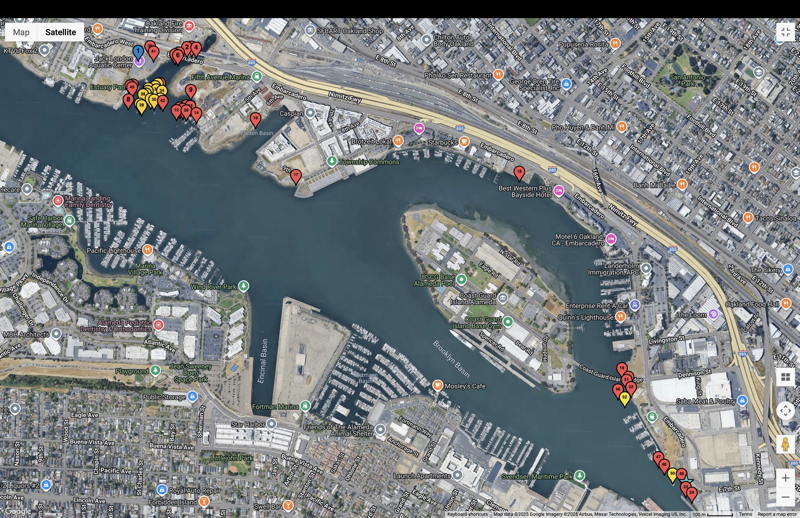
Mary explained the map and situation this way: “This map was created by community members who regularly use the Oakland Estuary. This is not an official map. The red markers indicate sunk boats. A few of these areas are debris piles of multiple boats that have gone down in storms and are decaying over time. To the best of our knowledge, these boats still remain on the Estuary floor — although marker 18 may have been removed.
“The recently sunk Blue Star is a boat that has an oil sheen and has been reported multiple times by various community members. We’ve been told that if we see an oil slick when out on the water to immediately report the oil slick to [the] Coast Guard.
“The most painful and dangerous consequence of these sunken boats is the threat they pose to our shoreline, our community, and our environment. It’s devastating to report a drifting or abandoned vessel, only to watch it slowly sink with the tides — ignored until it becomes an expensive, toxic wreck that breaks apart in the Estuary.
“The Oakland Estuary is facing a growing environmental and public safety crisis. Community members have observed numerous abandoned and illegally anchored vessels sinking, leaking fuel, and discharging pet and human waste directly into the Bay. Some people have repeatedly acquired and sunk multiple boats, leaving wrecks that are extremely costly to remove and destructive to the environment. As these vessels deteriorate, oil, gasoline, sewage, and fiberglass leach into the water, contaminating the Bay and damaging the shoreline. The ongoing pollution threatens water quality, marine life, and the health of the Estuary ecosystem.”
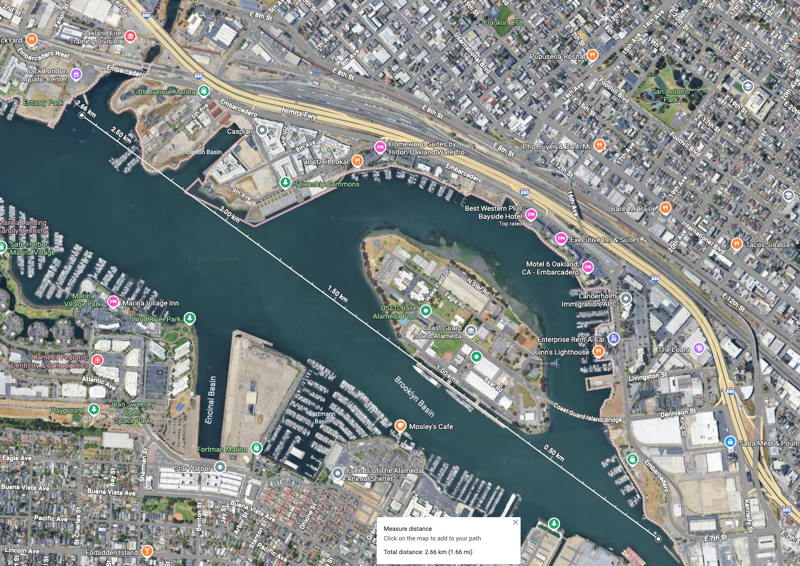
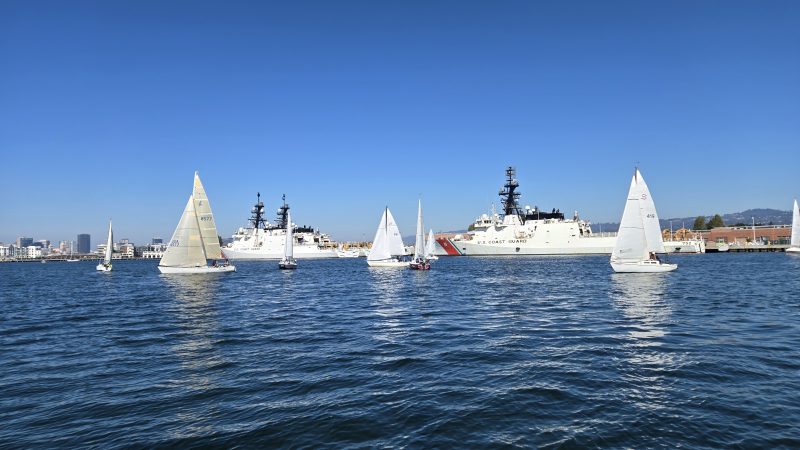
From a Latitude 38 perspective, we and all sailors are confident knowing that when someone is hundreds of miles offshore or in the middle of the Bay and calls, “Mayday,” the Coast Guard has dedicated, trained people and the resources to send helicopters, ships, paramedics and rescue planes to help. Unfortunately, when concerned citizens call the Coast Guard to say there is a boat sinking a few hundred yards from Coast Guard Island, the Coast Guard apparently does not have the budget or people able to respond. It’s a shame. When a boat is floating, the cost to dispose of it is reduced by thousands of dollars and the environmental damage is largely prevented. Coast Guard rescue boats generally have dewatering pumps that can keep your boat afloat if circumstances are right.
We also note that the first red pin to the northwest of Coast Guard Island is on the site of the stunning new Brooklyn Basin project. The total cost to build this mixed-use development in Oakland was estimated to be at least US $1.5 billion. It has at least 3100 housing units including 465 “affordable housing units” that are adjacent to the illegally anchored liveaboards who are causing so much heartache for bureaucrats, law enforcement, city budgets and citizens. The most expensive units are around $800,000, with a view of all the wrecks, anchor-outs and Coast Guard Island. It’s hard to make sense of the mismatch of funds, efforts and results. We are sure the residents and developers’ interests align with the sailors and community members who want to enjoy a clean, safe and accessible waterfront. It would be very cool to live at Brooklyn Basin and have your kids walk or ride bikes along the waterfront to participate in East Bay Rowing’s youth programs at the Jack London Aquatic Center less than half a mile away! It will happen — someday.
Last fall we announced the fantastic news that Oakland had received a $3+ million grant to clean up the Estuary. It’s Groundhog Day again; nothing has been done. Mary expressed the frustration of the whole community as she and many volunteers continue to spend their “free” time cleaning up messes that all the responsible agencies are in charge of preventing. The funds are there but have not been dispersed or allocated for the cleanup. Meanwhile, as boats continue to sink, the price of the cleanup only grows. While these boats sink on a regular basis, the upcoming winter storms will only exacerbate the problem.
Mary noted that members of the Alameda yacht clubs — Encinal, Oakland, Alameda, Island, and Aeolian — regularly show up to help in the volunteer cleanup efforts. We’re not sure if any Coast Guard or Oakland law enforcement officers have used some of their free time to volunteer to help keep the Estuary clean, but it seems as if it could be motivating.
The lack of response to boats sinking at the Coast Guard’s doorstep feels like a dereliction of duty. We know the phrase probably carries a heavy weight if you’re a military sort, but we are civilians and don’t know when a term like that kicks in. As observers, we feel all those red and yellow pins that continue to pollute and threaten the federal waterway appear as a dereliction of duty, but maybe there’s a better term for it.
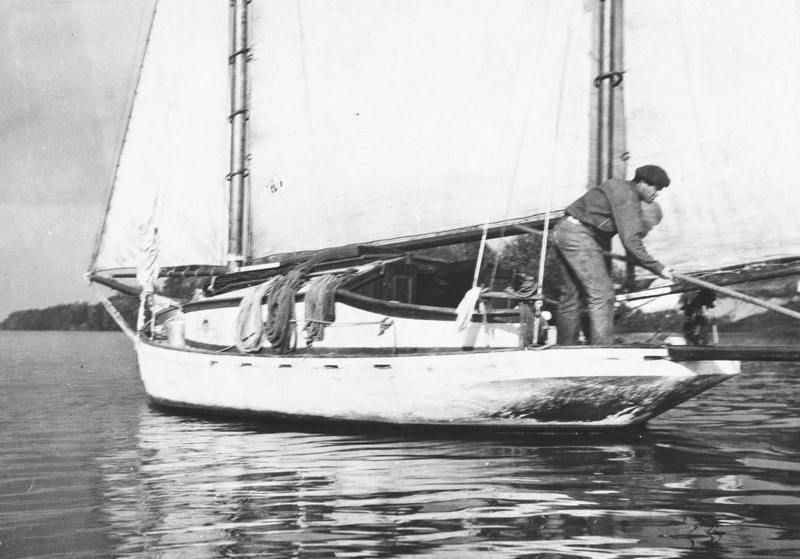
Our understanding is that the BCDC is beginning to take steps to use whatever enforcement power they have to require the City of Oakland and Port of Oakland to take care of their waterfront. Jack London would be proud to know that Jack London Square would be named after him but ashamed to see how the City of Oakland has treated the waterway and lost its respect for the maritime heritage he cared about so deeply. (Our November issue, coming out today, has a story by Aleta George on the sailboats of Jack London.)
We expect we’ll be writing several more installments of Groundhog Day on the Oakland Estuary, but, someday, we look forward to writing about East Bay residents sailing, paddling, swimming and rowing in the sparkling, clean, safe waters of the Oakland Estuary. The community deserves it, the resources are available, and in the meantime, it’s dedicated volunteers like Mary Spicer, Brock de Lappe and many others who keep the Estuary as clean as possible until the people employed to do the job are up to the task. We’re sure there are volunteers ready to assist and support whenever that effort comes forth.
As Bob Newhart used to say ,when giving advice to his clients as a therapist.Just Do It !
From Kris Leverich:
Those are just the wrecks you can see above water.
As bad as it is, and it IS bad, it would be a lot worse without funding and staffing for the SAVE grant program for proper vessel disposal, preventing un-loved boats in marinas from becoming “dollar boats” that wind-up on the rocks or bottom. The final cash buyers of dollar boats almost never document/register and insure the boats, as required by law, over which the seller has no control. We see over, and over, and over how boats in the custody of people who can’t/won’t maintain them are not safe housing solutions, and sometimes are used in criminal activities.
The article heavily blames the USCG for not managing the mess in the estuary, which is a misdirection; the CG has neither the statutory jurisdiction nor mandate to remove and dispose of these vessels.
Once a recreational vessel is docked or anchored, regardless of its legal disposition, its mostly beyond the service’s otherwise broad enforcement remit unless or until it produces a proven pollution event, or sinks or is abandoned in a location that directly impedes regular navigation (marked channels). Nowhere in the US does the service have crane barges and crews cleaning up and disposing of derelicts. Nowhere in the US does the CG have the resources to regularly stakeout illegal anchor-outs, 24/7 for weeks and months on end, waiting for the owner/operator to hoist anchor and nail them for federal violations while underway. Currently, all of the anchor-outs are outside the security zone of the base, and the service does not enforce state and local laws governing boating and anchorages that vary from federal law. It certainly does not regulate local issues which merge into housing, addiction, mental health and civil disorder amongst the anchor-outs which are endemic to homeless encampments ashore. No one at the base likes looking at the blight on the rocks and swinging with the tide on fraying anchor lines, but the problem is a 90% state, county, and city enforcement issue.
No local agency wants to be the “bad guy” in enforcing the law by itself without political leadership being ready to full-throatedly back them up when the bullhorn parade shows up to decry the sensible protection of the waterways, over chaos and negligence. Sadly in recent years, a number of county and municipal leaders have chosen blast or shut-down their own marine enforcement mechanisms when favoring outliers was politically rewarding, even promoting the anchor-out “life style” without any understanding of its outsize hazards. Several marine patrol units were defunded, disbanded when that was popular. So when the problem “shockingly” accelerated, they didn’t want to offend loud fringe constituencies by reversing course and doing the hard work their distant predecessors did to have an orderly waterfront. That was a choice and it doesn’t have to be that way. If ALL state and local leaders are on the same page to get their agencies on task, the CG has frequently cooperated within its jurisdiction and capacity to make sweeps and cleanups safe and successful. If few or none of the local leadership want ownership of the difficult work, the feds will only go to the narrow limits of their authorities. SAVE slowed the injection of future dollar boats, but by itself and without political courage (and with fickle funding) it’s just a band-aid measure. Boats are still being abandoned.
Meanwhile, cleanup of wrecks also requires political leadership at the top of cities, counties, the state bureaucracy, and federal government to cut red-tape, find funding and contractors, and actually get them out of the waterways. If any leg of that stool is missing, nothing happens. 2014 was the last time this area had a major cleanup.
Latitude 38 Magazine:
Kris Leverich – Thanks for your comments. We do understand the USCG is limited in its role and abilities to enforce. So is the BCDC and every other agency. The BCDC has enforcement powers but no boats. The USCG has boats. Port of Oakland, City of Oakland, Oakland police all have roles.
For example, our understanding that if a boat on the Bay were dumping raw sewage into the Bay that the Coast Guard would have a role. Do all the anchor-outs have proper Y-valves and holding tanks that are regularly pumped out? Do they have life jackets for each person aboard? A horn? Registration? An anchor light? To us, the problem is that all the agencies are trying to minimize their role and responsibilities rather than proactively working together to solve the problem.
The USCG is not responsible for the homeless crisis or anchor-outs but we have quoted them in the past, saying they would actively patrol the Bay and help with enforcement. Oakland Police says they don’t have budgets for enough trained boat drivers. The USCG has plenty of them. Sadly, it’s probably easier to invade Venezuela than to have the USCG and the Oakland police collaborate to solve that problem. In the normal world, all of us mariners help a buddy drive their boat if needed. We understand bureaucracy prevents such simple solutions but it doesn’t mean the USCG and others shouldn’t be working hard to find them.
With their environmental role we would think the USCG would be clamorning at the doorstep of the Port of Oakland, the City of Oakland, the Oakland Police department and the BCDC to offer whatever meager assistance they can to prevent the wrecks and pollution that are happening yards from their pristine island sanctuary.
We haven’t suggested the USCG has the responsibility or ability to clean up the estuary. However, as the only agency with its headquarters parked in the middle of the problem with a large number of boats with trained marine operators and law enforcement professionals, it feels like they could offer some experienced assistance to the other agencies who are also trying to narrowly define their roles to avoid responsibility. Who’s going to step up?
We do have sympathy and understanding for all the agencies. It’s a very tough problem to solve and the constraints within which they work seem overwhelming. But we still believe there are good people in each agency who do actually want to see this problem solved, including finding good homes for the unhoused (though that’s another set of agencies).
Kris Leverich:
There absolutely are people in all the related agencies who want to collaborate, with proviso they have the full backing of all of the local political leadership and their legal counsel.
With regard to your question on boarding and inspecting a vessel moored or at anchor (outside of a marked navigational channel) – even one with no externally apparent current registration or documentation – to verify that it is in compliance with marine safety and pollution laws, let me elaborate.
The court determined in U.S. v. Whitmire (1986), U.S. v. Piner (1994) that the USCG cannot board and inspect vessels at anchor or in berth, as those craft assume a higher degree of 4th Amendment right to privacy protections, even if no one appears to be abroad. Separate from the expansive terms of underway rec boat or commercial dockside inspections, the exception would be if a Boarding Officer has established sufficient evidence to assert Probable Cause for a docked or anchored recreational vessel without a warrant. Examples would be: seeing a federal crime in progress through a port hole, the vessel being left on federal property or in a designated security zone, hearing someone screaming for help below, watching blackwater being discharged, etc.. This is analogous to a police officer not being able to break into a locked car parked lawfully on the street and then jump the ignition so he can see if the turn signals work, or search the vehicle for current proof of insurance. So, the CG can’t board a static vessel to check the sewage Y valve, even if a reasonable person might assume that if no one ever sees the vessel move to be pumped out, it looks like someone is likely living abroad the vessel, and its very possible that said person is pumping or tossing human waste overboard – that alone isn’t probable cause.
State and local authorities have a significantly lower bar for enforcement which permits them to board and inspect vessels identified as being unlawfully docked or anchored on state waterways (often overlapping federal waterways) or municipal marine properties (usually marinas) after issuing warnings as prescribed by their agency policies. In that process, vessels without current registration AND owners present whom are ALSO able to remove them from the controlled waterway may be seized and impounded pending disposal, or possible release (if the owner pays fines and gets in full compliance). Just like an unregistered vehicle left for 2 weeks in a red zone. Even if someone shows up while the vehicle is being loaded on a truck bound for the city yard, the impoundment process still proceeds.
States, counties, and cities not staffing, resourcing, and tasking their marine enforcement and environmental agencies to monitor and protect the waterways is a political choice. Generally, agencies themselves WANT to do the job in partnership, leveraging stacked authorities, funding, and capabilities – even if the optics sometimes get ugly at the boat ramp. Political leaders of conviction and courage will take the arrows of the frantic outliers when those (usually out of full context) images hit the media, rather than be cowed by them. If they don’t, or actively join the mob, there’s your answer.
Good discussion.