

Ernest Gann, ‘The Odyssey,’ Sirens, and the Singing Girl of Fournoi
Have you got a favorite sailing book you lend out and never see again? Latitude 38 editor John Riise (JR) says his is Ernest Gann’s book, Song of the Sirens. He says he’s bought many copies and lent them all out and has to keep buying more. He shared a bit more about why it’s so good and so captivating.
One of my favorite authors is Ernest Gann. If you can’t quite place him (and have a few years on you), you’ll know a few of his works, like Fate Is the Hunter, The High and the Mighty, and Masada — books of his that were made into movies.
My favorite book of his is Song of the Sirens, first published in 1968. The title comes from The Odyssey. The sirens of Greek myth are beautiful women who sing to passing mariners, luring them to their deaths on the rocky shore. Ulysses wants to hear them, but doesn’t want to wreck the boat, so he orders his crew to put in earplugs, then has them tie him to the mast so he can hear the songs, and everybody lives to tell the tale.
In modern parlance, the “sirens’ song” is an irresistible calling that you succumb to even when you know deep down it might not be a good idea. In Gann’s book, the sirens are all the boats that have seduced him into ownership over his lifetime.
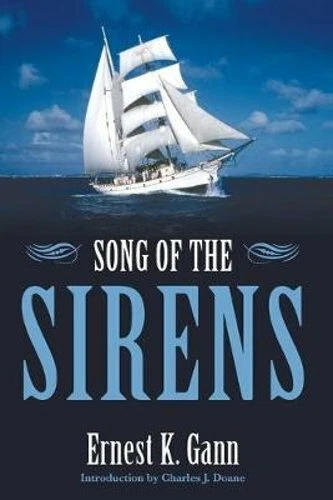
The passage that has always lingered with me comes toward the end of the book. He is aboard his latest boat, a 60-ft ketch named Black Watch, and they are anchored at the tiny Greek Island of Fournoi. A Meltemi wind blusters and buffets Black Watch. Ernie paces the foredeck with a troubled mind. He has just received news that his beloved schooner Albatros — which he restored in San Francisco over several years and aboard which he crossed oceans — had been hit by a white squall and sunk in the Gulf of Mexico. It sends him into a dark funk, making him wonder about the meaning of the loss, and indeed if a lifetime around boats has been little more than folly. He decides he is done with sailing, and can’t wait to sell Black Watch and move ashore and be done with it all.
Then …
“I was staring down at the ruffled water when I first heard the singing. It was a feminine voice, thin, high, very clear and gay — the voice of a Circe or Sprite, I thought, according to a man’s wish and imagination. It was a voice drifting down the wind from the ages; it was a cry of life from the fringes of the sea, of zest for all the temple of Poseidon offered.
“At first I was unable to find the source of the singing, although I carefully searched the arid bowl which rose up from the sea and shaped the cove of Fournoi. There were a few white plaster houses and the inevitable goats, but there had not been a sign of human life. Yet there, as if singing for my heart alone, was the voice. It seemed so near and clear that I dared not believe I had not really heard it.
“I walked to the quarterdeck and picked up my binoculars. Again I searched the shore, then stopped in disbelief. For I focused on a lone fig tree which was swaying violently in the wind. And in the tree was a young girl, skirt billowing, singing joyously, yet as if her very life depended on it.
(Here he calls his crew on deck and makes them look, to make sure he’s not imagining it.)
“In the binoculars we could see her head tilted back as if she sang to the sky. Her tune was difficult to classify because of the vagaries of the wind, which alternately muted and brought her voice full volume. It sounded improvised, as if she sang purely on inspiration, yet her lyrics were in distinct cadence and there was nothing shy about her style. Holding to a branch of the fig tree with one hand, she would make a sweeping gesture with her free hand to encompass her audience of none. It was a regal gesture to be seen at La Scala rather than impressing the dry rocks on a somewhat larger rock in the middle of the Aegean. Not once did I see her look our way. She seemed oblivious to our presence; nor did she concentrate on any other sector of her view. The wind was her audience, the sky, and the sea far beyond us.
“Nightfall came quickly and we thought surely that the singing girl of Fournoi would abandon her concert. Yet after dinner when we came on deck she was still there, somewhere in the darkness beyond our anchor light, singing as boisterously as before.
“After a while my thoughts followed their familiar way to the loss of the Albatros, but somehow my utter dejection had passed. Somehow my faith in the permanency of the sea had been restored by this daughter of Poseidon on a faraway isle in a faraway sea. And I know that I was in love again and always would be.
“Soon after my mood had changed, the singing ceased and was no more. There was only the sound of the sea and wind, and in the morning the singing girl of Fournoi did not reappear.”
JR then recounts that, “Black Watch was the boat I sailed around the Med on as Mar. The guy I worked for had bought the boat from Ernie. I don’t remember at that time whether I had read any of Gann’s books or articles. (He was also a flier in WWII and wrote about that as well as sailing.) But, not surprisingly, most or all of his books were on the boat. Once I read one, I went through them all. Every one is a great read. And actually, his writing is what inspired me to try to develop my writing skills into a career. I still try to emulate his style.
“If you want to try just a single Gann book, I would recommend The Trouble With Lazy Ethel. It’s not long, and despite the odd title, is like no other story I have ever read. Highly entertaining, especially when the plot twists and the ‘bad guy’ ends up saving the day at the end.”