
Submit Your Fleet or Yacht Club’s “Season Champions” Feature to Latitude 38!
As Halloween and then the holidays draw closer, fleets and yacht clubs around California are wrapping up their seasons and crowning this year’s champions. I myself just wrapped up a whirlwind past few weeks in which I raced in a regatta or practiced for an upcoming event for six of the past seven weekends.
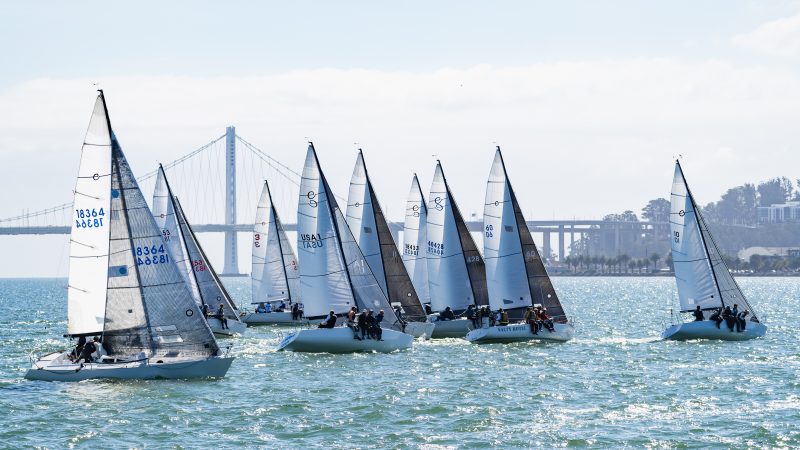
As the 2025 racing season draws to a close, now is the time to highlight the winners from the year. Latitude 38 has a long tradition of running our “Season Champions” feature in the December, January and February editions of the magazine. This will be my first year as racing editor taking charge of this duty, and I can’t wait to hear all of the stories from the various fleets and yacht clubs up and down the West Coast.
Last year, we highlighted over 30 season champions in the feature, but I want to highlight even more this year. If your fleet or yacht club hasn’t been featured in the past, and you have a season champion who has been crowned or a perpetual racing trophy that has been handed out, please don’t hesitate to contact me at [email protected]. Each feature will include a headshot of the winning skipper, a photo of their boat, and two to four paragraphs with anecdotes from the skipper about their 2025 racing season.
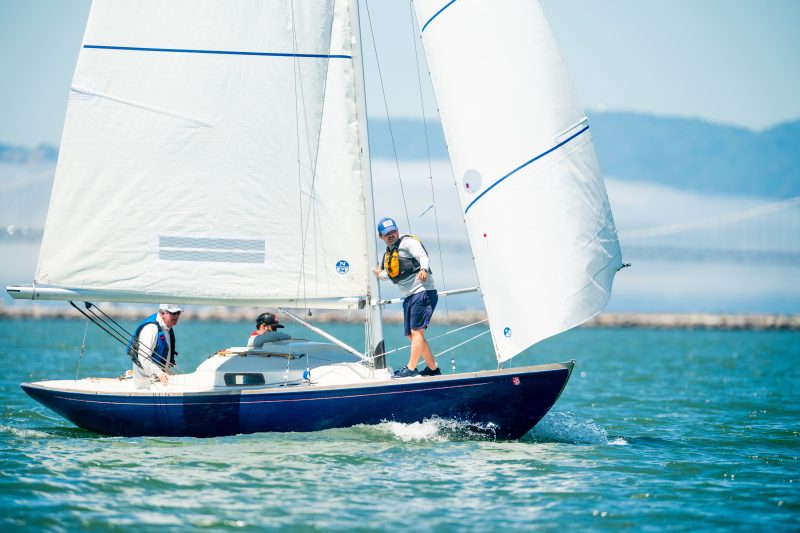
We want to tell your fleet or yacht club’s story, but we need your help to do so!
New YRA Women’s Series Challenges Experienced Racers
Competition has wrapped up for a new program geared to challenge the more experienced female racers: the YRA Women’s Championship Series, with fleets for PHRF Spinnaker, PHRF Non-Spinnaker and Open 5.70 One Design. A female must be at the helm, a woman must serve as tactician, and crew shall comprise at least 50 percent women. This series differs in that it sends sailors beyond San Francisco Bay to the ocean for a rounding at Point Bonita and back. Hosted on three days over the summer racing season, the series tallied points from the Sequoia Yacht Club’s “Rock the Boat” on May 17; Encinal Yacht Club’s “Shirley Temming” on June 28; and the championship, run on October 4.
Marking an outstanding season was the J/105 Chinook. Inspired by, and focused on, this new series for women, owner/skipper Elizabeth Henderson said newness prevailed: recruitment of brand-new crew, herself being a new skipper, and very recent acquisition of the boat (December 2024). “When I saw the advert for the YRA Women’s Championship Series it crystalized a vision and gave me a tangible goal to work toward. Since most of my sailing friends are women, we were able to form a 100-percent ladies crew. Chinook & Co. has come a long way in just six months,” says Henderson. “I hardly recognize the skipper: She didn’t dare hoist a kite in more than 16 knots of breeze. We made rookie mistakes, but we are better for each lesson learned.”
On October 4, with six series starts under their belt and moving up the leader board, the women primed for the hoist — even in eight feet of swell rounding Point Bonita and running back down through the Slot in 22 knots. “We kept the hammer down, even in adverse currents.” The clan tagged its first bullet in the last race and clinched the championship series. Henderson says she could not have asked for a better ending to the season, or a better start for her program.
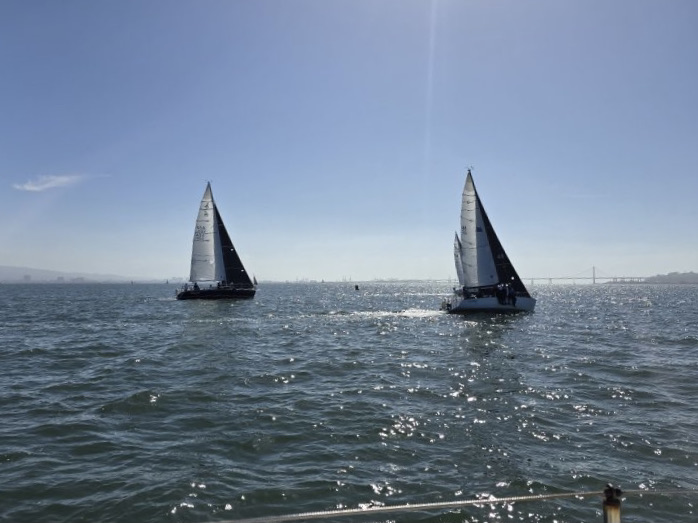
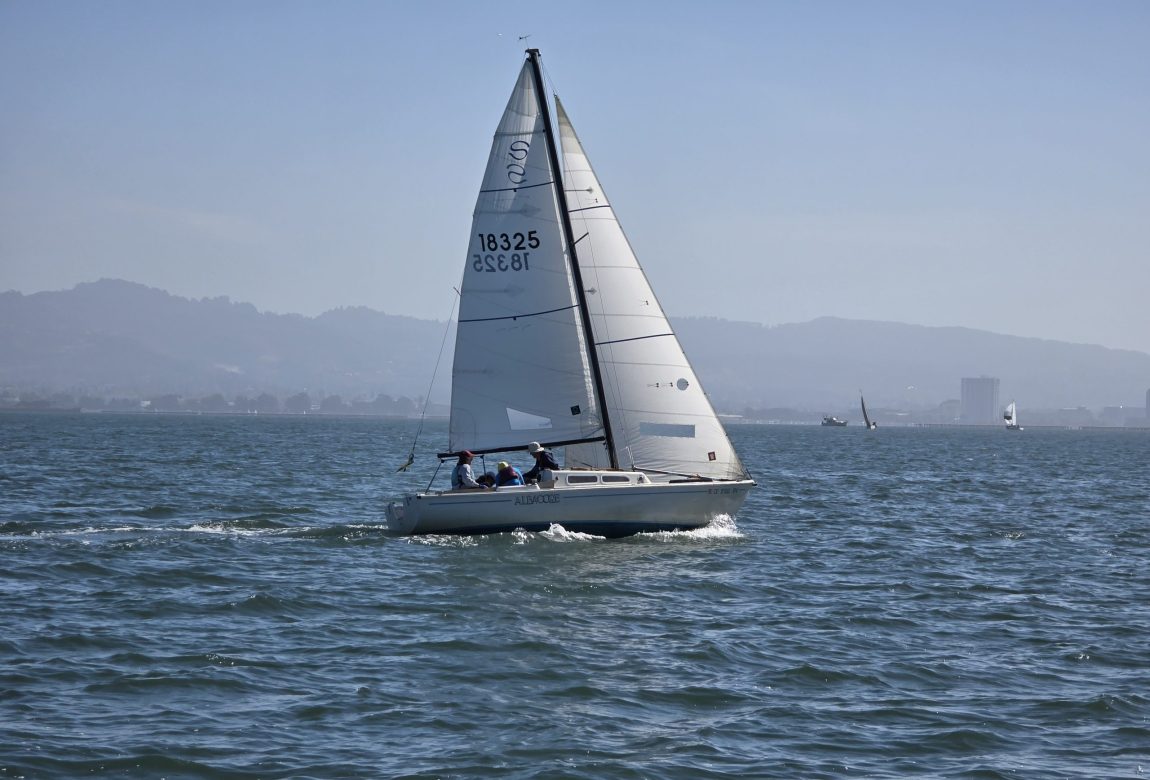
Samantha Chiu on Altair took to the start on two of three sail days, earning honors in her fleet. “I race an Open 5.70, so we did not compete October 4 due to the offshore aspect, as we are not equipped to head out there in terms of safety.” Chiu was the sole competitor to score in the Open 5.70 division. The Non-Spinnaker division attracted Sarah Hudspeth aboard Santana 22 Albacore and Samee Swartz of Flying Green Dragon, a Tartan 3500. Separated by one point at final tally, Hudspeth landed eight; Swartz earned seven. Overseeing all starts and finishes was a duo of female race committee volunteers anchored on a 40-ft C&C. Present was YRA director Peggy Lidster, who sums up positive vibes for this new challenge: “Excitement at each boat’s finish was easily heard on the signal boat.”
For this competition, organizers used a high-point percentage system to build standings based on scores from races in the series. 2025 served as the event inauguration, with plans in the making for a 2026 return.
Spaulding Marine Center, Full-Service Boat Yard and Education Center
How a Whimsical Desire for a New Racing Venue Became the Miracle of Zihuatanejo Sailfest
You’ve all heard it. You go to the companionway to head below and fetch something when someone on deck says, “While you’re down there …” The Baja Ha-Ha Grand Poobah is suggesting the same to you, when you’re in Mexico. “While you’re down there, you should head to Sailfest in Zihuatanejo.”
The year was 2001, and after several seasons of fabulous cruising and racing Profligate on Banderas Bay, I suggested to Blair Grinols of Capricorn Cat and the other regulars that maybe we should add another spot to the mix.
“Let’s all go down to Zihuatanejo in February 2002,” I said, “hold a little regatta, and maybe we could raise $150 for some kind of charity in Z-town.” The other members of the core group were in.
The whole idea almost never took off because I was snowed under with work at Latitude in January and was thus balking at taking Profligate that far south. “Come on,” everybody egged me on, “if you, Profligate, and Latitude don’t come, nobody else will.”
Little did I know that by my caving in and showing up in Zihua, an event would be born that has subsequently resulted in three million pesos being raised, and 160 classrooms in the Zihua area being built.
Thanks to the efforts of many cruisers and other people — I was mostly just the idea guy and magnet — we raised $1,500 that first year. The money came from people paying to sail on boats, and other donations. It was the beginning of the town of Zihua really getting behind the idea.
We decided to give the proceeds to a woman named Maria who, under a tree, was teaching Indigenous Indian children to speak Spanish. If they couldn’t speak Spanish, they couldn’t attend Mexican schools. It would be nice, we thought, if she could have a real classroom.
By another stroke of very good fortune, Richard and Gloria Bellack of San Diego were in Z-town, and had already been providing some funds to help Maria. They very generously decided to match the $1,500 that Sailfest had raised.
The next year, the last I was able to attend, was even bigger. Tenuous that the event ever came to pass, it was still tenuous that it continued in the early years. But thanks to an unlikely succession of cruiser volunteers — Pamela Bendel was a major player for a number of years — and the continued matching funds from the Bellacks, Sailfest has blossomed.
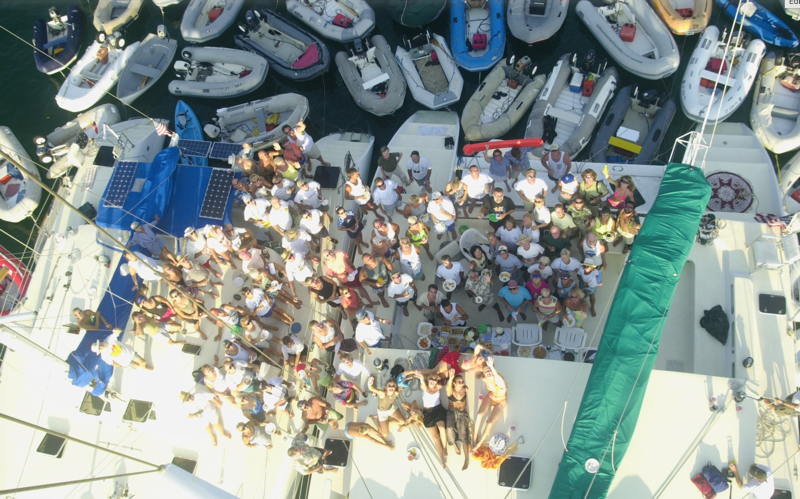
How can so many classrooms have been built? In recent years the event has raised in excess of $160,000 annually, and it costs about $22,000 per classroom.
In addition to the 160 classrooms that have been built, there have also been 57 kitchens, bathrooms, playgrounds and multipurpose covered outdoor spaces built. And over 50,000 meals a year have been served to students!
Oddly enough, this post is not an appeal for more money or more volunteers — there is plenty of both of those. What’s really needed are more sailboats, which were/should be the heart and soul of the event. Without the sailboats, Sailfest would be like Fleet Week without the fleet.

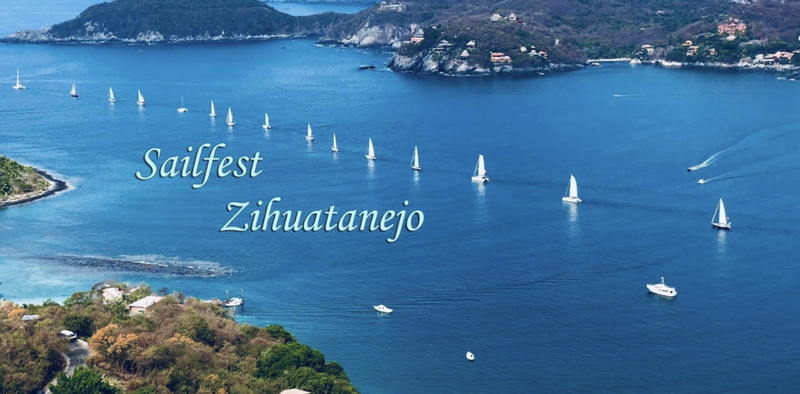
Sailfest features a host of sailing events for participating vessels, including music cruises, sunset cruises, a “Rally Round the Rock” fun regatta, and a sail parade. Zihuatanejo Bay offers protected anchorage, on-beach dinghy security or panga pickup, wonderful bars and restaurants, sightseeing, shopping and cultural events. If you haven’t been to Z-town, you haven’t really cruised Mexico.
The two-week Sailfest in 2026 is February 15 to 28. I highly recommend it. It’s not only a great cause, it’s great fun along the “contented coast,” home of fabulous sunsets.
For details, visit www.zihuatanejo-sailfest.com.
Mayday Response — Singlehanded Sailor Rescues Crew
The urgency in the distress caller’s voice had me reaching to turn up the volume on my VHF as a reflex — “Mayday, mayday, mayday … we are taking on water fast!” There was an unmistakable note of panic in the caller’s tone that was more than compelling. “This one sounds legit,” I thought. I studied the screen on my VHF as if it could offer more details of the mayday. I envisioned what the captain must be going through at this moment, trying to keep his composure while describing an active sinking event for crew and vessel. I leaned closer toward my VHF and throttled down, not wanting to miss the next crucial details.
“Vessel in distress, what is your vessel type, location, how many persons on board, and are all passengers wearing life jackets?” the Coast Guard radio operator queried.
“Marin Islands,” was the location given by the mayday caller. I was unfamiliar with that particular geographical designation, yet there are two small hilltop islands I pass along the channel to my base at Loch Lomond Marina off San Rafael. My head began to swivel to locate any vessel in sight that might be in distress. The Coast Guard asked the vessel for lat/long coordinates, but the captain indicated that he did not have GPS to comply. My position at this particular moment was about one mile north of the Richmond-San Rafael Bridge.
Earlier that Sunday morning, June 1, I had motored off alone at 7:30 a.m. on my Jeanneau 36.2 Pretty Naho from my home port in San Rafael to Sausalito for fuel. The day’s wind and sea conditions were unexpectedly heavy, with 35-knot gusts. Bare-poling through Raccoon Strait, I soon found myself punching through swells of heights I’d only encountered outside the Gate.
As I rounded the point off Tiburon and approached the Sausalito channel that would take me to the fuel docks, I realized it might be reckless to try to navigate the channel and close quarters of the fuel dock singlehanded. Today’s was a negative tide, and the thought of running aground from this morning’s strong gusts was in the back of my mind.
I turned upwind, away from the channel, setting the autopilot to hopefully hold me long enough to raise the main for at least a broad reach home. The autopilot, however, was overpowered by the heavy gusts, and a batten got caught up on a lazy-jack line before I could override it. It turned into a struggle to free the batten and reef for the downwind run back through Raccoon Strait.
I noted unusual whitecap activity that appeared to grow more powerful as I sailed under the Richmond-San Rafael Bridge two hours later. The challenge now at hand would be a trip to the mast to bring down the final section of mainsail by hand. The heavier gusts, swells and chop demanded a stronger grip and calculated footing at the mast. The time of the first “mayday” call, 1:40 p.m., found me circling at the entrance to the channel leading to my marina while the flood current slowly crept in. The distressed-vessel captain described more detail to the Coast Guard.
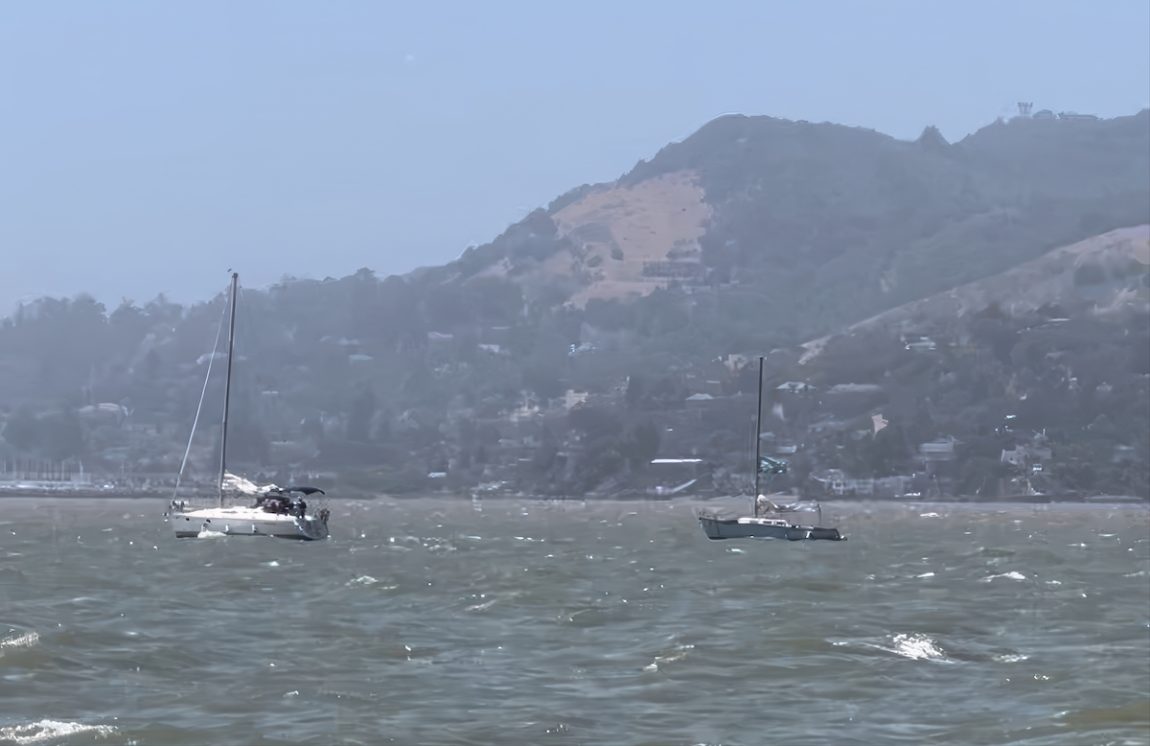
“We are taking on water fast through a big hole in our stern,” he stated, his voice more alarmed than before.
Haven Boatworks: Full Service Boatyard in Port Townsend