

Mayday Response — Singlehanded Sailor Rescues Crew
The urgency in the distress caller’s voice had me reaching to turn up the volume on my VHF as a reflex — “Mayday, mayday, mayday … we are taking on water fast!” There was an unmistakable note of panic in the caller’s tone that was more than compelling. “This one sounds legit,” I thought. I studied the screen on my VHF as if it could offer more details of the mayday. I envisioned what the captain must be going through at this moment, trying to keep his composure while describing an active sinking event for crew and vessel. I leaned closer toward my VHF and throttled down, not wanting to miss the next crucial details.
“Vessel in distress, what is your vessel type, location, how many persons on board, and are all passengers wearing life jackets?” the Coast Guard radio operator queried.
“Marin Islands,” was the location given by the mayday caller. I was unfamiliar with that particular geographical designation, yet there are two small hilltop islands I pass along the channel to my base at Loch Lomond Marina off San Rafael. My head began to swivel to locate any vessel in sight that might be in distress. The Coast Guard asked the vessel for lat/long coordinates, but the captain indicated that he did not have GPS to comply. My position at this particular moment was about one mile north of the Richmond-San Rafael Bridge.
Earlier that Sunday morning, June 1, I had motored off alone at 7:30 a.m. on my Jeanneau 36.2 Pretty Naho from my home port in San Rafael to Sausalito for fuel. The day’s wind and sea conditions were unexpectedly heavy, with 35-knot gusts. Bare-poling through Raccoon Strait, I soon found myself punching through swells of heights I’d only encountered outside the Gate.
As I rounded the point off Tiburon and approached the Sausalito channel that would take me to the fuel docks, I realized it might be reckless to try to navigate the channel and close quarters of the fuel dock singlehanded. Today’s was a negative tide, and the thought of running aground from this morning’s strong gusts was in the back of my mind.
I turned upwind, away from the channel, setting the autopilot to hopefully hold me long enough to raise the main for at least a broad reach home. The autopilot, however, was overpowered by the heavy gusts, and a batten got caught up on a lazy-jack line before I could override it. It turned into a struggle to free the batten and reef for the downwind run back through Raccoon Strait.
I noted unusual whitecap activity that appeared to grow more powerful as I sailed under the Richmond-San Rafael Bridge two hours later. The challenge now at hand would be a trip to the mast to bring down the final section of mainsail by hand. The heavier gusts, swells and chop demanded a stronger grip and calculated footing at the mast. The time of the first “mayday” call, 1:40 p.m., found me circling at the entrance to the channel leading to my marina while the flood current slowly crept in. The distressed-vessel captain described more detail to the Coast Guard.
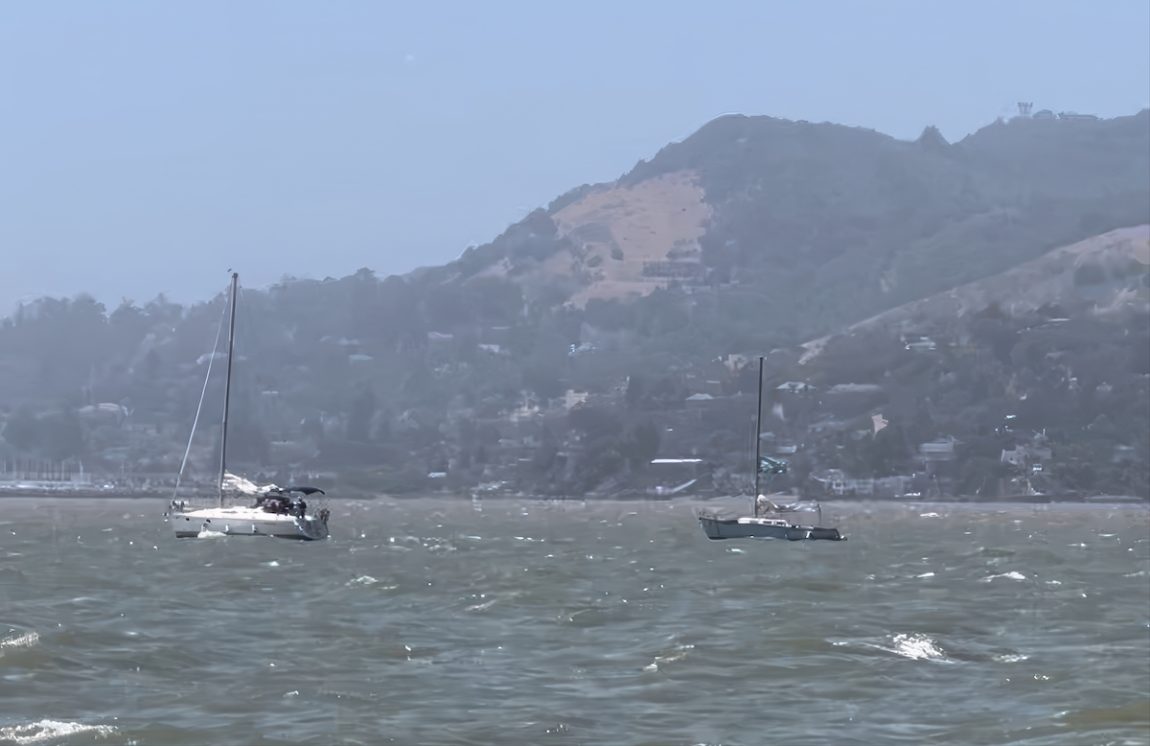
“We are taking on water fast through a big hole in our stern,” he stated, his voice more alarmed than before.