

Scow Bow For Racing and Cruising: ‘Palanad 4’ Wins RORC Transatlantic Race
After an overall win in the RORC Transatlantic Race, Palanad 4 continues to show that, in addition to cruising, scow-bowed yachts are also good for racing. We’ve been covering the building and cruising life of Barry Spanier’s junk-rigged, Antrim-designed scow-bowed cruiser Rosie G, which has us paying more attention to racing boats with a similar design. Our December issue included a letter from Barry with follow-up comments from designer Jim Antrim and another comment from Max Ebb.
Barry and his wife Samantha have now cruised their junk-rigged scow Rosie G from San Francisco to Australia. Barry wrote to us saying, “The scow bow is here to stay. I admit that before sailing Rosie G, we had to always consider Jim’s correctly given concerns about something few knew anything about, though he was willing to step in. [Jim Antrim drew the boat design from Barry’s sketches drawn in Tahiti in 1978.] Sailing in the Bay before our departure gave me confidence that Jim did a great job. The first offshore miles with him aboard added to that feeling. Now, with a full ocean of experience, I can also say, ‘DAMN! What a concept!’ Obviously, our choice of the junk rig is also a factor in our experience, and it has not been negative in any way. A WAG (wild ass guess) has been to keep it simple, less expensive [and] easy for elders (my main goal) and has proven to have some characteristics that were never considered because we had nothing to base ideas on. I think the fact that the total rig weight above the deck with the full sail set is likely under 500 lbs is a key factor in the stability (low heeling) and easy motion running. Being able to equal true wind speed dead down up to 4 kts true is also something never imagined. It’s made us very happy to have an autopilot because the wind vane doesn’t work with zero apparent wind.
“Now when I say scows rule, Palanad 4 is another example of the performance of scow-bowed boats. If Palanad 4’s beautiful example continues to achieve winning results, we will find out more about why the shape is banned in many classes. To me, that is simply driven by the fear of the lost value of very expensive race boats before any other reason.” We first wrote of Barry and Jim’s collaboration in ‘Lectronic Latitude in 2019.
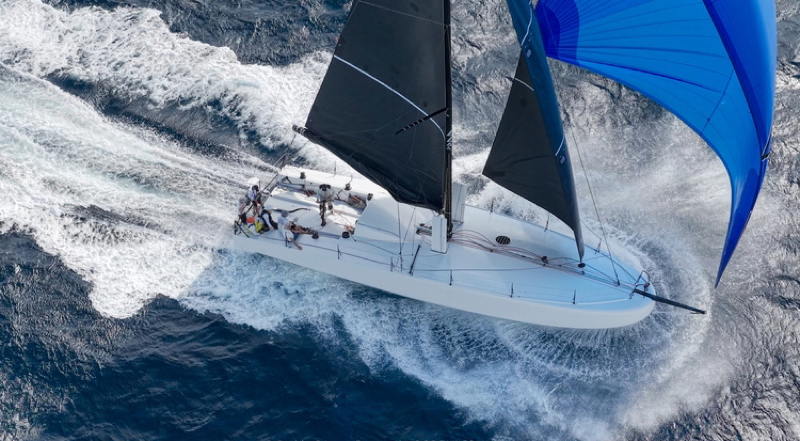
Scow bows have been winning the Mini Transat race for over a decade. The shape is appearing in Class 40 designs, and now the 50-ft Palanad 4 is showing the way in larger race boats. The Mach 50 Palanad 4 was showing off at the finish as it sailed across the line off English Harbour, Antigua, at 20+ knots.
Palanad 4’s designer, Sam Manuard, commented after the race. “This race was incredibly valuable. You can simulate a lot, but nothing replaces sailing for days in real trade-wind conditions, in VMG mode, with proper pressure. We learned a huge amount. One thing people immediately notice is how dry the boat is,” he explained. “Even at 20 to 25 knots downwind, the deck stays remarkably dry. That matters offshore. Comfort is performance. When the crew can stay focused, the boat goes faster.”
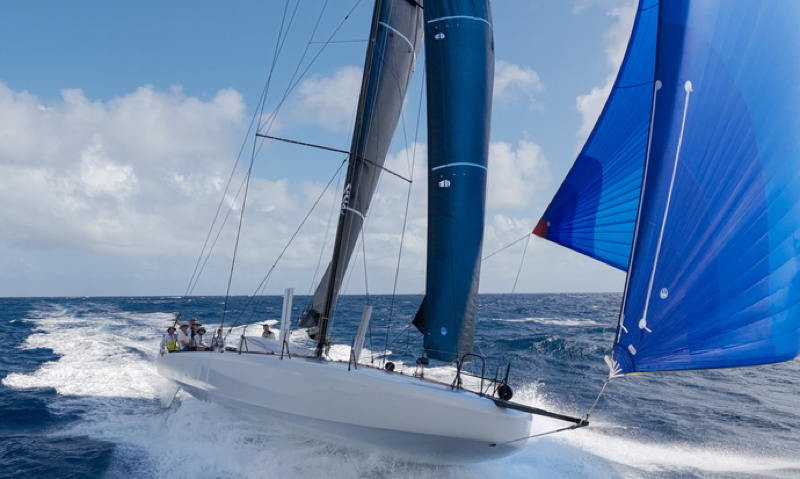
Manuard noted that Palanad 4’s win highlighted that performance doesn’t come from short bursts of speed, but from consistency and efficiency over distance.
For cruising, Barry has also noted that one of the other great reasons for a scow bow is the added interior volume. This creates added comfort and storage below, and you can fit the volume of a 50-ft boat in a 40-ft slip!
The scow bow is certainly making an impression. We received a note from Jim Antrim saying he’s now working with a new client on another scow-bowed cruising boat. We’re excited to see the results!
Note: This week’s Good Jibes (released each Tuesday) will feature guest Barry Spanier, who will talk a little about Rosie G and about his lifetime of sailing and sailmaking. Tune in here.