

Changes in Latitudes — Science From a Sailboat Aboard ‘Rafifi’
After crossing the Pacific on Kurt Christofferson’s Deerfoot 62 Emma a few years back, the crew of that voyage have scattered across the globe on adventures of different kinds. While Emma continued toward Fiji, I continued my career in marine science, founding the organization Windward Sciences. While looking for excuses to conduct research from sailboats whenever possible, I stumbled upon a ragtag group of scientists at the University of Oxford in 2023.
As we masqueraded as tea-sipping professionals in squashy common-room armchairs, plans grew to launch a research initiative to study evolutionary biology on island archipelagos across the world. We hoped to understand and model how biodiversity is being lost (or gained) over time, making islands the perfect study systems. (Think Darwin’s voyages — but this time, we came armed with advanced computing, DNA sequencing, and AI to address these age-old subjects.)
As we’d planned, the small research collective grew to include scientists, artists and free thinkers across three nationalities — Finnish, American and French. After many brainstorming sessions and funding applications, we cobbled together a shoestring budget to cover a few bits of essential science equipment and rental of the Jeanneau 40 Rafifi for a pilot expedition in Finland’s Turku Archipelago in the Baltic Sea.
With so many samples to collect and so few berths available, our sailing-savvy scientists doubled as skippers, and we were joined by Suzy Garren (one of my original Pacific crossing crewmates) to help make it all work.
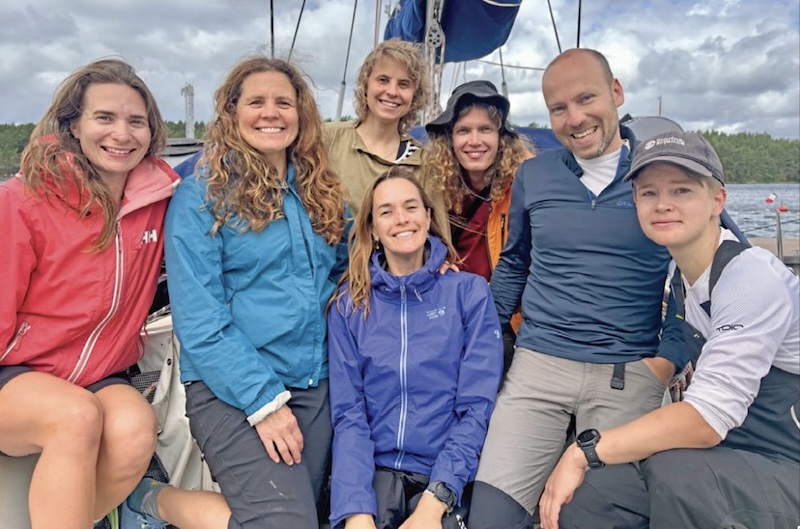
The seven of us set sail in August for what would become an incredibly exhausting yet rewarding couple of weeks in a landscape very foreign to me. To begin with, the Turku Archipelago in southern Finland was one of the most navigationally challenging places many of us had sailed. It was a labyrinth of tens of thousands of islands, some the size of Catalina and others barely big enough to land a gull. Given that we hoped to sample islands unaffected by humans, we were sleuthing our way through infrequently transited and unmarked passages. To make matters more interesting, the Baltic Sea is still rebounding from its last glacial maximum. This means that the ground is creeping upward after the giant ice sheet burying northern Europe melted some 20,000 years ago — like a memory foam mattress slowly returning to form after your removing your hand.