

The Resourceful Sailor’s DIY Winch Maintenance
Have you been thinking about doing your own winch maintenance on your sailboat? Maybe you want to, but haven’t found the time? Or maybe finding “the time” is really about finding the nerve? The unknown mechanical wizardry hidden below a winch’s sleek exterior can be intimidating. Are you afraid of losing valuable pieces? Are you worried about a mess? This Resourceful Sailor installment aims to demystify the process and inspire gumption and confidence by giving a few tips and insights to set you on the path to successful winch maintenance.
I won’t give a step-by-step approach to winch maintenance. That would be impractical and misleading. Winches of different manufacturers have different builds, and the larger and more powerful the winch, the more sophisticated its innards.
My examples for this installment are the Lewmar 8 and the Lewmar 16ST, which are small-boat winches. Their simplicity is a good introduction to the uninitiated. The 8s were on Sampaguita, a Pacific Seacraft Flicka 20, and the 16STs were on Mustang Sally, a 26-ft Thunderbird. Both boats were in the water during maintenance and were completed in an afternoon, a reasonable expectation for most sailors.
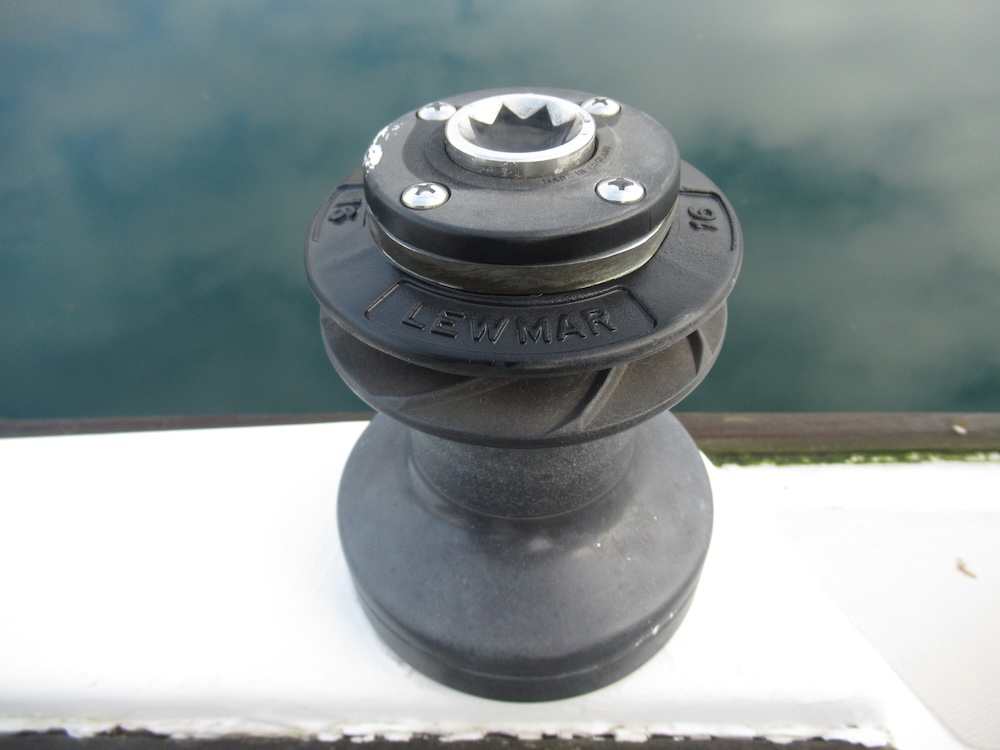
The above winches do not need removal for meaningful maintenance. Many do not. The crux is that winches are often “living on the edge,” installed on exposed cabin tops, cockpit coamings and masts. These positions lend themselves to winch parts inadvertently being lost overboard or down a drain. I think this is one of the main inhibitors to DIY winch maintenance. It is the pawls and the pawl springs that are most likely to be lost. These last are very small and difficult to handle, and easily “spring” away. It is also these pieces that are the ones most likely to need replacing. Therefore, I would recommend at least one manufacturer’s spare parts kit on hand for each winch model worked on. A plus is that many spare-parts kits cover a span of winch sizes. This kit may also include some plastic bits and bushings that may wear at a different rate than the metal pieces.
For example, Sampaguita had four Lewmar 8 winches, so I made sure I had one spare-parts kit on hand. It is also possible that the winch’s pawls and springs are in fine condition, with just a need for cleaning. That has happened far more than not in my experience. In this case, hold on to your spare kit for the next time. If you do change parts out, keep the old as spares. The Resourceful Sailor believes it is better to have a used part than no part at all.
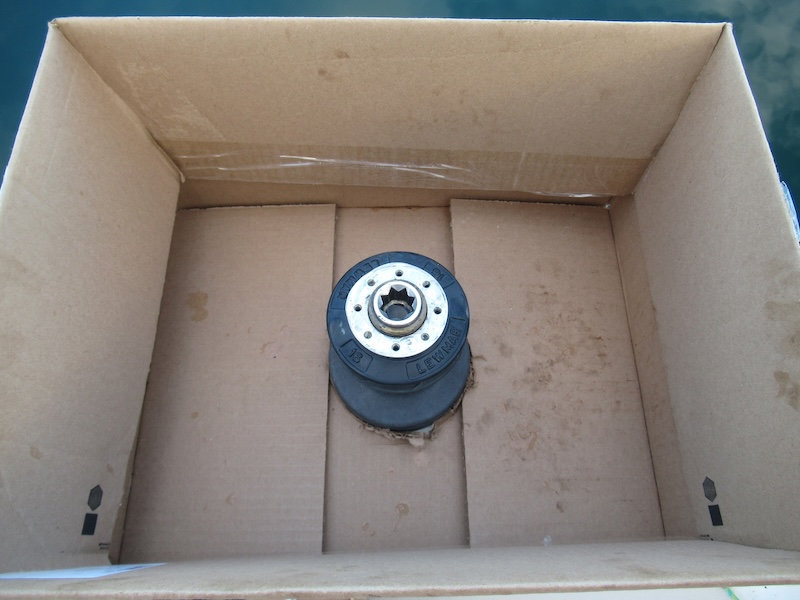
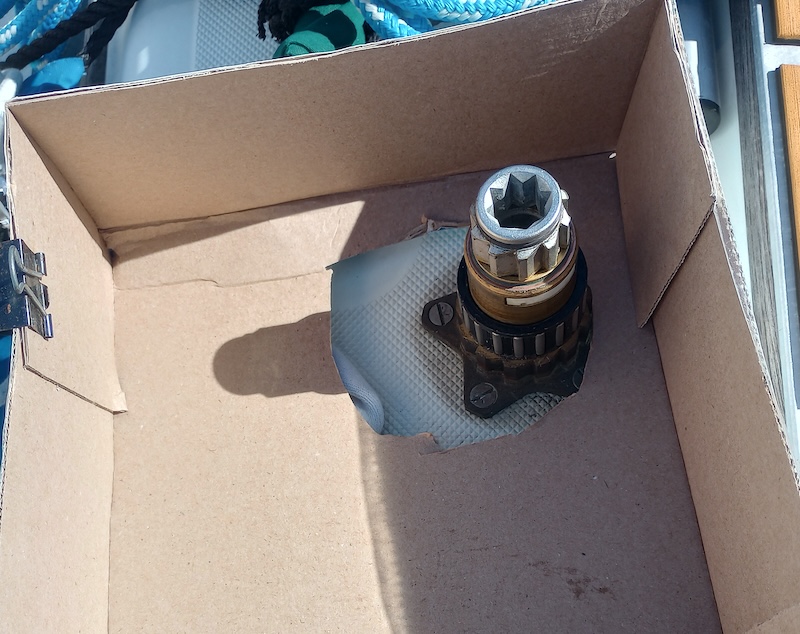
Of course, not losing pieces at all is best, especially gears, bearings and spindles. These are replaceable, but I shudder to think of their costs, and they are not the kind of parts you are going to buy ahead of time. Enter your friends: a couple of repurposed cardboard boxes. They will serve two purposes. One will have a winch-sized hole in its bottom for placement over and around the winch. The box will serve as a basket to catch inadvertent stray parts, acting as a barrier between the winch and the water. It can improve confidence, which in turn can aid performance. The other box, with no hole in its bottom, is a protected area for holding and cleaning the disassembled winch and helps to keep the parts together and the boat clean. Preventing a mess is usually easier than cleaning one up.
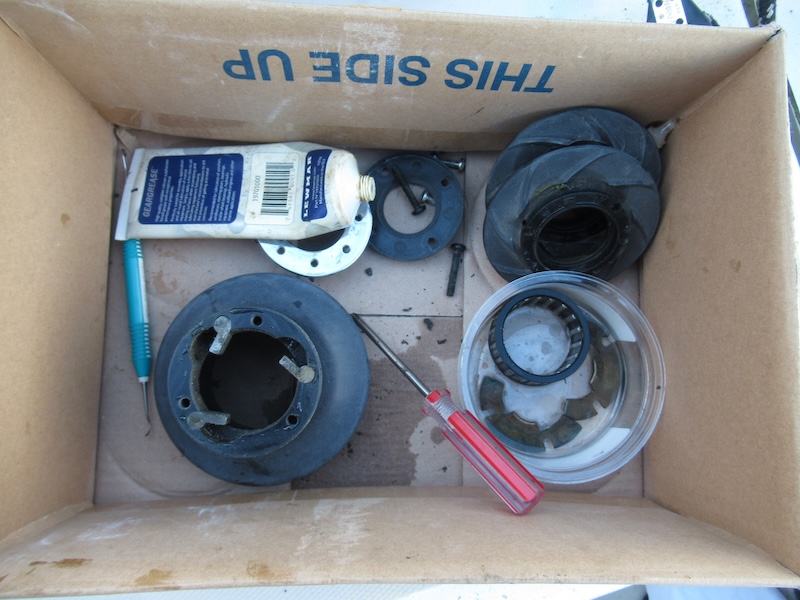
Neglected winches will have caked-on, sticky grease on almost every part inside. Cleaning the parts is the most difficult and time-consuming aspect of the chore. Once familiar, disassembly and reassembly of the winch may take only minutes. The cleaning will take considerably longer. A solvent will be helpful. Lewmar recommends mineral spirits because this is the least damaging to plastic pieces. Have plenty of rags and a dish for soaking pieces on hand. A toothbrush is an excellent tool for detailed cleaning of the many nooks and crannies of a winch, though be cautious about the bristles flicking dirty solvent around your boat. A deep cardboard box shines for this purpose.
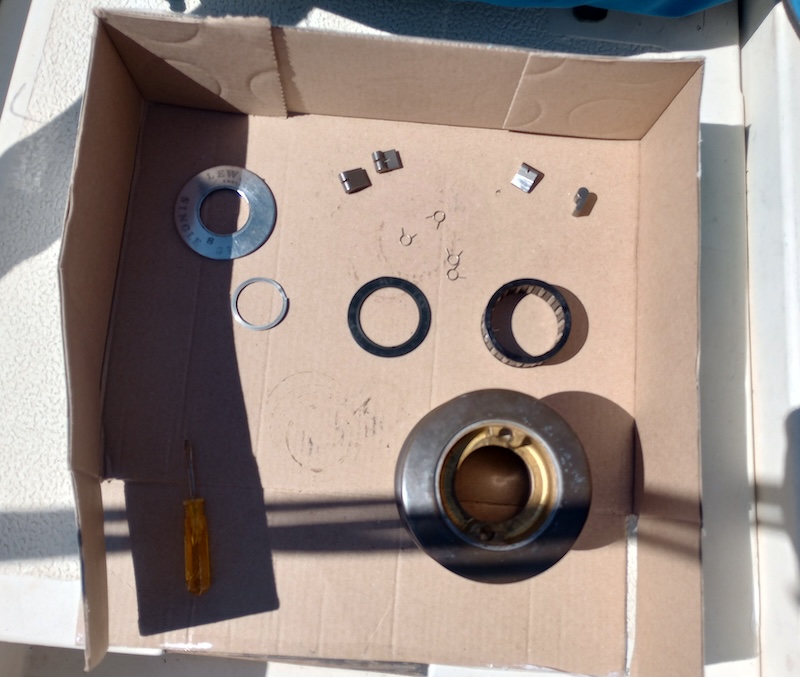
Proper reassembly is important, too. With the Lewmar 8 and the 16ST, this was easy and intuitive, lubricating the pieces as I went. I used a thicker grease for most parts, but the pawls and pawl springs required a lighter oil to prevent them from getting sticky and performing poorly. The winch manufacturers sell proprietary lubricants at a premium price. Only one’s wallet can go wrong with them. That said, they don’t have the market cornered on grease. There are alternatives, such as boat trailer wheel-bearing grease for the heavier lubes and something like 3-in-1 oil or all-weather bicycle chain lube for the lighter. Resistance to moisture, salt and corrosion are the properties to look for.
I used the Lewmar website to review their winch maintenance tutorials before my first go on each model. It gave helpful insight into each winch’s build. The clean, new winches dismantled in an indoor, controlled workspace were not a realistic maintenance presentation, but were still worth reviewing.
Winches are expensive and important sailing hardware, and it is prudent to maintain them properly. For the non-boat-owning racing sailor, it can be a way to contribute to an owner’s investment and elevate your own sailing experience. Once tried, the process may be much demystified. Additionally, the more often it is done, the easier and faster it goes, especially if you aren’t cleaning off years of crusty grease from a neglected winch. Use, environmental conditions and time will determine how often. In my experience and observations, winch maintenance is often delayed, and has never fallen into the “too much” category.
This video shows the process of stripping, cleaning, and reassembling the Lewmar 16ST.
Remember, keep your solutions prudent and safe, and have a blast.
And now for the bloopers …
The Resourceful Sailor here! Just this weekend, I serviced two Harken 16 winches on the Thunderbird sailboat, Corvo. Here is a video of one of those. I hope this helps and inspires. And thanks for reading.
https://youtu.be/JV8NSyEfgy4
I have found that winch covers, sized to snuggly fit over each size of winch, greatly increase the time between winch cleanings as well as the life of each winch. They can, of course, be purchased from any number of on-line sources. However, a resourceful sailor can also haunt marine swap meets for deals on lightly-used covers, or, if handy with canvas skills, roll your own.
Thanks, Bill. Good suggestion. Sampaguita came with such winch covers, and I used them off and on. If the boat is used often, they can easily get misplaced and lost (and blown off in the wind at the dock). In other circumstances, I have made my own, as you also suggested. Repurposed canvas and scraps (because they are small) work great for this (and using drawstrings if you don’t have Velcro) so it can essentially be free.