

On Trim: The Pursuit of Fleeting Perfection
I first understood “trim” as a command, meaning to pull in the sail and synonymous with “sheet.” Later, I would think of trim as an equilibrium of forces, a perfect angle. Sailing on bigger boats, I discovered the idiosyncrasies of telltales and how to stream them evenly on both sides of the sail. Then came the travelers, vang, halyard tension, barber haulers, numerous tweakers and, in general, gazillions of lines lying in the cockpit like a pot of spilt spaghetti, all trying to exert their effect and manipulate every inch of sail to achieve perfect trim — though perfection was at best fleeting, a thing to be forever chased rather than achieved.
The mysterious forces of trim so intrigued me that for a brief time I sought out technical diagrams and terms. “Laminar flow” had a certain gravitas. I was drawn to diagrams where uniform arrows flowed neatly across a sail, depicting some ephemeral state of perfect alignment. But ultimately, science and racing weren’t my thing. When I started windsurfing, I came to understand trim purely through feel. Trim became an act of the body to balance forces, flex through waves, and chase an invisible harmony.
This past summer, I had an epiphany on trim — from my unique sailing niche at my unique spot under unique-ish conditions.
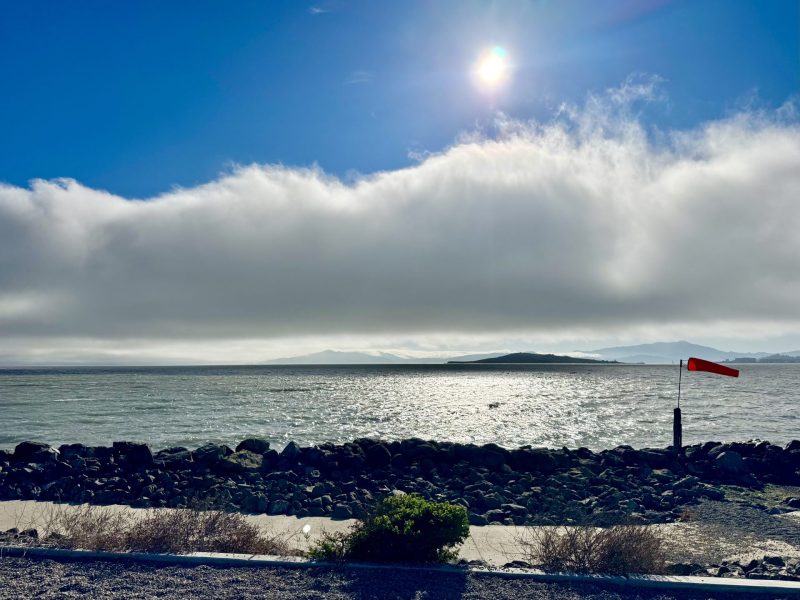
In July, the winds went southwest at Point Isabel, which lies south of Richmond Yacht Club, next to the Costco. A typical westerly wind will carry you in roughly north/south zigzags. But when it’s blowing from the south-southwest, you sail straight out to Brooks Island, to the west. This outbound port tack takes you straight into the waves, though it’s far smoother if you bear off a little and take the seas well forward of “the beam,” such as it is on a board. The return run, on starboard tack sailing east, means that you can be sailing on a tight-ish reach while going down-swell, through the peaks and valleys of the waves.
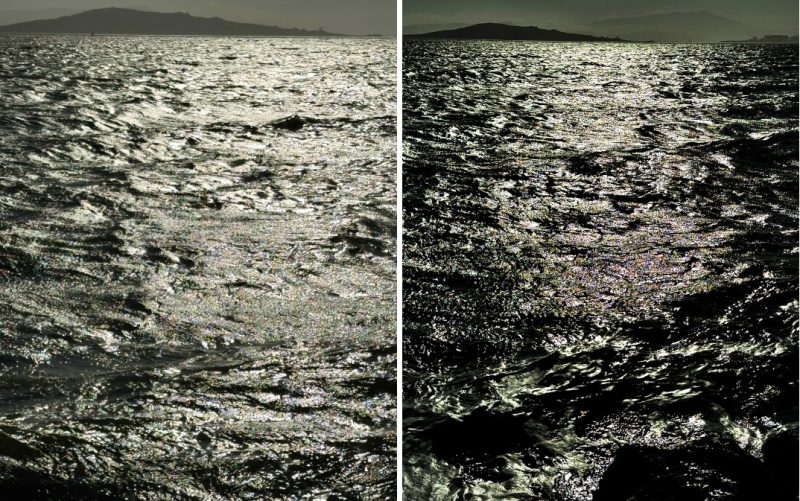
July 10 saw solid conditions — maybe 25 knots — at Isabel. I felt a little lit up, or overpowered, after my first run bashing inelegantly into the waves out to Brooks. I dropped the sail to the water and extended the boom so that I could tighten my outhaul in an attempt to depower. The subsequent down-swell run felt strange by comparison. My “window of power” was much smaller. (Depower successful!) Though on that first return run, I couldn’t find a satisfying angle and thought I might have over-outhauled. Over the next few runs, however, everything started to gel and the sail felt perfectly rigged for the conditions.
I realize that when I try to talk about the specifics of my unique sailing niche, I have no vocabulary for it. When I talk to other windsurfers, we might as well be speaking different languages. When I do attempt to describe specifics, I’m often surprised to find myself making hand and body gestures to demonstrate the various angles utilized through the varying conditions.
Once, when trying to describe windsurfing to a non-windsurfer, I was surprised to hear myself compare it to yoga, saying that you were essentially looking for the perfect pose — something that was both static and seemingly frozen in place, but also infinitely dynamic, with the body making hundreds of micro-adjustments as the board skittered across a heaving surface.
After making the outhaul adjustments and doing a few laps on the July 10 session, I started to think of the down-swell, starboard-tack run as a particular crouch. My body was a little more compact to adjust to the flatter sail. (Technically, I suppose, I was “hiking” less.) As I navigated my way through the undulating Bay, I was hyper-aware of my peculiar pose flexing and bending through the waves, everything in balance.
Suddenly, there it was: perfect trim.
But the sail is just one part of a multifaceted equation. Trim also applies to the board, and it is just as dynamic, if not more, than the sail. On the first few down-swell runs of the session in question, I kept plowing into the backs of waves and losing speed. But for every clunky, mistaken motion in windsurfing, the opposite and ideal motion is a tiny, near-imperceptible adjustment away. Instead of slamming into the backs of waves, I flexed my knees and accelerated over the tops, then dropped into the subsequent face, going through the waves as though I were on a roller coaster.
As I’ve written before in this magazine, I used to find these kinds of minute, crucial adjustments to be nothing short of transcendent, as if you could see the Matrix, use the Force, or were bestowed with superpowers. Though the conditions were better than average that day, and though I had found truly optimal trim, at best, I was merely sailing correctly.
“How was it?” a fellow windsurfer asked me as I returned to shore that day.
“Oh, man!” I answered. I put down my gear and, dripping wet, face smeared with white mineral sunscreen, snot lingering in my beard, head spinning from exertion and stoke, I put out my hands, crouched, and tried to describe that fleeting perfection — the equilibrium of forces, the flawless angles, the nirvana. The other windsurfer smiled politely.
“Cool,” they said.
But, for the first time, I understood it perfectly.