

NOAA Tide Page Bug Highlights Risks of Relying on a Single Navigation Data Source
Louis Benainous, owner of the CS 30 Blue Note sailing out of Berkeley Marina, was developing the tide web app Tide Tracker when he identified a timing discrepancy on official tide pages published by the National Oceanic and Atmospheric Administration (NOAA). This raises broader questions about the importance of verifying critical marine navigation data across multiple sources.
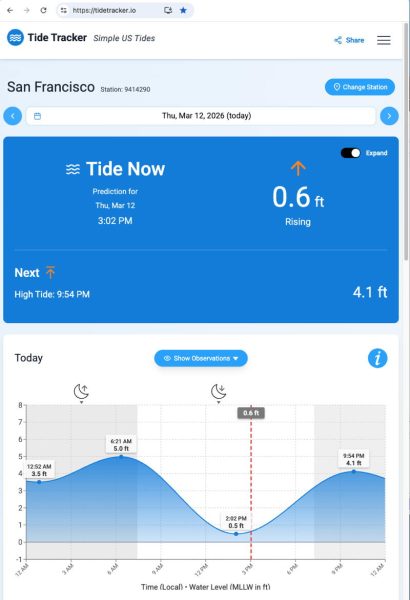
While testing Tide Tracker, the development team noticed that predicted high- and low-tide times displayed in their app differed by exactly one hour from those shown on the NOAA station page for the San Francisco Tide Station.
For March 12, Tide Tracker displayed a predicted high tide of 5.0 feet at 6:21 a.m., while the NOAA station page listed the same tide event at 5:21 a.m.
The team initially suspected a daylight-saving-time error in their own code. After extensive testing and code review failed to identify a problem, the developers contacted NOAA’s Center for Operational Oceanographic Products and Services (CO-OPS) to investigate.
In response, NOAA staff confirmed that the discrepancy is due to an issue affecting the station home pages themselves.
“Our IT staff is aware of this issue with the station home page. I cannot provide any guidance as to when this may be resolved or corrected,” the NOAA representative said.
The NOAA tide predictions available through the agency’s data APIs — the source used by Tide Tracker and many other marine applications — appear to be correct. The issue appears limited to how the station pages display the times, which currently (no pun intended) do not adjust for daylight saving time.
NOAA’s tide and current data are widely used by sailors, commercial mariners, harbor operators, fishermen, coastal planners and recreational boaters throughout the United States. Discrepancies in timing can matter when navigating shallow waters, entering harbors, or planning vessel movements.
“Like many marine app developers, we rely heavily on NOAA data,” said Tide Tracker’s lead designer, Louis Benainous. “Our first assumption was that we had introduced a bug. It took quite a bit of investigation before we realized the discrepancy was coming from the station page itself.”
The discovery underscores a longstanding principle of seamanship: “The prudent mariner will not rely solely on any single aid to navigation.”
Tide Tracker is a free web application designed to present NOAA tide data in a simplified format that shows predicted tides, observed water levels where available, and the current tide level (“Tide Now”) at thousands of US tide stations. Based on what NOAA staff have said, it seems the prudent mariner will do well to get the Tide Tracker app.
The web app is available at https://tidetracker.io
Interestingly, the discrepancy noted by Louis Benainous/Tide Tracker doesn’t appear in the NOAA PDF that ‘Latitude’ staff downloaded last year, and which was used to create the weekend tide and current tables that appear in the magazine and the YRA calendar. For March 12, he reports a 5.0-ft high tide at 0621, the same height and time listed in the NOAA PDF. Appears to be an online issue: AI?
Yes, the error only appears on the official NOAA tide station page — for San Francisco Station:
https://tidesandcurrents.noaa.gov/stationhome.html?id=9414290
NOAA’s other data sources I’ve checked, including their API, have the correct times. As mentioned in the article, NOAA is aware of the error and will hopefully correct it soon. I just checked, and the error is still there.