

Coast Guard Search and Rescue Specialist To Join Baja Ha-Ha Kick-Off Party
US Coast Guard Search and Rescue specialist (SAR) Douglas Samp will join the 2025 Ha-Ha Kick-Off Costume Party and BBQ in San Diego, co-hosted by West Marine. Samp has had considerable experience with the Ha-Ha, having given presentations at the Ha-Ha pre-events for the past three years. He was also the duty officer in 2009 when a Ha-Ha boat was hit by a whale (See EricSF’s comment below this story) and sunk about 180 miles south of San Diego. Samp oversaw what was later declared a “textbook rescue” at the extreme range of San Diego-based helicopters. The rescue was possible because of the boat’s preparation and the leadership of her captain, Eugenie Russell.
This year, USCG SAR is setting up a booth at the Kick-Off party in the West Marine parking lot, on November 2 (presuming the government shutdown has been resolved in time). Samp will share his knowledge and experience with this year’s fleet to help crews understand their own safety preparation and what to expect should they ever require rescue.
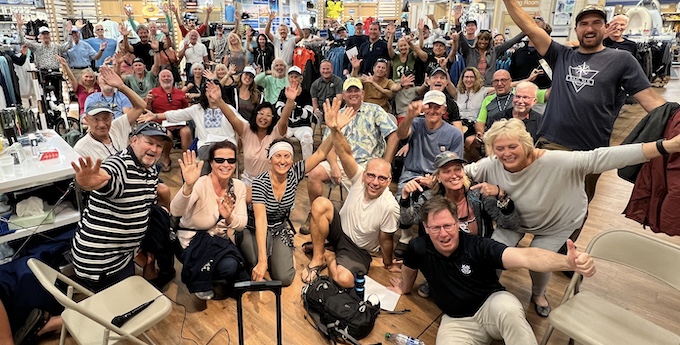
At the time of the 2022 Ha-Ha presentation pictured above, Samp was in charge of Coast Guard Search and Rescue for the entire Pacific Ocean. The Ha-Ha gets the best from the Coast Guard.
Samp, a very friendly and personable guy, has 26 years of Coast Guard and 15 years of Command Center experience as a command duty officer, search mission coordinator (SMC), and Command Center supervisor overseeing Coast Guard and interagency operations at district, area, and sector command centers. Instead of heading up SAR in the Pacific, Samp now travels around the world helping less-developed countries improve their SAR capabilities, although currently he is back in his old seat while District Southwest SAR manager Lauren Cefali is out on maternity leave until March.
We look forward to seeing Samp and the Ha-Ha fleet in San Diego next month. If you’re not sailing with us, come wave us off as we parade our way out of the harbor and south to Mexico.
May I suggest a correction? The Ha-Ha boat J/World was not “hit by a whale.” As the linked article goes to some effort to clarify,
“this completely inaccurate information got passed along. In reality, J/World had been sailing comfortably at about nine knots under a small jib and reefed main when, at the top of swells, the crew began to notice some whales in the area. Suddenly, they found themselves heading down a wave on a nearly head-on course with a humpback whale. Russell says J/World first hit the whale with her keel, and it felt as though they had run aground. Almost immediately afterward, she felt contact between the boat’s shaft and prop and the whale, resulting in blood in the water.”
It would be more fair and accurate to say “a Ha-Ha boat hit and injured a whale and sank about 180 miles south…”
Eric, thanks for your comment. In the past few years, we have had more readers responding to stories about sailboat/whale collisions in a similar manner when the story is framed as a whale “hitting or ramming a sailboat.” That’s fair enough! One of our favorite sailing novels is Herman Melville’s ‘Moby Dick.’ In that case, the whale, Moby Dick, did ram and sink the Pequod, but it was reasonable given Captain Ahab and the Pequod were out to kill him. It made for a great story. But you’re right; it’s hard to know the intentions of whales or sailors. When a whale hits a sailboat or a sailboat hits a whale, we assume neither wanted that to happen. Like yacht racing, you don’t want to hit another boat, regardless of who raises the red flag.
Another great book is ‘In the Heart of the Sea: The Tragedy of the Whale Ship Essex,’ where writer Nathaniel Philbrick writes about the loss of the whaler Essex in the Pacific Ocean in 1820. This appears to be another case where a whale rammed and sunk a sailboat, but again, the sailboat was a Nantucket whaler out to kill whales. The story was the inspiration for the novel ‘Moby Dick.’
It could be that a sailboat inadvertently sails between a mother and a calf, so the mother leaps to the defense of her baby and tries to sink the sailboat. That’s a reasonable reaction to a perceived threat. People have shot others knocking at their front door, even though the person knocking was lost and only wanted to ask for directions. We doubt that a sailboat has ever intentionally rammed a whale, but who knows? Then there are the orcas off of Gibraltar. Certainly, the sailboats aren’t purposely out trying to ram whales, and nobody is quite sure of the motivations of the orcas. But they have been sinking sailboats.
Either way, it’s a good point. However, “Whale Rams Sailboat…” will always be a more interesting headline than “A Sailboat and a Whale Inadvertently Bumped Into Each Other Causing Some Damage.” There are a lot more whales around these days and a lot more sailboats, so we’ll ask both to be careful out there.
Eric – thanks for your comment. In the past few years we have had more readers responding to stories about sailboat/whale collisions in a similar manner when the story is framed as a whale ‘hitting or ramming a sailboat.’ That’s fair enough! One of our favorite sailing novels is Herman Melville’s ‘Moby Dick.’ In that case the whale, Moby Dick, did ram and sink the Pequod but that seems fair since Captain Ahab and the Pequod were out to kill him. It made for a great story and whales hitting sailboats are always a fascinating read. But you’re right, it’s hard to know the intentions of whales or sailors. When a whale hits a sailboat or sailboat hits a whale we assume neither wanted that to happen. Like yacht racing, you don’t want to hit another boat regardless of who raises the red flag.
Another great book is ‘In the Heart of the Sea: The Tragedy of the whale ship Essex‘ where writer Nathaniel Philbrick writes about the loss of the whaler Essex in the Pacific Ocean in 1820. This appears to be another case where a whale rammed and sunk a sailboat but, again, the sailboat was a Nantucket whaler out to kill whales. The story was the inspiration for the novel ‘Moby Dick.’
It could be that a sailboat inadvertently sails between a mother and a calf so the mother leaps to the defense of her baby and tries to sink the sailboat. That’s a reasonable reaction to a perceived threat. People have shot people knocking at their front door even though the person knocking was lost and only wanted to ask directions. We doubt that a sailboat has ever intentionally rammed a whale but who knows? Then there are the Orca’s off of Gibraltar. Certainly the sailboats aren’t purposely out trying to ram whales and nobody is quite sure of the motivations of the Orcas. But they have been sinking sailboats.
Either way, it’s a good point. However, ‘Whale Rams Sailboat…’ will always be a more interesting headline than, ‘A Sailboat and a Whale Inadvertently Bumped Into Each Other Causing Some Damage.’ There are a lot more whales around these days and a lot more sailboats so we’ll ask both to be careful out there.