

A Local Mariner Aging Gracefully on the Bay
Latitude 38 reader Michael Konrad wrote to us recently to share some photos of his current life on the Bay as a rower.
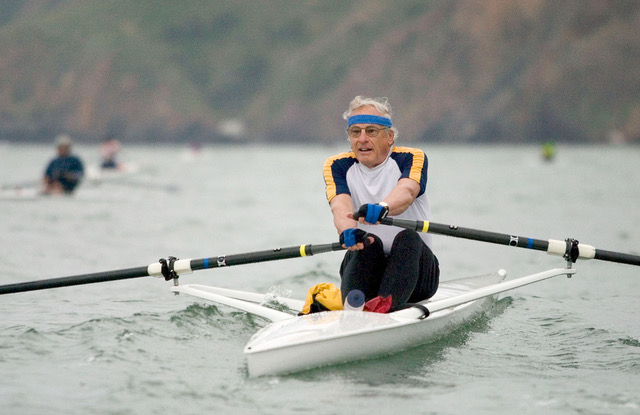
The only thing worse than growing old is not growing old. As readers of Latitude 38 well know, there are many ways to enjoy our beautiful Bay, and one that gets you close to the water is rowing. In the first photo, taken in 2004, I am rowing a Maas Aero shell back from Point Diablo to the Golden Gate during the annual Open Water Rowing Center regatta. The finish line was just off the sea lion statue and the Trident restaurant, and then we cooled off rowing back to our boathouse in Schoonmaker Point Marina. I came in third from last but was happy just to finish.
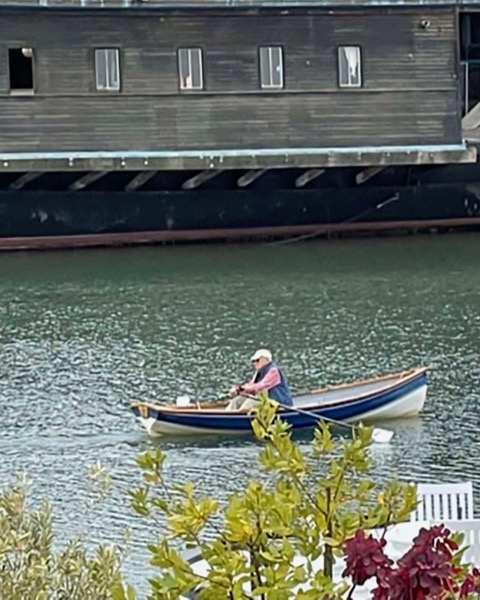
In the second photo, taken in 2024, I am rowing home at Waldo Point past the retired ferry Vallejo, built in 1879. Now I’m in a Gig Harbor Whitehall. It has a sliding seat just like the shell, and I’m using the same Concept lightweight fiberglass oars. Falling out of a shell, particularly in ocean chop, happens all the time, and you have to be able to easily pull yourself back in. That’s why the OWRC [Open Water Rowing Club] won’t let you out in one of their shells until you have demonstrated you can do this. Fortunately, I’m not very likely to fall out of this Whitehall in the calmer waters of Richardson Bay. It is still fun getting out on the water, just different now.
We wrote back and asked Michael to share a little more about himself and his life as a sailor.
• Where/when/how did you learn to sail?
In 1960, while a graduate student at UC Berkeley I bought a Higgins WWII landing craft that was being used as a houseboat in Sausalito and had it towed to Alameda, where I improved the inside modestly. There were no liveaboard berths near Berkeley then, so I used two outboards to take it to Point San Pablo Yacht Harbor and lived on it for a year.
Point San Pablo was quite funky then, and was only 200 yards from a whaling station. Whalers harpooned whales along the coast and towed them to the station, where they were butchered.
I had two other boats. One was a converted WWI 26-ft lifeboat with a one-cylinder Higgins engine that you started by hand. We went to Sausalito many times and had dinner once in Juanita’s restaurant.
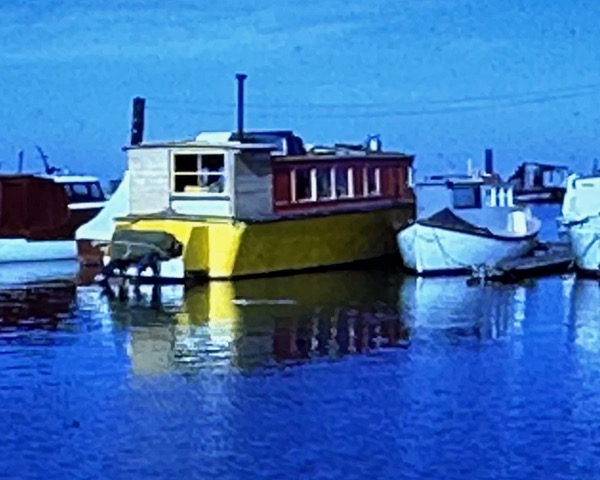
I also had a well-used 25-ft sloop that I bought for $500. I sailed it all over the north S.F. Bay. The most memorable sail was an ill-advised effort to sail around the Farallon Islands. We thought it would be clever to start early in the morning on an ebb, but about a quarter-mile before the Golden Gate realized we were in over our heads and turned back. The ebb was so strong that we barely made headway, but several hours later anchored at Angel Island and slept to noon. My wife became pregnant, so we sold the houseboat back to someone in Sausalito and moved to a Berkeley apartment.
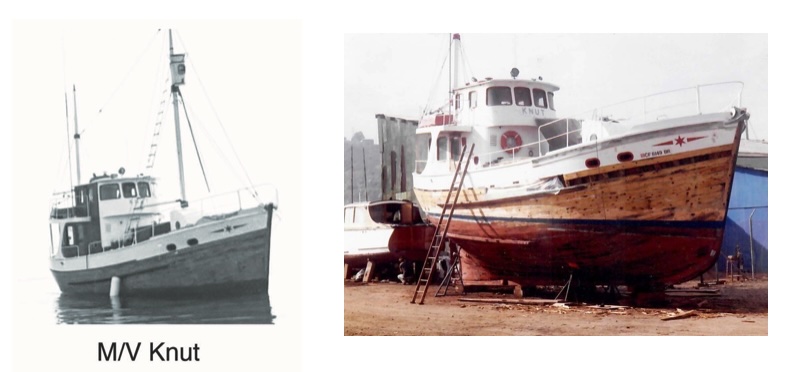
In 1978 I bought a 48-ft wood Romsdal fishing trawler, MV Knut, and lived in it for a year at Pier 39. It had sails, but they functioned mainly to dampen rolling. I later donated it to the Sea Scouts.
• Do you own a boat [aside from the rowing scull and the Whitehall]?
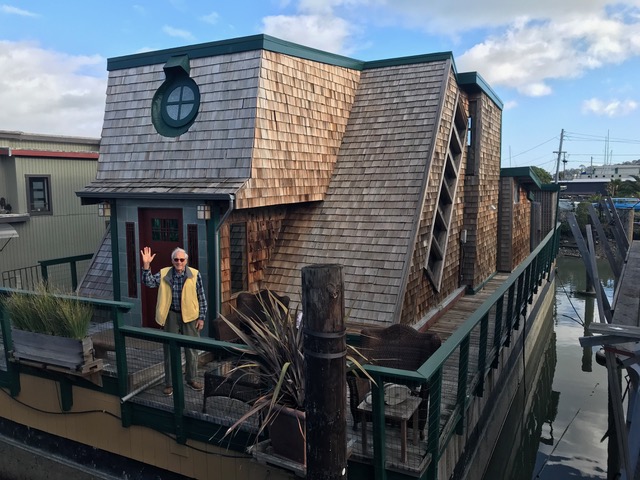
I live in and own a houseboat: HB Heron. It’s easier and cheaper to get a mortgage and insurance if you live in a house. Several years ago a resident of Waldo Point Harbor worked very hard to get Marin County to classify us as living in floating homes, but we all know they are houseboats.
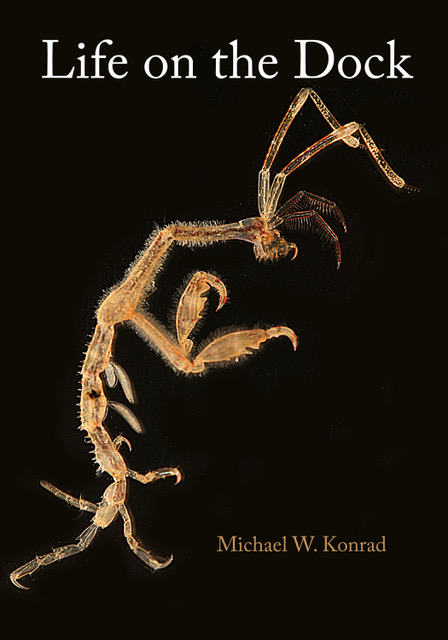
Michael is a retired biochemist and professor at UCLA, who later studied marine biology: “As a young man my hero was Doc Ricketts.”* In 2013 he published Life on the Dock and gave talks about the book at the Sausalito Yacht Club, Spaulding Marine Center, and Sausalito Books by the Bay.
You can see more about Michael’s work at http://www.scienceisart.com.
*Doc Ricketts is Edward Flanders Robb Ricketts (May 14,1897–May 11,1948). He was an American marine biologist, ecologist and philosopher, and renowned as the inspiration for the character Doc in John Steinbeck’s 1945 novel Cannery Row.
I share so many of similar circumstances. Arriving in Sausalito for the first time in 1961 at 17, but after a 4 year Marine Corps enlistment, returned in 1965 to Sausalito where I have too many stories. I too have lived aboard, sailed, rowed at OWRC and Marin Rowing. Someday I must tell them.
Hi Michael, Shirwin here – enjoyed your description of your water borne adventures, and sure do remember you from OWRC 🙂 Plus you live in pretty much my favorite houseboat – excellent choice! Keep it up – as long as we can keep our lives connected with water, we’ll be good💖
Michael Konrad is my neighbor on South 40 Dock and we chat often. I was delighted to see his photo essay in Floating Times, from where I tracked it to this site. I’ve lived in this community for about 60 years, a few of which I spent sailing around the Pacific. Latitude 38 may have some interest in my writings. Please take a look at my kindle book on Amazon. https://www.amazon.com/dp/B0FLMRM1K1 “Last Voyage Of The Redlegs'” is also in paperback. https://www.thehippievoices.com/books/