
Whales, Look Out! — Windsurfer Collides With Whale on San Francisco Bay
You may have already seen this. It’s been doing the rounds on social media, and even made it to primetime news. We felt it would be remiss of us not to share. Windsurfer Eric Kramers was cruising along on the Bay when his ride was cut short by a collision with a whale.
View this post on Instagram
Eric wrote about the incident, “It was a ‘whale’ of a day. Please be cautious and respect wildlife. I had reduced my speed greatly bc I had seen a couple whales in the area, but on my last run back it just popped up right in front of me. Glad we are both OK.”
This view was taken from Crissy Field, posted on Instagram by @fir3nsalt.
View this post on Instagram
Well, the windsurfer is “back on the horse.” Here’s a view, sans whale collision.
View this post on Instagram
This reminds us that these beautiful giant cetaceans are in our neighborhood for the coming months (hopefully), and we’d like to think there’s room for them and us to enjoy our vast waterways. Please, take care. Have an extra lookout on “whale watch.” And of course, take photos, and send some our way — [email protected]. We love whales!
The Very First “Big Sail” Between Cal and Stanford
Following our January 2026 story on “The Big Sail,” the annual collegiate regatta between Cal and Stanford, we received a letter from Berkeley Yacht Club staff commodore Michael Yovino-Young about his founding of the regatta in 1989. Berkeley YC (BYC) ran the regatta for the first two years; it has subsequently been run by the St. Francis Yacht Club.
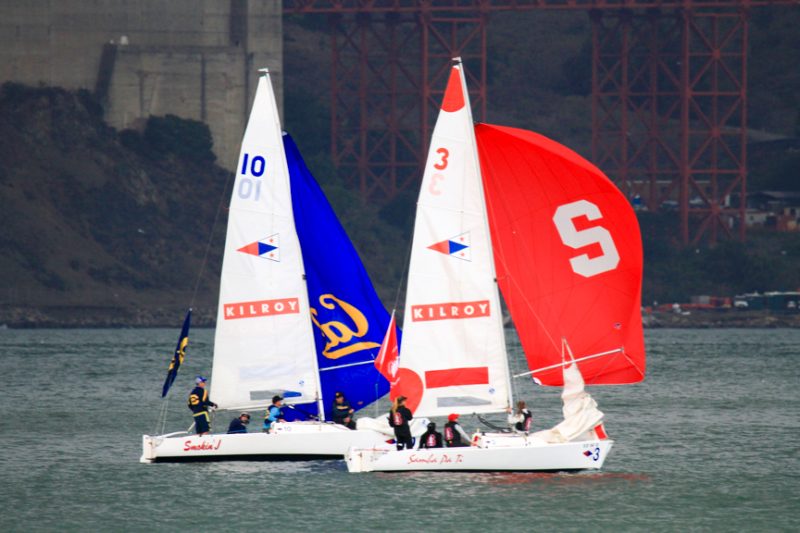
As BYC commodore in 1989, I was among the number of BYC members who were Cal alums, and we even had a few Stanford alums. I had long wanted to organize a Cal-Stanford regatta, and our club had some of the best intercollegiate racers in the state. To celebrate the club’s 50th anniversary, I decided to organize a “Big Sail” (later called the Cal Stanford Cup) and designed the trophy that included the school logos and, of course, the “axe,” which I believe is the same trophy in the St. Francis YC today.
I had arranged with J Boats to borrow two identical J/29s for the two teams, each with eight crew, of which two had to be women.
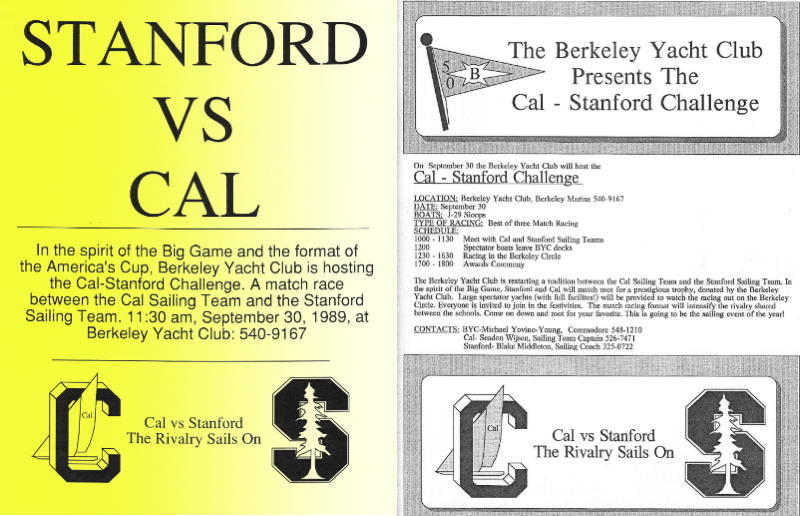
The sailing instructions stipulated that the winner would be the best of three match races, with crews switching boats for each race. Under the watchful eyes of BYC’s premier racing manager, Bobbi Tosse, the regatta was held on September 30, 1989, on the Berkeley Circle. The Cal team was clearly superior, winning the first two races with wide margins. The Stanford team graciously decided to concede the third race, and BYC hosted a trophy celebration for the crews, families, club members and spectators. One pundit said, “These races were a model of sportsmanship.” And so they were.
A second Cal Stanford Cup regatta was held on April 13, 1991, this time in Olson 30s with the same sailing instructions. Again, Cal prevailed, with three wins and bragging rights for the year.
We have no record of further regattas in the subsequent years, and the trophy seemed to disappear. It was only in the recent past while attending an event at the St. Francis YC that I saw the trophy and contacted someone in their race-management committee, but subsequently lost touch.
I am pleased to say that this event in modern times was the creation of the Berkeley YC and that the tradition is now in the capable hands of the St. Francis YC. I also take a little pride in knowing the special trophy I designed is still here and part of the current tradition. I hope to attend the next Big Sail, which I assume will be sometime later this year. — Gaetano Michael Yovino-Young, BYC Staff Commodore 1989.
The first Cal-Stanford match was covered in our November 1989 issue. We reread the story where it mentioned that one of the J/29s was J’Ouvert Mornin, donated by John Marsh and Andy Paul. Coincidentally, this was the boat we regularly raced aboard in the late ’80s! The second Cal-Stanford match was covered in the April 1991 issue of Latitude 38.
Visit Antioch Marina, the Gateway to the Delta
Mercurys Sail Encinal Spring Series #1
Alameda lived up to its billing for racing in the springtime: light (0–5 knots), shifty winds and some strong currents. The weather was great, with sunshine and a perfect temperature allowing beautiful sailing in shorts and T-shirts. Twelve boats made for a great fleet of racers.
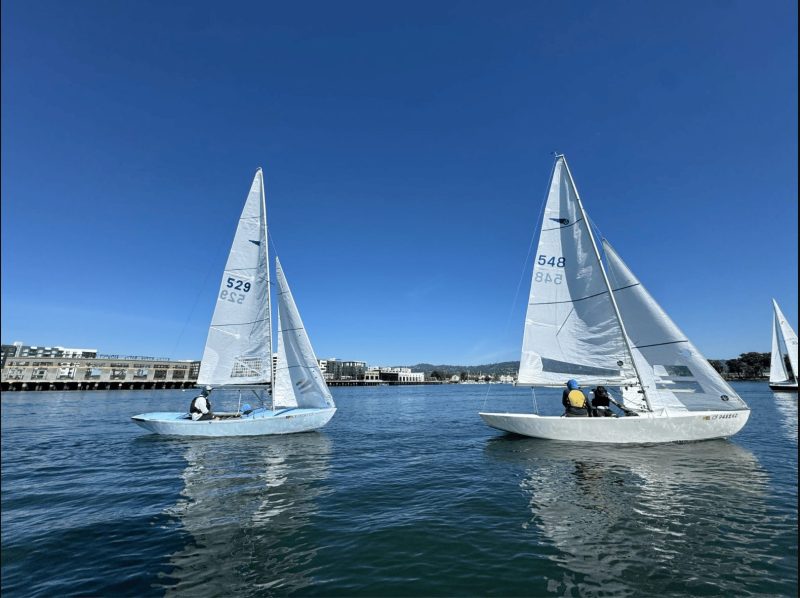
Throughout the day, picking the proper side of the course proved invaluable: Make a wrong choice and you could be sitting in a wind hole watching the rest of the fleet sail away. Upwind and downwind, the puffs, lifts and headers proved crucial to finishing well.
Local skipper John Hansen and crew Alan Sun showed a great knowledge of the wind shifts — when and where they would fill. Their finishes bore that out, recording bullets the last two races. Another John (skipper) and Michael (crew) Ravizza, perennial high finishers, had some strong races, and per John, he didn’t listen to his crew and they had a couple of mid-fleet finishes. Dave Bacci (skipper) and Scott Jenson (crew) made some good choices in the first two races, then stumbled with a couple of average starts in races three and four. They started late in race five for their throwout. Skipper David West and crew Chris Krueger booked results similar to the rest of the top 10. They had some strong races, then picked the wind incorrectly (or had some other issues, such as OCS or hitting marks) for some mid- to low fleet finishes.
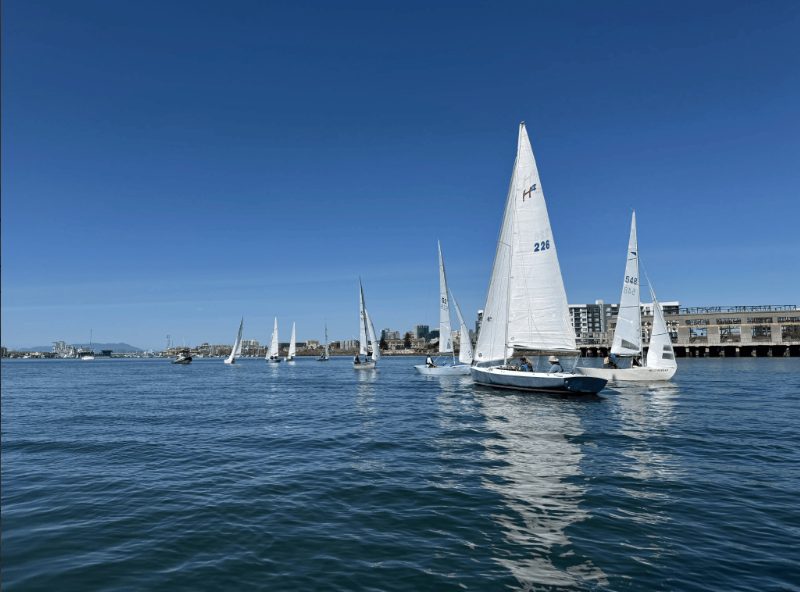
PRO Aaron Lee, with the help of John Buestad, did a great job under the conditions, picked correctly when to start the races, and made a complete course change once to keep the racing going. As usual, Encinal Yacht Club provided a great venue and super hospitality after the racing. A big thanks to EYC.
Hope to see everyone (and more skippers) back on April 4!
Another Beautiful Sailing Weekend on San Francisco Bay
Could this weekend be as good as last weekend? We may be lamenting the poor snowpack in the Sierra and the lack of rain to fill reservoirs, but there’s no doubt it’s been a beautiful winter and spring for sailing. We missed most of it due to rotator cuff surgery but finally finished PT a few weeks ago and were released to go sailing again. The timing was right.
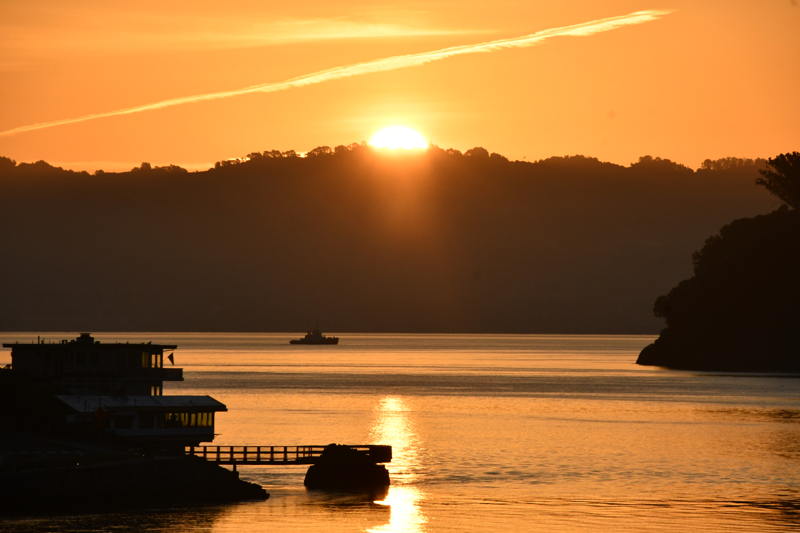
After spending Saturday night on the boat, we awoke for an early Sunday morning walk, cleaned up the boat, and waited a bit for some breeze to fill in. Our regular crew gathered to help get the boat ready for a sail under clear, sunny skies. Damn, we realized how much we’d been missing being out on the Bay.
As so often happens, we were also reminded of how many times the Bay’s reputation for severe conditions is far overshadowed by the many days and hours of very benign sailing. There are plenty of very breezy days in the “Slot,” but change the hours, location on the Bay, or the season you choose to sail and you’ll find there are many more hours of mellower sailing than most people believe. Last Sunday was another one of those many days.
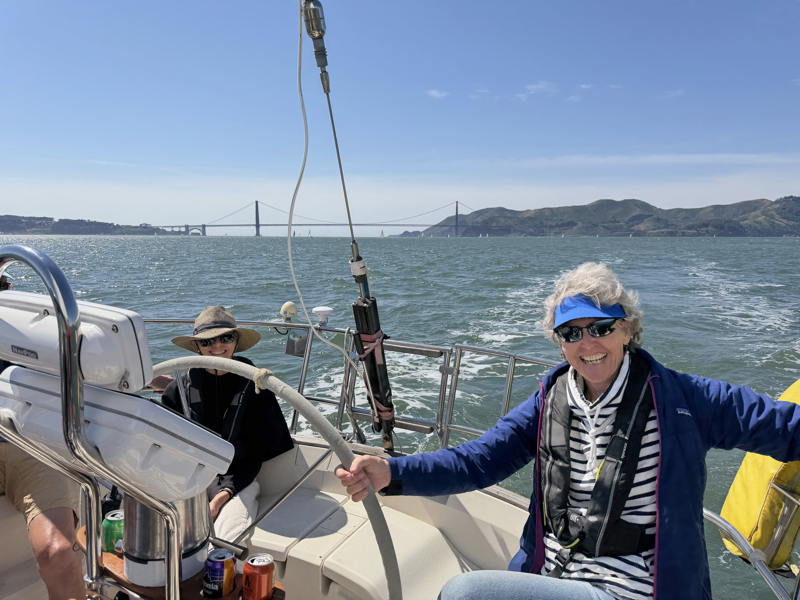
We followed the classic course we’ve called “The Perfect Daysail” that takes us upwind toward the Gate while the day’s breeze is still building. Last Sunday had a solid ebb around noon, so with a light breeze, we didn’t want to get too far out the Gate, knowing we’d have a slow time fighting the current to get back into the Bay. We turned downwind along the Marin shoreline, where both the breeze and current were light, making it ideal to pull out the sandwiches for the reach toward Crissy Field.
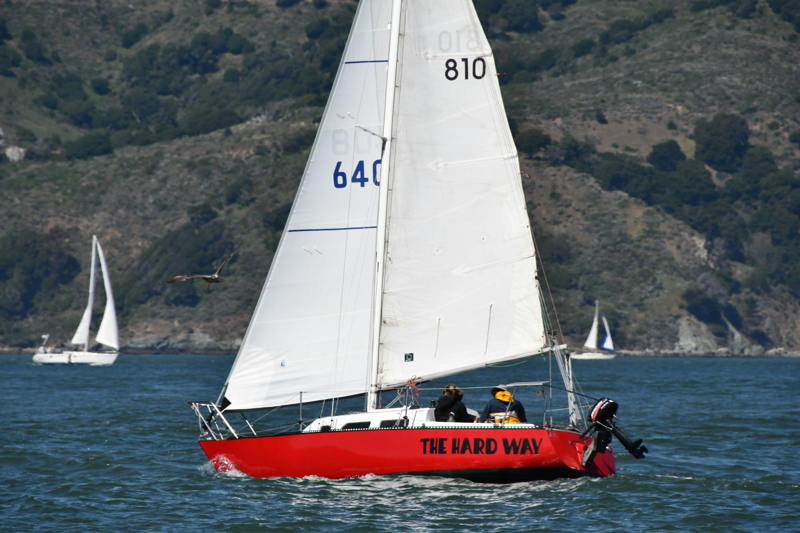
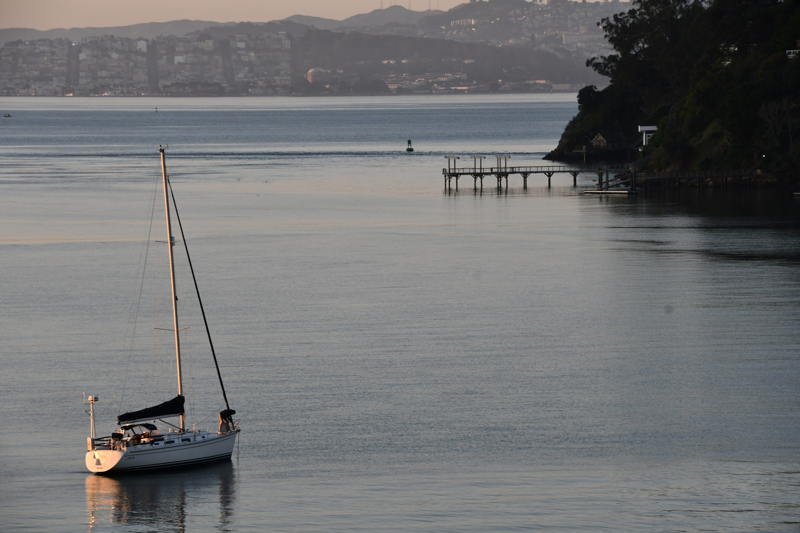
We weren’t alone out there. There were loads of sailboats savoring sailing on the Bay. One of the great positives about the Bay’s reliable breeze is that you can go boating almost anytime, all day long, without worrying about the price of fuel. Boats like The Hard Way, pictured above, rarely need to put that outboard into the water. Wind power has been quietly powering sailboats for almost 4,000 years, and there’s no place better than the Bay to take advantage of it.
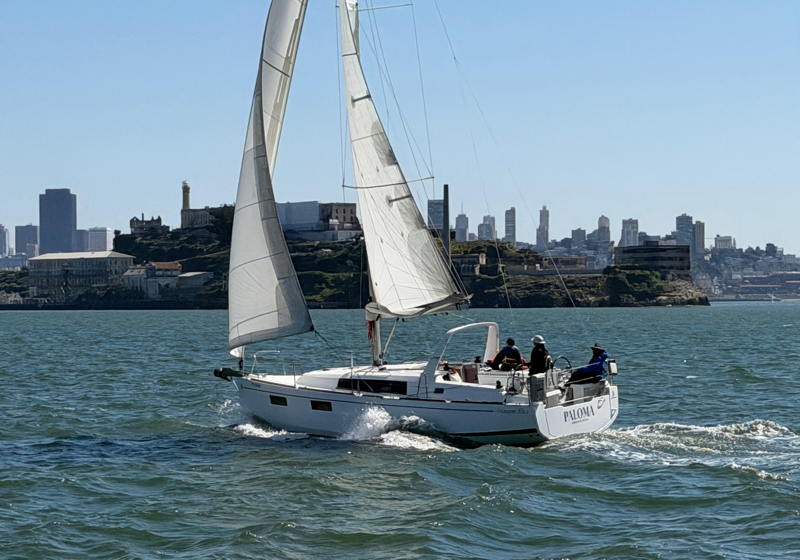
It looks like another amazing weekend ahead, with temperatures predicted to be in the 80s. Now that we’re sailing again, we’re going to start this weekend with tonight’s Corinthian Yacht Club Friday Night Beer Can races, then probably spend some more time with some small boat projects to get her ready for the rest of the season. The following weekend we’ll be doing the Friday night race again and then sailing for a good cause by participating in the Sailing4Parkinson’s Race on April 12.
Christine Weaver’s Wednesday ‘Lectronic Latitude offers some more events and beer can races that might inspire you to spend more time on your boat on the Bay. But don’t forget you can also spend these warm spring nights anchored in Clipper Cove, Paradise Cove, Belvedere Cove, Richardson Bay, Horseshoe Cove or Aquatic Park before heading out for another perfect daysail. The forecast looks good; we hope to see you out there racing, cruising or daysailing.
Ruby Gates’ Learning Curves Aboard ‘Makani’
I’ve sailed thousands of miles since I bought Makani back in 2021. She has endured a hurricane at anchor; violent squalls with lightning; heavy seas; thousands of miles of Pacific swells; aggressive, battering wind; busted rigging; failed electrical components; failed transmission; tattered sails — I could go on.
I keep a list of my repairs. At this writing, Makani has needed more than 30 significant repairs, or newly installed equipment, totaling around $44,000 over the four-and-a-half years I’ve owned the boat.
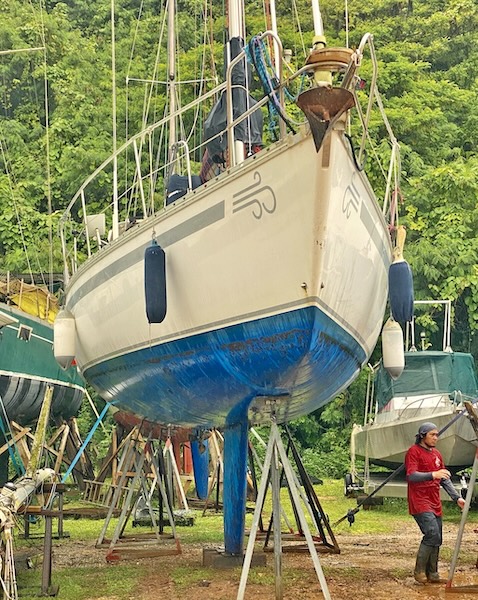
Salt water is punishing; constant motion eventually wears things out; and even non-use can take its toll. In 2024, I left the boat in Tahiti for three months during cyclone season. She was protected and attended to. Nevertheless, the rain and humidity did such a number on her that when I got back, I had to replace my autopilot controller, fix new leaks in the portholes, and deal with massive mildew — even though I had prepared her for the hot and humid conditions.
This year [2025], I had several issues, including replacing a thru-hull fitting, hunting down an electrolysis issue, replacing my watermaker solenoid, painting the bottom (again), and teaching myself how to repair damage to the fiberglass, incurred during an unfortunate encounter with a cement dock in Samoa. Moreover, the farther west I sail, the more Makani shows her wear and tear, and the more expensive parts become since I’m nowhere near a supplier for anything. I have massive amounts of spare parts, but rarely the one I need. The frustration and exasperation multiply when I have another repair to make before I’m done with the present one. Or I’m at sea with days to go before making landfall.
Repairs aside, just adhering to a maintenance schedule can get overwhelming, Back in the early days of my singlehanding, when these things seemed insurmountable, I often cried in frustration and felt like giving up.
Not so much anymore. These days, I often remind myself — no, congratulate myself on — how much I’ve learned to do on my own. Aspects of repairs I had no idea how to do four years ago now seem easy.
You Won’t Be a Stick in the Mud at Vallejo Yacht Club