

Scow Bow For Racing and Cruising: ‘Palanad 4’ Wins RORC Transatlantic Race
After an overall win in the RORC Transatlantic Race, Palanad 4 continues to show that, in addition to cruising, scow-bowed yachts are also good for racing. We’ve been covering the building and cruising life of Barry Spanier’s junk-rigged, Antrim-designed scow-bowed cruiser Rosie G, which has us paying more attention to racing boats with a similar design. Our December issue included a letter from Barry with follow-up comments from designer Jim Antrim and another comment from Max Ebb.
Barry and his wife Samantha have now cruised their junk-rigged scow Rosie G from San Francisco to Australia. Barry wrote to us saying, “The scow bow is here to stay. I admit that before sailing Rosie G, we had to always consider Jim’s correctly given concerns about something few knew anything about, though he was willing to step in. [Jim Antrim drew the boat design from Barry’s sketches drawn in Tahiti in 1978.] Sailing in the Bay before our departure gave me confidence that Jim did a great job. The first offshore miles with him aboard added to that feeling. Now, with a full ocean of experience, I can also say, ‘DAMN! What a concept!’ Obviously, our choice of the junk rig is also a factor in our experience, and it has not been negative in any way. A WAG (wild ass guess) has been to keep it simple, less expensive [and] easy for elders (my main goal) and has proven to have some characteristics that were never considered because we had nothing to base ideas on. I think the fact that the total rig weight above the deck with the full sail set is likely under 500 lbs is a key factor in the stability (low heeling) and easy motion running. Being able to equal true wind speed dead down up to 4 kts true is also something never imagined. It’s made us very happy to have an autopilot because the wind vane doesn’t work with zero apparent wind.
“Now when I say scows rule, Palanad 4 is another example of the performance of scow-bowed boats. If Palanad 4’s beautiful example continues to achieve winning results, we will find out more about why the shape is banned in many classes. To me, that is simply driven by the fear of the lost value of very expensive race boats before any other reason.” We first wrote of Barry and Jim’s collaboration in ‘Lectronic Latitude in 2019.
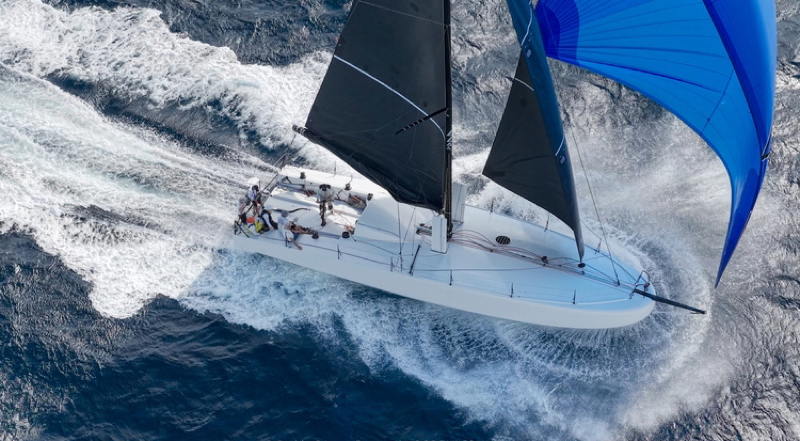
Scow bows have been winning the Mini Transat race for over a decade. The shape is appearing in Class 40 designs, and now the 50-ft Palanad 4 is showing the way in larger race boats. The Mach 50 Palanad 4 was showing off at the finish as it sailed across the line off English Harbour, Antigua, at 20+ knots.
Palanad 4’s designer, Sam Manuard, commented after the race. “This race was incredibly valuable. You can simulate a lot, but nothing replaces sailing for days in real trade-wind conditions, in VMG mode, with proper pressure. We learned a huge amount. One thing people immediately notice is how dry the boat is,” he explained. “Even at 20 to 25 knots downwind, the deck stays remarkably dry. That matters offshore. Comfort is performance. When the crew can stay focused, the boat goes faster.”
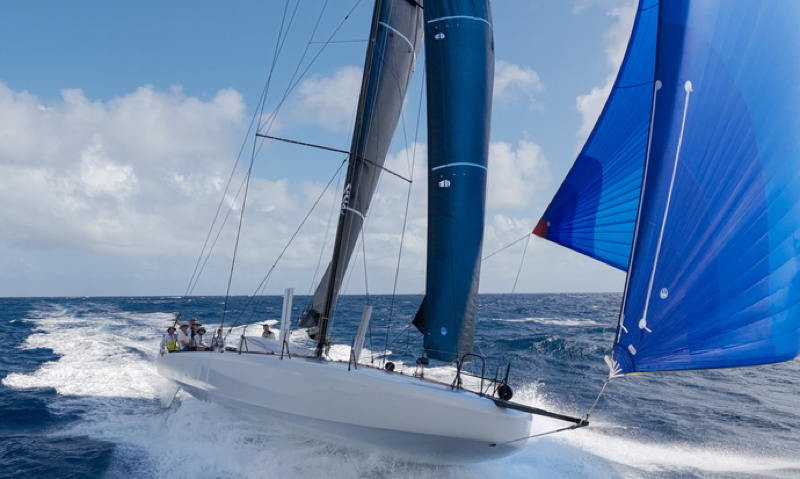
Manuard noted that Palanad 4’s win highlighted that performance doesn’t come from short bursts of speed, but from consistency and efficiency over distance.
For cruising, Barry has also noted that one of the other great reasons for a scow bow is the added interior volume. This creates added comfort and storage below, and you can fit the volume of a 50-ft boat in a 40-ft slip!
The scow bow is certainly making an impression. We received a note from Jim Antrim saying he’s now working with a new client on another scow-bowed cruising boat. We’re excited to see the results!
Note: This week’s Good Jibes (released each Tuesday) will feature guest Barry Spanier, who will talk a little about Rosie G and about his lifetime of sailing and sailmaking. Tune in here.
Join the Latitude 38 Spring Crew List Party on March 5
As the days get longer and the weather gets warmer, we’re excited to announce our upcoming Spring Crew List Party on March 5! This year’s spring shindig will be held at the Golden Gate Yacht Club in San Francisco. Amid the general celebration of sailing and community is the opportunity for sailors and want-to-be sailors to connect in person — the place where boat owners find crew and crew find boats to sail aboard.
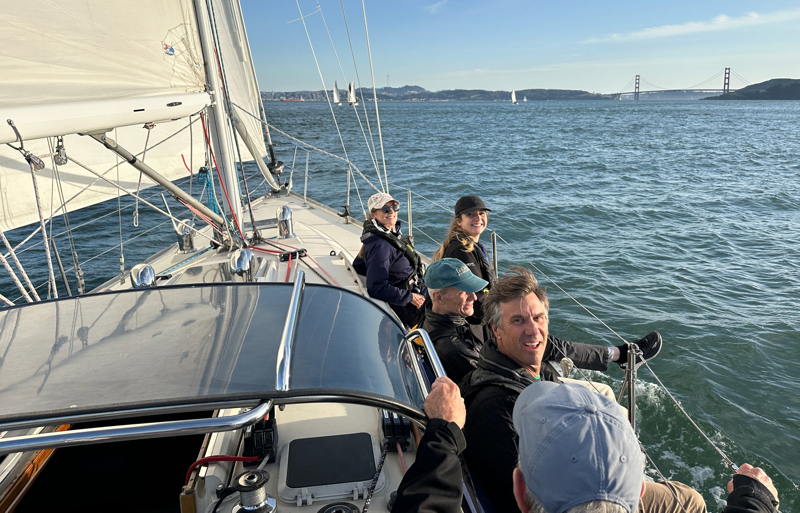
Looking for crew for an upcoming race? Hoping to join a summer cruise? Just want to spend more time sailing on the Bay? Our Crew List Party is all about bringing sailors together, whether you own a boat or are looking to hop aboard.
- Mingle with fellow sailors and skippers to find your next sailing opportunity
- Drinks will be available for sale from GGYC
- Casablanca Mediterranean food truck onsite for the evening
- Meet local sailing organizations and vendors who can help get you on the water
- Door prizes, sailing slideshows, and a lively sailing community
The Crew List Party is all about making sailing connections in a relaxed, social setting. To give yourself a head start, make sure your name is on the crew list here.
Details:
What: Latitude 38 Spring Crew List Party — San Francisco
Where: Thursday, March 5, 2026 | Golden Gate Yacht Club.
When: 6–9 p.m.
Entry: $10

Coming by water? Guest docks are available at GGYC for club members. San Francisco Marina has guest docks available. Please contact the marina directly to make arrangements.
Parking:
Golden Gate Yacht Club is located at 1 Yacht Rd., San Francisco, CA 94123. There is free public parking in the large parking lot west of the Golden Gate Yacht Club, near the stone lighthouse.
Hang out with skippers, sailors, sponsors and the sailing community at the Golden Gate Yacht Club on the San Francisco Bay waterfront. Whether you want to find a boat, find a ride, or find crew, this is the place to do it all.
Stay Connected:
Join the Latitude 38 Crew List in advance to post or search for crew opportunities — and keep the connections going year-round. You can sign up to crew or to find crew using our free online Crew Lists, but you don’t have to be on a Crew List to come to the party!
We’ll see you there! – Latitude 38
Visit Naos Yachts for Full Sales and Service
‘Sodebo’ Breaks Jules Verne Trophy Circumnavigation Record
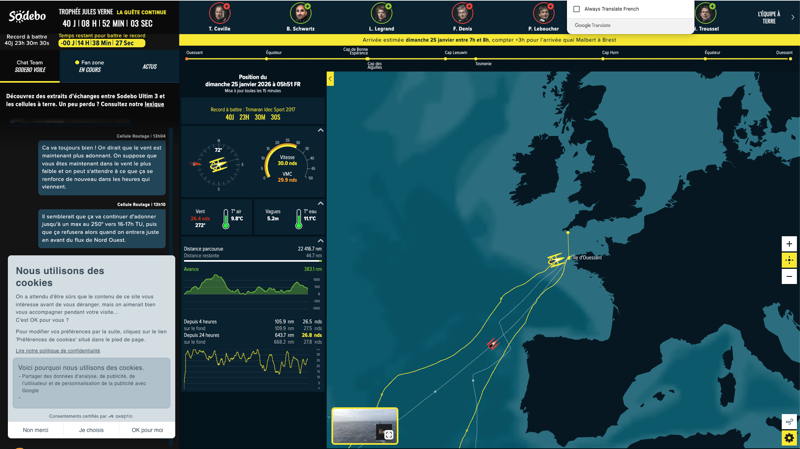
They made it! Sodebo crossed the finish line on Sunday morning, beating the Jules Verne Trophy circumnavigation record by almost 13 hours with a final time of 40 days, 10 hours, 45 minutes and 40 seconds. The record had stood since 2017, when Francis Joyon sailed nonstop around the world in 40 days, 23 hours, 30 minutes and 30 seconds. In December, Thomas Coville and six crew set off aboard the 100-ft trimaran Sodebo to attempt to break this already amazingly fast nine-year-old record.
The first Jules Verne record of sailing around the world in under 80 days was set by Bruno Peyron in 1993 aboard the 85-ft Commodore Explorer with American Cam Lewis aboard. It’s been lowered nine times since then.
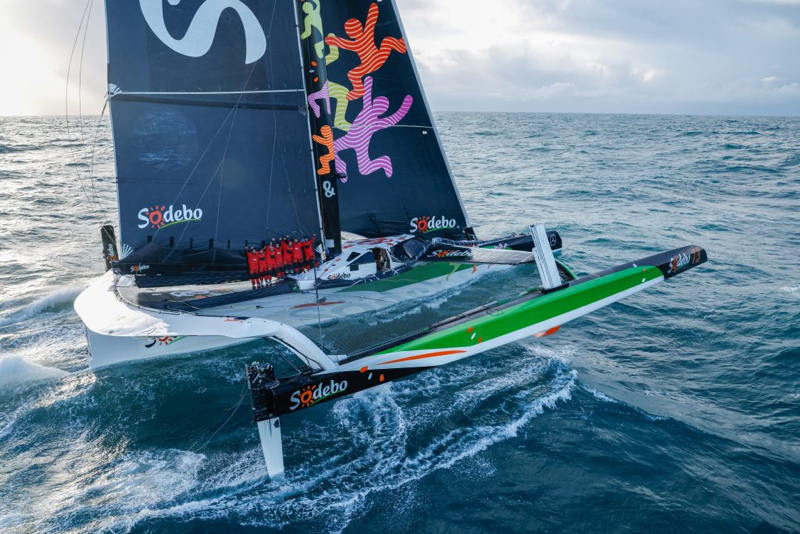
Sodebo skipper Thomas and the crew averaged about 29.17 knots for their over-28,000-mile route around the planet. They beat all kinds of records along the way, weathered storms, and dodged icebergs. Finishing in the North Atlantic in January always sounds like a bad idea, but if you want to break records these are the things you do. You want to get around Cape Horn in the “summer,” and that brings you home in the winter. In their last 1,000 miles the crew reported winds up to 55 knots and seas up to 38 feet. And it’s cold.
These 100-ft Ultime-class trimarans have the crews essentially entirely encapsulated in the cabin, so most of the line handling, winch grinding, helmsmanship, navigation and all the rest happens “down below.” They very rarely tack or jibe, and actually, we’d guess they tack fewer times in 28,000 miles than we do in the average weather leg on the Cityfront. It’s also amazing that they don’t hit anything. Most racers have some fear that they could hit a log or container in the middle of the night, so sailing at that speed 24/7 for 40 days would be extra worrisome. Many prior record attempts have been aborted due to collisions with UFOs (unidentified floating objects).
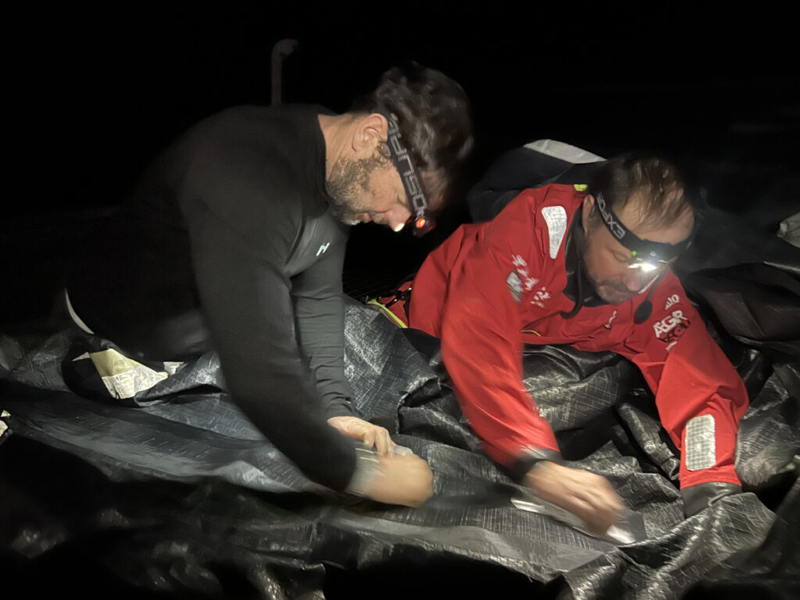
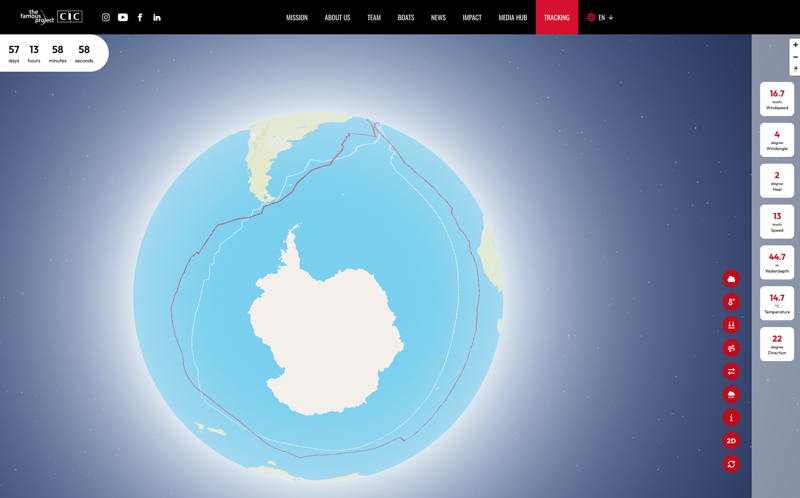
While Sodebo was on their record-setting run there was another record attempt underway. The all-women’s team, The Famous Project, was looking to set the benchmark for the fastest time around the world for a female-crewed boat. The team has succeeded in their goal by completing their run for the Jules Verne Trophy in 57 days, 21 hours and 20 minutes. The Famous Project crew were also racing to break Joyon’s record, aboard Joyon’s 100-ft Ultime IDEC SPORT. Regardless of their finish time, they have broken new ground with their successful voyage, punctuated by countless racing challenges and unpredictable adversities on the ocean.
The Famous Project carried a total crew of eight from seven different nations, including skipper Alexia Barrier, Dee Caffari, Annemieke Bes, Rebecca Gmür Hornell, Deborah Blair, American Molly LaPointe, Támara Echegoyen, and Stacey Jackson. They were, above all, eager to make history in women’s sports and sailing by becoming the first exclusively female crew to complete this nonstop circumnavigation. They’ve done it!
Like the Vendée Globe, the Jules Verne Trophy seems dominated by the French, who have held the record nine out of the 10 times it’s been set. The first six records were set on catamarans, but since 2010 all the records have been set on trimarans.
The complete list of 10 records is here (with Bruno Peyron setting it three times!):
2026 – Thomas Coville, Sodebo – 40:10:45:50
2017 – Francis Joyon / IDEC SPORT – 40:23:30:30
2012 – Loïck Peyron / Banque Populaire V – 45:13:42:53
2010 – Franck Cammas / Groupama 3 – 48:07:44:52
2005 – Bruno Peyron / Orange II – 50:16:20:04
2004 – Olivier de Kersauson / Geronimo – 63:13:59:46
2002 – Bruno Peyron / Orange – 64:08:37:24
1997 – Olivier de Kersauson / Sport-Elec – 71:14:22:08
1994 – Peter Blake, Robin Knox-Johnston / Enza New Zealand – 74:22:17:22
1993 – Bruno Peyron / Commodore Explorer – 79:06:15:56
It will likely be the French who break this record again; it’s getting harder and harder to beat.
Pacific Puddle Jump Registrations Now Open
Last spring we announced that Sail Tahiti had taken over the Pacific Puddle Jump, and that from summer 2025, the new PPJ website would offer free access to content covering everything from preparing the boat for the crossing to tips for discovering Polynesia off the beaten track. Sail Tahiti has made good on that promise, and the PPJ is now open for registrations for this year’s rally to French Polynesia, with free and paid options.
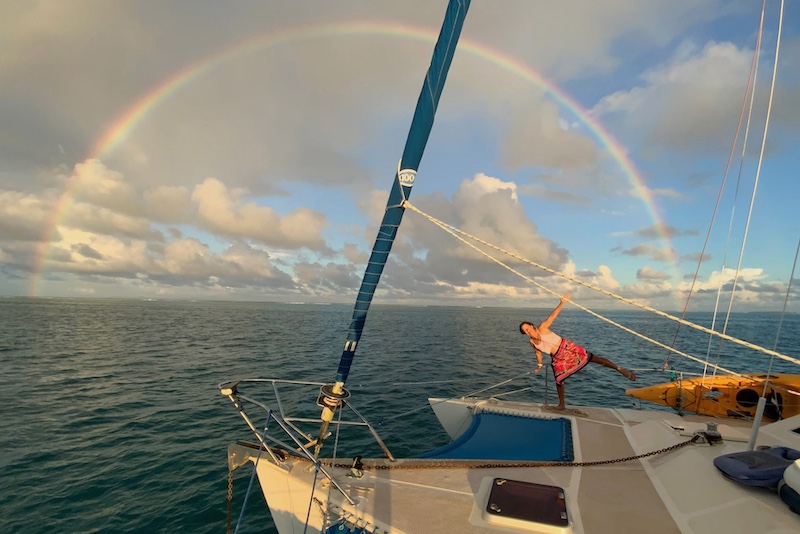
Prior to Sail Tahiti’s takeover, the Pacific Puddle Jump had been run by former Latitude 38 editor Andy Turpin. Andy started the PPJ in 1997 as the first organized and supported cruising rally from the Americas’ west coast to French Polynesia. Participants would take up the offer of various pre-sail seminars and support along the way, and crossings would begin anytime between February and May, from various ports. It soon established itself as one of the world’s leading offshore sailing rallies. Now under the Sail Tahiti banner, the PPJ is set to continue the tradition of minimal rules, camaraderie, and support. Designed above all for the safety and solidarity of the fleet, the PPJ is an international community of navigators united by a passion for long-distance sailing and French Polynesia exploration. Since 1997, over 4,000 people of more than a dozen nationalities have embarked on this collective ocean adventure.
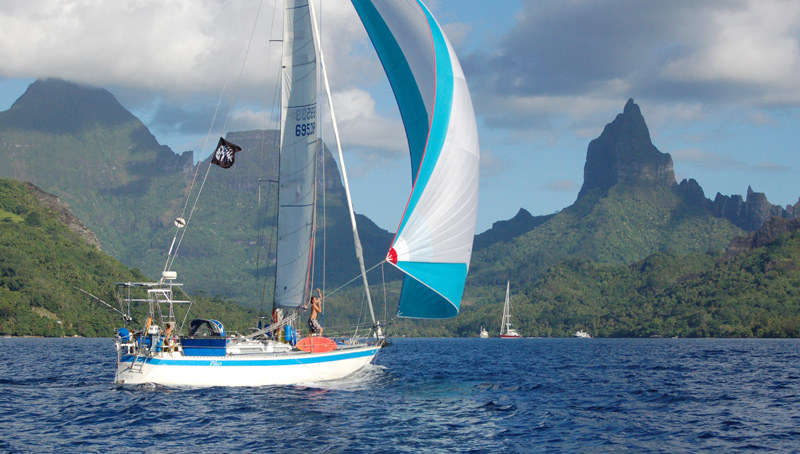
To join the rally, sailors have three options. Tumu, the free option, enables participants to attend the information seminars, access the online information, and display their boat’s position to other participants and friends and family. The next two tiers, Manava and Aupuru include upgrades such as weather briefings, webinars, discount packages, technical support and other services. However you decide to sail, you’ll be a part of a fleet of sailors experiencing the unique adventure of crossing the Pacific to French Polynesia with the Pacific Puddle Jump and its 28 years of history.
For more information and to sign up for the rally, go to PacificPuddleJump.com.
Did Your Hat Go Where the Wind Blows?

Go to www.latitude38store.com