
ARC ‘Gloria’ Now in San Francisco Bay
We should know not to presume sailboats always keep to schedule. Not even a 212-ft-long, three-masted barque visiting from Colombia. … On Monday we reported that the ARC Gloria would be sailing into San Francisco Bay on Thursday, October 9. She is in fact already in the Bay, having sailed under the bridge at around 8 a.m. today.
As far as we can tell, her weekend-long schedule remains the same, though one source said the Parade of Sail, expected for Saturday, has been canceled.
While we can’t confirm any more details right now, we can tell you what we know. Firstly, her advertised schedule.
Gloria is expected to be at Piers 15-17 from Thursday (possibly now today) to Monday, October 13, at which time she will sail out the Gate “in full ceremonial formation.” This includes crew lining the yardarms among all the colorful flags.
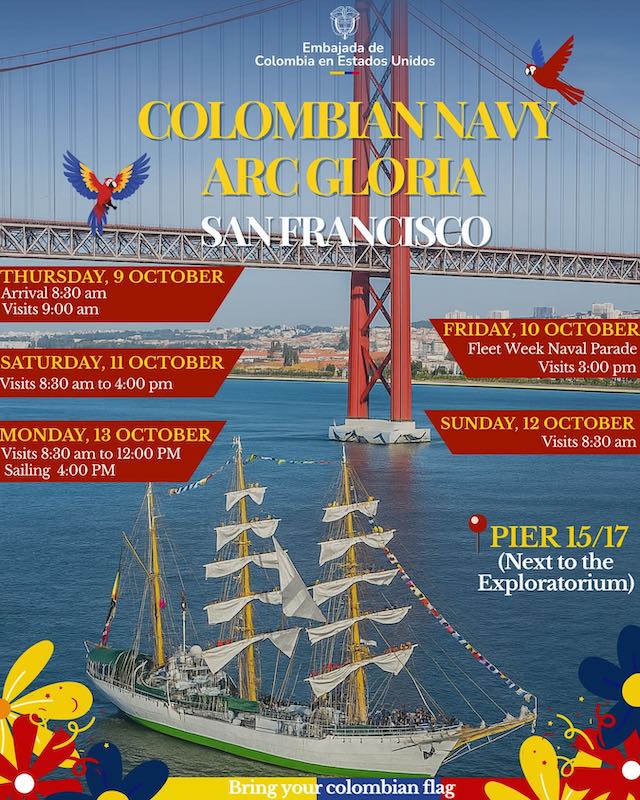
Visitors will be welcomed to tour the ship at the dock during certain hours across the weekend. According to Gloria’s schedule published on social media, the ship will be open for tours on Saturday, October 11, from 8:30 a.m. to 4:00 p.m.; Sunday from 8:30 a.m. (no closing time specified); and on Monday, October 13, from 8:30 a.m. to 12 p.m..
Unlike some other navy tall ships, Gloria doesn’t appear to have her own website, but the “Embassy of Colombia in the United States” Facebook page shares the image below outlining her schedule and inviting visitors to tour the ship.
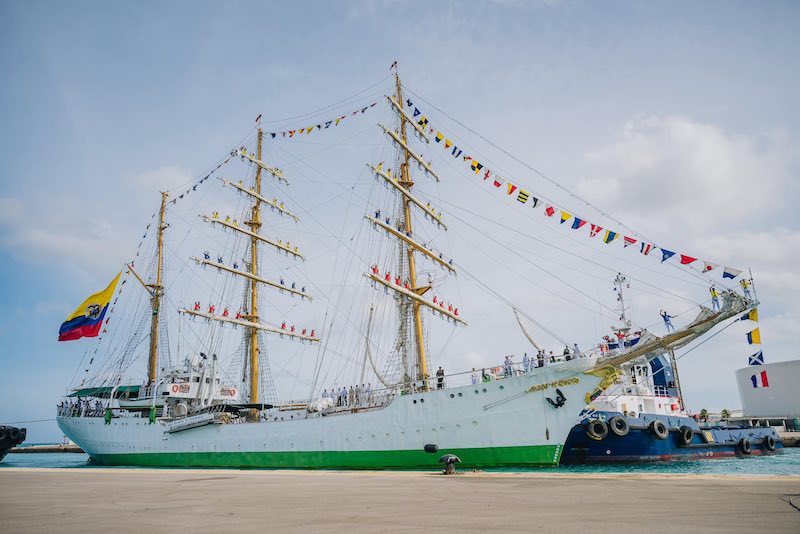
Here are a few facts about ARC Gloria taken from the Sail Training International website.
Gloria was built in 1968 after the Colombian government “authorized the National Navy, with Vice Admiral Orlando Lemaitre Torres as its Commanding Officer, to acquire a sailing vessel like a three-masted Barque to become the Training Ship of the Colombian Navy.”
Her hull length is 183.63 feet, with a height of 155.16 feet.
She sails with 85 permanent crew, and 75 trainees.
Her home port is Cartagena, Colombia.
Good Jibes #212: Dennis Surtees on Sailing Championships Around the World
Welcome to Good Jibes Episode #212. This week we chat with Dennis Surtees about his lifetime of sailing championships with legendary crews. Dennis is a 95-year-old racer who has done it all in the 5O5 class, and also won on the Antrim 27.
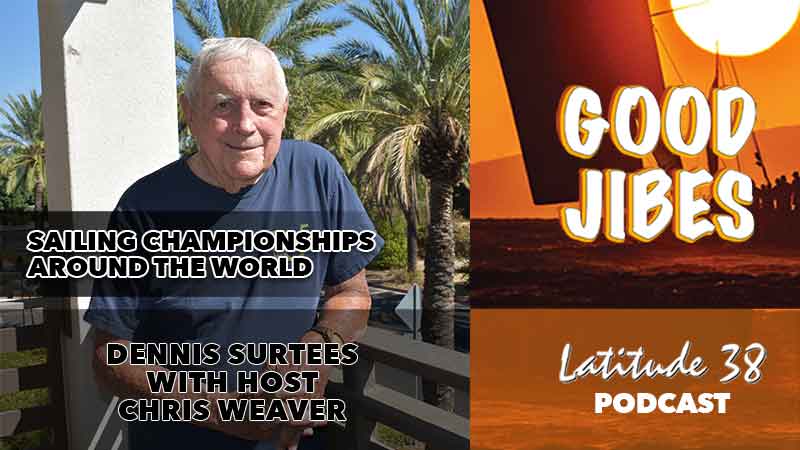
Join Good Jibes host Christine Weaver as she chats with Dennis about how he fell in love with the 5O5, how he overcame his reputation for capsizing, what to do when your mast breaks, his stories from racing with a young Paul Cayard, and frightening tales from sailing with sharks.
Here’s a sample of what you’ll hear in this episode:
- The first Abracadabra origin story
- 1979 South Africa Worlds
- Everything broke in South Africa
- Insurance and carbon masts
- Racing in Japan
Learn more about Dennis Surtees and Tony English here.
Listen to the episode on Apple Podcasts, Spotify and your other favorite podcast spots — follow and leave a 5-star review if you’re feeling the Good Jibes!
Yacht Charter Placement with Modern Sailing

A Hands-On Trick to Learn Port From Starboard
We’ve all been there: Which is the port or starboard side of the boat? Is it the left or the right? How do we know which is what? Over time it becomes second nature; we no longer stop midship and wave our hands around, turning from bow to stern and back again while deciding if we’re on the port or starboard side of the boat. But how does a beginner learn to recognize port versus starboard?
During our time on the water we’ve heard a few different phrases or rhymes that helped us find our way. “There’s no port left in the bottle.” This one clearly matches port with left — both words are in the same sentence, port is a reddish color, and a boat will show a red light on its port side, so port is the left side of the boat (looking forward). We came across a variation of this standard phrase on Reddit: “Port is wine. Wine comes in a bottle. At the end of a good night (or a bad one) there’s a little bit of port left in the bottle.” Sounds a bit convoluted. And besides, who leaves a bit of port in the bottle?
Here’s another way to explain and remember port from starboard. Port and left both have four letters. Another one we found uses the alphabet: “The letter ‘P’ (port) comes before ‘S’ (starboard) in the alphabet, just as the left side comes before the right side when reading.”
This week we heard about yet another trick to help new boaters learn port from starboard: Write it on the back of your hands.
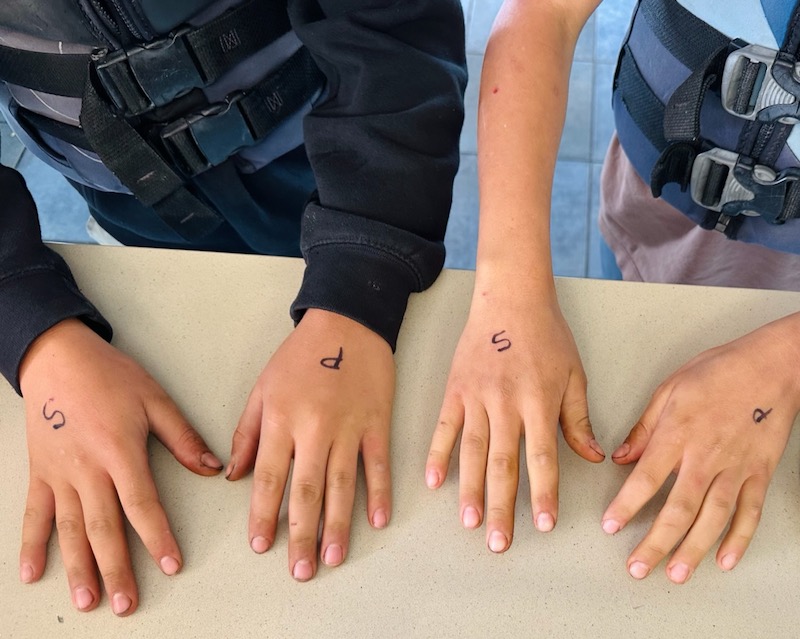
Latitude 38 reader Amy Kardel sent us the above photo of a simple way to remember port from starboard. “These young sailors were ready to race at the Chris Lockwood Memorial Junior Regatta at the Morro Bay Yacht Club on October 5, 2025.”
Writing on your hands is a great short-term exercise for a (hopefully) long-term gain. We expect the letters will wash off, if not while sailing, certainly over a couple of days at the most, unless you have the letters tattooed on the back of your hands. We don’t recommend that. But the letters may stick around long enough to cement the knowledge in your head. And if they don’t, just grab a Sharpie and write them again!
What was your trick for learning port from starboard?
‘Can O’Whoopass’ Sails the 2025 Vallejo 1-2
A great way to tell which approach to a course “be da bess” is when two one-design boats take completely opposite takes on the puzzle. So it was in Saturday’s Race One of the Singlehanded Sailing Society’s (SSS) Vallejo 1-2, when two equally talented Cal 20 skippers took on the very technical problem of getting to the VYC without the benefit of anything resembling a fresh breeze, and doing so before a full-moon afternoon ebb kicked in.
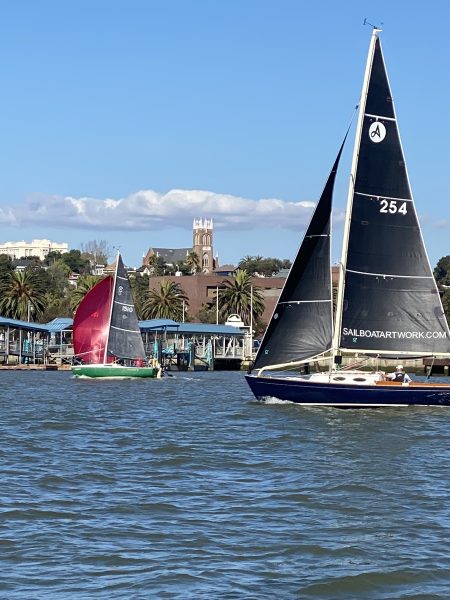
The regatta PRO smartly adopted the “laissez-faire” mode, and sent the fleet off on time in order to maximize exposure to a dwindling but robust flood current. Paul Sutchek’s Slainte (SSS) took mentor Gordie Nash’s advice, and hit the deepest-water route, often on the extreme left side of the course, while Can O’Whoopass opted for the shortest-distance route, on the right side.
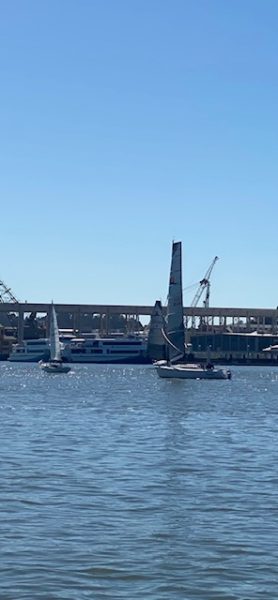
At various points on the trip, the Can had mile-plus leads, and at others, Slainte led by a half-mile or more. On the right side, the entire Wyliecat fleet played for ultimate current relief. When the ebb hit around 2:00 p.m. some boats on course left took extreme measures to stay as close as legal to the south side of the Pinole ship channel, where the remnants of the flood would linger longer.
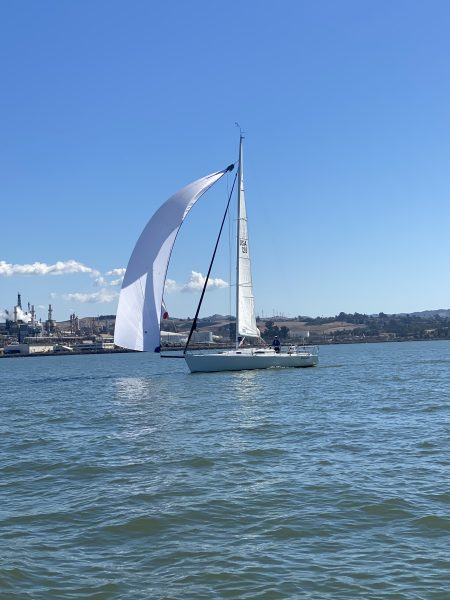
The boats on the right would need the predicted southwesterly to build on their side early, and it did not. We watched the left-siders hit the ebb wall, and then scoot along the Mare Island seawall in the narrow relief zone. The right-siders, one by one, peeled off to acknowledge their false hopes dashed. Can, in full cognizance of that reality, carried on past the Martinez refinery on a starboard headstay reach, jibing to a port headstay reach to cross the last mark, fetching up exactly at the green turning mark and able to carry the kite up the Strait.
That ploy put her about 800 yards behind Slainte and the DayGlo-green Santana 22 Three Fisted Rat Boy (EYC) (cool name!?!). The Can was blasting up the Strait, and Slainte, who was taking the victory lap a bit early, set her kite for the final mile of course. Passing the ‘Tuna, it seemed actually possible to salvage a missed call on the course, but, alas, the finish line came one minute and 35 seconds too soon. All that hard work, on both sides, gave the “slowest” boats a fifth and sixth, overall corrected time, out of more than 45 starters.
In epilogue, Slainte decided not to wait out the doldrums on Sunday, and burned gas home, while the Can made a full weekend of it, finishing fourth of 12 starters, just behind a bunch of speedys.
Two Hot Takes on Each End of Environmentalism
Coming soon in the November issue of Latitude 38’s Letters, we have two letters proposing what we can only call extreme environmental views on opposite ends of the spectrum. One take proposes prohibiting motoring in a sailboat in the name of environmentalism; the other take proposes to cull the pod of orcas that have been “playing with”/”attacking” sailboats in the Mediterranean.
However, the thrust of this ‘Lectronic Latitude is not to excessively give in to base emotions and illicit outrage to fill out Letters. Rather, we’re wondering if these respective hot takes might help us thread some kind of radically rational middle ground.
We have long maintained that despite the polarizing rhetoric, as sailors, we all fundamentally agree that we love the ocean and are interested in its stewardship. We’re willing to bet that the authors of the following hot takes are against dumping oil and trash into the water. In fact, we’re willing to bet that no matter where any sailor stands on the environmental spectrum, they believe that we should have clean air and water.
So we agree on some fundamentals! Isn’t the rest just a matter of degree?
Here’s hot take #1:
“As a lifelong environmentalist and former environmental campaigner and environmental attorney, I have to respond to the letters and responses in the September issue regarding motoring while delivering boats home from races. Motoring on a sailboat is motorized recreation, plain and simple. When I was an environmental campaigner, motorized recreation is one of the human activities we fought against.
“Consuming and burning oil, polluting the air and water, and making unnatural noise that disturbs the animals that live in the ocean, and all for some fun? I don’t see any justification for this. I realize that the delivery back from the Transpac is hard — I made that passage once when returning from Tahiti — but this is, after all, just fun, not some necessity.
“Refraining from motoring is not about global warming/climate change. If the only greenhouse gas emissions were from sailboat engines, human-caused global warming/climate change wouldn’t exist. Real environmentalists don’t obsess on global warming/climate change to the exclusion of and/or to the detriment of other environmental issues. I listed the main environmental problems with motoring on the water, and global warming/climate change is not one of them.”
We 100% disagree! There is so much to unpack here, namely the entire premise of what the author described as the main environmental problems: “Consuming and burning oil, polluting the air and water, and making unnatural noise that disturbs the animals that live in the ocean.” If the author concedes that sailboats do little to contribute to climate change (we 100% agree with that), then surely motoring sailboats’ contributions to air, water and noise pollution are even more negligible.
It seems that the writer is fixating on the morality of burning fossil fuels for “fun.” If we unpack how much pollution results from buildings and public parks, or building and operating a public transit system, then guess what? Those projects are far more polluting than a single racer-cruiser motoring all the way back from Hawaii. (Some readers also made the case that the wear and tear on a set of sails also has a carbon footprint. We’ll have a full breakdown of the various numbers in the November issue.)
We think this brand of environmentalism, which fixates on the perceived morality of an activity and wildly (and inaccurately) inflates its impact, is, as the author said, ultimately detrimental to other environmental issues.
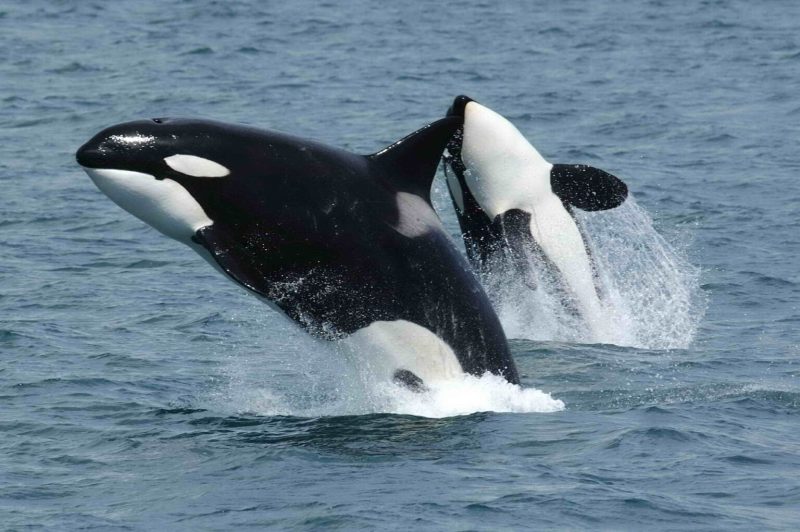
Here’s hot take #2, which was commenting on a story last year about another sailboat in the Med sunk by orcas.
“That pod of whales needs to be hunted and culled, regardless of how ‘endangered’ they are, or if they are swimming in ‘their home.’ This is nonsense. These whales are destroying property and endangering human lives. When tigers or lions eat humans they are hunted and put down. The Spanish government is responsible for these whales not being properly dealt with. Send out a team of professionals and deal with this problem, or mariners will eventually solve it for themselves. When someone dies because a pod of dangerous whales is permitted to attack small vessels, then the gloves come off.”
We 100% disagree, and there’s a lot to unpack here, too, but we acknowledge that the Iberian orca attacks are a frightening and very real problem. (Some people object to the word “attack” being used to describe the behavior of the Mediterranean ocas; one study suggested that the offending orcas were “just bored teenagers.”) Just three weeks ago, one sailboat was sunk and another was damaged by orcas off the coast of Portugal. Since 2020, some 250 boats have been damaged and somewhere between seven and eight have been sunk.
We’re getting especially hung up on “When a pod of dangerous whales is permitted to attack small vessels.” It almost sounds as though the whales have been sanctioned (or even encouraged) by bureaucrats to go after sailboats after filling out the requisite paperwork. Just as everyone wants clean air and water, everyone wants safety and security, too.
So what’s your take, Latitude Nation? Again, we’re hoping that rather than outrage, we can use the above takes like bumpers on the bowling alley to stay honed in on the target and avoid the gutter.
Special thanks to Kareem Rahma and SubwayTakes.
“A Well MISSPENT Youth” by Ben Needly