

Will AI Win the Pacific Cup?
AI beats humans at chess, Go programming, and Jeopardy!. Is sailing next? As a Pacific Cup race board member, I wanted to share some of our thoughts about what keeps the fun in the “Fun Race to Hawaii.” Artificial Intelligence is appearing everywhere. The magic technology is ghostwriting term papers and email replies and writing sophisticated software, and even driving autonomous taxis.
With the ability to learn over time and access wide swaths of data and convert it into an intelligible and useful format, AI has become a powerful and accessible tool in the hands of many. With Starlink, it operates offshore. Sailors will surely benefit. NOAA has recently announced the integration of AI into its weather models, and sail and yacht designers will use AI-assisted tools to enhance their work too.
For the racer and voyage planner, AI-assisted polar generation and routing are already available for a modest fee from PredictWind or others. You can even get AI to help write your blog posts as you cheerily tell folks on land about your adventures. Just over the horizon, however, things may not be so cheery. Starlink gives racers the ability to bring AI’s “brain power” with them so that AI and advanced instrumentation could easily destroy the fun. Imagine a race where each crew has a headset and gets instructions — “TRIM” or “TWO DEGREES to PORT” every few seconds. The boat performs perfectly to her polars, winning the race.
But nobody is smiling. The instructions come from an untiring, unfed, uncomplaining AI system somewhere. No tactical or boat-handling decisions are made by anyone aboard. Basically, the people on the boat are just meat-powered robots. The “white-collar” jobs of navigator and tactician have been eliminated, leaving the “blue-collar” jobs to execute the AI-generated tactics and strategy. Are we having fun?
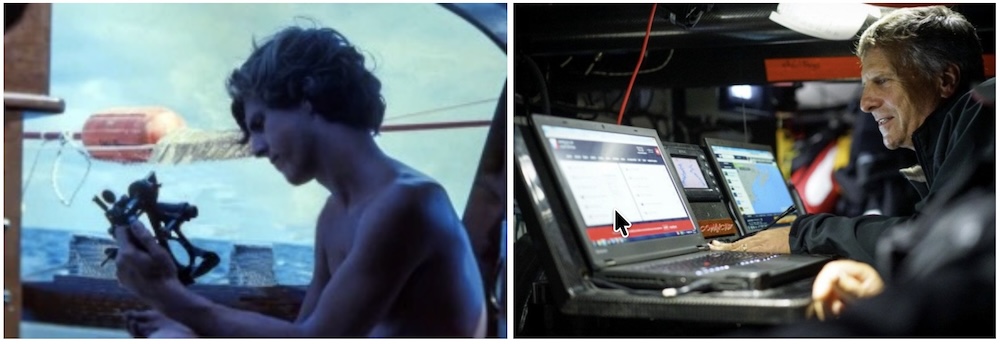
Once again, sailing must decide the rules on an event-by-event basis, adjusting rules depending on whether it’s the America’s Cup, dinghy racing or offshore. It would vary, as it does now, for the Vendée Globe, The Ocean Race, the Jules Verne Trophy or the Global Solo Challenge. The tech provides the information and the human “decider” determines the outcome. Yet, the day may still come when Waymo and Tesla are competing in the autonomous round-the-world race.
For fairness, regattas define what equipment may be used in a race. Many small-boat races restrict what instruments are allowed, and virtually all events prohibit outside assistance under Racing Rule 41, which states, “A boat shall not receive help from any outside source, except….”
I am definitely NOT a fan of AI at all. I come from and enjoy a life where people were (are) unique, based on their own minds that made their own decisions. With AI us people (and the world we live) will eventually be all the same, perfect-ly boring place and not at all interesting because of individuals that have no use for their own unique and interesting minds. That’s a shame and I feel sorry for the future.