

A Journey to the Fourth Coast — Discovering Chicago’s Sailing Scene

Calling all Midwest sailors! Do you hail from the “Fourth Coast” or consider yourself a Midwestern sailor? Are you a West or East Coaster who’s spent time racing or cruising on the Great Lakes? Or are you a freshwater sailor from another part of the country or world? We’d love to hear from you. Please comment below or email us here.
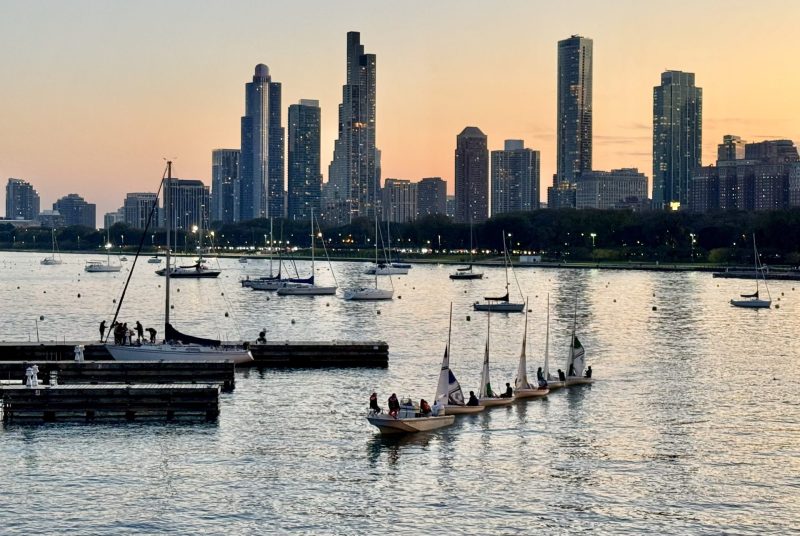
I did not expect Chicago to be a beach town, or a sailing town, but that was my first and lasting impression on a recent trip to the Fourth Coast.
The idea of Midwest sailing had fascinated me ever since the 1987 America’s Cup. As a 12-year-old living in San Diego, I was stunned to see that the Chicago Yacht Club had a challenger — or that Chicago had the audacity to have a yacht club at all. I had to consult a globe to educate myself on the hydrography of middle America.
The Great Lakes would go on to occupy an almost mystical spot in my mind. The name Buddy Melges, the skipper of that Chicago YC America’s Cup challenge, held great significance both in terms of his awesome legend and his speedy, namesake boats. The Chicago Yacht Club Race to Mackinac was another revelation: offshore racing in the Midwest? A charming, New England-esque island in the Great Lakes with its own unique history?
But Chicago itself, immortalized in so many movies from the 1980s and early ’90s, formed my early visions of what a city should be — some kind of mystical mix of Gotham and Oz, famously windy, bitter-cold for much of the year, and dense with buildings.
That Chicago was also a beachy waterfront town with a vibrant sailing scene was a wonderful discovery.
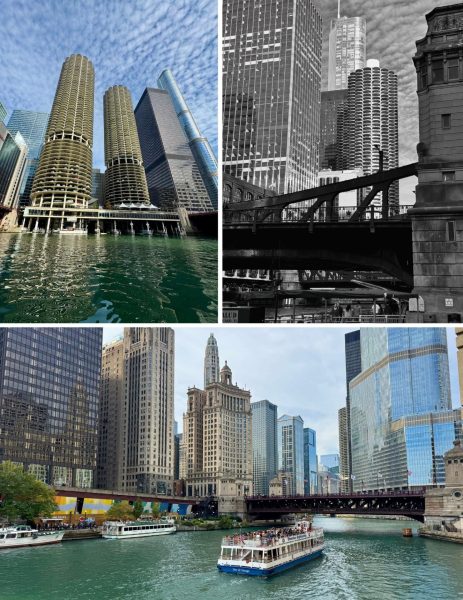
My favorite body of water in Chicago was, without debate, the Chicago River.
I got to Chicago via Duluth, Minnesota, aboard the 1,013-ft iron ore bulk freighter Paul R. Tregurtha, after waiting out several wind events that stirred up 20-ft seas on Lake Superior. Reporting a story as editor of Professional Mariner magazine, I rode along with the crew for three days across Lake Superior, through the Soo Locks and St. Marys River along the Canadian border, and down Lake Michigan, passing the Chicago skyline at night before arriving at a steel mill in Indiana.
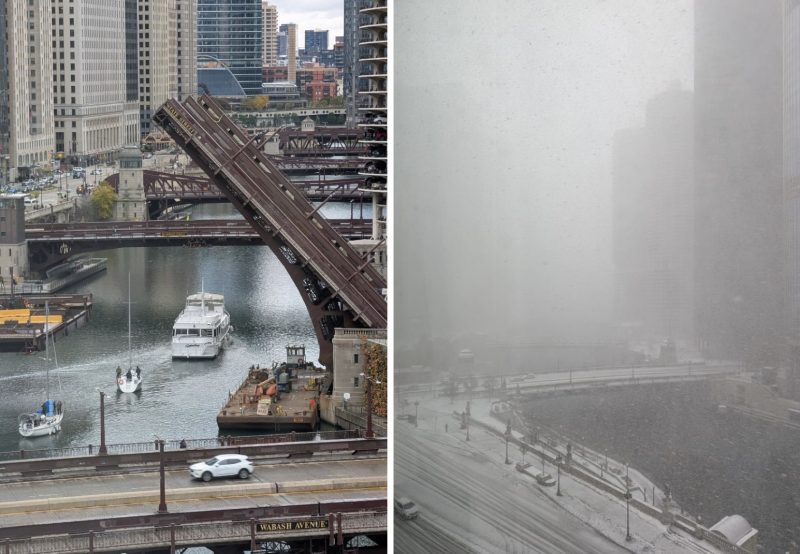
But it was the narrow river running inland from Lake Michigan through a canyon of buildings that captured my imagination. I must have walked the roughly 1.25-mile Chicago Riverwalk 25 times over three days. The river was packed with tour boats, some hosting enormous weddings, along with a handful of small rental motorboats, kayaks and the occasional paddleboard.
I met Capt. Bob Angone aboard one of Chicago’s architecture-tour boats. A Chicago native and longtime sailor, he started racing Tartan Tens (T-10s) out of Montrose Harbor in the early 1990s, but eventually settled into family life and a career in advertising. When his kids were older, the family discovered Sea Scouts and joined Columbia Yacht Club, where Angone and his wife helped run the program for roughly six years.
Unlike traditional Scouting, Angone said, Sea Scouts gave the kids considerable autonomy to plan their own activities and adventures, with adults providing guidance and ensuring safety. “It was more teamwork, more autonomy — that made it exciting,” he said.
Angone had been involved in a real-life man-overboard rescue just the evening before, when the crew spotted someone in the river. He said the training was so ingrained that everyone remained calm. “We managed the people on the boat, and we got that person onto the shore with the help of the Marine Police. Everything clicked, and we saved that guy’s life.”
Angone invited me to dinner at Columbia Yacht Club, about a 15-minute walk from the Riverwalk.
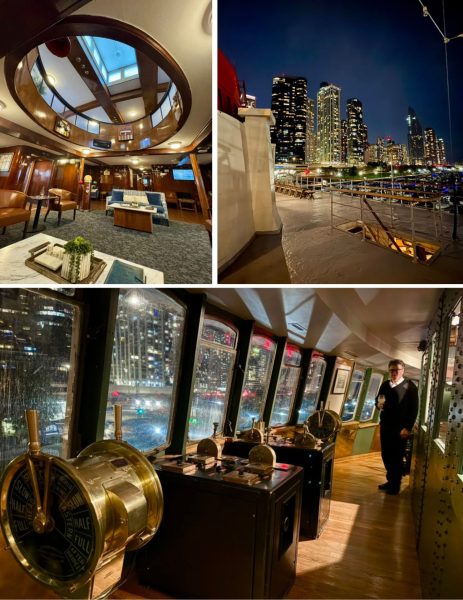
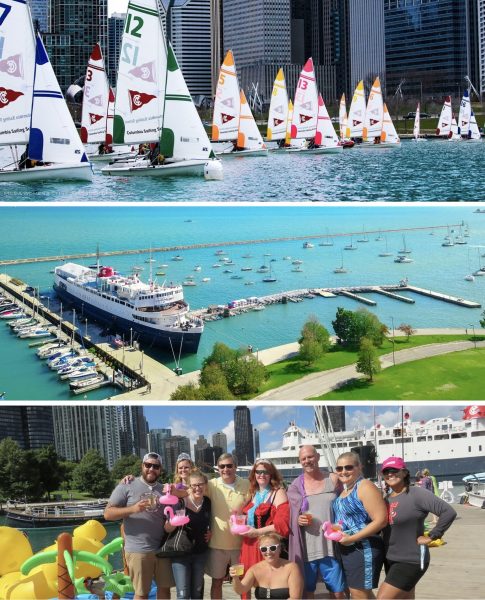
Abegweit, a historic 372-ft Canadian icebreaking ferry built in Quebec in the 1940s and now permanently moored in Chicago Harbor, felt like a working ship. The upper decks were opulent and bustling with activity, including a large party beneath a tent on the stern. The bar was full of trophies and half models. (I’d asked Bob if I was dressed appropriately in my flannel shirt and jeans; he said Columbia was the sailors’ club. The club that sponsored the America’s Cup challenge was, apparently, a tad fancier.) We toured the bridge, staterooms and ship’s library, with the towering Chicago skyline visible through every shore-facing window.
But the lower deck smelled faintly of diesel and housed the junior sailing program, with sails, gear and a fleet of remote-control boats.
Angone had a few other hobbies that sailors might appreciate, including motorcycle ice-racing and skiing in Michigan. He said last winter had been especially good. Even though there’s not much vertical in the Midwest, the snow quality was excellent and there were satisfying laps to be had.
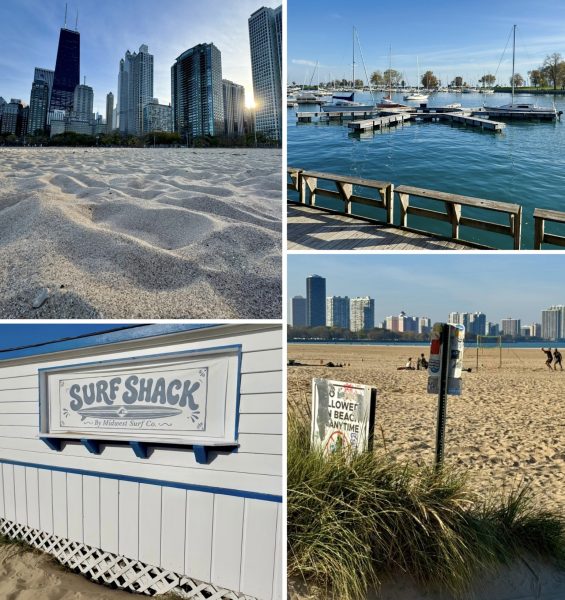
On Sunday, October 25, I rented a bike and rode to Montrose Harbor. People were beaching hard on every patch of grass and sand, and the bike and pedestrian paths lining the shore of Lake Michigan were packed. As one local explained to me, everyone had dropped everything to enjoy the weather before winter really started to show itself.
The shore was a mix of rock, grass, trees and sand, and the trees were just starting to show their rusty fall colors. It was a light-wind day, with maybe five to eight knots of breeze. A good-sized fleet of dinghies were racing just offshore with a bunch of support boats nearby. Standing at the water’s edge with your back to the lake, you’d see that tall buildings almost always framed the beaches. (In a sentence surely never before uttered, Chicago reminded me a little of Waikiki, at least in terms of buildings meeting beaches.)
Chicago was both everything I thought it would be and nothing that I expected. I left the Midwest with one nagging question:
What did I miss?