

Richard Gordon-Rein and Angi Lungu’s Second Chance Cruise
This year’s Puddle Jump was the second time I have left La Cruz, Mexico, bound for Hiva Oa, but it was my first time actually making it there. On March 10, 2020, I sailed from La Cruz on my Pearson Triton 28 Darwind, bound for the South Pacific and beyond. I was 19 years old. I had already sailed 4,000 miles alone from my home in Seldovia, Alaska, to get there. But for me, the voyage really started here, with my first solo ocean crossing, and departure from North America
The wind was light but fair, and Darwind, with her six-hp outboard removed and lashed to the pulpit, made good time through the light winds near the coast, out past the Islas Revillagigedos, and into the NE trades. Meanwhile, and completely unbeknownst to me, the COVID-19 pandemic was beginning, and the first shutdowns and closures began to take effect.
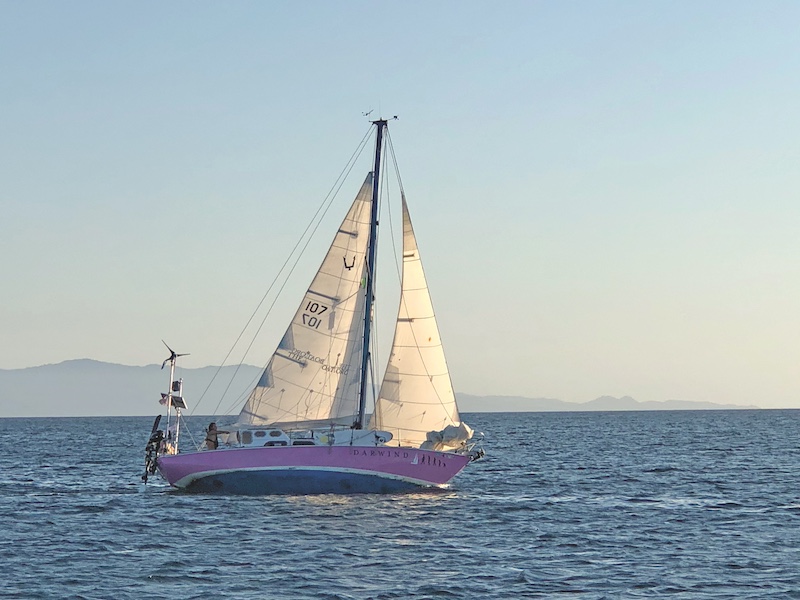
I use a Garmin inReach as my primary communication with shore. Eventually, I began to get the news — 160 characters at a time. Ten days and 900 miles out from Mexico, I learned that French Polynesia had closed its borders. It was time to alter course. I ended up sailing to Hawaii, and from there attempted to sail back to Alaska. After a knockdown in a westerly gale halfway there, I eased the sheets and in June made landfall in Washington, completing the 11-month voyage.
After returning to life on land in the first year of the pandemic, I moved back on board Darwind while attending university in Washington, and started looking for a bigger boat. When I found Mistral, I knew she was perfect: a medium-displacement cruiser, built in 1970 by Harry Hallberg’s yard in Sweden, just before it became Hallberg-Rassy. At 33 feet, she seemed spacious compared to Darwind, well laid-out with plenty of storage, and with the extra waterline, sharp bow, and fin keel providing decent performance to windward. Off the wind, the large skeg protecting the rudder and propeller keeps her tracking like an arrow. The other thing that made Mistral so appealing was that she is a veteran circumnavigator, having sailed from Seattle to Seattle via the Suez and Panama canals in the ’80s and ’90s. Over the course of this voyage, nearly everything useful on board had been strengthened and improved, while anything unnecessary or cumbersome had been stripped away.
The lack of a chartplotter was most intriguing to me, as it is considered practically essential equipment these days. But the previous owners had reasoned that if they could sail around the world without a GPS, why would they need it now?
Read.