

The Resourceful Sailor Asks: “Are Your Dock Lines Ready for Winter?”
The North American winter will soon arrive, and with it, inclement weather. In the Pacific Northwest and Northern California, that means high winds, rain, a chill, and shorter days. These and the holiday season may conspire against many boaters’ will to get out on the water; a boat may float in its slip, unused and unattended, during a time when it needs monitoring most. In this installment, the Resourceful Sailor addresses the preparation of dock lines for the winter conditions.

Fall is a good time to inspect your dock lines to ascertain that they are up to the task for winter and have adequate chafe protection. If your dock lines aren’t nylon, I’ll go out on a limb and say they should be. Nylon provides considerable elasticity, mitigating the shock loads on a boat’s hardware and a dock’s cleats as the boat wiggles in the weather. Some sailors like double-braid nylon lines due to increased strength and durability. I wouldn’t argue with that, but it doesn’t mean it is invincible. Take a walk down nearly any marina dock, and you will see double-braid lines chafed and in need of retirement.
Personally, I prefer three-strand nylon for my dock lines. It is even more elastic and less expensive than double braid, if not quite as durable. Having lived on a boat in a marina for many years during the winter, I have observed how different boats using different lines ride in the weather. Additionally, I have spent many a storm aboard a boat tied to a dock, feeling the sometimes alarming motion and hearing the groaning of the lines under strain. This research has convinced me my choice is best for my boat.
Correctly sizing the line to the boat, taking its weight and windage into account, is key. While it may seem counterintuitive, oversized is not better. An oversized line, though stronger, with more margin for chafe, will not provide the proper elasticity to prevent shock loading. Manufacturers and vendors often have charts for sizing your dock lines appropriately to a boat’s length and weight. These provide a good starting point that can then be fine-tuned using experience and observation.
Nylon’s elasticity can also be its Achilles heel. The stretching fibers in constant motion chafe against each other and anything they touch. Common culprits are chocks, cleats and other lines. Chafe wear is often easily seen. The bummer is that once it occurs, it can’t be undone. The art is in being able to eye potential problem spots and protect the line before it happens. Another consideration is that nylon line has a lifespan. Even if chafe is avoided, repetitive stretching will cause the line to reduce elasticity over time. It will permanently elongate the line and, in the process, make it visibly thinner. The fibers will stiffen and become brittle over time from UV radiation.
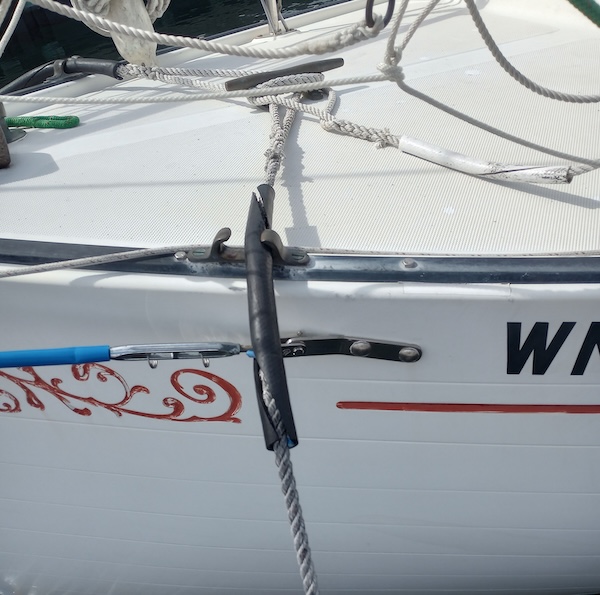
We can’t win against time, but we can win against chafe. Here are a couple of tips for protecting your lines throughout the year. Chafe-protection devices can be purchased, but that is not the Resourceful Sailor way. I prefer to repurpose discarded automotive, garden, or RV hoses for the job. When an acquisition opportunity arises, I seize it and always keep some on hand, ready for when I need it. I might add a solid segment before I put in eye splices, or a spiral-cut segment afterward.
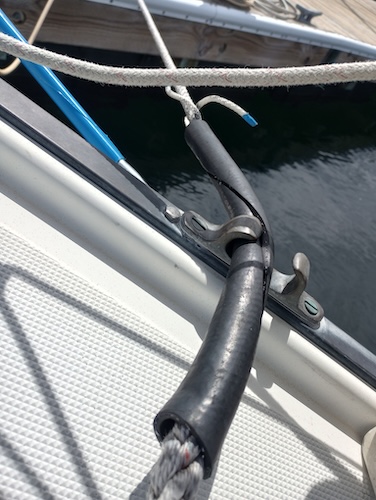
One problem that can occur as the boat squirms around at the dock, flexing the lines, is that the hose can shift over time. Observation has noted this to be a downhill shift. Since I use three-strand line, a simple solution is to thread small stuff through it on the downhill side of the hose, blocking its shift.

Take some time this fall to make sure your boat is prepared for winter weather. New lines will make the boat look good, and chafe protection will make its steward look seamanlike. It will provide confidence (and an example) for marina managers and slip neighbors. When the wind is raging and the cats and dogs are falling, and you are cozy, warm, and dry in your abode (or away on holiday), you can enjoy the peace of mind of knowing that your vessel is secure. The Resourceful Sailor believes that prevention is the best medicine, and with a boat, the least expensive. Remember, keep your solutions safe and prudent, and have a blast.
Those chafe protectors are a good idea, I went to a local fire department and got a used firehose to cut up and use on my dock lines, I gave sections to my dock mates too. Another storm protecter is to put a sail tie on a furled headsail to keep it that way in a wind storm, we have all seen the shredded jibs from high wind unfurling.
Greg,
Thanks for the good tips! And thanks for reading.