

NTSB Releases Preliminary Report on Tahoe Tragedy
The National Transportation Safety Board (NTSB) has released a preliminary report on the capsizing on Lake Tahoe in which eight people died. Ten people were aboard a privately owned 28-ft Chris-Craft when it capsized amid 30-knot winds and a six- to eight-foot swell on Saturday, June 21. The NTSB states that the report, released on July 23, is subject to change. Below are details of the report.
The capsized vessel, named Over the Moon, was a 2023 Chris-Craft Launch 28 GT with a fiberglass-reinforced-plastic hull and an eight-cylinder, 6.2-liter, 430-hp Volvo Penta direct-injected gasoline engine. The vessel had seating capacity for 12 people and was fitted with two 1,100 GPH bilge pumps. Over the Moon was California-registered to two owners, one of whom was the sole operator of the boat.
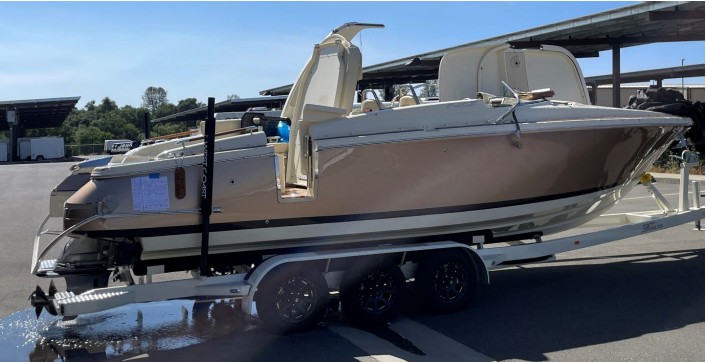
Over the Moon was launched from a boat ramp in Tahoe City at about 1040 on the morning of the accident. Four adults were aboard including the boat’s second registered owner. The operator drove the vessel to two nearby marinas; six additional adults boarded at the second marina.
At 1158, with all passengers aboard, the boat traveled to Emerald Bay (about 10 miles south), a sheltered area popular with boaters, on the west side of Lake Tahoe. The boat anchored in Emerald Bay for about an hour to an hour and a half. Weather conditions at the time were clear skies, light southerly winds, and an air temperature of 54°F. The National Weather Service had issued no marine warnings or small craft advisories for the Lake Tahoe area for the day, although the local forecast indicated a slight chance of thunderstorms.
Sometime before 1400, the clouds increased, and the boat operator decided to return to the marina where he had picked up the passengers. However, after he got underway, the winds, rain, and waves increased, and he returned to Emerald Bay. After about 10 minutes, the operator made a second attempt to return to the marina.
One of the survivors told investigators that once Over the Moon was away from Emerald Bay, two- to three-foot waves splashed into the boat with the pouring rain, but no water was accumulating on the deck. The winds increased. The survivor reported marble-sized hail collecting in the boat, waves increasing to eight to 10 feet, with some breaking over the sides and bow, and about an inch of water accumulating on the boat deck. The operator turned on the bilge pumps.
Time lapse footage recorded at about 1436 from a camera about a mile and a half south of the accident site (looking toward South Lake Tahoe) captured whitecaps on the lake and low-layer clouds moving from north to south. About 1445, the footage showed blowing rain and mixed freezing precipitation, and at 1449, blowing snow. At 1453, an automated weather station about seven miles southeast of the location recorded winds from the north at 14 knots with a peak wind of 34 knots. The water temperature was reported to be 54°F.
At some point, with the vessel between 50 and 100 yards offshore, Over the Moon’s engine stopped, and the boat ended up broadside to the waves. The boat took on water, and some of the passengers attempted to bail the water out of the boat. The boat listed to starboard, submerging the starboard aft corner. At one point, a particularly large wave overtook the boat, causing water to enter. One of the survivors donned a PFD and distributed PFDs to everyone else in the boat. No one else immediately donned their PFD. Shortly after, the boat rolled over to starboard, and the passengers entered the water. The survivor recalled that it started snowing after the boat rolled over while the people were in the water. No distress calls were made from the boat.
About 1457, a group of hikers witnessed the boat capsize after a large wave washed over it. At 1458, one of the hikers called 911. Another hiker and a California State Parks lifeguard helped recover the survivors from the water. Multiple agencies responded; the marine unit reported eight-foot waves in the area. Eight people, including the two survivors, were recovered. Six of the recovered people (one of whom was the operator) were pronounced dead on scene, some following CPR efforts. None of the six were wearing PFDs. Of the two survivors, one was wearing a PFD and the other was clinging to one. The remaining two passengers were found and recovered from the lake bottom near the casualty site the next day. Four PFDs and one life ring, all from the vessel, were recovered from the accident site.
About 1605, the snow stopped, and the weather began to clear, with cloudless skies about 1725.
The Chris-Craft was recovered on June 22 and later examined by USCG and NTSB investigators and party representatives. They reported no evidence of hull leak, grounding, or contact with an object. Onboard were found one PFD still in its packaging with tags on it, one infant life vest still in its packaging, an unzipped life vest stowage bag, and five inflatable PFDs in stowage compartments. Electronic systems were recovered and sent to the NTSB laboratory for further examination of any potential internal memory. The vessel’s two bilge pumps and engine fuel filter were retained for further examination.
NTSB investigators have interviewed one survivor, a lifeguard, witnesses and good Samaritans, salvage company personnel, and personnel employed for the stowage, launching, and recovery of the boat.
Toxicology tests for alcohol and other drugs for the deceased were conducted; the results are pending. The NTSB investigation is ongoing. You can view the full report here.
As the conditions deteriorated, I can’t understand why the skipper didn’t have the passengers put on PFD’s. Also, no distress call when the boat started foundering in that weather? In hind sight, hanging out in Emerald Bay for a couple of hours would have probably saved the day, although they would probably be cold.